[analyse_image type=”featured” src=”https://images.euronews.com/articles/stories/09/91/28/40/1200x675_cmsv2_53b1c136-85f9-5655-9787-72d828be6b65-9912840.jpg”]

Novo to use Anthropic’s Claude to advance AI drug discovery

Edgar Barrera leads the 2026 Latin Grammys with ten nominations

Russia used Claude AI for espionage, disinformation and drone swarms

Exein becomes unicorn: Italian Physical AI security start-up valued at $1.7bn
Novo to use Anthropic’s Claude to advance AI drug discovery
Edgar Barrera leads the 2026 Latin Grammys with ten nominations
Russia used Claude AI for espionage, disinformation and drone swarms
Exein becomes unicorn: Italian Physical AI security start-up valued at $1.7bn
Free trade agreement with India: EAEU countries accelerate negotiations
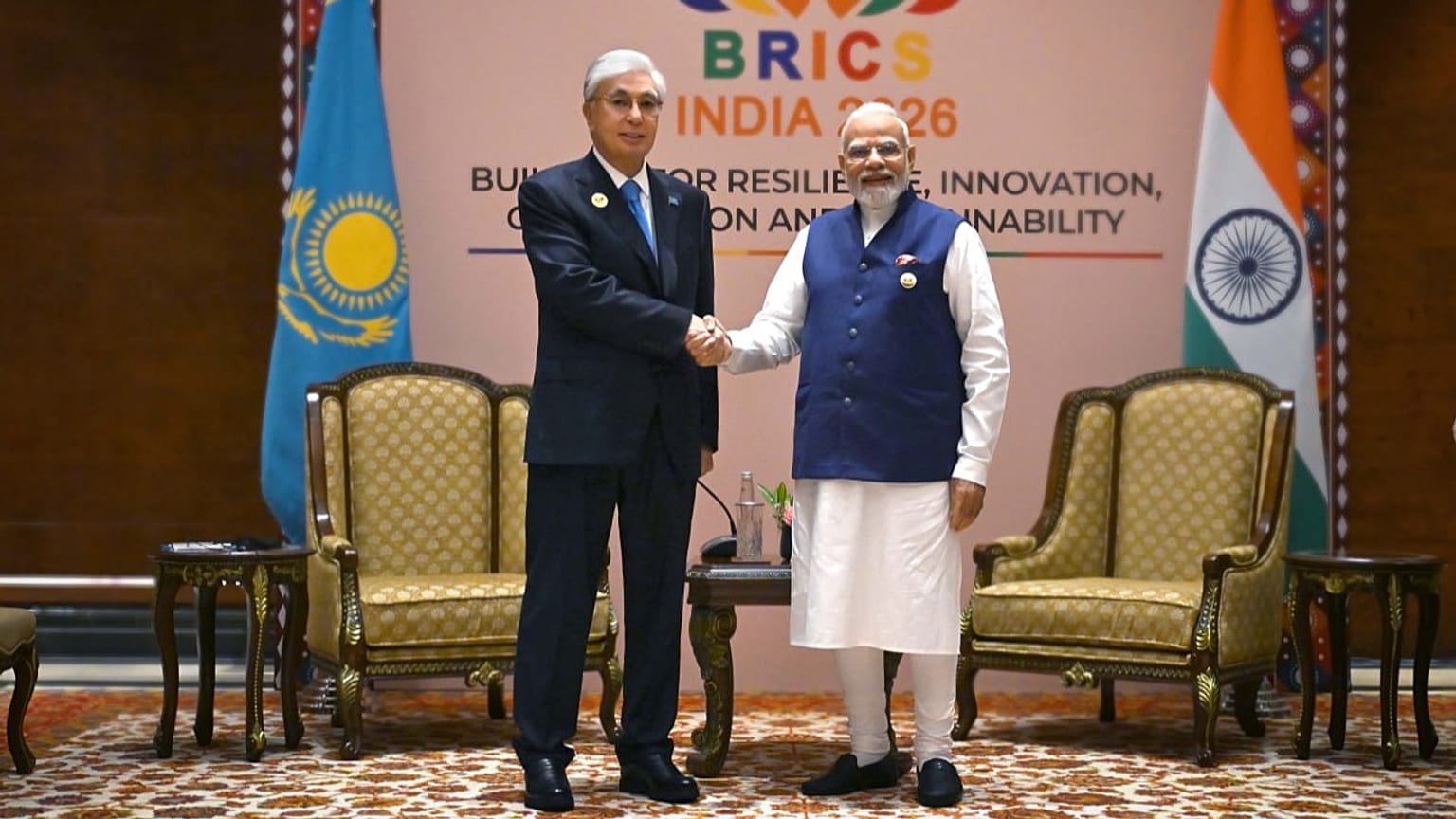
brics
– Copyright Press service of Kazakhstan President

 Facebook
 Twitter
 Flipboard
 Send
Send Reddit
 Linkedin
 Messenger
 Telegram
 VK
VK Bluesky
 Threads
 Whatsapp
The free trade area agreement between India and the Eurasian Economic Union (EAEU) is crucial for the growth of trade in the region and improvement of on-land transport corridors, which will prove to be favourable for Europe as well.
On the sidelines of the BRICS Summit in New Delhi, the Eurasian Economic Union (Kazakhstan, Kyrgyzstan, Belarus, Armenia and Russia) and India agreed to speed up the signing of the free trade area agreement.
 ADVERTISEMENTADVERTISEMENT
At the meeting, the Eurasian Economic Commission’s (EAEU’s governing body) Minister of Trade Andrey Slepnev and Indian Minister of Commerce and Industry Piyush Goyal positively assessed the progress of negotiations and agreed to hold the third round of full-scale negotiations in November. Previous rounds took place in November 2025 and June 2026.
The sides noted that both the EAEU and India are interested in moving the process forward as quick as possible.
Kazakh President Kassym-Jomart Tokayev, as the EAEU chair for 2026, expressed a similar sentiment in his speech at the BRICS Summit over the weekend.
“As chair of the Eurasian Economic Union, Kazakhstan advocates for expanding economic cooperation with BRICS and advancing work on concluding a free trade agreement with India,” he said.
This rings particularly important considering that a president of Kazakhstan had not made an official visit to India since 2009.
Benefit of the agreement
Although the sides have been working on the document for a year, details, such as the amount of mutual tariffs (if any) and the list of goods for export, have not been disclosed, which makes it difficult to prognose the economic impact the agreement will have.
However, it is clear that it will benefit both sides. For India, the agreement will open up a market with over 180 million consumers and provide access to Eurasia’s transport and logistics capabilities.
For the EAEU, it will significantly reduce non-tariff barriers and transaction costs, while giving access to one of the world’s largest and most rapidly growing markets.
“Such an agreement could lower trade barriers, expand access to the Indian market for Kazakhstani and other Eurasian producers, and, consequently, create additional opportunities for the growth of trade, investment, and cooperation,” said Manarbek Kabaziyev, Deputy Chair of the Foreign Policy Research Institute under the Kazakh Ministry of Foreign Affairs.
He highlighted that Kazakhstan will benefit the most from the transport aspect that will follow as the result of the agreement.
“Increased trade with India will objectively drive demand for reliable overland and multimodal routes, including the Trans-Caspian International Transport Route (TITR) and other corridors linking Central Asia with Europe,” Kabaziyev explained.
Connecting TITR with the North-South Corridor will also allow India to bypass geographical bottlenecks such as Iran.
“This gives rise to an indirect European interest as well: the greater the freight flows between India, Central Asia, and Europe, the stronger the economic incentive to develop infrastructure, reduce logistics costs, and increase the capacity of these routes,” Kabaziyev said.
Tokayev also welcomed BRICS Framework for Cooperation on Logistics and Supply Chains proposed by India.
Kabaziyev noted, however, that the agreement itself will not automatically accelerate the delivery of goods to Europe.
“While the agreement generates economic demand, the speed of transport depends on infrastructure, border procedures, digitalisation, tariff harmonization, and the efficiency of the Trans-Caspian International Transport Route itself,” the expert said.
Go to accessibility shortcuts
Read more
China’s Xi Jinping proposes BRICS ‘open-source AI zone’
UAE and Iran leaders meet at the BRICS summit for the first time since the war
BRICS leaders arrive in India ahead of two-day summit as global conflicts set to take centre stage
State of the Union: Five takeaways from Ursula von der Leyen’s speech
Von der Leyen ‘horrified’ by Mladić funeral, holds off Serbia action
Canada invited to become first ‘associate member’ of the EU

Four years since Mahsa Amini, rights groups warn crackdown persists
Canada in talks to join EU’s Erasmus+ exchanges programme
Canada invited to become first ‘associate member’ of the EU
Canada, heatwaves and Ceuta: Von der Leyen delivers State of the Union
US threatens EU with retaliation over European preference in EU budget
Belarus launches drills near Suwalki Gap on NATO’s eastern flank
Why is Greece’s seabed littered with concrete blocks?
[analyse_source url=”https://www.euronews.com/2026/09/15/free-trade-agreement-with-india-eaeu-countries-accelerate-negotiations”]