[analyse_image type=”featured” src=”https://images.euronews.com/articles/stories/09/91/40/04/1200x675_cmsv2_379af446-2e10-5e11-9296-d4fe42ff5723-9914004.jpg”]

Twenty-five years on, Dubai’s media bet has become a global platform

TEU has ‘the power’ to lead on ‘global treaty on AI’, says MEP

Danish PM condemns Russian flare attack on helicopter as ‘reckless’

UN urges full access for investigators as Gaza death toll mounts
Twenty-five years on, Dubai’s media bet has become a global platform
TEU has ‘the power’ to lead on ‘global treaty on AI’, says MEP
Danish PM condemns Russian flare attack on helicopter as ‘reckless’
UN urges full access for investigators as Gaza death toll mounts
China’s retail sales slow again as Beijing struggles to revive consumer spending
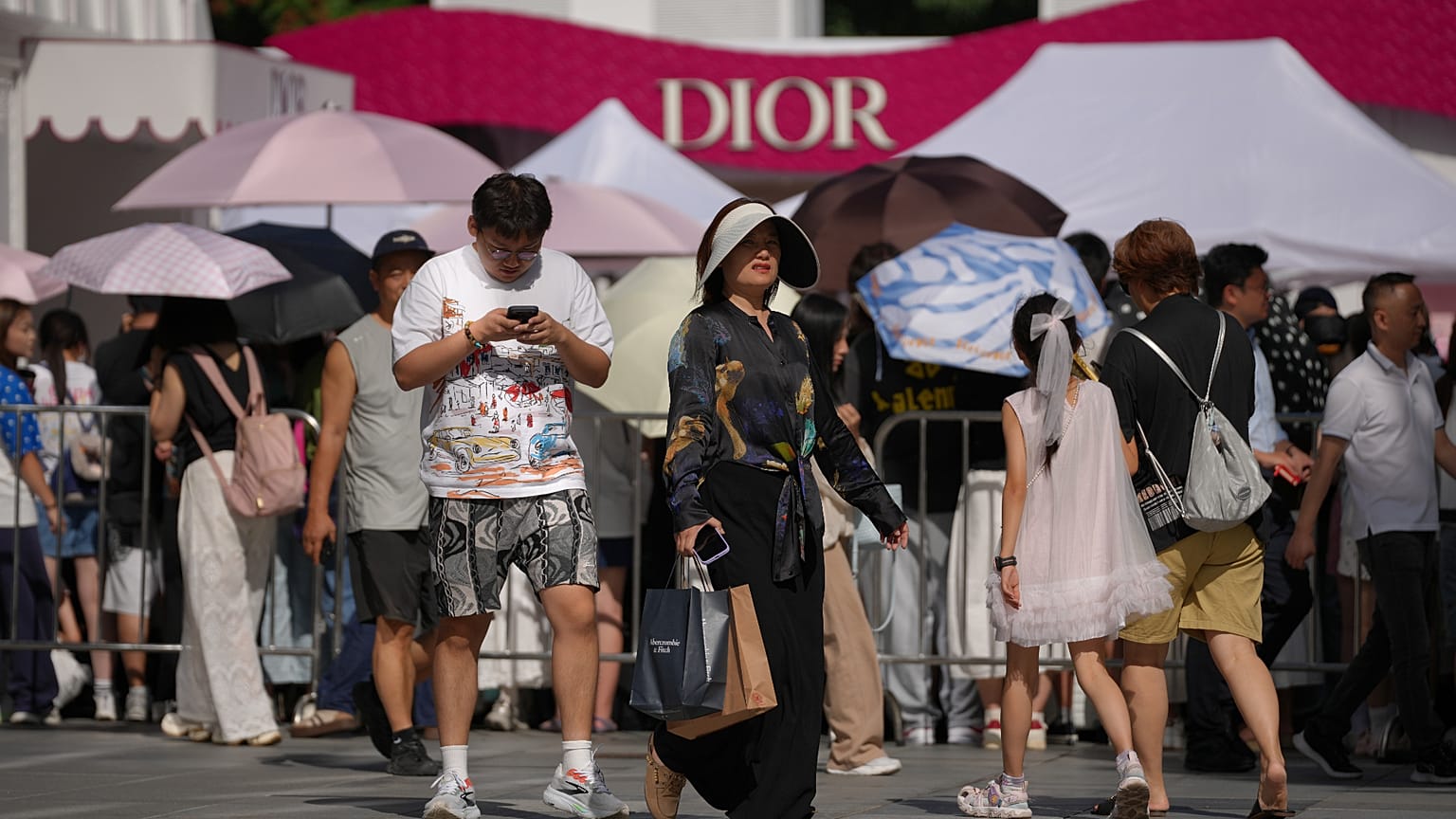
FILE. A woman with her shopping items walks by other shoppers gathering outside a Dior promotion booth in Beijing, 17 Aug. 2026
– Copyright AP Photo/Andy Wong

 Facebook
 Twitter
 Flipboard
 Send
Send Reddit
 Linkedin
 Messenger
 Telegram
 VK
VK Bluesky
 Threads
 Whatsapp
Retail sales in China grew just 0.4% in August, the slowest pace since growth resumed and the second consecutive monthly slowdown, underlining how little progress Beijing has made in reviving consumer spending even as factory output accelerates.
Chinese shoppers are barely spending more than they were a year ago, and the gap between what the country makes and what it buys is widening.
 ADVERTISEMENTADVERTISEMENT
Figures published by China’s National Bureau of Statistics on Tuesday showed year-on-year retail sales growth of just 0.4%, falling short of the 0.8% economists had forecast and slowing from 0.6% in July and 1% in June.
However, the number is at least positive.
Retail sales shrank 0.6% in May, so August represents an improvement on the low point, but it leaves consumption close to flat at a time when the Chinese government has made reviving it a priority.
Domestic spending has been sluggish since the end of the Covid-19 pandemic, dragging on economic growth even as exports have boomed.
Factories up, investment down
The rest of the data pulls in opposite directions.
Industrial production expanded 5.2% in August, a jump from July’s 4.5% and comfortably ahead of the 4.8% forecast. Fixed-asset investment, by contrast, contracted 7.2% year on year in the first eight months of 2026, in line with forecasts.
The statistics bureau said the economy “operated steadily” last month while conceding that “adverse external factors are intensifying.”
It went further in describing the underlying problem by stating that “the domestic imbalance between strong supply and weak demand remains pronounced, some firms face operational difficulties, and the foundation for steady economic improvement requires consolidation.”
Analysts read the same split.
“China’s economy continues to show diverging signals, as consumption and investment remain weak while industrial production maintains the momentum,” wrote Zhiwei Zhang, president and chief economist at Pinpoint Asset Management.
Beijing is targeting economic growth of between 4.5% and 5.0% for this year, its lowest goal in decades.
Money already committed
The figures land days after Beijing moved to shore up its financial system.
Announced the previous Sunday, the finance ministry is leading a 360 billion yuan (€46.1bn) capital injection into eight state-owned banks and insurers, with around 290 billion yuan (€37.2bn) going to banks specifically to preserve their capacity to keep lending as the government presses them to support and stimulate economic activity.
Whether that filters through to household spending remains a question.
Zhang expects continued weakness in the near term precisely because fiscal support takes time to reach the economy.
“The economy faces downside risk in [the third quarter] as the fiscal support takes time to be implemented and transmitted to the economy,” he wrote.
That leaves Beijing leaning on the one part of the economy still performing, with industrial output expanding and exports remaining strong.
The next move is diplomatic.
Xi Jinping is expected to travel to Washington on 24 September and is reportedly preparing to bring a large delegation of Chinese business executives — a departure for a leader who rarely travels with corporate figures and has not done so on this scale since 2015.
Many of those executives lost standing during the regulatory crackdowns on technology, education and property that began in 2020.
Bringing them to meet US President Donald Trump would signal a willingness to invest and trade, though expectations for the summit remain modest, with the two sides still divided over which products should count as non-sensitive under existing trade arrangements.
Go to accessibility shortcuts
Read more

Canada sells itself as a safe bet ‘in a very uncertain world’
US 10-year Treasury yield breaches 5% as global bond sell-off deepens
Here’s how much idle savings are costing Europeans every year
Canada sells itself as a safe bet ‘in a very uncertain world’
US 10-year Treasury yield breaches 5% as global bond sell-off deepens
Here’s how much idle savings are costing Europeans every year
Canada sells itself as a safe bet ‘in a very uncertain world’

Here’s how much idle savings are costing Europeans every year
Germany seeks UniCredit guarantees over Commerzbank takeover

US 10-year Treasury yield breaches 5% as global bond sell-off deepens

Oil surges past $108 after Hormuz attack and Saudi pipeline shutdown
Trump concedes on ethics rules as major US crypto bill nears vote
Oil surges past $108 after Hormuz attack and Saudi pipeline shutdown
Capgemini sells US subsidiary criticised over ICE contract
Donald Trump pledges to remove a 15% tariff on Irish whiskey
How the ECB rate hike will affect mortgage borrowers
[analyse_source url=”https://www.euronews.com/business/2026/09/15/chinas-retail-sales-slow-again-as-beijing-struggles-to-revive-consumer-spending”]