[analyse_image type=”featured” src=”https://velo-cdn.outsideonline.com/wp-content/uploads/2026/09/Z8C_2893-2.jpg”]
Bigger boobs might not be faster boobs after all.
At least, that’s according to a new study by tech wizards AiRO that found the UCI’s fears of illegal chest-maxxing might be overinflated.
“Small chest volume changes, as they could be hidden in a sports bra, do not seem to make riders faster,” concluded the paper.
“Athletes need a large object, at least the size of a large bottle, correctly shaped, to get into the range where anyone should start to care.”
Wait one sec.
Why should anyone care about this?
And why is AiRO – a Utah-based tech firm that provides software to bike fitters – devoting time and resources to studying bra sizes?
Bra doping concerns spark unprecedented checks at the Tour de France Femmes
AiRO’s analysis isn’t just some attention-grabbing marketing gimmick.
Fears of riders illegally “chest-maxxing,” “bra doping,” “boob boosting” – call it what you will – caused a cacophony of controversy at the recent Tour de France Femmes avec Zwift.
When teams began raising concerns about rivals padding out their sports bras at the biggest race in the women’s calendar, the UCI was compelled to act.
Because bra-boosting isn’t just some aesthetic choice.
It’s a nefarious aero workaround that contravenes UCI rules. The governing body specifically forbids riders from wearing non-essential equipment that “modifies their morphology.”
According to a 2024 study led by Belgian aerodynamicist Bert Blocken, a suitably sized chest fairing – whether that’s a water bottle down the front of the jersey, a padded-out bra, or whatever else – can reduce drag by 3.6 percent.
That’s a sizable chunk of free speed.
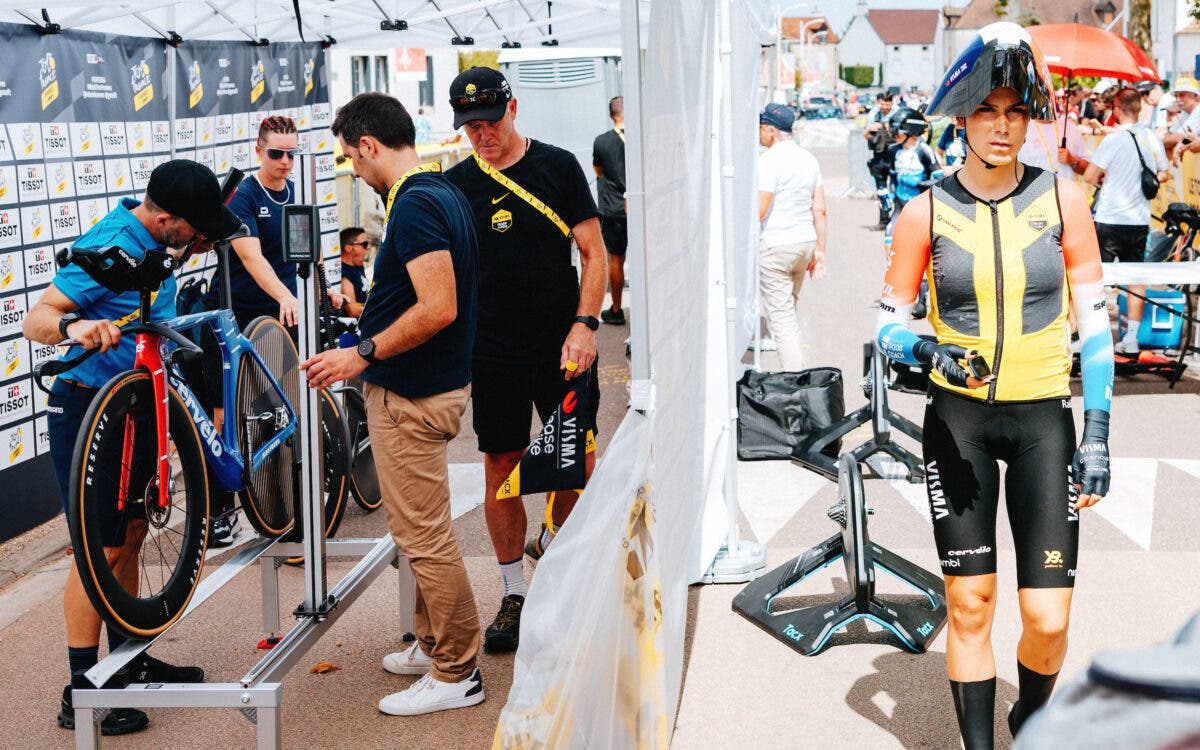
The UCI promptly responded to the Tour de France peloton’s concerns about maxxed-out bras with the rushed rollout of unprecedented “chest checks” ahead of the stage 4 time trial.
Suspiciously busty riders were subject to mandatory inspections by race commissaires ahead of the crucial race against the clock.
It was prime fodder for tabloid rags and cycling publications alike. For a short period, the Tour de France Femmes was the talk of world sport.
AiRO study: There’s no free speed to be found inside a sports bra
Data published by AiRO last month suggests it might have all been a storm in a bra cup.
The Salt Lake-based aero experts used their software to model the CdA (coefficient of aerodynamic drag) of two identical female riders in a tucked riding position.
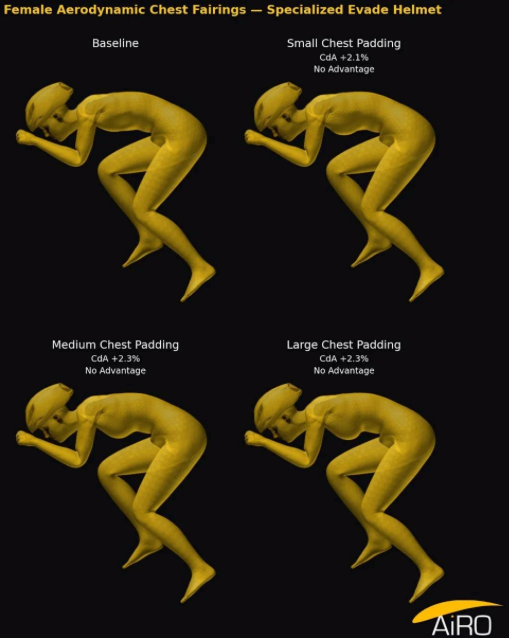
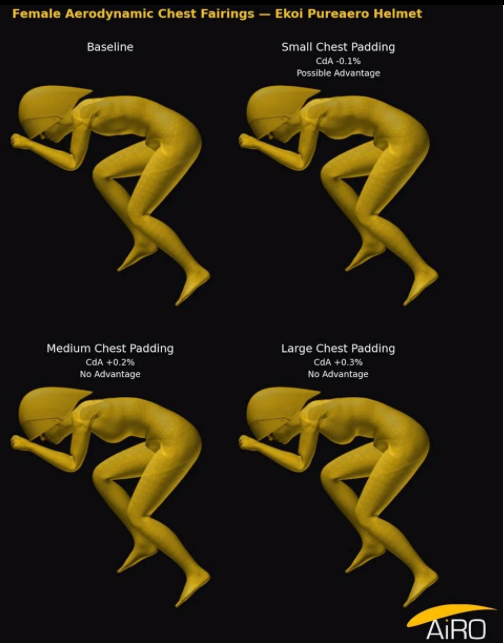
One “digital twin” wore a Specialized Evade helmet, the other wore an Ekoi Pureaero lid.
In the experiment, the size and shape of the twins were kept identical except for one key variable – chest volume. Simulations were run on each “rider” to reflect small, medium, and large amounts of bra padding.
AiRO used these two wildly different helmets – the stubby Evade and the “teardrop” Pureaero to account for the significant downstream effects of airflow over the head.
The results?
“Not one configuration produced a measurable gain. Going from small to large padding barely moved the [CdA] on either helmet,” AiRO concluded.
In fact, in the case of the Specialized Evade, AiRO found a stuffed bra would actually make a rider slower.
AiRO study: Summary results
Specialized Evade
- Small chest: 2.1% slower
- Medium chest: 2.3% slower
- Large chest: 2.3% slower
Ekoi Pureaero
- Small chest: 0.1% faster
- Medium chest: 0.2% slower
- Large chest: 0.3% slower
AiRO also modeled a male rider with a water bottle stuffed down the front of their jersey.
This illegal hack got notorious aero-tinkerer Jan-Willem van Schip disqualified from the Ronde de L’Oise by UCI officials earlier this year. And perhaps the punishment was justified.
Perhaps.
AiRO’s modeling of a male with a chunky water-bottle-sized fairing and a Giro Aerohead helmet tested 0.7% faster than baseline. It was 0.1% faster when tested with the Specialized Evade.
Those are the most marginal gains you can get.
“The best case is a possible small advantage that is within measurement uncertainty,” AiRO concluded on its water bottle test.
Clarifying the nuance of cycling’s most awkward aero debate
So what does all this mean? And does it matter?
First, it’s worth pointing out that AiRO’s study is limited in scope and hasn’t been subject to external review.
Second, AiRO’s findings don’t mean Blocken’s widely cited, peer-reviewed analysis was wrong – far from it.
But as AiRO points out, the headline-grabbing “four percent faster” conclusion from Blocken’s paper that did the rounds during the bra-doping controversy only applies to a fairing the size of your kid’s forearm.
In Blocken’s study, a 3.6 percent aero gain was achieved only with an object measuring 313mm x 87mm (12″ x 3″).
He found the gains to be had from a small fairing – perhaps of the size of a doped-out bra – were insignificant.
AiRO’s analysis reaffirms that crucial nuance.
To requote from the start of this post:
“Small chest volume changes, as they could be hidden in a sports bra, do not seem to make riders faster. Athletes need a large object, at least the size of a large bottle, correctly shaped, to get into the range where anyone should start to care. That object is visible, it is already illegal, and needs no additional policing of sensitive body parts.”
More UCI chest checks in future?
So can we call time on the bra doping debacle?
The debate has gone very quiet. There hasn’t been a TT in the Women’s WorldTour to fuel it since the Tour de France Femmes.
It may light up again when the women’s peloton next races the clock later this month at the Montréal road worlds.
In the meantime, Velo reached out to the UCI to ask if bra-boosting checks will be added to mandatory assessments of sock lengths, helmet sizes, skinsuit fabrics, and all the rest.
But if UCI commissaires do continue inspecting bras, it seems they won’t find any illegal speed hidden inside them.
[analyse_source url=”https://velo.outsideonline.com/road/road-racing/bra-doping-debunked-uci-fears-found-to-be-oversized/”]