[analyse_image type=”featured” src=”https://images.euronews.com/articles/stories/09/90/03/44/1200x675_cmsv2_ea6ce6eb-2735-5e5f-9517-fb43ac80d686-9900344.jpg”]

Spain calls for EU climate resilience overhaul

US will ask Europe to repay all aid sent to Ukraine, Trump says

‘A Dubai invite’: Registrations close after 90,000 applications

Travelling to Europe? EES border checks are changing this weekend
Spain calls for EU climate resilience overhaul
US will ask Europe to repay all aid sent to Ukraine, Trump says
‘A Dubai invite’: Registrations close after 90,000 applications
Travelling to Europe? EES border checks are changing this weekend
99% of Ireland’s population growth ‘driven by foreigners’: True or false?

People watching the annual St. Patrick’s Day Parade in Boston, US, 2016
– Copyright AP/Steven Senne

 Facebook
 Twitter
 Flipboard
 Send
Send Reddit
 Linkedin
 Messenger
 Telegram
 VK
VK Bluesky
 Threads
 Whatsapp
The short answer is ‘false’, but the truth is not much far from that.
As fertility rates plunge across the EU, the impact of migration on demographics is becoming increasingly evident.
 ADVERTISEMENTADVERTISEMENT
Since 2012, more people have been dying in the EU than have been born, and last year, new births reached their lowest point on record, at 3.46 million.
Although migration is indeed helping to keep demographic collapse at bay, figures circulating online are not always accurate.
Take this video shared by Tommy Robinson, a British far-right activist, which was watched nearly 700,000 times, claiming that nearly all population growth last year was driven by foreigners.
The video doesn’t cite sources, but data from Ireland’s Central Statistics Office can clear up a few things.
First of all, the majority of all births last year — about 70% — were to Irish citizens.
However, that rate is falling steeply and rapidly; it stood at 76% in 2022.
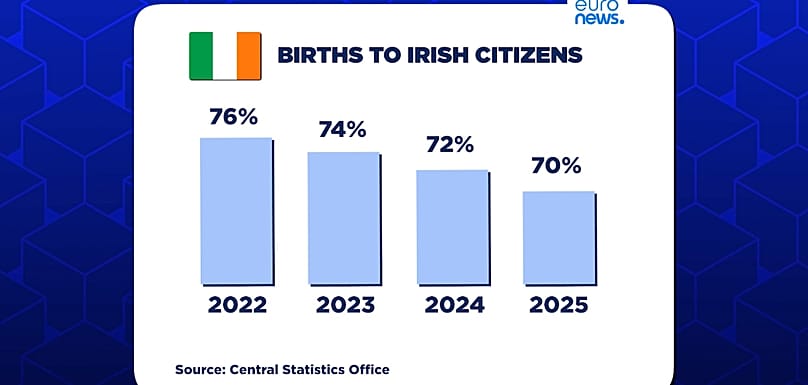
Then migration comes into play.
The latest estimates — April 2025 to April 2026 — say that there was a net flow of around 53,000 non-Irish migrants coming to the country, so around 72% of the total population growth.
At the same time, more Irish citizens left the country than those who arrived, with a net loss of around 5,000.
For context, Ireland’s population grew by nearly 67,000 people between April 2025 and April 2026, and about 28% of that growth came from “natural increase”, meaning there were almost 19,000 more births than deaths.
So migrant arrivals are significantly contributing to Ireland’s population growth.
That’s also been certified by Eurostat, which classified Ireland as a country where population growth is mainly due to net migration.
This aspect is even more pronounced in countries such as Spain, Portugal, the UK and France, where, Eurostat says, population growth last year was “only due to positive net migration” last year.
In no country surveyed by Eurostat is population growth happening only due to natural change.
Go to accessibility shortcuts
Read more
Migrant row: Ireland seeks returns to Italy, Sea Watch 5 detained in Naples
21st-century democracy: How Ireland consulted the public on its EU Presidency
Road to extinction? Europe’s birth rates hit rock bottom. These are the least fertile countries

US will ask Europe to repay all aid sent to Ukraine, Trump says

EU warns Serbia Mladić funeral is ‘important test’ for membership bid

Driver of lorry hit by Polish train refused to break through barriers

EU tries to turn the page on enlargement after Iceland’s referendum

Russia shifts tactics with round-the-clock air strikes on Kyiv
Norway seizes Russian ship over Ukraine’s $4.2bn Crimea claim
Netherlands moves 86 tonnes of gold from US and Canada to UK
China demands France scrap fast fashion law targeting Shein and Temu
Why so many countries want to join the EU, except Europe’s richest
Europe’s most charitable countries: Where do people give the most?
[analyse_source url=”https://www.euronews.com/my-europe/2026/09/04/99-of-irelands-population-growth-driven-by-foreigners-true-or-false”]