[analyse_image type=”featured” src=”https://velo-cdn.outsideonline.com/wp-content/uploads/2026/08/Philly-Race-Legends-scaled.jpg”]
Anyone who lived, worked or played in Philadelphia between 1985 and 2012 knows about the 156-mile bike race that annually heralded the beginning of summer. It has been credited with revitalizing the hillside neighborhood of Manayunk, giving Philadelphia a Paris-like feel of the Tour de France and providing American cycling with a crowning jewel that the sport needed and few expected.
The race became an instant hit in 1985 when Eric Heiden, four-time Olympic speed skating gold medalist at the 1980 Winter Olympics, flashed across the finish line on the Benjamin Franklin Parkway to become the first ever honest-to-goodness professional cycling road race champion.
Thousands of people showed up to watch that first race, mostly curiosity seekers. The majority of them knew nothing about cycling. Sure, there were those who knew that the Tour de France was a big deal in Europe or that American cyclists had won gold medals at the LA Olympics the year before. But shutting down major Philadelphia streets for a six-hour bicycle race? No way.
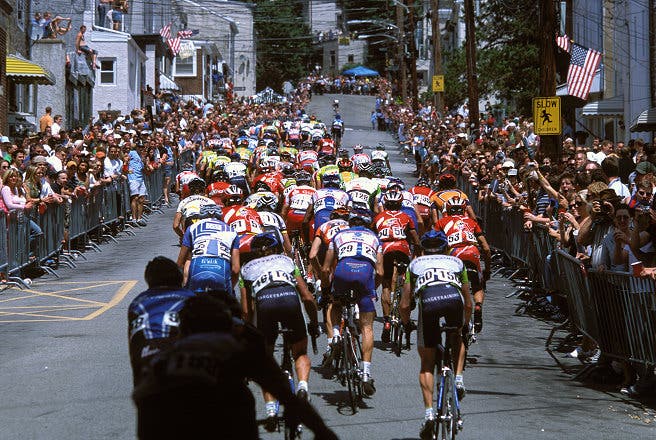
But on that day, June 23, 1985, no one could have predicted that this race, founded as the CoreStates USPRO Championship, would become an annual Philadelphia tradition or that a steep little street in a Philadelphia neighborhood would gain worldwide recognition as the Manayunk Wall.
How this happened and why the race became the official National Professional Road Championship for twenty years, an American cycling icon and one of Philadelphia’s biggest annual special events is a backstory yet to be told. Here it is.
I know. I lived it for twenty-eight years.
The Revival of American Bicycle Racing
It began in the 1970s, long after cycling’s Golden Age—from the turn of the 20th Century through the Great Depression. Over a century ago, cycling was a track sport that entertained sellout crowds at some 100 banked “velodromes” throughout the country and at popular Six Day Races held on smaller indoor tracks at major arenas including Madison Square Garden. That was during the dawn of professional sports. Back then feats of endurance and winning rough and tumble bicycle races paid more than hitting home runs and scoring touchdowns.
After World War II that era had disappeared. Shortsightedness on the part of race promoters coupled with the lack of new investment or stream of new talent during the Depression eroded the bike game. As automobiles became more accessible, the public began shifting their fascination toward motorized speed, growing auto racing’s popularity at cycling’s expense. Most wooden velodromes had burned down or been cut up for firewood, remembered only in fading scrapbooks or by the retired promoters and ex-riders who kept the sport alive by organizing amateur races in parks and small towns.
By the late 1960s, the United States was experiencing a different kind of bicycle boom. Fueled by a fitness revolution, popular books like Aerobics, and the demand for lighter European-style multi-speed bicycles drove entrepreneurs to open bike shops and buyers to discover the fitness benefits of riding a bike. “Ten Speed” entered the pop culture vernacular and between 1970 and 1974 annual bicycle sales hit 14 to 15 million, surpassing automobile sales for the first time and flipping bicycle users from children to adults.
As a youngster, I was swept up by the budding cycling culture. My older brother and his friends got eight speed Raleigh “racing” bikes and started the Main Line Milers bicycle club to tour the quiet farm roads west of Philadelphia and hold races on a local high school running track. Along with three of my buddies, we formed the under twelve “junior division” of the Milers.
It wasn’t long before I got hooked on racing. One of the senior Milers, Craig Currie, discovered the little-known circuit of amateur races that were held between Baltimore and Boston and encouraged me to watch him race in the annual Tour of Somerville, NJ. It was called the “Kentucky Derby of Cycling” and had been held every Memorial Day since the late ‘40s.
My dad drove me to the race. I was blown away by the colorful jerseys, the shiny bikes and the cheering crowd. When Olaff Moetus of Indiana sprinted across the finish line to win the fifty mile senior race my dad turned to me and said, “It looks like you want to try this.”
I did. Totally.
Back then, the only place to learn about bike racing was at a good local bike shop. In the Philadelphia area, the epicenter was the Hill Cycle Shop in Chestnut Hill. It was founded in 1929 by Gerard F. Casale who opened during the tail end of the golden era of six-day racing and had all the old parts and racing memorabilia to prove it. It was the gathering place for road and track racers from throughout the Mid-Atlantic region. I coaxed my brother to drive me there so I could hang out for hours learning about equipment, training, and racing from the underground tribe of regional racers and old timers who recalled racing glories from long ago. To get there, we often drove through the hillside Philadelphia neighborhood of Manayunk.
The heart and soul of Hill Cycle was the owner’s son, Jerry Casale, Jr. I first met him there when he was 21, recently mustered out of the US Army and full of enthusiasm to modernize his dad’s bike shop into a bridge between the golden age of six-day racing and the modern emerging era of American cycling. Long before Italian bicycles became widely available in the U.S., Jerry brought in premier brands with names that rolled off the tongue like Masi, Colnago, Pinarello, Cinelli, Campagnolo, and Gianni.
Love of Racing
When I was thirteen, Jerry gave me my first part-time job, assembling and delivering bikes at Hill Cycle over Christmas vacation. As I got deeper into racing he fueled my habit by feeding me tires, equipment and brotherly advice. He loved promoting cycling, local racing and sponsoring the Pennsylvania Bicycle Club. It was the beginning of a lifetime friendship that years later evolved into a unique business partnership.
I soon began to learn about the culture of bike racing. In the mid-sixties there wasn’t much to go on: no televised races, no dedicated magazines, no internet, no little league or YMCA to “sign-up” for cycling lessons. A rare eight-page color photo spread of the Tour de France
appeared in Sports Illustrated one year. I cut out all the pictures and stuck them on my bedroom wall. I took French as a sophomore in high school and did my report on the only textbook chapter about the Tour de France. It was the only A+ I got in the course.
Cycling in the Olympics gave the sport legitimacy. I was hungry to learn more. By 1964 I started racing in every junior race (under 18) I could find. Members of the U.S. Olympic cycling team were like gods. They were only seen at the biggest races and only appeared through club newsletters and word of mouth. That is, until Sports Illustrated published the Lure of the Wild White Noise.
It was a lengthy feature about Jackie Simes III, the first American sprint cyclist who had an outside chance to win a medal at the 1964 Olympics in Tokyo. I devoured that article about his family’s lineage in cycling, his dedication to training for the sport and his racing experiences at the Rome Olympics and at other major events in places like Rome, Copenhagen and Paris. Making the 1968 Olympic Team became my single-minded obsession.
As my racing career progressed, I joined the Century Road Club of America, based in metropolitan New York, the nation’s oldest and biggest club with deep roots back to cycling’s Golden Age. Simes was the star member of that club and, after the Tokyo Olympics, was living in New Jersey and had his sights set on Mexico City leading to the 1968 Games. Jack mentored me and a few of the other promising young riders in the region. We raced and trained together and, by 1968, Jack and I were teammates at the Olympics in Mexico City.
I really got to know Jack during that period. If anyone’s DNA was laced with bike racing, it was his. I didn’t realize it then but his toughness and dedication to his sport was less about cycling than it was about a life of purpose and the single-minded dedication and character it takes to pursue that purpose to great heights. We were kindred spirits.
Transitions
By 1975, Jack and I had both retired from racing. I had competed in my second Olympics in Munich and had raced throughout Europe where cycling was extremely popular and ingrained in the culture. Jack turned pro shortly after the 1968 Olympics (his 3rd), raced in eleven punishing European Six-Day races and was now the coach of the US Olympic track cycling team.
Jerry was buried in the cycling business, still running Hill Cycle Shop in Philadelphia and itching to get more involved in the sport, principally through importing top cycling brands from Europe. Through Jack’s connections, Jerry began importing bikes from Holland. In 1972 they developed a side hustle called J&J Enterprises to bring in esoteric bikes, tires, and equipment to serve the small but growing number of bike racing fanatics. The three of us kept in touch.
Jack and I became the founders and principals of a company we called Omni-Sports with the motto, “Developing American Bicycle Racing”. We cut our teeth creating and managing the new Trexlertown Velodrome, a bicycle racing track built on vacant land owned by Bob Rodale, a philanthropist in rural Pennsylvania. Under our direction for the first three years, “T-Town” arguably became the best outdoor velodrome in the world. We ran Friday night races that consistently drew 2,000 to 3,000 paying fans, hosted top cyclists from a dozen countries, ran annual international meets, promoted and managed the 1978 Junior World Championships and created the best youth cycling development program in the United States.
We left the velodrome to grow Omni-Sports into a multi-faceted company focused solely on elevating cycling to a higher standard. Over the next few years we created and ran the Yoplait 50K Challenge, a citizen’s racing series that we produced in seven urban locations; started and managed a racing team sponsored by Panasonic and Shimano; developed a series of races called the American Bicycle Racing Circuit; and seriously explored every new opportunity to grow the sport. I did a lot of freelance writing and became the race announcer and an informal advisor to Michael Aisner, director of the Red Zinger Classic in Colorado, the biggest U.S. road race at the time. Jack was hired by Madison Square Garden to consult on bringing back Six-Day racing.
Everything we did was to advance our goal of developing the sport. We learned that we could convey the excitement of cycling and sell it to a new audience. We had also experienced the amazing passion for professional cycling throughout Europe and believed that we could import that passion to the United States. What America needed for cycling to catch hold was a pro class of paid riders and top-quality events at the top of the pyramid. That became our mission.
Developing Professional Racing
It was a daunting challenge. In the late seventies, professional athletes were not allowed to compete in the Olympics or in any amateur events, including bicycle races in the United States. Any amateur who accepted prize money risked having his racing license suspended. It was assumed that the United States Cycling Federation (USCF), since it was affiliated to the UCI (cycling’s international governing body) sanctioned all the races and licensed all the riders in the U.S., would be the logical organization to develop and run pro racing.
It wasn’t.
We believed that a dedicated business was needed to focus on creating well-funded exciting races, nurture an active pro class and provide unprecedented professional promotion. Omni Sports was up to the task. We prepared a detailed plan to develop pro racing. It leaned heavily on our success at running the Trexlertown Velodrome, on Jack’s thorough knowledge from racing on the pro circuit in Europe and our shared viewpoint on what was needed to showcase the sport to an American audience.
In 1979 we flew to Colorado Springs to present our plan to the USCF board. On the flight, our top race official from the velodrome, Artie Greenberg, discovered from official UCI documents that the license to govern pro racing in the United States belonged to an organization called PRO, the Professional Racing Organization, not the USCF.
The USCF board applauded our proposal and said they would submit it to their membership for review. There was no mention of PRO during the presentation.
After we left the meeting, Jack immediately contacted PRO and spoke to its owner, Chris VanGent, a Belgian-American businessman and former Six-Day rider. He had staged unsuccessful Six-Day races in Detroit and Los Angeles and was frustrated by the USCF’s lack of interest or ability to help develop the professional side of the sport. As it turned out, VanGent had personally paid the annual fee to keep PRO’s UCI license active for eleven years.
At VanGent’s invitation, we became controlling members of the PRO board, changed its name to USPRO and informed the USCF that, as official owners of the pro license, we would now begin developing professional racing in the United States. After several months of bickering and legal disputes with the USCF, the UCI ruled in favor of USPRO.
Beginning in 1980, Jack, as new president of USPRO, took on the heavy responsibility for developing the professional class, recruiting riders, establishing national championships, building a circuit of pro events and selecting the U.S. team for the World Professional Championships, while I remained on the board and concentrated on Omni-Sports’ other projects including creating and running our “Yoplait 50K Challenge” cycling events around the country for a NYC ad agency.
Our big break came in late 1981. Rikki Baker, marketing director of WMAR-TV in Baltimore, called with an idea: the station wanted to create a cycling event that would celebrate the city’s Inner Harbor redevelopment. After contacting the USCF, Baker was not convinced they could deliver the caliber of event WMAR envisioned. Her research led her to “the other” American cycling federation: USPRO in Allentown, Pennsylvania. She cold-called the USPRO number, and got Jack.
“We needed to create a high-profile USPRO National Championship,” Jack recalled. “I told Baker that if WMAR committed to sponsorship and live television coverage, they could have the rights to the first U.S. Professional National Championship, featuring pros from Europe, including Jock Boyer, the first American to ride the Tour de France. She was blown away.”
The first USPRO Championship was a circuit race held over 40 laps of a twisting 1.5 mile course we created in Baltimore’s redeveloping Inner Harbor. The 100 kilometer (62 mile) race featured a $25,000 cash prize list for an imported field of 71 riders from 9 nations. There were 12 American pros and, by special invitation, the amateur National Teams from the U.S. and Canada. Shane Sutton of Australia won the race and John Eustice, an American racing in France, placed sixth. As the first American pro to finish, he became the first USPRO National Champion. Jock Boyer finished ninth.
VeloNews called the race a huge success, “…unlike any one-day bicycle race ever held in America”.
The next year, 1983, was another banner year for USPRO. In April, USPRO sanctioned the “Tour of America”, a three-day stage race from Viginia Beach to Washington, DC, televised by CBS Sports and organized by World Tour Cycling, a joint venture between NYC sports agency, Capital Sports, and the organizers of the Tour de France.
In June, we ran the second USPRO Championship in Baltimore, boosted in prestige by a $100,000 prize list, the biggest purse ever offered for an American bike race. According to the Baltimore Sun, the race drew an estimated 90,000 fans and featured 79 Riders from 15 nations including Tour de France winners Laurent Fignon from France and Stephen Roche from Ireland.
Leading up to the 1984 Los Angeles Olympics, national amateur teams were allowed, by special invitation, to race with pros in international events. Davis Phinney, member of the US Olympic Team finished first to claim the $25,000 first prize. But because he was an amateur, he could only keep $200. International rules allowed the race sanctioning body to retain excess amateur prize money. USPRO used the surplus to fund the USPRO team to the World Championships and other pro races in Europe. Phinney wasn’t happy but he finally acquiesced. John Eustice was again the first American professional to finish and captured his second National Pro Championship title. He placed 15th in the race and won $1,000.00.
American pro racing continued on a roll that year. In July, Jock Boyer finished the three-week Tour de France in twelfth place. In September, Greg LeMond became the first American pro to
win the World Road Championship. USPRO licensed thirty-five riders in 1983, many of them due to an alliance with the USCF allowing pro license holders to enter big amateur events like the popular Coors Classic in Colorado.
Suddenly, the cycling world began to see America as a sleeping giant. No one more so than the sport’s GOAT, Eddy Merckx, five-time winner of the Tour de France, now building his own iconic bicycle brand with ambitions to break into the lucrative American market. We had crossed paths with Eddy when he had come to our final race at Trexlertown in 1978.
As Jack recalls, “I was home on the farm in PA when I received a call from Merckx. He asked if I would meet with a Belgian friend of his, Jean-Claude Garot, who was in NYC and wanted to publish a single-issue commemorative magazine for American readers about Eddy’s career. I invited Garot to come down for a chat.”
The three of us spent several days in Jack’s kitchen hatching a plan to leverage the Merckx Legend into a premiere issue of a new monthly magazine we called Winning, Bicycle Racing Illustrated. It was a joint venture between Omni-Sports and Garot’s publishing company, Offpress, in Belgium and would become the official publication of USPRO, offer complete coverage of the USPRO Championship and insightful, colorfully produced reporting on the top races in the U.S. and around the world. We referred to it as the “Sports Illustrated of Cycling”. Jack’s role was Executive Director in charge of business affairs in the U.S. and my role was Editor-in-Chief.
Not long after the successful second USPRO Championship in Baltimore, WMAR informed us that the station was undergoing management and programming changes and could not sponsor the event in 1984. Another blow came when the second annual Tour of America was unexpectedly cancelled by Capital Sports for lack of a major sponsor.
That put American pro cycling and USPRO at a crossroads. On the plus side, our top USPRO license holders, Greg LeMond and Jock Boyer, were two of the best pros in the world. On the track Gibby Hatton was 3rd in the Keirin World Championship and contracted to be the first American to ride the upcoming Keirin season of professional betting races in Japan. We had a slick magazine documenting pro cycling events. But we needed more pros and more domestic pro races with big prize money and talented athletes.
Enter Fred Mengoni. He was a diminutive sixty-year-old Italian immigrant and ex bike racer who had come penniless to New York and, through sheer grit and hard work, made a fortune in Manhattan real estate. Fred’s passion was pro cycling. He carried a roll of hundred-dollar bills and doled them out to aspiring cyclists who showed character and single-minded dedication. He backed LeMond and Boyer and wanted to help USPRO field a strong team for them at the Professional World Championships, to be held in Barcelona a month after the 1984 Los Angeles Olympic Games. Jack convinced Fred to kick in cash to help fund the team. Mengoni became the passionate Patrone of USPRO.
Philadelphia’s Roots in Barcelona
It all came together in September 1984. Fred, Jack, Jerry and I were in Barcelona as the official USPRO delegation supporting the twelve-member U.S. professional cycling team entered to ride the 155-mile World Championship Road Race. Led by LeMond, defending champion, and Jock Boyer, most of the rest of the squad were neo pros, riders who had just turned pro after the
recent Olympics in Los Angeles with no experience in longer and tougher Championship pro races.
Fred was paying the bills and Jack had done a good job assembling the team. I was there as Jack’s former teammate, business partner and journalist on assignment to cover the race for the New York Times. Jerry, with his extensive equipment background at the legendary Hill Cycle Shop in Philadelphia and business relationship with Jack, was in Barcelona as assistant team manager and official team mechanic.
Despite LeMond’s stellar reputation as the defending world champion, he finished a disappointing 27th in the nearly seven-hour Championship race. All the other Americans, including Boyer, tried hard but abandoned at various points before the finish of a very tough, relentlessly hilly event.
My article in the New York Times was appropriately entitled Americans Trying Hard in Pro Cycling.
The World Championships is typically at the end of a long season of racing. It was time to reflect on the year’s performances and assess the future of American pro cycling. Our top riders, LeMond and Boyer had world status and bright futures. American cyclists had won medals at the LA Olympics and 7-Eleven was rumored to be sponsoring an all-pro team for 1985. The nation’s biggest multi-day road race, the Coors International Classic was allowing pros to ride and other promoters were starting to step up.
The bad news was our loss of two marquee events, the Tour of America and the USPRO Championship in Baltimore.
Jack, Jerry, and I frequently talked about what was needed to put pro racing in America on the global stage. Over pitchers of sangria and cigars following that disappointing Barcelona performance, we envisioned the dream: Create an American road racing classic that rivaled Barcelona and the best one-day races in Europe. Offer the biggest purse, at least $100,000. Challenge a stellar field of world and Olympic champions from the top cycling nations around the world to race on our turf. Live television in the center of a major city. The official USPRO National Championship open to all nations. Philadelphia, why not?
Creating the Legend
Back to reality in the U.S.
Running Winning was no longer a priority nor of financial interest to us so we ended our Omni Sports partnership with its Belgian publisher and closed the Omni-Sports office in Allentown.
Jack was busy creating a representative board of directors to govern and grow USPRO made up of event producers, team directors and at-large advisors, headed by Mengoni. Jack was running USPRO on a phone line out of an office he set up in the barn on his farm.
Since our final Baltimore event, I had been hustling back and forth to Europe, covering the Tour and major cycling events for Winning and other publications. I was recently married, moved to New York and ran into the founders of World Sports Group, a sports marketing company that wanted to broaden its interest from tennis into other sports, like cycling.
Jerry, back in Philadelphia from the Worlds, was excited about the concept of finding a classic course for the major USPRO Championship we had envisioned in Barcelona. He had a cycling friend, Jack Toland who had a connection to a local bank with possible interest in sponsoring the race.
The plan was hatched. Jack, as head of USPRO, would serve as the Race Director in charge of all technical aspects of running the event according to UCI rules. Jerry would be the lead contact with the city overseeing logistics and work with Jack on developing concessions. My role was to be executive director in charge of marketing and promotion through the cycling division I had started with World Sports Group.
Following a meeting in NYC where Mengoni confirmed his support to help finance USPRO with Jack at the helm, Jack and I met at the Vince Lombardi Service Plaza on the New Jersey Turnpike. We signed a contract granting World Sports Group the exclusive license to conduct the annual USPRO National Road Race Championship for twenty years starting in 1985.
It was dated November 27, 1984.
Jerry and I first met with Barbara Fenhagen, Philadelphia’s managing director. Back then she said the city was interested in growing its international image as well as showcasing Philadelphia as a city of neighborhoods. She loved the idea of hosting an international race with the added prestige of being an official national championship on a course that linked a Philadelphia neighborhood with the majesty of the Benjamin Franklin Parkway.
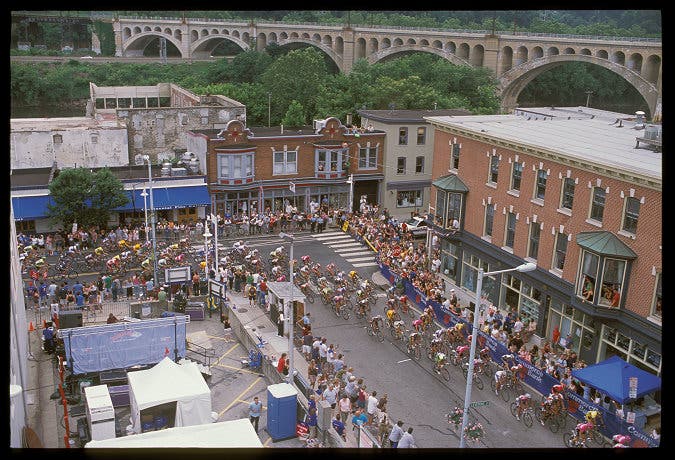
UCI rules required that all classic one-day professional road races had to be a distance of at least 250 kilometers (156 miles) on a circuit of at least 20 kilometers (12 miles). We wanted a majestic start/finish location (the Parkway), an out and back stretch where riders could be seen both coming and going (Kelly Drive) and some hills to provide a tough challenge every lap. We scoured the hillside neighborhood of Manayunk and discovered Levering Street, a torturous half-mile climb that we named the Manayunk Wall.
We knew the only way the race would work was with a television and radio partner, like Jack and I had in Baltimore. Rey Olsen, head of Worlds Sports Group and I set meetings with all four local TV stations. After being laughed out of the local ABC and NBC affiliates (‘Six-hour bicycle race? You’ve got to be kidding’), we met with Gordon Hughes, the innovative programming director at WCAU, an affiliate of CBS, the network that owned the first U.S. rights to televise the Tour de France. “Find a sponsor and we’ll televise it,” he said.
Thanks to Jack’s foresight and reputation, he secured first year approval from the UCI to list Philadelphia as a major international race on par with great European classics like Milan-San Remo, the Tour of Flanders, and Paris Roubaix. He also scored the unprecedented distinction of also being the USPRO National Championship as an aid to help develop our emerging pro class.
With a 20-year international and championship license, the course set, a TV partner, and the city backing the plan, all that was left was to find the money to pull it all off. Olsen and I met with Bob Palmer and Maury Dorrance at CoreStates Financial Corp, the bank that Toland said might be interested. CoreStates had recently purchased the Philadelphia National Bank and
needed to introduce their brand and gain favor with the community through a high-profile special event. We signed the deal for the CoreStates USPRO Championship on March 1, 1985
with the race set for June 23rd. It was a three-year deal with the option for the bank to opt out of the final two years within sixty days after the first event if they weren’t happy.
June 23rd 1985
We scrambled to organize the race. Michael Aisner, promoter of the Coors Classic in Colorado sent us two miles of snow fencing he used for crowd control at his event. We lined up dozens of volunteer marshals, motorcycle and car drivers, race officials, announcers and thirty-one sponsors and official suppliers. CoreStates launched a massive promotional campaign about the upcoming race. WCAU saturated local TV with information about the course, the leg breaking Manayunk Wall, the riders and the little-known sport of bicycle racing. Seventy-five professional racers from twelve nations competed, featuring thirty-six licensed American pros, including Tour de France veteran Jock Boyer and the powerful 7-Eleven team, America’s only licensed international pro team, made up of veterans from the 1984 Olympics.
The crowd grew to an estimated 100,000 around the 14-mile circuit throughout the six-hour race. We had Maury Dorrance, CoreStates Chairman, follow the riders for the last few laps in his limousine to witness the thousands of cheering fans and party goers. He stepped out of the car grinning from ear to ear. He shook my hand and gushed, “I saw ‘Thank you CoreStates’ signs in Manayunk! We’re in for the duration”.
A week later Sports Illustrated came out with a two-page spread on the race entitled “Now Eric’s Hell on Wheels Too”. It was the first and only time that the race was covered by SI and the victory by Eric Heiden immediately gave the race worldwide notoriety.
CoreStates ended up re-signing as title sponsor for a total of twenty years, surviving mergers with First Union and Wachovia through 2005. Commerce Bank signed on as title sponsor through 2008 followed by TD Bank from 2009 through 2012, my last year running the race.
The Bike Race Experience
Over the years, USPRO registered teams grew from one to fourteen and the quality of American cyclists significantly improved. At the same time, we boosted the prize money, upping the visibility and prestige of the race on the international calendar.
We focused on creating an unforgettable fan experience for cyclists who traveled across the country to see the nation’s biggest international bike race. Philadelphians called it a party. They came by the thousands, from hospitality tents and bleachers along the Parkway to the row houses perched on the steep Manayunk Wall. We created a Party Zone on Lemon Hill. CoreStates entertained over 20,000 guests in sponsored VIP tents on Eakins Oval. Jerry’s operations team set up big screen TVs on the Manayunk Wall and in view of the finish line with live announcers at all three locations. Dozens of exhibitors signed up for the race expo near the Art Museum and we treated special guests to rides following each lap of the race in a fleet of 15 VIP cars and vans. Our finish line announcing duo, led by Michael “the Voice” Aisner provided entertaining race commentary with frequent race updates from our announcers on the Wall and Lemon Hill.
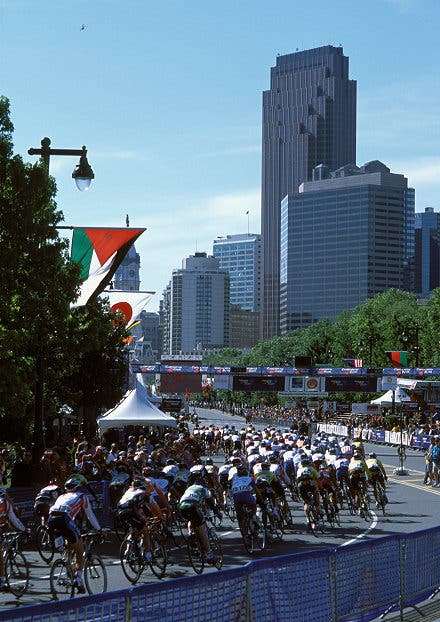
Throngs of fans—families, friends, partygoers, and hardcore cyclists alike—were drawn by the caravan of color, the thumping of TV choppers overhead, blaring music, and the world’s fittest, sinewy, Lycra-clad international cyclists.
Building the Legacy
In 1993, a relatively unknown triathlete from Texas by the name of Lance Armstrong emerged onto the cycling scene. By then, the race had grown into one of the country’s premier cycling events, and we were looking for a way to build on that success and raise the profile of professional racing even further. We created a Triple Crown of Cycling, linking Philadelphia with two other races we produced—the Thrift Drug Classic in Pittsburgh and the Kmart Classic in West Virginia—and offered an unprecedented $1 million bonus to any rider who could win all three.
Lance Armstrong, then a young professional with the Motorola team, did exactly that. He swept all three races, culminating with the CoreStates in Philadelphia, capturing national attention and adding a dramatic new chapter to the race’s growing legacy.
Then In 1994 we introduced the Liberty Classic, a top ranked international women’s road race that attracted the world’s top female competitors as well as fledgling American teams. Held on the same championship course with a start ten minutes after the men, the Liberty Classic completed four laps of the 14.5-mile circuit for a total race distance of approximately 100 kilometers. Not one of the 19 Liberty Classic races was won by an American rider as powerful German squads dominated women’s racing on the world scene. They took 13 victories with Petra Rosner a seven-time winner between 1996 and 2004 and Ina Teutenberg who took over in 2005 and notched a total of 5 wins including the last race in 2012.
The event’s annual expansion grew to be known as “Philly Week,” with preview events expanding across Freehold, Trenton, Lancaster, Reading and Allentown.
The race also became the proof of concept for a string of one day televised UCI classics we created and ran in Pittsburgh, Atlanta, Minneapolis, San Francisco, and New York. It led to our Saturn USPRO Tour of criterium races, the Kmart Classic of West Virginia and the Tour de Georgia, multi-day stage races. These events touched the lives of millions of people from some of the world’s top racers to hundreds of staff and volunteers who came each year to help make Philly and all the other events we created the best cycling events ever held in the U.S.
A Shifting Environment
2005 was the final year of the race as the USPRO Championship under its original 20-year international license. By 1995 the strict distinction between amateurs and professionals had been modified to the point that the UCI required all member nations with separate amateur and professional organizations to begin operating as one entity. USPRO was disbanded as a separate organization and its structure became the “pro committee” within the renamed governing body, USA Cycling.
Despite not serving as the USPRO Championship beyond 2005, USA Cycling, now in charge of pro racing, thought it would be a good idea to put the annual Championship out to bid and make it for American pro riders only, like other nations. We renamed our race as the Philadelphia International Cycling Championship to continue its reputation and notoriety as the highest ranked American race on the international calendar.
The world’s top teams continued to accept invitations to Philadelphia, bringing many of the sport’s biggest names and highest-level professionals to compete each year, and the race’s commercial success was bigger than ever. In total, foreign cyclists won 16 of the 28 editions of the race. During the period between 1985 and 2012 the number of U.S registered professional teams grew from one to fourteen and, by 1994 there were over 200 licensed pro riders, providing the United States with the distinction of having more registered pros than any other country in the world.
The Philadelphia race experienced its peak success during Ed Rendell’s eighteen years as mayor of the city followed by Governor of Pennsylvania between 1992 and 2010. He instinctively knew that capping the city staging and permitting costs to an affordable and predictable level was worth the $20 to $25 million in annual economic benefit the event brought to the city. He was the true champion of Philadelphia and truly believed that effective public/private partnerships were the lifeblood of sustainable public events.
During my 28 years at the helm as a race founder and director, the legacy we created was built through the passion and dedication of many people. The team we developed came to understand the transformational power of what major one-day bike races could do for a city and for the development of American cycling.
Over the years I had amazing partners and shared visionaries in this venture. Most importantly, Jack Simes, the passionate no-fear pioneer who successfully believed professional cycling needed to be recreated in the United States and figured out how to do it against significant odds. Jerry Casale, my business partner, was like a brother to me and an indispensable technical director for more than 100 races we ran together. We attracted and recruited successful corporate leaders to invest in our projects: Mark Geraghty, Mike Halstead, Harlan Stone and Octagon, Loren Smith, Carl Frischkorn, Strauss Zelnick, and my brother, Frank Chauner.
What many people do not know much about are the behind-the-scenes volunteers and staffers who came together each year, many helping since 1985 as marshals, motorcycle and caravan drivers, stage crew, and hospitality coordinators with day jobs ranging from lawyers and art directors to security specialists and homemakers. For them it was about the love of the iconic race, but also about getting together every year for the biggest ‘family’ reunion they could have. From the party atmosphere of ‘The Wall’ in Manayunk and Lemon Hill to the Lifestyle Expo on the Parkway and the early morning recreational ride on the pro course, Philly’s unofficial summer kick-off was a much-welcomed uplift for participants, Philadelphia residents and legions of fans who flocked to the City to experience this unique event. Importantly, Jack, Jerry, and I created the annual Founder’s Ride, held every Saturday morning before the race. It was a sixty-mile motorcycle-escorted ride from the Trexlertown Velodrome to the start/finish line of Sunday’s Championship for invited shakers and movers of the cycling business community, as a show of appreciation for their support.
For nearly three decades, the race became far more than a single day of competition. It helped define an era of American professional cycling, transformed the streets of Philadelphia into one of the sport’s great stages, and showed what was possible when ambition, community, and a belief in the sport came together.
2012 marked the final year of key contracts with title sponsors, TD Bank, KYW radio and Comcast SportsNet. Escalating and prohibitive city permitting costs, the death of co-founder and my partner of 25 years, Jerry Casale, and the disappointing end of Lance Armstrong’s stardom, put me in a position to reevaluate the American cycling business model. Virtually all the other major road races of that era run by us and other top promoters disappeared for many of the same reasons. The Coors Classic in Colorado, the Tour Dupont, Tour of California, Tour de Georgia, Tour of Missouri, and more had brilliant runs but fell victim to the decline.
After many hard-fought efforts to keep the race alive, my company and I made the difficult decision to step away from producing the event. A reduced version of the race continued for four more years under different management until it succumbed from lack of adequate sponsorship and municipal support.
The Future of American Cycling
Fourteen years have passed since I ran the last edition of the full race in 2012. Since then, the landscape of professional sports has shifted dramatically. While traditional European cycling events continue to thrive thanks to massive media rights and significant government support, the US has moved further toward short-form content, action-packed and entertaining sports formats that build on traditional or Olympic models and are often contained to arenas or other controlled environments. Reshaping the future of American cycling along these lines is where my efforts are now focused.
A new organization has stepped in to revitalize the Philadelphia race, building on the 28-year legacy my partners and I created. With cycling’s popularity bigger than ever, I wish them success.
[analyse_source url=”https://velo.outsideonline.com/road/road-culture/creating-a-legacy-the-philadelphia-bike-race/”]