[analyse_image type=”featured” src=”https://velo-cdn.outsideonline.com/wp-content/uploads/2026/08/IMG_4521-scaled-e1787966562468.jpg”]
Shimano has a new Dura-Ace groupset on the horizon and has caused a stir. Not for what it adds—the 13-speed cassette was the obvious next step for the brand—but more for what it hasn’t changed.
Curiously, the new Shimano groupset, which broke ground at the Vuelta a España on the bikes of Alpecin-Premier Tech, is not fully wireless, retaining the same internal battery and wired connections to the derailleurs that Shimano has now.
After the release of the new 1x GRX and XTR Di2 groupsets, many thought the new road groupset would follow suit and ditch the internal battery in favor of individual “outboard” batteries for both the front and rear derailleur. Yet, Shimano is resolute in retaining the internal batteries and its sleek, small derailleurs.
Compared to other groupset leaks, the Dura-Ace spy shots have been coldly received. Media commentary has largely panned the groupset as not exciting. Nevertheless, when it is all tallied up, Shimano moving to 13-speed is not a marginal move, even if the wire is still included.
Here is why I think the new Dura-Ace, based on what we know about it from shots taken by Velo’s Andrew Hood at the Vuelta, does enough to keep Shimano’s flagship road groupset at the top of the mountain.
What’s new with the upcoming Shimano Dura-Ace groupset?
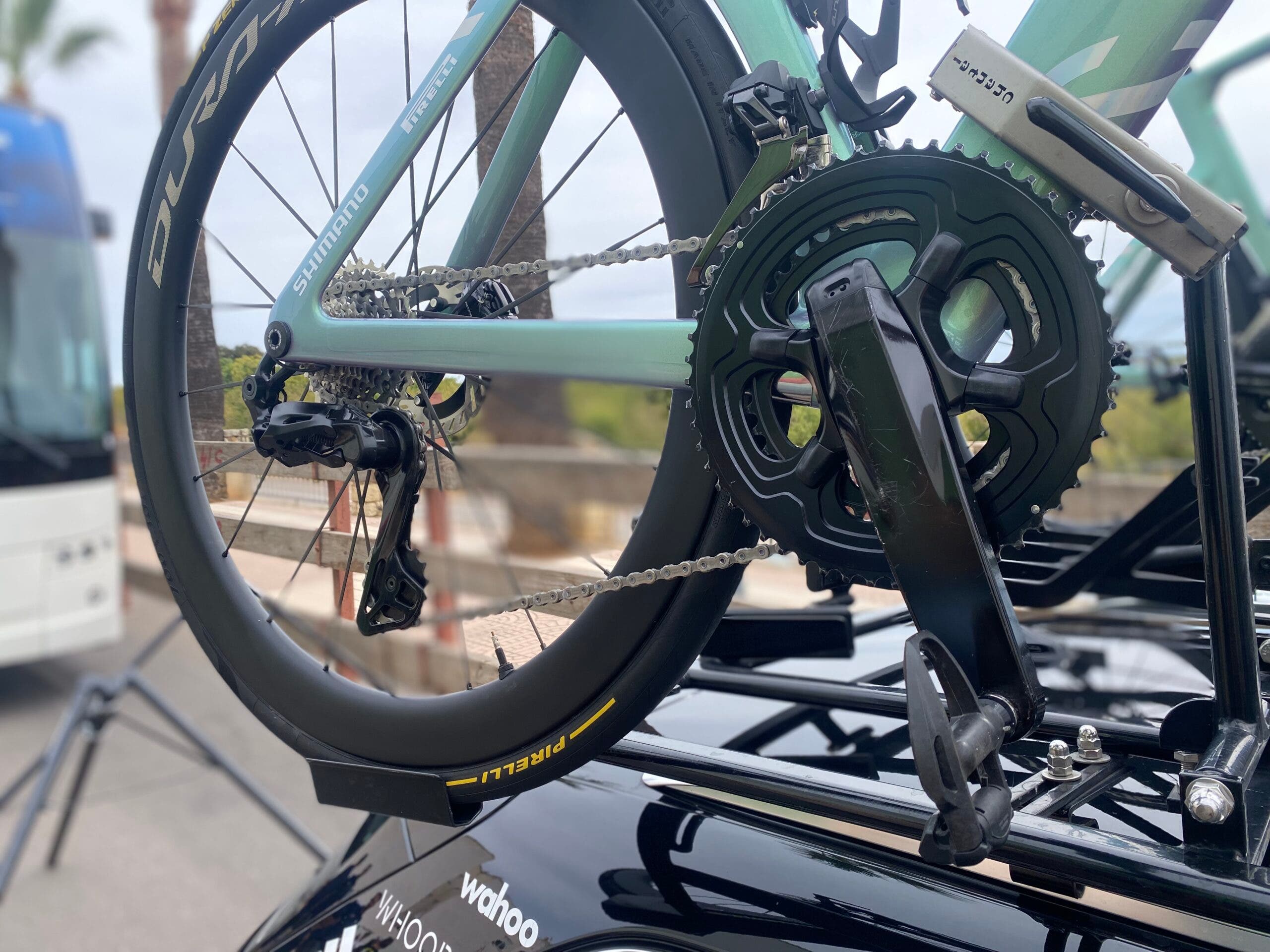
First and foremost, all that we know about the new Shimano Dura-Ace groupset is from photos from the Vuelta.
Furthermore, Shimano has told us that nothing major is coming out this year, which means what has been spotted from Shimano at the Vuelta won’t see a formal release until at least 2027. That means anything that is raced right now is still firmly a pre-production prototype.
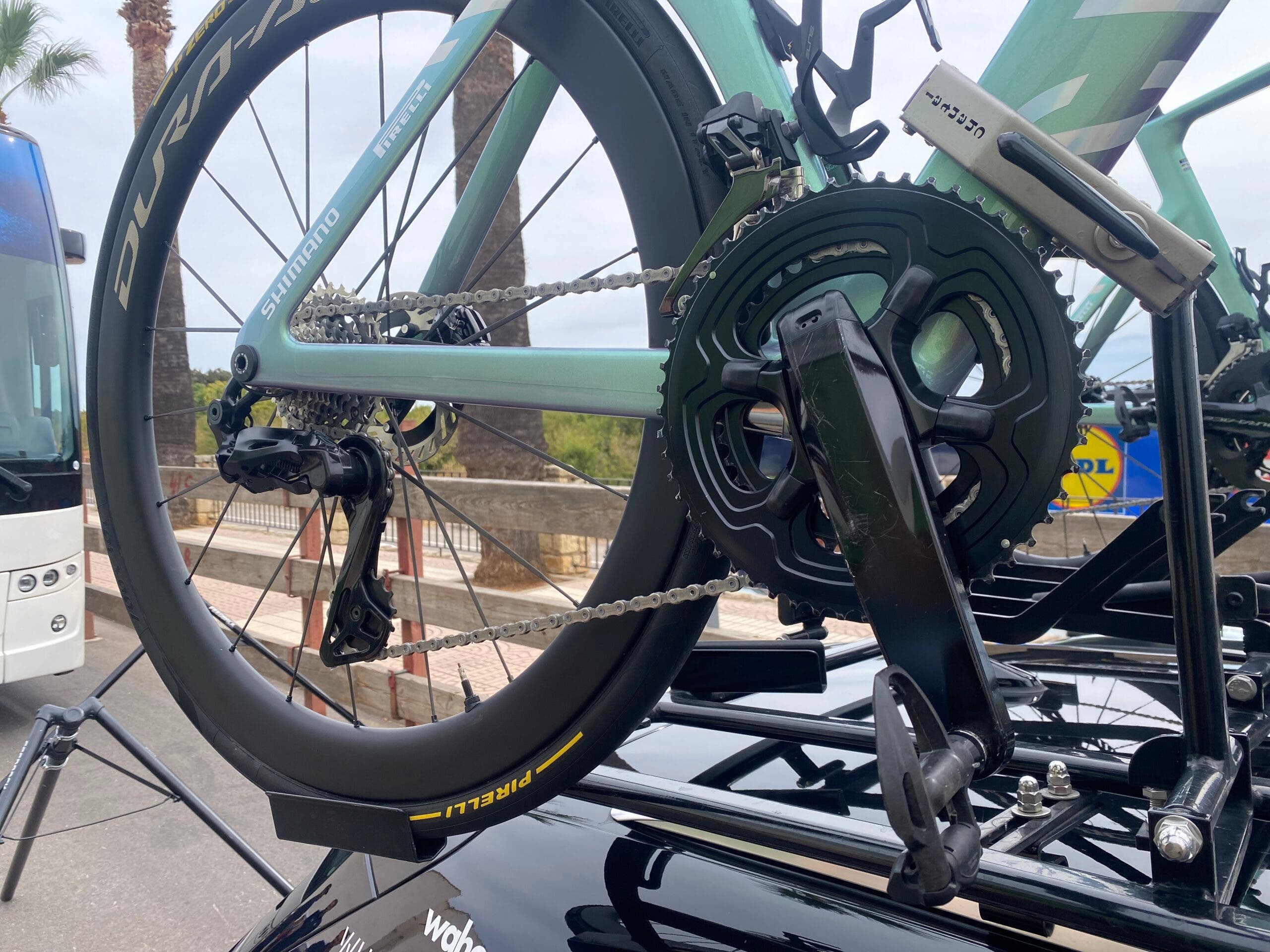
From what we can see, it’s clear Shimano will move to 13-speed cassettes to further boost range and manage the jumps in the road groupset. From our analysis of the group, the new 13-speed cassette appears to have a smaller cog than Dura-Ace 9200. The upper end of the cassette looks the same as the current 34t sprocket, but we can’t say for sure; team officials wouldn’t let us get too close to the new equipment.
What we can say is that Shimano does offer a 9-45t 12-speed cassette for its off-road line, so it could push past the 10t small cog that SRAM has across its groupsets. That said, the vast majority of Shimano’s gravel athletes have opted for 10-51 cassettes rather than the 9-45 option. That suggests the efficiency of the 9t cog might not be optimized for drop bar demands and the Shimano cassette sticks with a 10t smallest cog.
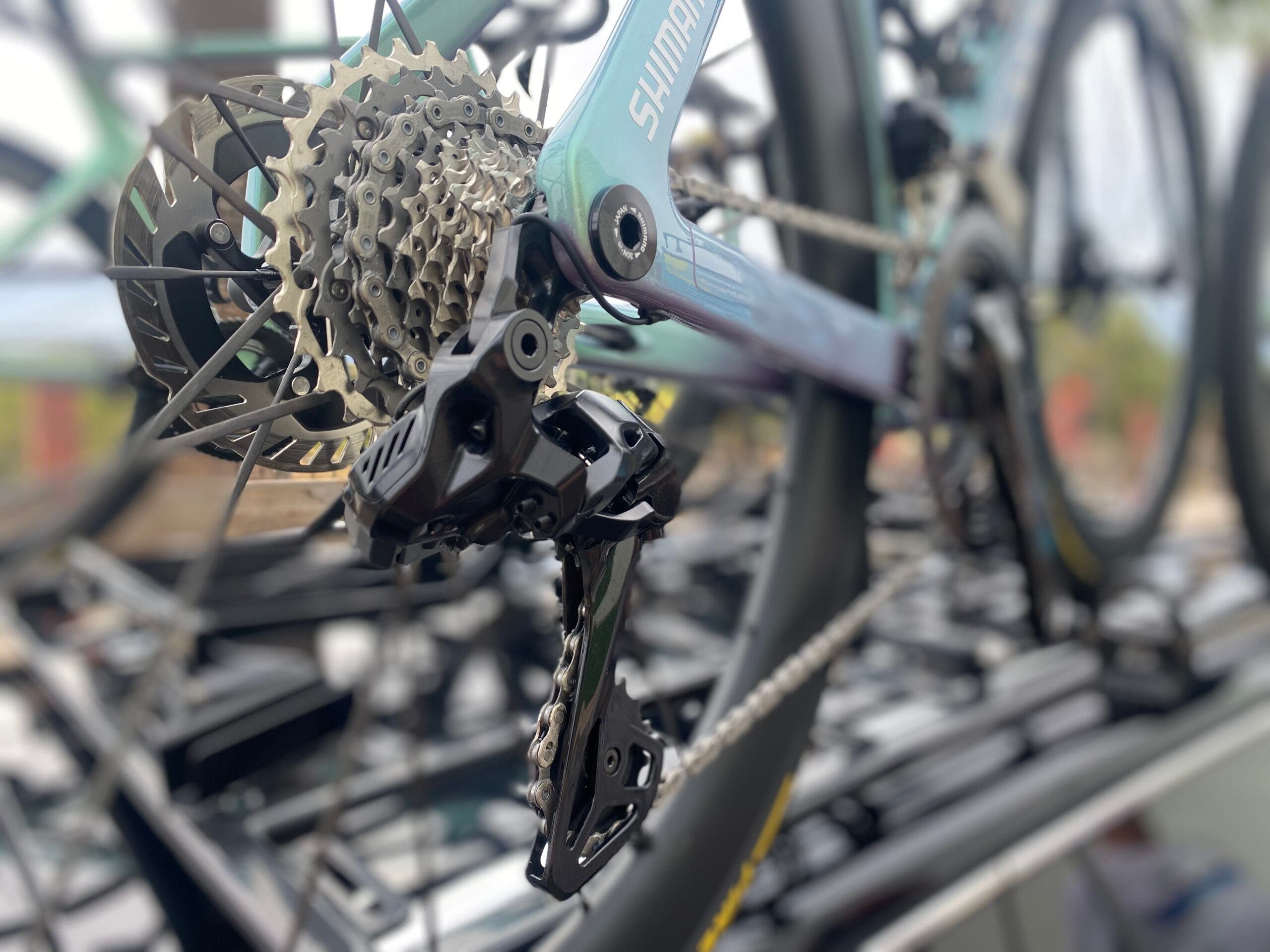
This is also one groupset on one WorldTour race bike. If this is a 10-34t 13s cassette, it is a safe bet that there will also be a 10-36t to push the range to at the very least equal SRAM’s 12-speed groupset. For reference, a hypothetical 10-34 13s Shimano cassette would look like this:
- 52/36: 10, 11, 12, 13, 14, 15, 17, 19, 21, 24, 27, 30, 34
Regardless of what those cogs are, it seems likely that Shimano will need to change its freehub design to accommodate the smallest cog. There also appears to be a UDH-styled hanger that Shimano has for the new derailleurs. Shimano could potentially follow SRAM’s lead and add an additional cog without requiring a narrower chain or tighter spacing between the rear sprockets.
The crankset that we found on the bike in question looks to be a direct-mount build rather than a one-piece crankset. Additionally, it looks to have an integrated power meter. Shimano will certainly hope to add a better integrated power option to its new groupset after its previous failures.
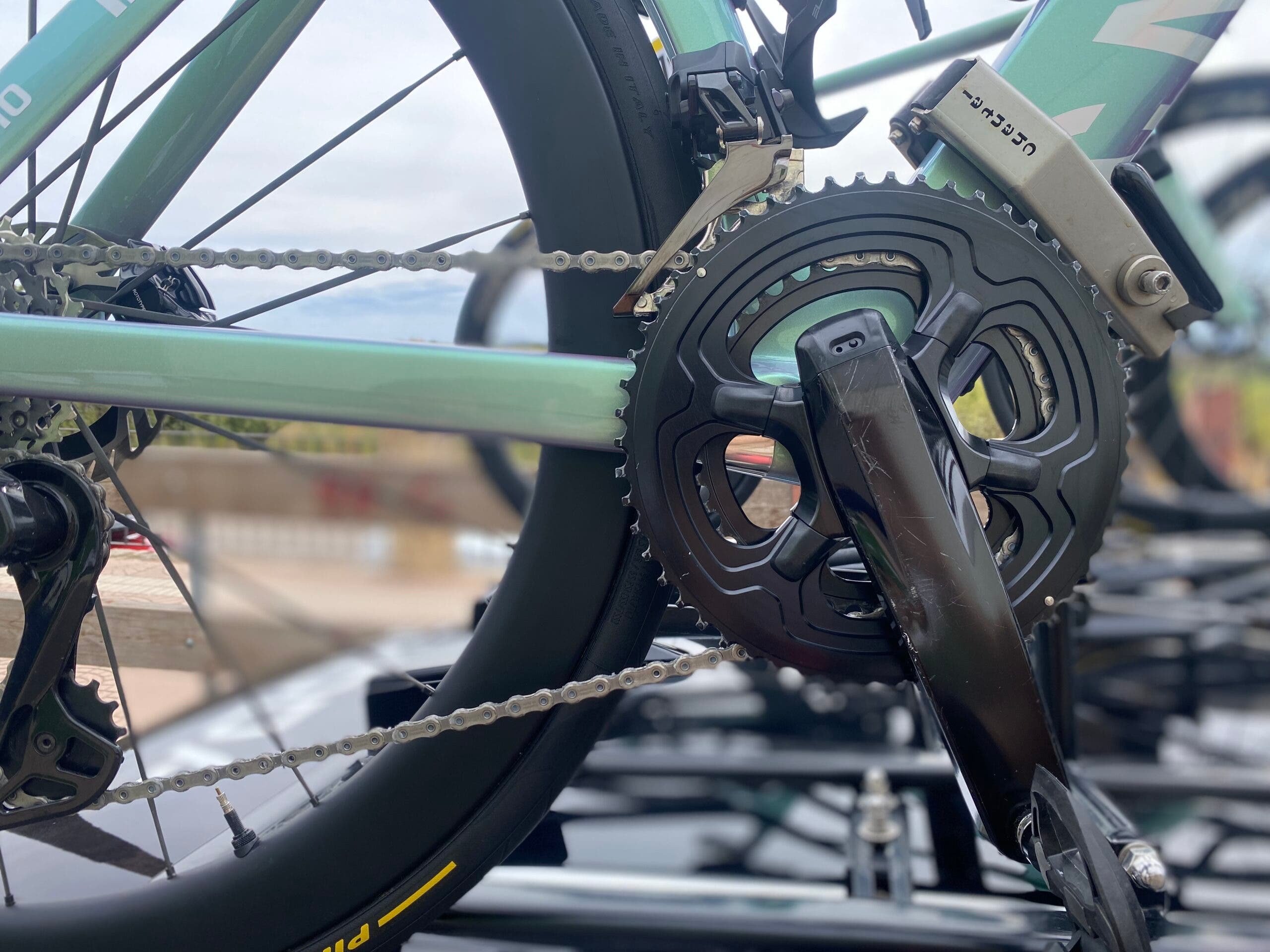
Ultimately, here is where there should be a bit of caution before jumping to conclusions about what the final groupset will be. With the crankset, a few aspects of this chainring look to be still in development. Not only are the chainrings not quite flush with the spider, but the crank itself looks unrefined. Fans of carbon cranksets certainly will hope so, as the bike we spotted the new Dura-Ace on was sporting what looked to be alloy cranks.
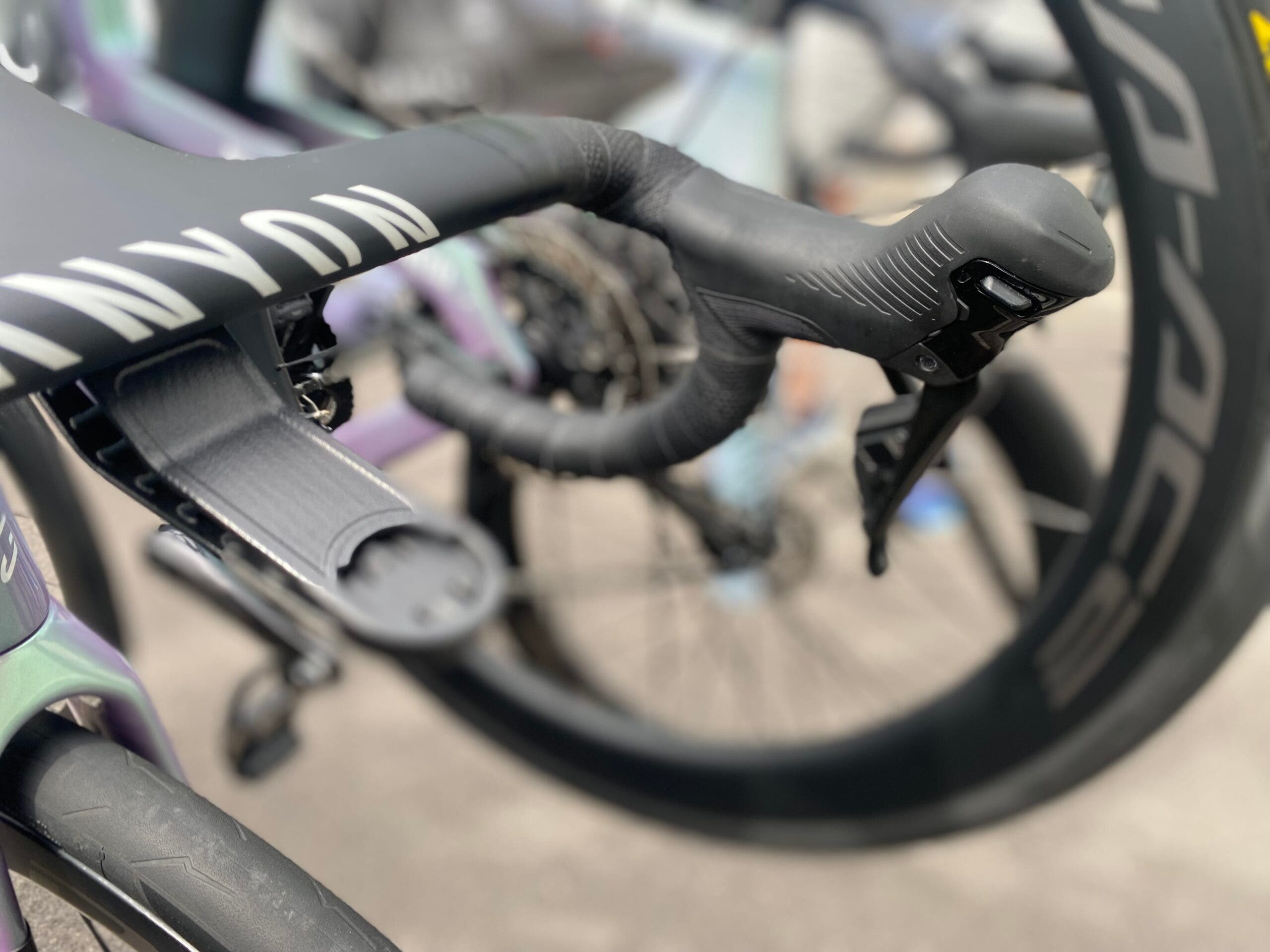
Up front, the other visible change is to the shifters. The general shape of the shifter is similar to the hood shape of the current iteration of Shimano’s road groupset. The notable change is the prominent bonus button on the inside of the peak of the shifter. Compared to the buttons on the GRX hoods, the new Dura-Ace button is more of a small lever than a button. That change should also provide more tactile shifting and bike computer screen adjusting.
The brakes we saw also look the same as the current Dura-Ace caliper. This is not a huge surprise since Shimano is widely lauded for its superior braking performance. There might be a slight change to the brake pads with the cooling fins shifting from a diagonal to horizontal orientation. Yet, this is another area where we must flag that these are advanced prototypes and not a final production groupset.
Why did Shimano keep the wires?
The big talking point from the initial Cyclingnews story that spotted the group was that Shimano did not do what many thought was obvious. Dura-Ace will keep the internal battery and wires rather than follow the lead of SRAM and run full wireless setups.
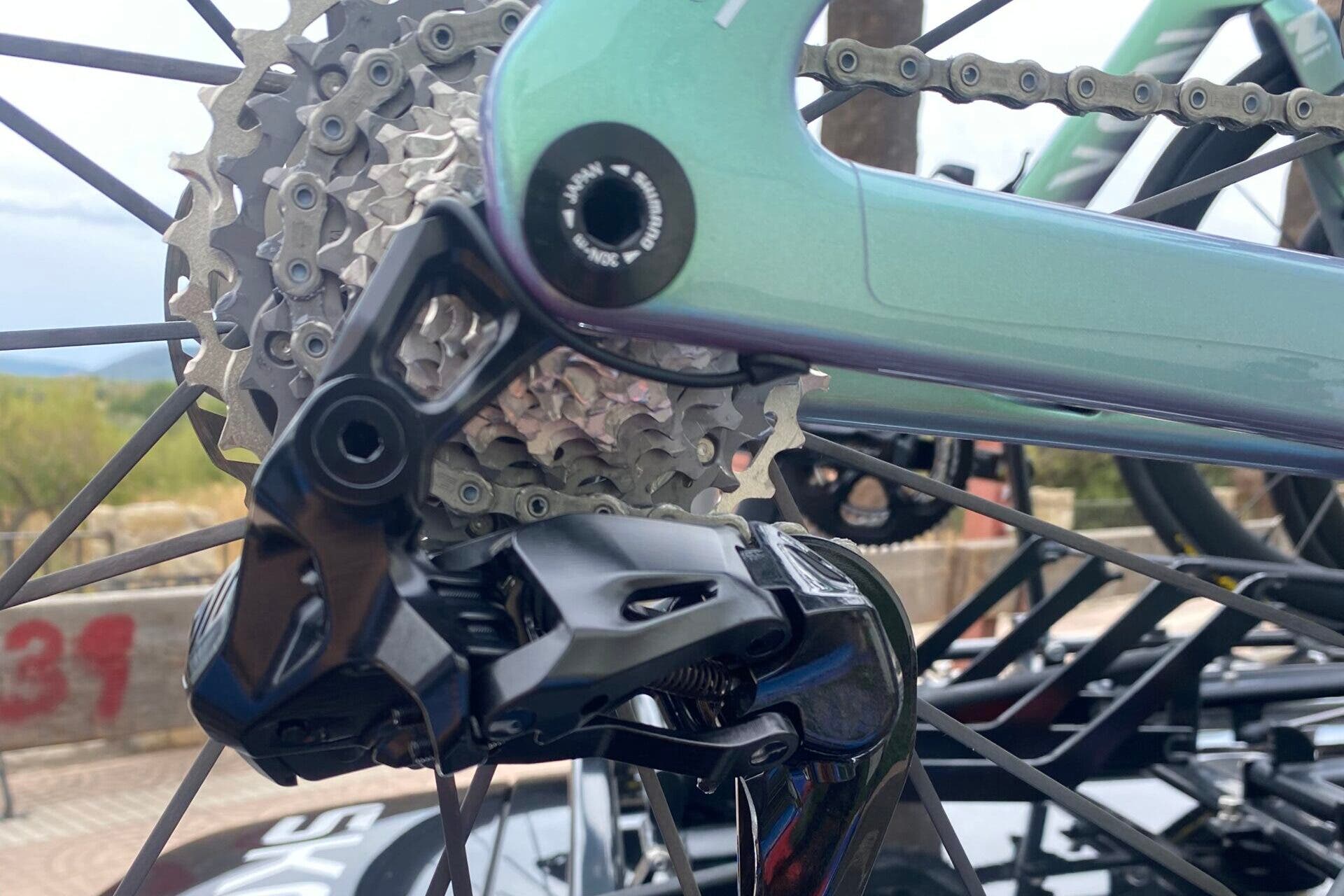
For many, this will be frustrating news, especially for the bike companies that were in the dark about what Shimano was planning to do with batteries. The big hurdle that companies will continue to have to reckon with is crafting places to situate the internal Di2 battery. Traditionally, the large, cylindrical battery has been in the seat post or seat tube. But as seat tube designs change to unorthodox shapes, Di2 batteries have to move to the down tube. This change requires extra material, wiring around the bottom bracket, and difficult-to-access locations.
Not to mention, the internal battery also requires those pesky wire points and clean wire routes from the battery to the front and rear derailleurs. As SRAM has proved, using an external battery for each derailleur keeps things very simple from a frame design and maintenance perspective.
So why would Shimano keep the internal battery? The answer is probably twofold. First off, SRAM has a key patent that protects its design that uses the same battery for the front and rear mech. Shimano would have to follow Campagnolo’s lead and have two different batteries for the front and rear derailleurs.
Secondly, without dedicated external batteries, Shimano can reduce the bulk of both derailleurs and have a longer-lasting battery. Through this combination, Shimano will likely argue that it has a faster and longer-lasting overall shifting system.
What are the ramifications of the decision?
Beyond the obvious reasons why Shimano has kept an internal battery might just be a secret third reason: Shimano wants to double down on its 2x shifting advantage by playing to its strengths and improving around the margins.
The bike media landscape has been widely disappointed by this sneak peek of the new Shimano Dura-Ace 9300 because it is seen as not doing enough to improve on Dura-Ace 9200. Yet, I see it differently. I feel like we are all far too accustomed to seeing big jumps from groupsets—i.e. SRAM groupsets—because they had so much catching up to do in the first place.
For road racing technology, it is almost impossible to overestimate how much of a competitive advantage Shimano had over SRAM before the pandemic. In 2018, Shimano accounted for 14 out of the 18 teams. SRAM accounted for one.
That is not due only to marketing priority. Shimano had better road tech, largely because SRAM had notorious issues with front shifting.
And then came the pandemic, and SRAM capitalized on the benefits of its eTap Bluetooth shifting to make up for front derailleur problems. This changed the calculus, and through bold upgrades and exciting technology, SRAM quickly became Shimano’s equal.
Nevertheless, that shouldn’t be seen as something Shimano needs to replicate. Beyond the notorious issues with Shimano’s power meters, Dura-Ace 9200 kept up with ease with SRAM, even many years after its release. No one is suggesting Tadej Pogačar is at a disadvantage to Jonas Vingegaard technologically because he has to run Shimano and not SRAM. If anything, Vingegaard’s decision to run 1x SRAM at the Tour de France came under scrutiny because of the limitations of that 1x range.
Both the addition of 2×13 road and an improved integrated power meter shouldn’t be seen as marginal. With a 13-speed ramp that seems like the obvious choice, Shimano will have answered the challenge posed by SRAM XPLR. Contrary to common belief, XPLR does have a better gear range than Shimano. Shimano’s advantage has always been the number of gears, battery life, and smaller jumps between those gears. A 2×13 upgrade would also give Shimano a bigger range, on top of that.
It is a true “have your cake and eat it, too” proposition.
From a consumer standpoint, the number-one competitive advantage that SRAM has over Shimano is an integrated power meter. It is the big failure of the previous iteration of Shimano’s road groupsets, and it is the big success of SRAM’s integration with Quarq. We shouldn’t understate just how important making a good new integrated power meter will be for Shimano’s future success.
If we are going to speculate about the power meter, we should also note that the apparent design is a bit of a return to an older Dura-Ace design. With a direct mount set-up, the cranks are independent of the spider.
This means riders can adjust crank length without swapping out the power meter spider. Additionally, Shimano has always had a very simple chainring mounting design. That looks to be relatively unchanged, which will be a nice bit of consistency for riders hoping to swap between chainring sizes.
Shimano will lose some sales, but their priorities remain performance
Ultimately, keeping the internal battery will push people and some bike companies further into the SRAM universe. For some bike brands, especially small, American ones, there was already a growing sentiment that Shimano was lagging behind SRAM from a standpoint of margins and build simplicity. Consumers who are more interested in mechanical ease or 1x groupsets on the road will also be pushed further to SRAM.
All this being said, Shimano seems to be doubling down on the current battery system because it believes in its 2x shifting structure. Changing to front and rear derailleurs with external batteries might get in the way of that performance; whether it is shifting speed, weight, aerodynamics, or some other thing Shimano found in the R&D process. Trading what works with Dura-Ace 9200 for different performance characteristics and mechanical ease is not a trade I want.
Clearly, the move to 2×13—which is not something SRAM currently has, and based on production cycles seems a long way out—was the big priority and should be the main point of discussion.
The move from Dura-Ace 9200 to 9300 seems like it will be iterative rather than revolutionary. Some critics have argued that this isn’t enough. Yet, those arguments were heavily focused on comparing Shimano against expectations of what it should be.
I do not see it this way. We shouldn’t evaluate groupsets based upon comparisons with themselves, but instead where that groupset sits in the landscape of the products available at a given time. What I can see from this sneak peek is that a great groupset—that has won 23 out of the last 24 men’s one-day monuments since it was released—just got better.
Temper your expectations, people; that kind of success doesn’t always need a massive make-over.
[analyse_source url=”https://velo.outsideonline.com/road/road-gear/shimano-dura-ace-going-13-speeds/”]