[analyse_image type=”featured” src=”https://images-prod.dazeddigital.com/1200/0-0-2400-1600/azure/dazed-prod/1450/1/1451908.jpg”]
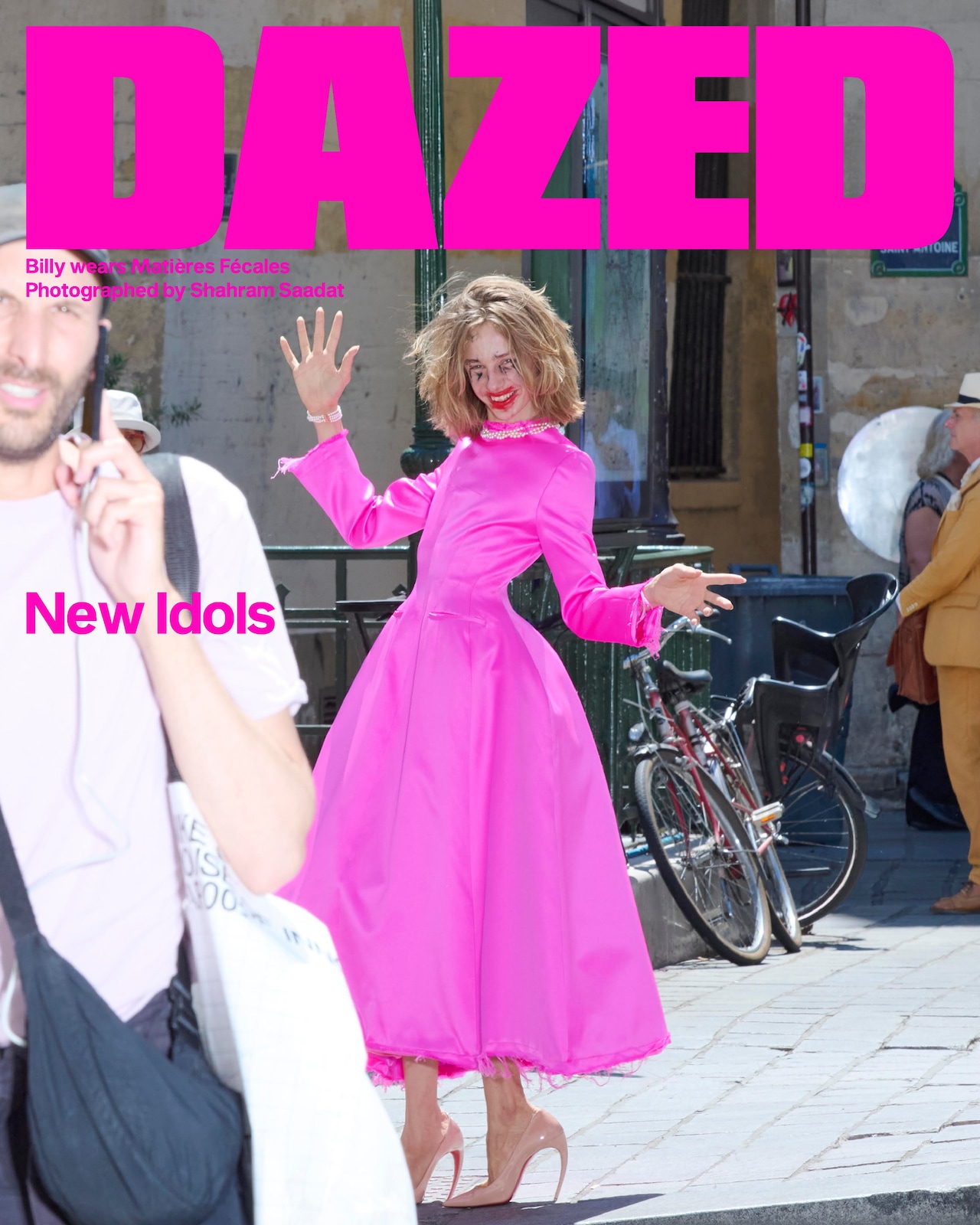
How fashion outsiders Matières Fécales won over the establishment
From runway provocations to off-kilter bridal wear, Matières Fécales’ seductive style is reaching new heights. Here, designers Hannah Rose Dalton and Steven Raj Bhaskaran reflect on their journey from misfit outsiders to fashion-world darlings
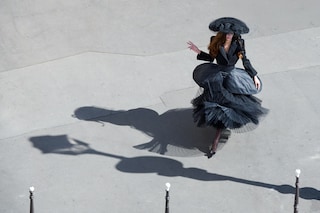
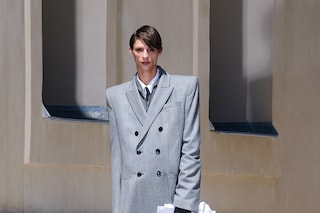
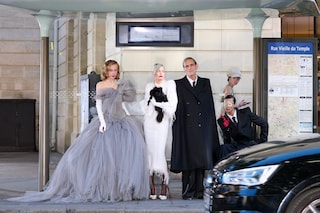

When a pair of bare, mutant feet emerge on a runway – supported by ten-inch spears of flesh bursting from their heels – people tend to sit up and pay attention. That’s what happened at Hannah Rose Dalton and Steven Raj Bhaskaran’s first-ever catwalk show, Non-Human, staged in October 2018 at the Mandrake Hotel in London. Known jointly as Matières Fécales, the designers had until then been posting images of their alienoid, DIY garments to Instagram, augmenting their strangeness with SFX and image-editing. In otherworldly regalia, Dalton was often seen with flesh-toned stilts extending from her heels, her feet digitally distorted to resemble a pair of en-pointe skin shoes. On the catwalk, the pair actualised the illusion they’d been teasing for years. Made from silicone and moulded to Dalton’s feet, the first physical version of the shoes shifted their online fantasy into material reality.
The heels – thigh-high streaks of alien eroticism – acted as an entryway into the world of Matières Fécales. The Canadian duo, who are partners in both fashion and life, had been purveyors of extreme clubwear since 2015, selling mid-priced designs on an uber-popular Depop page – but the moment exposed Dalton and Bhaskaran to an even broader audience.
Years later, when I meet Dalton and Bhaskaran in person, there are no feats of anatomical impossibility. The sense of immediate, physical discomfort that dominated those early shows has melted into something more luxury-minded, even as it retains its transgressive edge. Though Dalton’s look is disarmingly businesslike – a shin-length wool dress in a mid-grey twill – her signature shaved head, full-coverage white make-up and soaring, curved heels are enough to offset any assumptions of normalcy. Bhaskaran is dressed, more casually, in cargo shorts, a camouflage cut-off tee and leather platform boots. Today, he’s forgone his usual dramatic eye make-up for arching black sunglasses. His own shaved head is covered by a baseball cap that reads PAINSLUT.
The time is 11am and we’re in Rose Bakery, a sparsely decorated café on the ground floor of Dover Street Market Paris, where their studio has been based since early 2025. It’s the final day of the A/W26 couture season, and the temperature outside is searingly hot. Dalton excuses herself to procure a peppermint tea, and returns on the phone, her brow pinched in concentration. “Oui… oui…. oui…,” she repeats, hurriedly.
“I’m so sorry,” she says when the call finishes. “When we did our first show, Law Roach sent Steven a message about the wedding dress I wore at the end. He said, ‘Can you save this? There’s something special we have to do with it.’”
The pair have been in and out of fittings with Zendaya since March 2025, when Roach decided to use the look as the final, showstopping gown for The Odyssey press tour. Dalton was on the phone arranging shipping to New York, the last hurdle in an arduous 18-month journey – fitting, given the film’s subject matter. Five days after our conversation in Rose Bakery, Zendaya arrives at the premiere in a pleated white gown sprouting floor-length angel wings – the final look from their A/W25 show. It’s a major fashion moment that further confirms their status as a brand to be reckoned with. Before this, the pair had already collaborated with Demi Moore, Chappell Roan and Lady Gaga. They also designed Gabbriette’s “distorted Cinderella” dress for her wedding to The 1975 frontman Matty Healy in July – their first foray into bridal wear. “Anything custom goes through us,” says Bhaskaran. “We start by asking, ‘Would this person protect us on the street if we were being harassed?’”
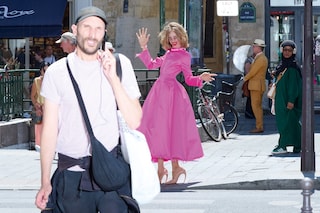
Our meeting also takes place the day after Kylie Jenner’s Dunkin’ ad drops. In the glossy commercial, Jenner introduces a line of “King Kylie” beverages while wearing a satin pink skirt suit from Matières Fécales S/S26. “She bought that,” Dalton responds offhandedly. “I didn’t send that.” I mention that the pairing did seem out of step with their usual custom clients. “No, she purchased it,” Dalton reconfirms. “Also, you can see she’s removed the shoulder pads. She took it and remade it, actually–”
“Anything custom goes through us. We start by asking, ‘Would this person protect us on the street if we were being harassed?’” – Steven Raj Bhaskaran
“Which I love!” Bhaskaran interjects, quickly.
“Yeah, it’s chill,” claims Dalton in return.
“What’s amazing is that we’re a real brand, selling luxury clothes that are beautiful and desirable,” says Bhaskaran, diplomatically. “People can embody it the way they want to embody it.”
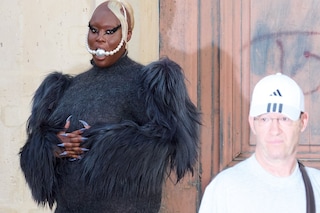
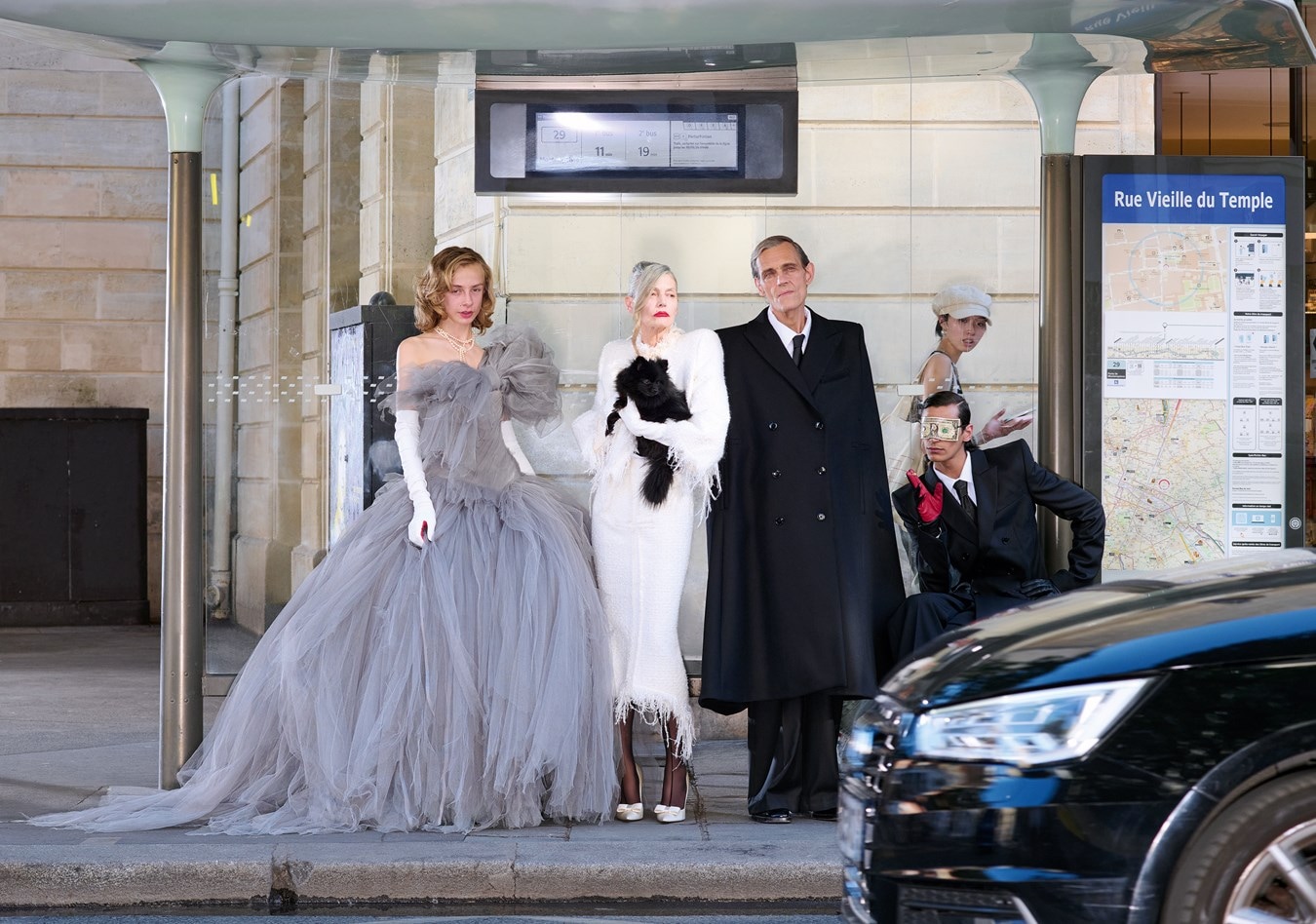
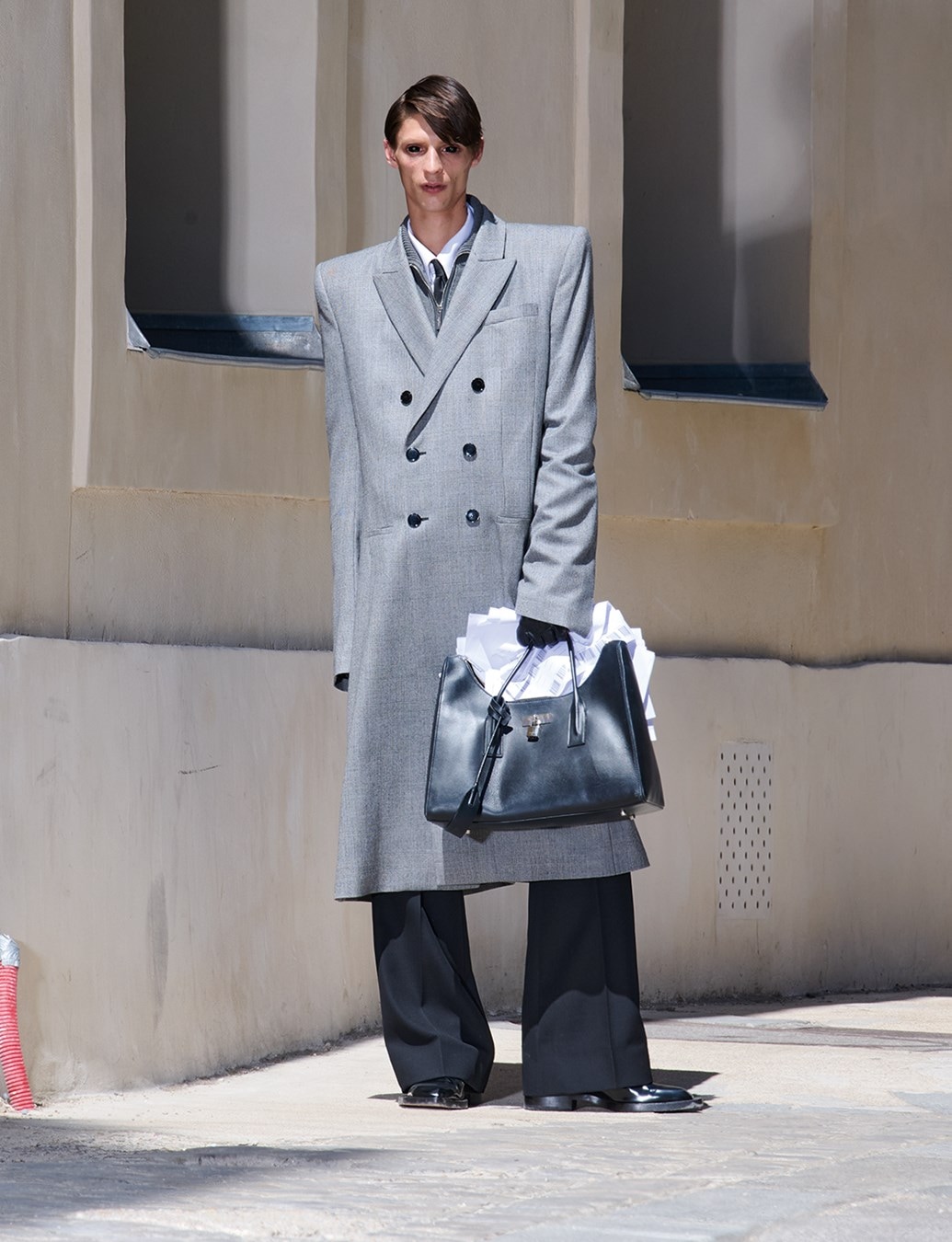
Alongside outfitting global stars, another defining moment was the pair’s A/W26 show, their third on the official Paris Fashion Week schedule. Titled The One Percent, the collection was an incisive send-up of the filthy rich, designed to spark conversation about wealth inequality. Featuring menacing businessmen and women with blood on their hands (which were actually the crimson palms of leather gloves), A/W26 was an exploration of the one per cent’s endless quest for immortality. Dior’s New Look silhouette was “fecalised” with jutting shoulders and frayed hems; cadaverous socialites were blinded by money masks or had their wrists bound with pearls; Alexis Stone transformed into “Catwoman” Jocelyn Wildenstein to parody an obsession with plastic surgery, while “longevity advocate” Bryan Johnson appeared in the final section of the show, his presence symbolising the pernicious hunt for eternal youth. Alongside the satirical overtones, the show demonstrated Dalton and Bhaskaran’s skills as genuine couturiers who know how to advance their vision beyond the “outsider” aesthetic that has come to define them.
Though Matières Fécales are technically an emerging brand, for the last ten years they have been the poster children for subversive beauty and outsider fashion. The One Percent, with its vast, shaggy greatcoats and couture-grade gowns, was a declaration that Dalton and Bhaskaran’s provocative vision – and what they represent as people – had outgrown the confines of online notoriety, ready for a much grander stage. Still, the collection’s commentary on extreme wealth inequality had its detractors – mostly from those who took exception to the idea that fashion designers, who operate within a largely elitist industry, should have the temerity to make such a critique. Dalton manoeuvres the potential hypocrisies by drawing a parallel to the art world. “It relates back to, ‘Do you see fashion as art?’ In art you can make a statement like that, but in fashion it’s like, ‘Oh, you can’t do that,’” she says, reminding us that “a painting is worth more than a dress. Art is a business, too.”
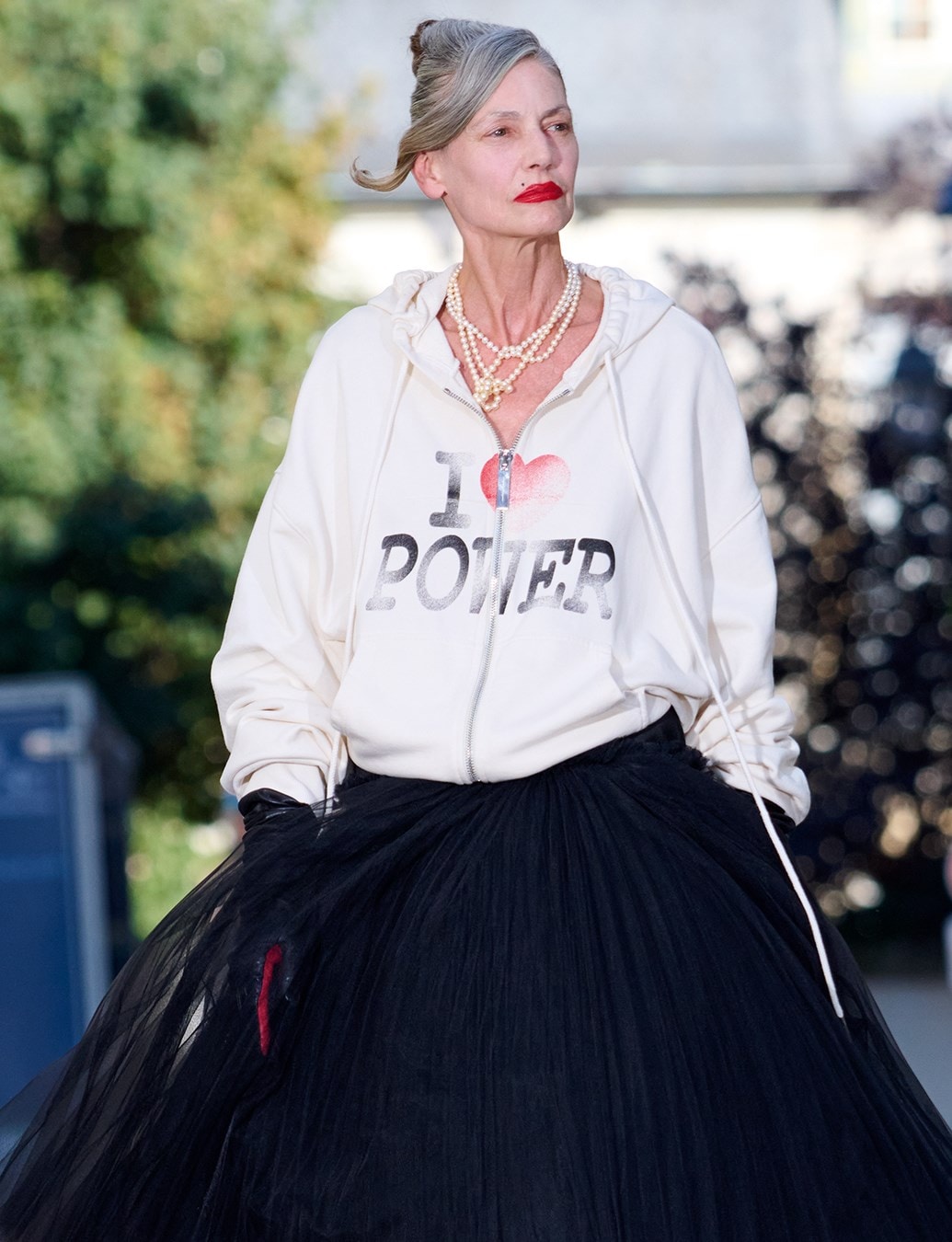
Actor Sarah Paulson drew a similar parallel. When the 2026 Met Gala proposed that “Fashion Is Art”, Paulson responded with a shredded ball gown and dollar bill mask from The One Percent collection. Her thinly veiled commentary on the Gala’s billionaire backers didn’t go unnoticed, but many saw an irony in the stunt – she was attending the same event they were, after all. “I understood that, I guess,” concedes Dalton, in response to the criticism. “To clarify, she didn’t buy the dress; we loaned that – there were a lot of articles like, ‘She spent $100k on her seat! She spent another $100k on her dress!’,” which, ultimately, was not true. “The only way to deconstruct and reconstruct dynamics is from within,” says Bhaskaran. So was the dress taking direct aim at Jeff Bezos and Amazon’s involvement in the Gala? “Of course!” they say in unison. “But it goes beyond the Met Gala,” says Bhaskaran. “It’s how we see life.”
The seed that Matières Fécales sprang from was planted 12 years ago, when Dalton and Bhaskaran met at LaSalle College in Montreal. Bhaskaran, a lower-income student in combat boots and a Beth Ditto T-shirt, encountered Dalton for the first time in a fashion illustration class. “I came in late and saw Hannah sandwiched between two other girls. You were wearing a pussy-bow blouse” – he says, turning towards her – “and you had a below-the-knee pleated skirt. And Tory Burch flats.” Bhaskaran’s curiosity was piqued; Dalton, with her long, mousy hair, seemed prissy in comparison to himself. “There was a little bit of bitterness,” he recounts. “Seeing someone like Hannah physically represent a symbol of privilege, of acceptance and normality – it was a confrontational feeling.”
When discussing her upbringing, Dalton is upfront about the advantages she enjoyed. Born in New Zealand in 1995, Dalton and her family moved to Montreal when she was just six months old, following her father’s work. “Because my dad was a diplomat, I had a wide set of privileges – going to private school and being in a circle of elite people in Westmount.” Though she was obsessed with fashion as a child, when she was 17 this love was put to the test by the collapse of the Rana Plaza factory in Bangladesh. “That burst my bubble, to know that there was suffering happening through something I would purchase at Abercrombie…” she says, trailing off. “From that moment I decided not to buy fast fashion any more.” (The name Matières Fécales was later born from this same feeling – Dalton and Bhaskaran both agreed that the fashion industry was “shit”.)
“I never wanted to be seen or noticed. I just wanted to blend in and get through it” – Hannah Rose Dalton
Dalton continued to pursue garment-making, but with sustainability as a driving force. She began experimenting with her clothes, making pieces out of newspaper and other found materials. “I was very prim and proper,” she says of her childhood style, which Bhaskaran compares to Blair Waldorf from Gossip Girl. “I was literally making my school uniform, but out of recycled materials.” Though she had begun to create for herself, fashion had yet to assume the identity-making function it would later in life. “I never wanted to be seen or noticed. I just wanted to blend in and get through it.”
Bhaskaran’s path to fashion school was markedly different. Born in Montreal in 1993, to a Guyanese mother and Sri Lankan father, his family relocated to Guyana after the death of his maternal grandmother, when he was just six months old. But their family life was further upended following the revelation that his father had had a child with another woman. For three years, Bhaskaran’s father, who was often violent, forced them all to live together. “My dad was abusing [my mother] and forcing her to live with this woman that he cheated on her with,” he recalls. “They were all sleeping in the same bed. It was the craziest environment.” Bhaskaran’s mother eventually escaped the grasp of her husband, fleeing to New York to seek refuge with her sister. “I still remember my mom abandoning us when I was three.”
Four years later, by which time Bhaskaran was seven and his sister ten, their mother returned to Guyana and took them back to Montreal. Bhaskaran’s father made his fortune through nefarious means, which allowed his children to attend private schools, but left them in extreme poverty when they returned to Montreal. “I was very cocky, very arrogant,” remembers Bhaskaran, moving on to his fashion school days, during which he attended underground raves with his boyfriend and dabbled in illegal substances. “I always came in late. I had issues [with the teacher] because I sort of drew better than he did, so I would redraw things that he would do.” To improve his standing in class, Bhaskaran befriended teacher’s pet Dalton – here’s a person who would let me copy their notes!, he thought. The friendship they struck up soon developed into something more than a platonic bond.
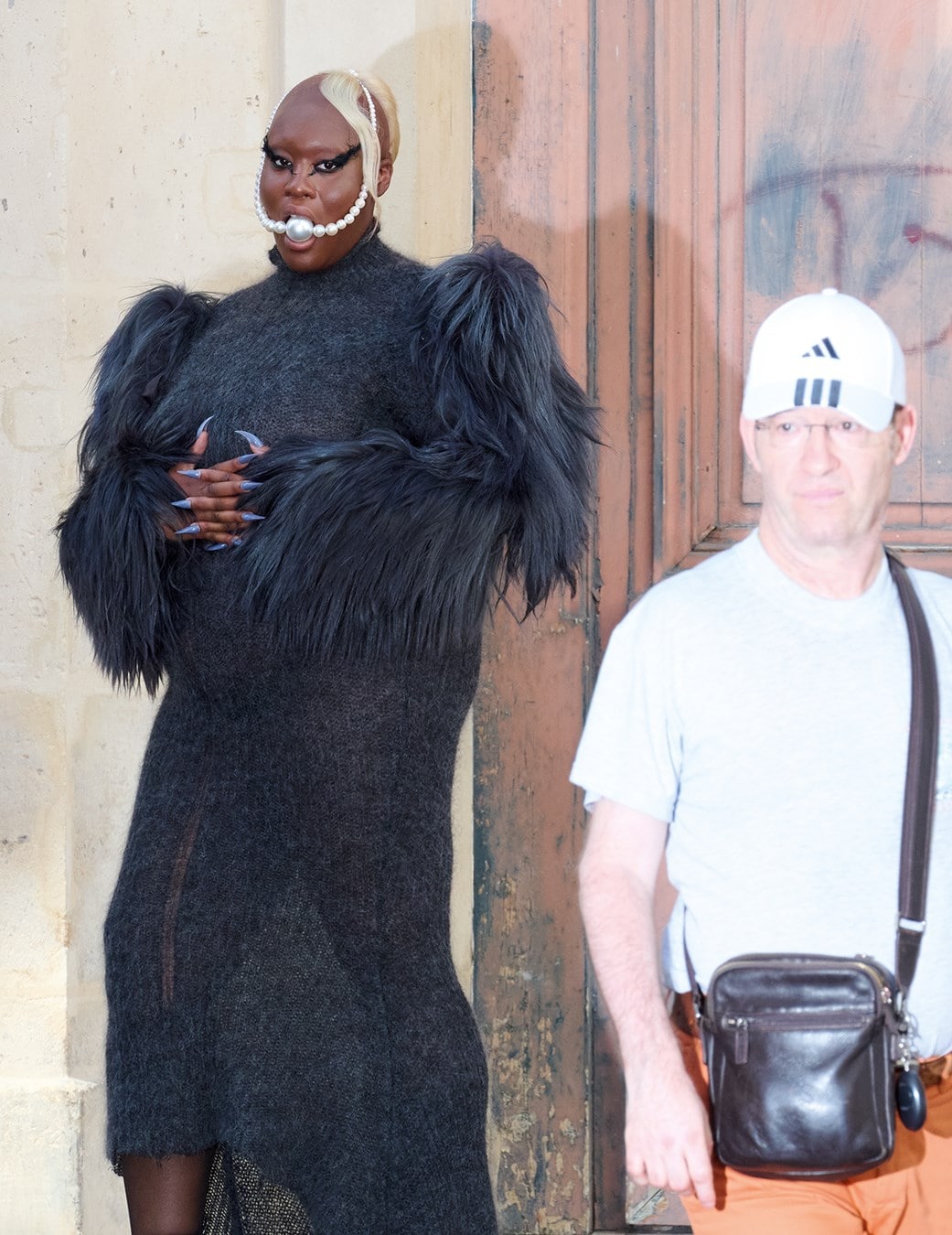
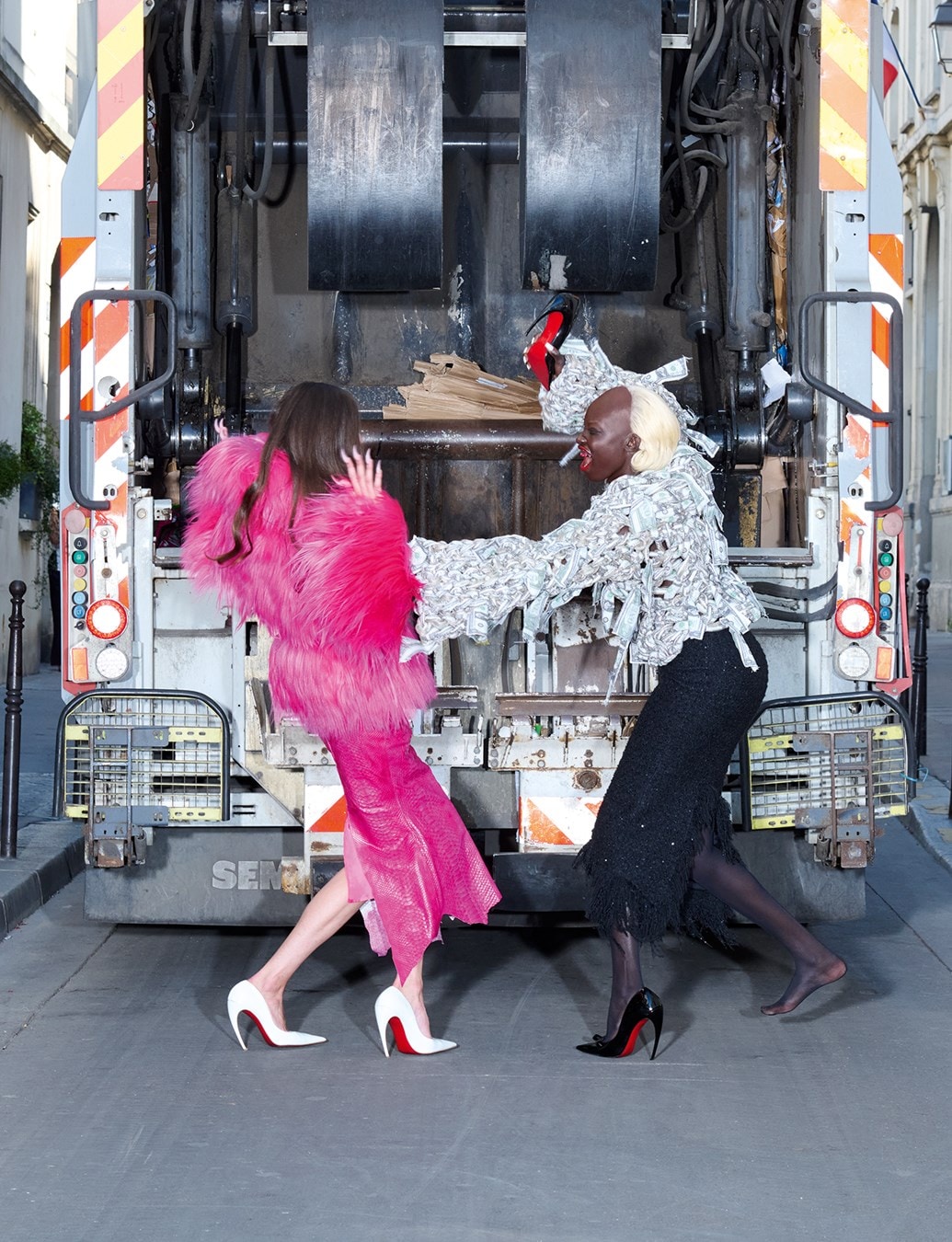
The word that Dalton and Bhaskaran use the most, by a wide margin, to describe the start of their romantic relationship is “confusing”. “I never had a boyfriend or girlfriend, so I’d never experienced falling in love with somebody, which was confusing,” remembers Dalton. “When our friendship blossomed into our relationship, it was very confusing for both of us,” recalls Bhaskaran. “It was confusing for you, who had spent so much of your life trying to be gay, and convincing your mom that it’s OK to be gay,” continues Dalton, who adds that their relationship is “beyond sexuality – it’s love.”
It’s a kind of partnership that might remind you of Rick Owens and Michèle Lamy, who have played a pivotal role in the Matières Fécales story. In 2018, Owens cold-emailed the pair after reading an interview with them in The New York Times. Dinner in Paris soon followed, and Owens vowed to look after them, taking on a mentor’s role. Dalton and Bhaskaran quickly became part of Owens’ world, modelling in his shows and becoming “unofficial ambassadors” for the brand. “It became an amazing moment for them also,” says Dalton, “because we’re from a different generation, but still committed to the same philosophies of beauty and human transformation.”
But in 2022, Dalton and Bhaskaran were forced to put their brand on hold after moving to Paris and experiencing the competitive nature of the industry. A chance encounter with Adrian Joffe, the Dover Street Market and Comme des Garçons president, backstage at a Madonna concert, would change that. The duo later pitched to him an upscale Matières Fécales, harnessing the raw energy of their Depop days but focused on the luxury market. “Then he ghosted us for four months,” Dalton says with a laugh. “Four months of standby.” When Joffe finally did respond, the pair were DJing at Lamy’s 80th birthday in Venice. His text read: “let’s do this”.
“We’re, like, popular today” – Steven Raj Bhaskaran
Outside of these relationships, their own network had also been taking shape. “It was so exhilarating, being a part of their world,” says Chadd Curry, a performance artist who walked in that first show at the Mandrake Hotel. While at high school in Montreal, Bhaskaran discovered Curry on the street style blog Lookbook.nu, when Curry was a Rick Owens sales clerk in chalky white make-up and Edwardian attire. The mutual admiration blossomed into a years-long online friendship between the trio, but it wasn’t until the S/S19 runway that they met in the flesh. Curry wore a minidress fashioned from aluminium office blinds, fitted directly to his body before the show. He was one figure in a wider creative circle that’s now central to Matières Fécales’ shows, alongside DJ Lewis G Burton, performance artist Gena Marvin, drag queen Dragoness Lola von Flame and cult model Debra Shaw.
This creative vision, bolstered by the stewardship of Owens, Lamy and Joffe, has burst open the doors of possibility. Today, Dalton and Bhaskaran are beacons of attention for fashion’s top set. Lady Amanda Harlech, the stylist, consultant and former Lagerfeld muse, approaches our table to introduce herself. She’s prepping for a “Narnia shoot” and just needs to let them know she’s pulled one of their pieces. Konstantinos Katalakinos, the husband of Jean Paul Gaultier, later arrives to bemoan their absence from the label’s couture show a day earlier (“I’ve been so busy, but looking from afar and sending good vibes,” Dalton offers as consolation). Joffe also bounces into frame, inviting us all upstairs to his office once the interview has concluded. “We’re, like, popular today,” laughs Bhaskaran.
As they sit across from me, one might assume that the pair’s bright and warm demeanours are antithetical to their visual aesthetic. But, really, the essence of Matières Fécales wills you to understand the very opposite, to unlearn the prejudice that difference – sometimes even extreme difference – is something to be shunned. Handling scrutiny of their image has become second nature to Dalton and Bhaskaran, ever since the pair shaved their heads in university, an act of defiance against what they saw as a toxically normative world. What constitutes “normal” is a question that is repeated multiple times in our conversation. “Before we met each other, we were very normal, and we felt suffocated in that,” says Bhaskaran, who describes a hypothetical stylist who might take one of their dresses, “strip it back and put it on somebody who looks super normal.” But what does that look like to them? “Normal is someone who is naturally beautiful, but relies on that,” says Bhaskaran. “In fashion that’s sort of the norm. We like to push that even further – but our standards of normality are quite far out.”
Hair Gabriel de Fries using MODOM Grooming, make-up Catalina Sartor at OPUS Beauty, nails Anastasiia Herasymeniuk, models Adem Aston at Garçons by Gervais, Konrad Bauer and Didier Vinson at Elite, Balat Pal at Metropolitan Models, Akila Mameri at SEE Models, Sigrid de l’Epine at Marilyn Agency, Witney Laplace at Dream Model Management, Billy, photographic assistants Shane Burk, Adrien Granon, styling assistant Charlyne Perez, hair assistants Yili Dong, Pol Guarné Ayuso, make-up assistants Alexandra Gavrilescu, Sandra Lefort, production Sonia Haouat and Roman Birenzweigue at Premier Cri, production assistant Merwan Foiret, post-production Granon Digital, casting Tanguy Gavignet and Tom Goddard
Trending

Yayoi Kusama: Connecting the dots on her love affair with fashion
Rei Kawakubo on AI, the colour black and her advice for young designers
adidas
adidas is 3D-printing the future of footwear

GTAVI: An exclusive deep dive into the video game of the decade
5 iconic life lessons from Dolly Parton
A coming-of-age story told across 1,000 photographs
Where are all the Black coming-of-age shows?
In pictures: Dolly Parton’s beauty evolution
When a pair of bare, mutant feet emerge on a runway – supported by ten-inch spears of flesh bursting from their heels – people tend to sit up and pay attention. That’s what happened at Hannah Rose Dalton and Steven Raj Bhaskaran’s first-ever catwalk show, Non-Human, staged in October 2018 at the Mandrake Hotel in London. Known jointly as Matières Fécales, the designers had until then been posting images of their alienoid, DIY garments to Instagram, augmenting their strangeness with SFX and image-editing. In otherworldly regalia, Dalton was often seen with flesh-toned stilts extending from her heels, her feet digitally distorted to resemble a pair of en-pointe skin shoes. On the catwalk, the pair actualised the illusion they’d been teasing for years. Made from silicone and moulded to Dalton’s feet, the first physical version of the shoes shifted their online fantasy into material reality.
The heels – thigh-high streaks of alien eroticism – acted as an entryway into the world of Matières Fécales. The Canadian duo, who are partners in both fashion and life, had been purveyors of extreme clubwear since 2015, selling mid-priced designs on an uber-popular Depop page – but the moment exposed Dalton and Bhaskaran to an even broader audience.
Years later, when I meet Dalton and Bhaskaran in person, there are no feats of anatomical impossibility. The sense of immediate, physical discomfort that dominated those early shows has melted into something more luxury-minded, even as it retains its transgressive edge. Though Dalton’s look is disarmingly businesslike – a shin-length wool dress in a mid-grey twill – her signature shaved head, full-coverage white make-up and soaring, curved heels are enough to offset any assumptions of normalcy. Bhaskaran is dressed, more casually, in cargo shorts, a camouflage cut-off tee and leather platform boots. Today, he’s forgone his usual dramatic eye make-up for arching black sunglasses. His own shaved head is covered by a baseball cap that reads PAINSLUT.
The time is 11am and we’re in Rose Bakery, a sparsely decorated café on the ground floor of Dover Street Market Paris, where their studio has been based since early 2025. It’s the final day of the A/W26 couture season, and the temperature outside is searingly hot. Dalton excuses herself to procure a peppermint tea, and returns on the phone, her brow pinched in concentration. “Oui… oui…. oui…,” she repeats, hurriedly.
“I’m so sorry,” she says when the call finishes. “When we did our first show, Law Roach sent Steven a message about the wedding dress I wore at the end. He said, ‘Can you save this? There’s something special we have to do with it.’”
The pair have been in and out of fittings with Zendaya since March 2025, when Roach decided to use the look as the final, showstopping gown for The Odyssey press tour. Dalton was on the phone arranging shipping to New York, the last hurdle in an arduous 18-month journey – fitting, given the film’s subject matter. Five days after our conversation in Rose Bakery, Zendaya arrives at the premiere in a pleated white gown sprouting floor-length angel wings – the final look from their A/W25 show. It’s a major fashion moment that further confirms their status as a brand to be reckoned with. Before this, the pair had already collaborated with Demi Moore, Chappell Roan and Lady Gaga. They also designed Gabbriette’s “distorted Cinderella” dress for her wedding to The 1975 frontman Matty Healy in July – their first foray into bridal wear. “Anything custom goes through us,” says Bhaskaran. “We start by asking, ‘Would this person protect us on the street if we were being harassed?’”
Our meeting also takes place the day after Kylie Jenner’s Dunkin’ ad drops. In the glossy commercial, Jenner introduces a line of “King Kylie” beverages while wearing a satin pink skirt suit from Matières Fécales S/S26. “She bought that,” Dalton responds offhandedly. “I didn’t send that.” I mention that the pairing did seem out of step with their usual custom clients. “No, she purchased it,” Dalton reconfirms. “Also, you can see she’s removed the shoulder pads. She took it and remade it, actually–”
“Anything custom goes through us. We start by asking, ‘Would this person protect us on the street if we were being harassed?’” – Steven Raj Bhaskaran
“Which I love!” Bhaskaran interjects, quickly.
“Yeah, it’s chill,” claims Dalton in return.
“What’s amazing is that we’re a real brand, selling luxury clothes that are beautiful and desirable,” says Bhaskaran, diplomatically. “People can embody it the way they want to embody it.”
Alongside outfitting global stars, another defining moment was the pair’s A/W26 show, their third on the official Paris Fashion Week schedule. Titled The One Percent, the collection was an incisive send-up of the filthy rich, designed to spark conversation about wealth inequality. Featuring menacing businessmen and women with blood on their hands (which were actually the crimson palms of leather gloves), A/W26 was an exploration of the one per cent’s endless quest for immortality. Dior’s New Look silhouette was “fecalised” with jutting shoulders and frayed hems; cadaverous socialites were blinded by money masks or had their wrists bound with pearls; Alexis Stone transformed into “Catwoman” Jocelyn Wildenstein to parody an obsession with plastic surgery, while “longevity advocate” Bryan Johnson appeared in the final section of the show, his presence symbolising the pernicious hunt for eternal youth. Alongside the satirical overtones, the show demonstrated Dalton and Bhaskaran’s skills as genuine couturiers who know how to advance their vision beyond the “outsider” aesthetic that has come to define them.
Though Matières Fécales are technically an emerging brand, for the last ten years they have been the poster children for subversive beauty and outsider fashion. The One Percent, with its vast, shaggy greatcoats and couture-grade gowns, was a declaration that Dalton and Bhaskaran’s provocative vision – and what they represent as people – had outgrown the confines of online notoriety, ready for a much grander stage. Still, the collection’s commentary on extreme wealth inequality had its detractors – mostly from those who took exception to the idea that fashion designers, who operate within a largely elitist industry, should have the temerity to make such a critique. Dalton manoeuvres the potential hypocrisies by drawing a parallel to the art world. “It relates back to, ‘Do you see fashion as art?’ In art you can make a statement like that, but in fashion it’s like, ‘Oh, you can’t do that,’” she says, reminding us that “a painting is worth more than a dress. Art is a business, too.”
Actor Sarah Paulson drew a similar parallel. When the 2026 Met Gala proposed that “Fashion Is Art”, Paulson responded with a shredded ball gown and dollar bill mask from The One Percent collection. Her thinly veiled commentary on the Gala’s billionaire backers didn’t go unnoticed, but many saw an irony in the stunt – she was attending the same event they were, after all. “I understood that, I guess,” concedes Dalton, in response to the criticism. “To clarify, she didn’t buy the dress; we loaned that – there were a lot of articles like, ‘She spent $100k on her seat! She spent another $100k on her dress!’,” which, ultimately, was not true. “The only way to deconstruct and reconstruct dynamics is from within,” says Bhaskaran. So was the dress taking direct aim at Jeff Bezos and Amazon’s involvement in the Gala? “Of course!” they say in unison. “But it goes beyond the Met Gala,” says Bhaskaran. “It’s how we see life.”
The seed that Matières Fécales sprang from was planted 12 years ago, when Dalton and Bhaskaran met at LaSalle College in Montreal. Bhaskaran, a lower-income student in combat boots and a Beth Ditto T-shirt, encountered Dalton for the first time in a fashion illustration class. “I came in late and saw Hannah sandwiched between two other girls. You were wearing a pussy-bow blouse” – he says, turning towards her – “and you had a below-the-knee pleated skirt. And Tory Burch flats.” Bhaskaran’s curiosity was piqued; Dalton, with her long, mousy hair, seemed prissy in comparison to himself. “There was a little bit of bitterness,” he recounts. “Seeing someone like Hannah physically represent a symbol of privilege, of acceptance and normality – it was a confrontational feeling.”
When discussing her upbringing, Dalton is upfront about the advantages she enjoyed. Born in New Zealand in 1995, Dalton and her family moved to Montreal when she was just six months old, following her father’s work. “Because my dad was a diplomat, I had a wide set of privileges – going to private school and being in a circle of elite people in Westmount.” Though she was obsessed with fashion as a child, when she was 17 this love was put to the test by the collapse of the Rana Plaza factory in Bangladesh. “That burst my bubble, to know that there was suffering happening through something I would purchase at Abercrombie…” she says, trailing off. “From that moment I decided not to buy fast fashion any more.” (The name Matières Fécales was later born from this same feeling – Dalton and Bhaskaran both agreed that the fashion industry was “shit”.)
“I never wanted to be seen or noticed. I just wanted to blend in and get through it” – Hannah Rose Dalton
Dalton continued to pursue garment-making, but with sustainability as a driving force. She began experimenting with her clothes, making pieces out of newspaper and other found materials. “I was very prim and proper,” she says of her childhood style, which Bhaskaran compares to Blair Waldorf from Gossip Girl. “I was literally making my school uniform, but out of recycled materials.” Though she had begun to create for herself, fashion had yet to assume the identity-making function it would later in life. “I never wanted to be seen or noticed. I just wanted to blend in and get through it.”
Bhaskaran’s path to fashion school was markedly different. Born in Montreal in 1993, to a Guyanese mother and Sri Lankan father, his family relocated to Guyana after the death of his maternal grandmother, when he was just six months old. But their family life was further upended following the revelation that his father had had a child with another woman. For three years, Bhaskaran’s father, who was often violent, forced them all to live together. “My dad was abusing [my mother] and forcing her to live with this woman that he cheated on her with,” he recalls. “They were all sleeping in the same bed. It was the craziest environment.” Bhaskaran’s mother eventually escaped the grasp of her husband, fleeing to New York to seek refuge with her sister. “I still remember my mom abandoning us when I was three.”
Four years later, by which time Bhaskaran was seven and his sister ten, their mother returned to Guyana and took them back to Montreal. Bhaskaran’s father made his fortune through nefarious means, which allowed his children to attend private schools, but left them in extreme poverty when they returned to Montreal. “I was very cocky, very arrogant,” remembers Bhaskaran, moving on to his fashion school days, during which he attended underground raves with his boyfriend and dabbled in illegal substances. “I always came in late. I had issues [with the teacher] because I sort of drew better than he did, so I would redraw things that he would do.” To improve his standing in class, Bhaskaran befriended teacher’s pet Dalton – here’s a person who would let me copy their notes!, he thought. The friendship they struck up soon developed into something more than a platonic bond.
The word that Dalton and Bhaskaran use the most, by a wide margin, to describe the start of their romantic relationship is “confusing”. “I never had a boyfriend or girlfriend, so I’d never experienced falling in love with somebody, which was confusing,” remembers Dalton. “When our friendship blossomed into our relationship, it was very confusing for both of us,” recalls Bhaskaran. “It was confusing for you, who had spent so much of your life trying to be gay, and convincing your mom that it’s OK to be gay,” continues Dalton, who adds that their relationship is “beyond sexuality – it’s love.”
It’s a kind of partnership that might remind you of Rick Owens and Michèle Lamy, who have played a pivotal role in the Matières Fécales story. In 2018, Owens cold-emailed the pair after reading an interview with them in The New York Times. Dinner in Paris soon followed, and Owens vowed to look after them, taking on a mentor’s role. Dalton and Bhaskaran quickly became part of Owens’ world, modelling in his shows and becoming “unofficial ambassadors” for the brand. “It became an amazing moment for them also,” says Dalton, “because we’re from a different generation, but still committed to the same philosophies of beauty and human transformation.”
But in 2022, Dalton and Bhaskaran were forced to put their brand on hold after moving to Paris and experiencing the competitive nature of the industry. A chance encounter with Adrian Joffe, the Dover Street Market and Comme des Garçons president, backstage at a Madonna concert, would change that. The duo later pitched to him an upscale Matières Fécales, harnessing the raw energy of their Depop days but focused on the luxury market. “Then he ghosted us for four months,” Dalton says with a laugh. “Four months of standby.” When Joffe finally did respond, the pair were DJing at Lamy’s 80th birthday in Venice. His text read: “let’s do this”.
“We’re, like, popular today” – Steven Raj Bhaskaran
Outside of these relationships, their own network had also been taking shape. “It was so exhilarating, being a part of their world,” says Chadd Curry, a performance artist who walked in that first show at the Mandrake Hotel. While at high school in Montreal, Bhaskaran discovered Curry on the street style blog Lookbook.nu, when Curry was a Rick Owens sales clerk in chalky white make-up and Edwardian attire. The mutual admiration blossomed into a years-long online friendship between the trio, but it wasn’t until the S/S19 runway that they met in the flesh. Curry wore a minidress fashioned from aluminium office blinds, fitted directly to his body before the show. He was one figure in a wider creative circle that’s now central to Matières Fécales’ shows, alongside DJ Lewis G Burton, performance artist Gena Marvin, drag queen Dragoness Lola von Flame and cult model Debra Shaw.
This creative vision, bolstered by the stewardship of Owens, Lamy and Joffe, has burst open the doors of possibility. Today, Dalton and Bhaskaran are beacons of attention for fashion’s top set. Lady Amanda Harlech, the stylist, consultant and former Lagerfeld muse, approaches our table to introduce herself. She’s prepping for a “Narnia shoot” and just needs to let them know she’s pulled one of their pieces. Konstantinos Katalakinos, the husband of Jean Paul Gaultier, later arrives to bemoan their absence from the label’s couture show a day earlier (“I’ve been so busy, but looking from afar and sending good vibes,” Dalton offers as consolation). Joffe also bounces into frame, inviting us all upstairs to his office once the interview has concluded. “We’re, like, popular today,” laughs Bhaskaran.
As they sit across from me, one might assume that the pair’s bright and warm demeanours are antithetical to their visual aesthetic. But, really, the essence of Matières Fécales wills you to understand the very opposite, to unlearn the prejudice that difference – sometimes even extreme difference – is something to be shunned. Handling scrutiny of their image has become second nature to Dalton and Bhaskaran, ever since the pair shaved their heads in university, an act of defiance against what they saw as a toxically normative world. What constitutes “normal” is a question that is repeated multiple times in our conversation. “Before we met each other, we were very normal, and we felt suffocated in that,” says Bhaskaran, who describes a hypothetical stylist who might take one of their dresses, “strip it back and put it on somebody who looks super normal.” But what does that look like to them? “Normal is someone who is naturally beautiful, but relies on that,” says Bhaskaran. “In fashion that’s sort of the norm. We like to push that even further – but our standards of normality are quite far out.”
Hair Gabriel de Fries using MODOM Grooming, make-up Catalina Sartor at OPUS Beauty, nails Anastasiia Herasymeniuk, models Adem Aston at Garçons by Gervais, Konrad Bauer and Didier Vinson at Elite, Balat Pal at Metropolitan Models, Akila Mameri at SEE Models, Sigrid de l’Epine at Marilyn Agency, Witney Laplace at Dream Model Management, Billy, photographic assistants Shane Burk, Adrien Granon, styling assistant Charlyne Perez, hair assistants Yili Dong, Pol Guarné Ayuso, make-up assistants Alexandra Gavrilescu, Sandra Lefort, production Sonia Haouat and Roman Birenzweigue at Premier Cri, production assistant Merwan Foiret, post-production Granon Digital, casting Tanguy Gavignet and Tom Goddard
[analyse_source url=”https://www.dazeddigital.com/fashion/article/70867/1/matieres-fecales-dazed-cover-autumn-2026-hannah-rose-dalton-steven-raj-bhaskaran”]