[analyse_image type=”featured” src=”https://images.euronews.com/articles/stories/09/88/91/09/1200x675_cmsv2_f6a22ab6-e441-5268-be33-809332ec40cb-9889109.jpg”]

If Iceland joins the EU, where does that leave Norway?

Ireland keeps nuclear door open as data centre energy demand surges

Prince Harry, Meghan, and their children arrive back in the UK

Meta agrees to pay $17bn in landmark US child-safety settlement deal
If Iceland joins the EU, where does that leave Norway?
Ireland keeps nuclear door open as data centre energy demand surges
Prince Harry, Meghan, and their children arrive back in the UK
Meta agrees to pay $17bn in landmark US child-safety settlement deal
Nvidia earnings preview: The report the entire market is waiting on
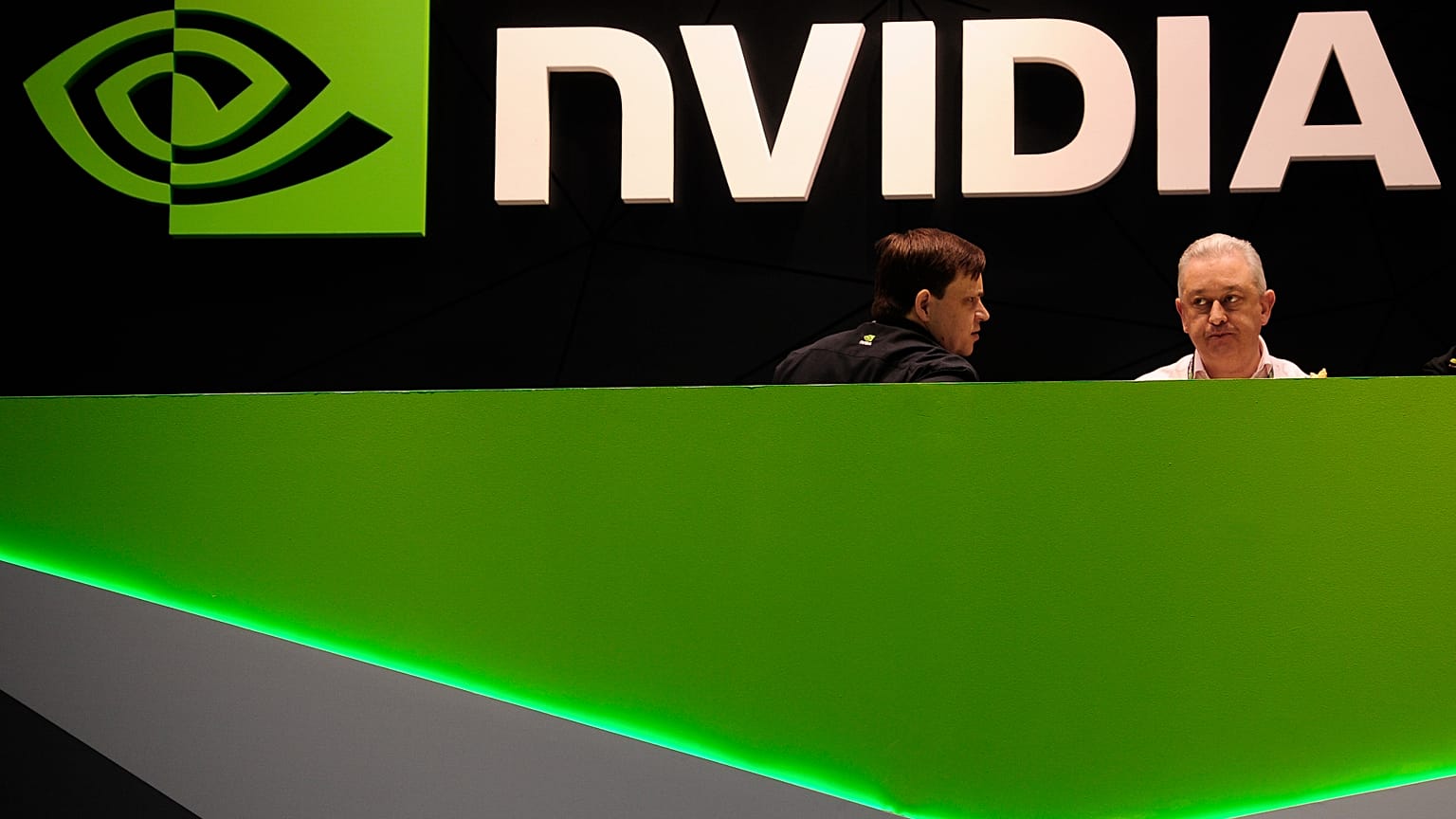
FILE. People gather in the Nvidia booth at the Mobile World Congress mobile phone trade show in Barcelona, Spain, Feb. 2014
– Copyright AP Photo/Manu Fernandez

 Facebook
 Twitter
 Flipboard
 Send
Send Reddit
 Linkedin
 Messenger
 Telegram
 VK
VK Bluesky
 Threads
 Whatsapp
Nvidia will report its second-quarter results after the US market closes on Wednesday, with analysts expecting revenue of roughly $92 billion (€78.8bn) and investors treating the chipmaker’s guidance as a verdict on whether the AI rally still has room to run.
The most consequential corporate event of the quarter lands tonight.
 ADVERTISEMENTADVERTISEMENT
Nvidia will drop its earnings after the US close at around 22:00 CET, and while the past quarter is expected to be enormous, what will move markets is what CEO Jensen Huang says about the months ahead.
Nvidia’s matters more than most because it makes the chips that power the artificial intelligence boom. If its outlook disappoints, the shockwaves will not stay in Silicon Valley.
The company has become a proxy for the entire AI rally.
The report will land on the back of a difficult run for Nvidia’s stock, having lost ground for seven consecutive sessions, its longest losing streak since 2022. Shares rebounded roughly 3% since Monday ahead of the earnings report but are still down over 6% from last week’s open.
European chipmakers have as much riding on tonight’s guidance as Wall Street.
ASML, the Dutch group whose lithography machines underpin Nvidia’s entire supply chain, has raised its own 2026 sales forecast twice this year on the back of AI demand, and its shares — along with those of Dutch chip-equipment maker BE Semiconductor and German optics group Jenoptik — tend to move in step with Nvidia’s outlook.
For the month of August, Nvidia is still up around 8% and year-to-date performance is solid with the stock increasing over 13% since the yearly open.
Analysts polled by Bloomberg expect adjusted earnings of $2.09 a share on revenue of roughly $92 billion (€78.8bn), which would represent growth of 96% on the same quarter last year.
Nvidia itself had forecast $91 billion (€78bn), give or take 2%, meaning consensus sits less than a percentage point above the company’s own midpoint. That narrow gap raises the bar as a modest beat may not be enough to satisfy investors.
As for data centre revenue, it is forecast to top $85.4 billion (€73.1bn), up around 105%.
Investors will get a clearer look at where that money comes from, because Nvidia changed its reporting last quarter to separate sales to hyperscalers and AI clouds, expected at $43.5 billion (€37.2bn), from industrial and enterprise customers, projected at $41.7 billion (€35.7bn).
The company has beaten Wall Street estimates in 22 of the past 24 quarters.
The question hanging over Nvidia’s quarter
The main concern regarding Nvidia is concentration.
The firm still draws the bulk of its revenue from Amazon, Google and Microsoft, each of which is designing its own chips to reduce reliance on the company, and the new disclosure will show precisely how large that dependence remains.
Huang’s commentary on demand into 2027 therefore carries more weight than any single figure.
The question has grown sharper since July, when markets fell on doubts about whether vast AI investments will generate returns.
Nvidia’s answer has been to help finance the buildout itself, assembling a $500 billion (€433bn) capital pool with Wall Street firms this month and backing an eight-gigawatt data centre in Ohio alongside OpenAI.
A week stacked with market catalysts
Nvidia is not the only major test for the markets this week.
July’s personal consumption expenditures index, the Federal Reserve’s preferred inflation gauge, is due at 14:30 CET on Wednesday alongside a second estimate of second-quarter GDP.
Economists expect headline prices to have risen 0.1% on the month and the core measure 0.2%, leaving the annual core rate at 3.3%.
Attention then shifts to Wyoming, where the Kansas City Fed’s Jackson Hole symposium opens on Thursday.
Kevin Warsh delivers the keynote on Friday, his first as Fed chair, 19 days before a September policy meeting that markets currently price as roughly a one-in-three chance of a rate rise.
The ECB’s Isabel Schnabel joins a panel the same day.
Go to accessibility shortcuts
Read more

Second arrest over deadly sword attack at Swedish school

Europe’s gas prices are surging. Who will be the first to pay more?

What the new US sanctions on Iran mean for European businesses
Second arrest over deadly sword attack at Swedish school
Europe’s gas prices are surging. Who will be the first to pay more?
What the new US sanctions on Iran mean for European businesses

Warsh faces yields, a Treasury rescue and inflation at Jackson Hole

Netherlands may not have enough gas for a harsh winter, Gasunie warns

Anthropic IPO: Five things to know before its Wall Street debut

Europe’s gas prices are surging. Who will be the first to pay more?

After Uber, Waymo to launch the EU’s first robotaxis in Munich
Europe’s gas prices are surging. Who will be the first to pay more?
Luxottica founder’s son resigns, says company has lost its soul
Nvidia earnings preview: The report the entire market is waiting on
Spanish workers spend the equivalent of 231 days paying taxes, study says
UK firm running Portugal’s largest solar plant files for insolvency
[analyse_source url=”https://www.euronews.com/business/2026/08/26/nvidia-earnings-preview-the-report-the-entire-market-is-waiting-on”]