[analyse_image type=”featured” src=”https://images.euronews.com/articles/stories/09/88/62/28/1200x675_cmsv2_a1d6db3b-e0d8-501d-b570-1164c81f9596-9886228.jpg”]

Remains of 16th-century hospital that treated sailors found in Peru

‘Unique and irreplaceable’: Dolly Parton tributes from public figures and celebrities

More than 1,000 volunteers pull historic castle back to its original site in Japan

Back-to-school: How to reset children’s sleep schedules
Remains of 16th-century hospital that treated sailors found in Peru
‘Unique and irreplaceable’: Dolly Parton tributes from public figures and celebrities
More than 1,000 volunteers pull historic castle back to its original site in Japan
Back-to-school: How to reset children’s sleep schedules
Higher education: Renting a room in Lisbon costs over €500 as demand outstrips supply

Higher education: renting a room in Lisbon now costs over 500 euros as demand outstrips supply
– Copyright AP Photo/Armando Franca

 Facebook
 Twitter
 Flipboard
 Send
Send Reddit
 Linkedin
 Messenger
 Telegram
 VK
VK Bluesky
 Threads
 Whatsapp
Almost 50,000 new students have been placed in higher education, creating fresh housing pressures as demand for rooms rises, supply shrinks and rents stay high.
September marks the start of the new academic year, bringing new challenges for thousands of Portuguese students. For those entering higher education, one of the toughest begins straight away: trying to find somewhere to live.
 ADVERTISEMENTADVERTISEMENT
According to data from the Directorate-General for Higher Education (DGES), 49,991 students were placed in the first phase of the National Access Competition for Higher Education, 6,092 more than in the previous year, corresponding to an increase of 13.9%.
Within this group, thousands are forced to leave their parents’ home to continue their studies at a university in another city. The figures appear to confirm this trend: according to Idealista, the property sales and lettings portal, demand for rooms rose by 27% in the second quarter of 2026.
According to the platform, Beja was the market with the sharpest surge in demand, recording “an increase of 160% year on year”. Next came Coimbra (120%) and Porto (104%), “two of the country’s largest markets, where demand more than doubled in a year”. The portal also identifies Évora, Viseu and Bragança as having “very significant increases”.
The Portuguese capital, Lisbon, recorded a rise of 17 per cent in demand for rooms to rent.
Setúbal, Vila Real, Faro, Braga, Castelo Branco and Portalegre were the only cities where demand fell compared with the previous year.
Demand increased but supply did not keep up: according to Idealista, the number of rooms on the market fell by 11%.
“Porto (-43%) and Coimbra (-48%) saw the largest contractions in supply — precisely two of the markets where demand more than doubled, which is increasing the pressure on prices in these cities,” the platform said in a statement.
Évora, Lisbon and Leiria also saw supply decline.
Demand rises but prices remain relatively stable
According to the platform, “room rents increased in 13 of the 20 municipalities analysed”, with the biggest rises recorded in Funchal and Vila Real.
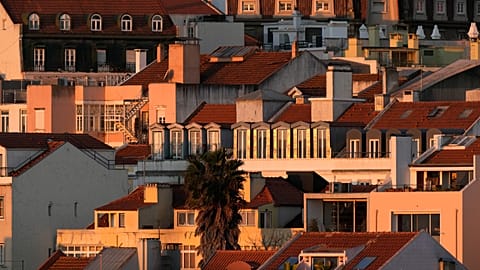
For those coming to Lisbon to study, the challenge goes even further than simply finding a room: the Portuguese capital remains the country’s most expensive city for room rentals, “with median prices of around 550 euros a month”.
Next come Funchal, at 500 euros per month, Porto, at 450 euros, Ponta Delgada, at 430 euros, and Faro rounding out the top five with a median price of 420 euros.
Rooms costing up to 300 euros can only be found in Leiria, Vila Real, Beja, Viseu, Castelo Branco and Portalegre. Guarda and Bragança are the most affordable cities, at 210 and 220 euros respectively.
By way of comparison, the August report published last year by the Student Housing Observatory (source in Portuguese) indicated that renting a room in Lisbon had an average price of 500 euros, with the highest price found at 722 euros. The same report showed that, over the same period, renting a room anywhere in the country cost an average of 416 euros.
Students are not the only ones renting rooms
Although university students are one of the main drivers of the rental market, the country’s current reality means they are not the only ones looking for rooms.
At a time when rents are rising and it is becoming increasingly difficult to buy a home, this tough equation is also pushing up demand for rooms among the wider population, particularly young people of working age.
“The data published in this analysis show that the rental of rooms is not a housing option only for students, but is also becoming the option chosen by young people in their first years in the labour market and in some cases even later,” the statement reads.
“The current reality of the Portuguese rental market in major cities means that it is difficult for many single or divorced people to bear the cost of a home, making the rental of a room the most advantageous option” – and, very often, the only one.
Student residences cannot keep up with demand
Renting a room on the private market is one option for those starting their studies, but there are also public and private student residences, although these are too few to meet demand.
The latest data from the Purpose Built Student Accommodation (PBSA) report by property consultancy CBRE showed that there are 27,700 beds in public and private student residences. Last academic year there were 147,000 Portuguese students living away from home, plus 80,000 foreign students, with the figures pointing to a shortfall of more than 100,000 beds in student residences.
In June 2026, the National Plan for Accommodation in Higher Education (PNAES) estimated the supply of accommodation for higher education students at 17,974 beds (source in Portuguese) in residences belonging to public higher education institutions.
To help young people now starting their search for a room, DECO Proteste has launched a platform (source in Portuguese) that allows students to find the accommodation offered by higher education institutions and to see which municipalities in the country provide student accommodation or support programmes for students living away from home.
Go to accessibility shortcuts
Read more
Why €400,000 may not be enough to buy you a home in Portugal

Student rentals exceed €400 for the first time in Portugal

Renting a room in Lisbon costs over €500 as demand outstrips supply
Why €400,000 may not be enough to buy you a home in Portugal
Student rentals exceed €400 for the first time in Portugal
Renting a room in Lisbon costs over €500 as demand outstrips supply

Europe’s gas prices are surging. Who will be the first to pay more?

Anthropic IPO: Five things to know before its Wall Street debut

What the new US sanctions on Iran mean for European businesses

Eni doubles down on Egyptian gas: $8.5bn in investments and 230 new wells

German economy grows faster than estimated as exports rebound
UK firm running Portugal’s largest solar plant files for insolvency
Spain’s housing crisis: Why young people are swapping cities for villages
Spanish workers spend the equivalent of 231 days paying taxes, study says
What the new US sanctions on Iran mean for European businesses
German economy grows faster than estimated as exports rebound
[analyse_source url=”http://www.euronews.com/business/2026/08/26/higher-education-renting-a-room-in-lisbon-costs-over-500-euros-as-demand-outstrips-supply”]