[analyse_image type=”featured” src=”https://velo-cdn.outsideonline.com/wp-content/uploads/2026/08/Vuelta-Espana-Stage-04-Harry-Talbot-2009-3.jpg”]
The 2026 Vuelta a España could be the hardest grand tour of the modern era.
One stat pretty much tells you everything: 58,156 meters.
That’s how much vertical climbing organizers have stuffed into 21 stages and 3,298.5km for the 81st edition of the Spanish grand tour.
That’s about 190,800 feet of climbing, or the equivalent of riding from sea level to the summit of Mount Everest roughly six and a half times.
No wonder sprinters have avoided this Vuelta.
“Our route model works and we try to stay faithful to it,” Vuelta race director Javier Guillén told EFE. “It’s a Vuelta with major mountain attractions.”
For the past two decades, the Vuelta has increasingly staked out its turf as the climber’s grand tour. Think shorter stages, steeper “impossible climbs,” and weird goat-track ramps that have become La Vuelta’s trademark.
The 2026 route turns the dial up another notch.
Non-stop climbing
At least there’s no climbing in Saturday’s time trial start in Monaco, but from there, it almost doesn’t stop.
Font-Romeu delivers the first summit finish on Stage 3, followed by a 104km Andorran stage the next day packed with more climbs but finishing in the valley.
By the time the race reaches Granada on September 13, the peloton will endure 51 categorized climbs and seven summit finishes.
“La Vuelta offers the same as in other years, but in different places,” Guillén said. “Instead of the north taking center stage, it will be the south.”
That means no Lagos de Covadonga, no Pyrénéan monsters, and no Angliru.
Instead, La Vuelta will be a string of new and familiar beasts in the south and along the Mediterranean coast, where heat and wind will be two more factors adding to the accumulating suffering.
Where does this Vuelta rank?
On paper, it’s a monster.
Organizers are claiming this is “one of the toughest editions in the history of La Vuelta,” with two time trials, seven summit finales, four medium mountain stages, and eight hilly or flat stages.
But there’s an important caveat — any route is only as hard as the riders make it.
If Tadej Pogačar starts dropping haymakers from the opening week, those 58,000m could produce three weeks of peloton-busting pain. If Pogi blows the GC apart early and then UAE decides to lock down the race, this savage route could become slightly more manageable.
Slightly is the key word. The climbs are still there to be raced, it’s just that the pace might change a bit for the riders trying to make the time cut in the gruppetto.
ProCyclingStats data backs up the Vuelta’s reputation as the climber’s grand tour.
Across the past five editions, PCS calculates an average of 2,649 vertical meters per stage at the Vuelta, compared to 2,426 at the Tour de France and 2,339 at the Giro d’Italia.
That doesn’t make 2026 the most vertical ever. PCS estimates several recent grand tours at more than 55,000 meters, including nearly 60,000 meters at the 2024 Vuelta.
But make no mistake, this year’s route sits at the extreme end of the modern grand tour scale.
Heat, sun, wind
And then comes southern Spain.
The final 10 stages unfold entirely in Andalucía, where steep rough roads and potentially suffocating late-August and September heat are waiting.
Spain recently broke out of a “heat dome” phenomenon, but temperatures could still push into the high 90s and low 100s Fahrenheit almost daily. Managing the heat, hydration, and recovery will add another layer of hurt to an already brutal climbing Vuelta.
La Pandera, Calar Alto, Peñas Blancas, and the vicious Collado del Alguacil in the stage 20 “queen stage” are all stacked up in the back half.
Guillén and his route designers have done their part.
“We have written the script,” Guillén said. “Now the riders have to interpret it.”
The 7 summit finishes at the 2026 Vuelta
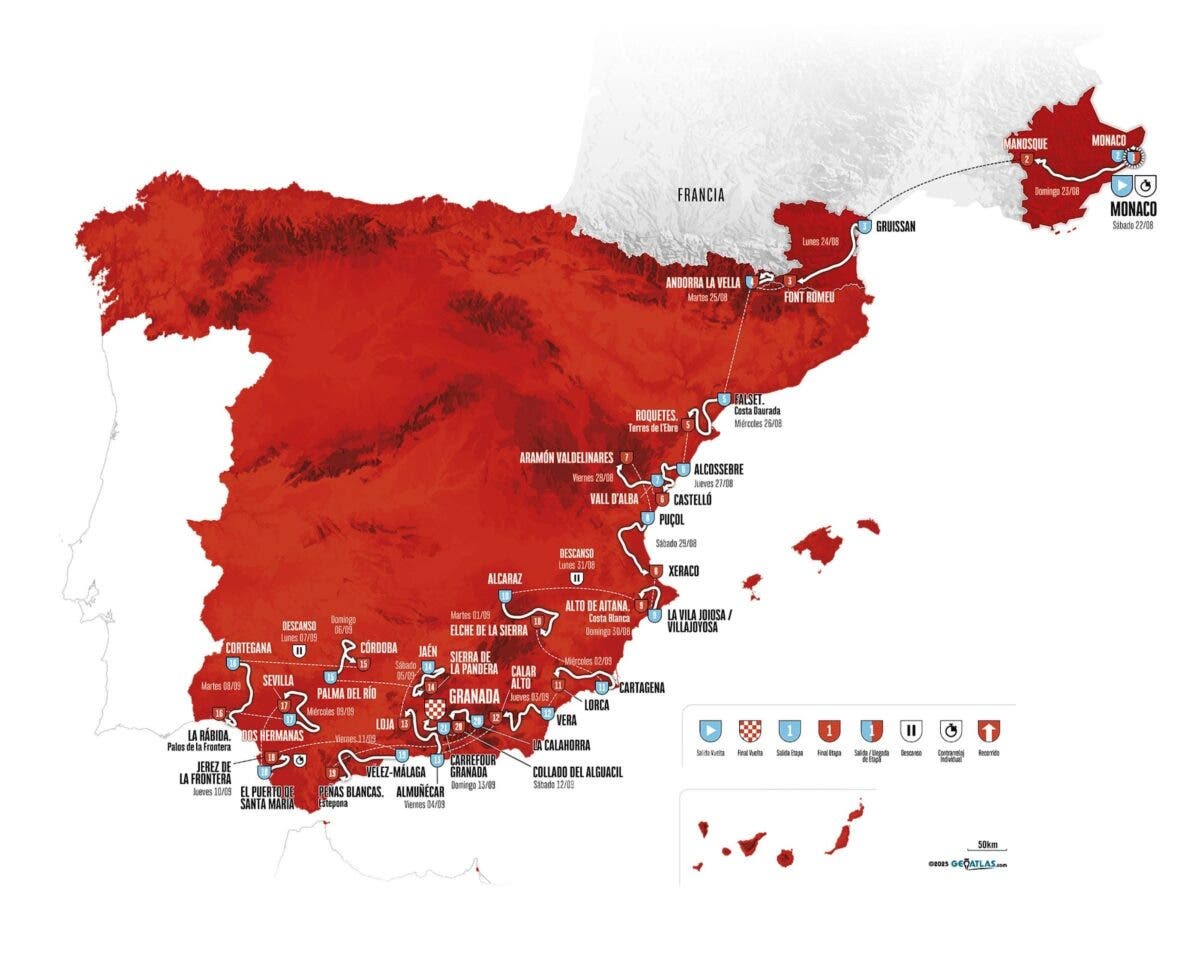
This is a Vuelta for climbers. La Vuelta de los escaladores features seven summit finishes and another handful of hard climbing days.
That’s one major summit finale every third day on average, with plenty of vertical packed in even on the transition stages.
Here are the major mountaintop finales that will define and decide the 2026 Vuelta:
Stage 3: Font-Romeu (French Pyrénées)
The Vuelta wastes almost no time turning uphill. Font-Romeu delivers the race’s first summit finish as the peloton crosses southern France after leaving Monaco. Nearly all of the stage’s climbing is crammed into the final 35 kilometers, with a Cat. 1 climb teasing out the Cat. 2 summit push. Can Pogačar resist this new Vuelta climb?
Stage 7: Aramón Valdelinares (Teruel, Aragón)
Valdelinares brings the Vuelta’s first summit finale on Spanish roads with the grinding ascent through the Sistema Ibérico. Heat and uneven road surfaces will make this one hurt even more. Winner Anacona won here in the last Vuelta finish here in 2014.
The irregular gradients and a nearly a full week of racing should make Valdelinares an early GC eliminator.
Stage 9: Alto de Aitana (Costa Blanca, Alicante)
If Pogačar hasn’t won a stage yet, he will put a circle around this one. At 22km, Alto de Aitana is the longest finishing climb of the entire 2026 Vuelta and provides a fitting conclusion to the brutal opening week. Pierre Latour won here the last time the Vuelta tackled this monster in 2016.
The Mediterranean heat and humidity could make this climb feel even longer. After nine days of racing, this will set the first major GC hierarchy.
Stage 12: Calar Alto (Almería, Andalucía)
Organizers are making this one considerably nastier by sending the peloton over the demanding switchbacks at the Cat. 1 Alto de Velefique — where Ryder Hesjedal won a stage in 2009 — before Calar Alto in what’s the hardest stage up to this point of the race.
The stage ends at the barren, high-altitude observatory at Calar Alto, where the exposed upper slopes can catch strong crosswinds. Miguel Ángel López won here the last time La Vuelta finished on the summit in 2017.
Stage 14: Sierra de la Pandera (Jaén, Andalucía)
La Pandera is pure Vuelta madness. The 11.8km climb rises on narrow, rough roads and the most vicious 15 percent gradients came near the finale. Extreme heat and wind can punish the bunch in this stage across Spain’s “sea of olives.”
It’s every rider for themselves in one of Spain’s “impossible climbs,” sometimes called the Angliru of the south. Richard Carapaz won here in 2022 in its last visit.
Stage 19: Peñas Blancas (Estepona, Málaga)
Peñas Blancas (19km at 6.5%) comes just one day after the flat, power-heavy 32.5km individual time trial in Jerez. Heat and wind often blast this exposed climb overlooking the golf courses and beaches along the Costa del Sol.
Any pure climber who hemorrhages time against the clock will have a chance to strike back. Carapaz won here as well, also in 2022.
Stage 20: Collado del Alguacil (Sierra Nevada, Granada)
Race organizers were forced to remove the planned double ascent of the Alto de Hazallanas after landslides in February damaged the access road. The revised route instead throws in the demanding El Duque, while El Purche will now be climbed twice rather than once.
Then comes the brutal finale in what’s still this Vuelta’s “queen stage.”
The stage ends atop the previously unused Collado del Alguacil, with 8.3km averaging a brutal 9.8 percent. It’s the only HC — or “categoría especial” — summit finish in the 2026 edition. Pogačar will want this one.
[analyse_source url=”https://velo.outsideonline.com/road/road-racing/vuelta-a-espana/vuelta-a-espana-2026-route-climbing-summit-finishes/”]