[analyse_image type=”featured” src=”https://images-prod.dazeddigital.com/1200/157-0-1620-1080/azure/dazed-prod/1450/0/1450880.jpg”]
What does it mean to be ‘underground’ in 2026?
As Ug artists become some of the biggest names around and labels increasingly haunt Reddit forums in search of new markets, we investigate how the digital age has transformed one of music’s oldest debates: the underground vs the mainstream
Solomon PM
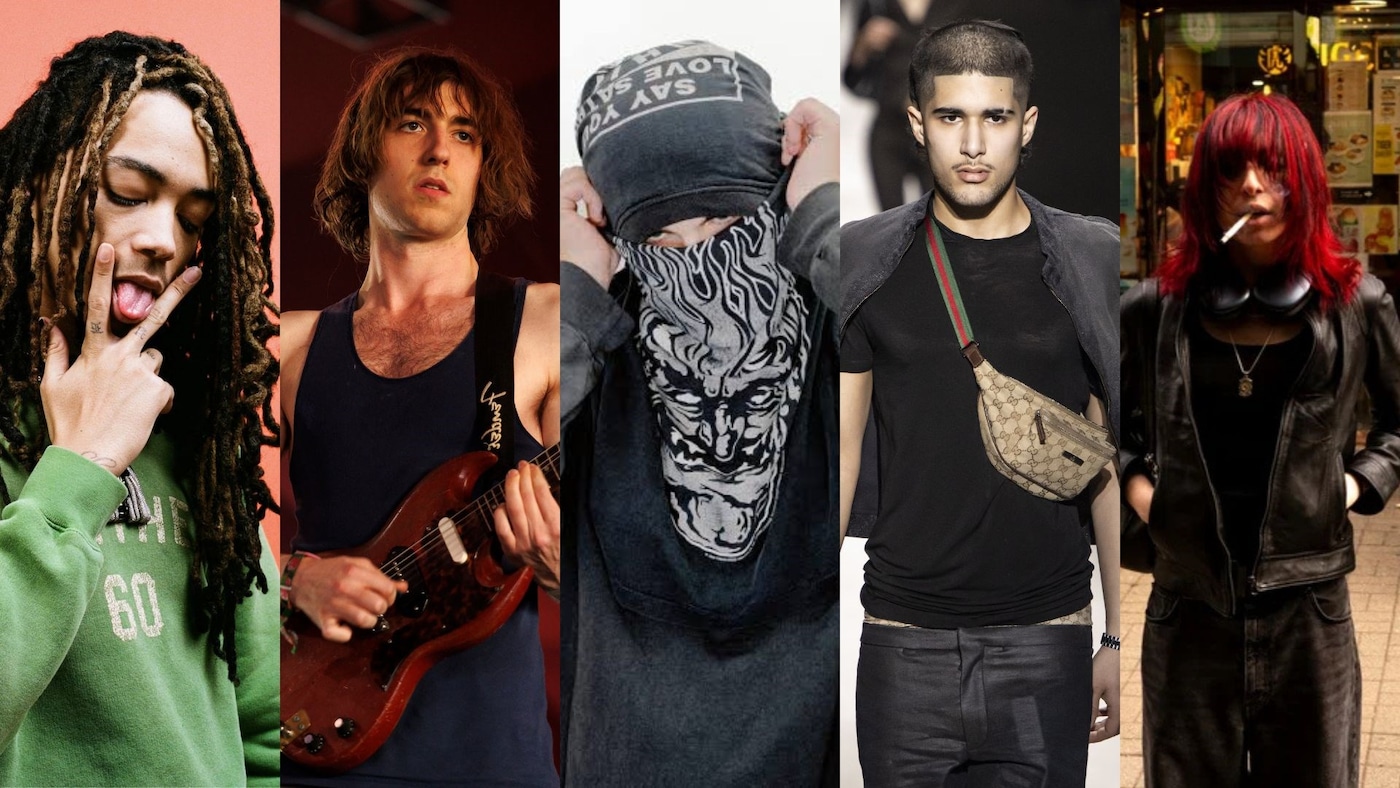
Underground music is pretty popular right now. Not long after reportedly signing a £30 million record deal, UK Ug star EsDeeKid has just announced a headline show at London’s Wembley Arena, having played there as a support act (for Yung Lean) less than a year ago. Over in the states, meanwhile, rage rappers like Che and Osamason – longtime favourites of the /r/ug_music subreddit – are accruing streams in the hundreds of millions. Even Geese, today one of the hottest bands around, are downstream from the original counter-culture movements of the 1960s, with their crooning, experimental rock ballads.
But if underground artists are getting this popular, are they even underground anymore? This is the question raised by UK Ug godfather Lancey Foux, who prefers the term ‘overground’ when referring to emerging British acts like Jim Legxacy and EsDeeKid. “That’s simply what it is,” he told me in an interview last month. “What we’ve known as underground, as fully non-conformist and not mainstream, is just not really the case anymore. The shit we think is mainstream isn’t even mainstream nowadays. These kids are the biggest ones we have right now. But the reason why we can’t call it a certain kind of rap music is because they’re doing so many different sounds.” While genres like grime and garage were underpinned by easily-distinguished sounds, Lancey said, today’s young artists are picking and choosing from a variety of different sonic palettes. So, he concluded: “we’ve got to call it overground.”
It’s a fair point, and one that nods to an even deeper shift: that ‘Ug’ refers to something beyond just not being mainstream. “I think Ug music is no longer just another way of saying underground music,” says /u/aimanhakim249, who moderates the /r/ug_music subreddit and first saw the term used on Twitter and Discord around 2021. “Over time, it’s become its own thing. It’s more like an internet subculture around artists, aesthetics, and communities that grew through social media. A lot of it is rage, plugg, jerk, and such, but it’s also about the fashion, arts, memes and fan culture.” In this sense, ‘Ug music’ has practically become a genre in and itself, albeit a diffuse one, which captures the range of sounds and influences underpinning internet-native artists today.
UNDERGROUND CURRENT MONTHLY LISTENERS (AUGUST 2026) 📊
fakemink: 7.9 million
Molly Santana: 5.8 million
Buckshot: 3.6 million
sosocamo: 3.5 million
Lex Amarni: 3.3 million
2muchmotion: 2.9 million
twentythree: 2.5 million
Fimiguerrero: 2.2 million
OsamaSon: 1.8 million… pic.twitter.com/nSPsYddaJm— For the Speakers (@forthespeakers) August 4, 2026
This shift is particularly important because the ‘underground’ versus ‘mainstream’ divide looks very different in the digital age. Just this month, the UK’s top-performing single of the year, Olivia Dean and Sam Fender’s “Rein Me In”, faced a perplexing problem: virtually no one, it seems, has actually heard it. This paradox speaks to the cultural fragmentation that underpins online existence today. Before the 21st century, it was easy to identify so-called mainstream artists simply because they were unavoidable: they were backed by major labels, performed at places like Wembley Arena, did collabs with luxury brandsand enjoyed constant airtime. But nowadays the lines are far more blurred: “Ug” artists can enjoy many of these hallmarks without having achieved anything close to monocultural saturation.
Fans of so-called ‘underground’ artists, meanwhile, now find themselves immersed in a digital ecosystem that runs entirely in parallel to mainstream currents, inhabiting underground music forums and generally being able to avoid artists like Olivia Dean and Sam Fender altogether. This development hasn’t gone unnoticed by the major labels: it’s now an open secret that industry figures increasingly stalk these online underground haunts in the hopes of capturing the market.
This commercialisation of alternative and underground music scenes has been a long time coming. As Mark Fisher writes in Capitalist Realism: “In the 1960s and 1970s, capitalism had to face the problem of how to contain and absorb energies from outside… [Today] ‘alternative’ and ‘independent’ don’t designate something outside mainstream culture; rather, they are styles, in fact the dominant styles, within the mainstream.” By the 90s, Fisher argues, the possibility of underground musicians existing outside of, and in opposition to, capitalism had been crushed – and this sense of alternative-without-anti-commercialism is writ large across so-called ‘Ug’ music today. If nothing else, EsDeeKid’s (reported) signing for £30 million just six months after dropping his debut album suggests that the dreams of ‘Ug’ artists now very much exist inside commercial structures.
Being underground in 2026 isn’t really about having low streams or being unsigned anymore. It’s more about having a loyal community, creative freedom, and your own identity before the mainstream catches on.
– /u/aimanhakim249, /r/ug_music moderator
Tellingly, for both /u/aimanhakim249 and his fellow /r/ug_music moderator /u/Subject-Property-343, the presence of major labels in online underground spaces is a “net positive”. “The fact that you have these labels and industry execs looking on [our forum] for the next big thing means that, for these kids who have a passion for making music, their dreams aren’t far out of reach,” the latter tells me. “I think it’s good for major labels to see what has potential in real time. Nowadays, the only thing separating artists from a major label is the click of a mouse.” With the alternative channels that online underground spaces open up, artists no longer need to conform to mainstream standards to be successful, and fans, it seems, don’t hold it against them when they do succeed. Where they draw the line, however, is when artists appear to sacrifice their authenticity.
“I think being underground in 2026 isn’t really about having low streams or being unsigned anymore,” /u/aimanhakim249 tells me. “It’s more about having a loyal community, creative freedom, and your own identity before the mainstream catches on.” /u/Subject-Property-343 agrees: “Nowadays, the internet has become pretty good at sniffing out who’s an industry plant and who genuinely has a real life fanbase, so these labels have to work harder at finding genuine talent that has longevity. People value authenticity above everything.”
While authenticity is a notoriously difficult quality to define, underground spaces are policing it in ever more advanced ways. Fakemink’s rise in 2025, for example, was accompanied by the introduction of the term ‘newgen’ – a pejorative for anyone perceived as hopping on the bandwagon. Meanwhile, /r/sleazepop has been gripped by a near-Red Scare level of paranoia in recent months as users have accused each other (and reporters like myself) of being part of a major label psy-op, aimed at profiting from the fans who gather there.
Perhaps the most recognisable example of this struggle for authenticity, however, is this year’s Geese-gate. While fans generally seemed sanguine about the band achieving commercial success, controversy arose when it emerged that they had hired manipulative digital marketing agency Chaotic Good to get there. It’s fine to go commercial, it seems, as long as you didn’t compromise on your authenticity to get there.
These efforts to avoid the total commercialisation of the underground pipeline run deep. Logging onto forums like /r/fakemink or /r/Ug_music can almost feel like reading A Clockwork Orange, as lurkers are met with a futuristic vocabulary of abbreviations (‘Ug’), phrases (‘newgens’), and in-jokes (e.g. the sleazepop psy-op). It’s a practice that pushes slang to the point of steganography – a mode of online encryption that takes place in plain sight. In a world where the click of a mouse can take you anywhere, forum slang acts as a way of reclaiming exclusivity, and of preventing laymen, newgens and label A&Rs from participating in the conversation too early on in an artist’s career.
Recently, I’ve been listening to an artist called xxffcyuvcui – a sort of midwest-emo adjacent rapper whose name is so convoluted it requires me to literally copy and paste it from my notes app to find him. While the so-called ‘overground’ Ug has virtually become a genre in and of itself, divorced from the counter-culture’s original anti-commercial values, perhaps this meaningless string of letters is what real underground music looks like in the digital age. Un-Googleable, in-describable, un-signable; at least, until someone hyperlinks his music in an article and the majors sniff him out…
Trending
A rare interview with Tricky, Bristol’s trip-hop phantom
Malcolm Todd may forget his shirt, but the Gap jeans and flip-flops stay on
10 of the hottest Instagram accounts fusing art, sex and erotica
Is the grid dead? How young people are changing the feed
Could singles wrestling be an alternative to dating apps?

Olivia Rodrigo: ‘A breakup can be an opportunity to redirect your life’
Rage against the machine: how incel culture went mainstream in 2023
Punketos: Meet the Gen-Z punks of Mexico City
Underground music is pretty popular right now. Not long after reportedly signing a £30 million record deal, UK Ug star EsDeeKid has just announced a headline show at London’s Wembley Arena, having played there as a support act (for Yung Lean) less than a year ago. Over in the states, meanwhile, rage rappers like Che and Osamason – longtime favourites of the /r/ug_music subreddit – are accruing streams in the hundreds of millions. Even Geese, today one of the hottest bands around, are downstream from the original counter-culture movements of the 1960s, with their crooning, experimental rock ballads.
But if underground artists are getting this popular, are they even underground anymore? This is the question raised by UK Ug godfather Lancey Foux, who prefers the term ‘overground’ when referring to emerging British acts like Jim Legxacy and EsDeeKid. “That’s simply what it is,” he told me in an interview last month. “What we’ve known as underground, as fully non-conformist and not mainstream, is just not really the case anymore. The shit we think is mainstream isn’t even mainstream nowadays. These kids are the biggest ones we have right now. But the reason why we can’t call it a certain kind of rap music is because they’re doing so many different sounds.” While genres like grime and garage were underpinned by easily-distinguished sounds, Lancey said, today’s young artists are picking and choosing from a variety of different sonic palettes. So, he concluded: “we’ve got to call it overground.”
It’s a fair point, and one that nods to an even deeper shift: that ‘Ug’ refers to something beyond just not being mainstream. “I think Ug music is no longer just another way of saying underground music,” says /u/aimanhakim249, who moderates the /r/ug_music subreddit and first saw the term used on Twitter and Discord around 2021. “Over time, it’s become its own thing. It’s more like an internet subculture around artists, aesthetics, and communities that grew through social media. A lot of it is rage, plugg, jerk, and such, but it’s also about the fashion, arts, memes and fan culture.” In this sense, ‘Ug music’ has practically become a genre in and itself, albeit a diffuse one, which captures the range of sounds and influences underpinning internet-native artists today.
UNDERGROUND CURRENT MONTHLY LISTENERS (AUGUST 2026) 📊
fakemink: 7.9 million
Molly Santana: 5.8 million
Buckshot: 3.6 million
sosocamo: 3.5 million
Lex Amarni: 3.3 million
2muchmotion: 2.9 million
twentythree: 2.5 million
Fimiguerrero: 2.2 million
OsamaSon: 1.8 million… pic.twitter.com/nSPsYddaJm— For the Speakers (@forthespeakers) August 4, 2026
This shift is particularly important because the ‘underground’ versus ‘mainstream’ divide looks very different in the digital age. Just this month, the UK’s top-performing single of the year, Olivia Dean and Sam Fender’s “Rein Me In”, faced a perplexing problem: virtually no one, it seems, has actually heard it. This paradox speaks to the cultural fragmentation that underpins online existence today. Before the 21st century, it was easy to identify so-called mainstream artists simply because they were unavoidable: they were backed by major labels, performed at places like Wembley Arena, did collabs with luxury brandsand enjoyed constant airtime. But nowadays the lines are far more blurred: “Ug” artists can enjoy many of these hallmarks without having achieved anything close to monocultural saturation.
Fans of so-called ‘underground’ artists, meanwhile, now find themselves immersed in a digital ecosystem that runs entirely in parallel to mainstream currents, inhabiting underground music forums and generally being able to avoid artists like Olivia Dean and Sam Fender altogether. This development hasn’t gone unnoticed by the major labels: it’s now an open secret that industry figures increasingly stalk these online underground haunts in the hopes of capturing the market.
This commercialisation of alternative and underground music scenes has been a long time coming. As Mark Fisher writes in Capitalist Realism: “In the 1960s and 1970s, capitalism had to face the problem of how to contain and absorb energies from outside… [Today] ‘alternative’ and ‘independent’ don’t designate something outside mainstream culture; rather, they are styles, in fact the dominant styles, within the mainstream.” By the 90s, Fisher argues, the possibility of underground musicians existing outside of, and in opposition to, capitalism had been crushed – and this sense of alternative-without-anti-commercialism is writ large across so-called ‘Ug’ music today. If nothing else, EsDeeKid’s (reported) signing for £30 million just six months after dropping his debut album suggests that the dreams of ‘Ug’ artists now very much exist inside commercial structures.
Being underground in 2026 isn’t really about having low streams or being unsigned anymore. It’s more about having a loyal community, creative freedom, and your own identity before the mainstream catches on.
– /u/aimanhakim249, /r/ug_music moderator
Tellingly, for both /u/aimanhakim249 and his fellow /r/ug_music moderator /u/Subject-Property-343, the presence of major labels in online underground spaces is a “net positive”. “The fact that you have these labels and industry execs looking on [our forum] for the next big thing means that, for these kids who have a passion for making music, their dreams aren’t far out of reach,” the latter tells me. “I think it’s good for major labels to see what has potential in real time. Nowadays, the only thing separating artists from a major label is the click of a mouse.” With the alternative channels that online underground spaces open up, artists no longer need to conform to mainstream standards to be successful, and fans, it seems, don’t hold it against them when they do succeed. Where they draw the line, however, is when artists appear to sacrifice their authenticity.
“I think being underground in 2026 isn’t really about having low streams or being unsigned anymore,” /u/aimanhakim249 tells me. “It’s more about having a loyal community, creative freedom, and your own identity before the mainstream catches on.” /u/Subject-Property-343 agrees: “Nowadays, the internet has become pretty good at sniffing out who’s an industry plant and who genuinely has a real life fanbase, so these labels have to work harder at finding genuine talent that has longevity. People value authenticity above everything.”
While authenticity is a notoriously difficult quality to define, underground spaces are policing it in ever more advanced ways. Fakemink’s rise in 2025, for example, was accompanied by the introduction of the term ‘newgen’ – a pejorative for anyone perceived as hopping on the bandwagon. Meanwhile, /r/sleazepop has been gripped by a near-Red Scare level of paranoia in recent months as users have accused each other (and reporters like myself) of being part of a major label psy-op, aimed at profiting from the fans who gather there.
Perhaps the most recognisable example of this struggle for authenticity, however, is this year’s Geese-gate. While fans generally seemed sanguine about the band achieving commercial success, controversy arose when it emerged that they had hired manipulative digital marketing agency Chaotic Good to get there. It’s fine to go commercial, it seems, as long as you didn’t compromise on your authenticity to get there.
These efforts to avoid the total commercialisation of the underground pipeline run deep. Logging onto forums like /r/fakemink or /r/Ug_music can almost feel like reading A Clockwork Orange, as lurkers are met with a futuristic vocabulary of abbreviations (‘Ug’), phrases (‘newgens’), and in-jokes (e.g. the sleazepop psy-op). It’s a practice that pushes slang to the point of steganography – a mode of online encryption that takes place in plain sight. In a world where the click of a mouse can take you anywhere, forum slang acts as a way of reclaiming exclusivity, and of preventing laymen, newgens and label A&Rs from participating in the conversation too early on in an artist’s career.
Recently, I’ve been listening to an artist called xxffcyuvcui – a sort of midwest-emo adjacent rapper whose name is so convoluted it requires me to literally copy and paste it from my notes app to find him. While the so-called ‘overground’ Ug has virtually become a genre in and of itself, divorced from the counter-culture’s original anti-commercial values, perhaps this meaningless string of letters is what real underground music looks like in the digital age. Un-Googleable, in-describable, un-signable; at least, until someone hyperlinks his music in an article and the majors sniff him out…
[analyse_source url=”https://www.dazeddigital.com/music/article/70766/1/what-does-it-mean-to-be-underground-uk-ug-esdeekid-fake-mink”]