[analyse_image type=”featured” src=”https://velo-cdn.outsideonline.com/wp-content/uploads/2026/08/unnamed-2.jpg”]
In 2025, Keegan Swenson won the Leadville 100 by 15 minutes. But in 2026, he only won it by 15 inches. This year’s edition of the Leadville 100 was like no other, held on a course rerouted due to significant wildfires. All the course recon done months ago had to be thrown out the window. In many ways, it was a nod to the history of mountain biking and adventure. Many riders were seeing certain sections of the course for the first time.
The dirt had been slow just a week prior, but on race day at 10,000 feet, the Leadville Trail 100 MTB was going to be faster than ever. There was much less climbing than previous editions, with more than 2,500 feet cut out, and the field was as stacked as ever. Quinn Simmons was a special guest on the start line, representing Lidl-Trek after an impressive performance at the Tour de France. Simmons certainly had as much power as anyone in the field, but there is a lot more to Leadville than pedaling hard.
Altitude is the single biggest factor at Leadville, a race that starts at 10,000 feet and makes its way up to more than 12,300 feet at the summit of Columbine. Swenson is the master of altitude, hailing from Utah and having dominated the Leadville 100 for five years running. The marathon MTB world champion typically climbs his way to victory, squeezing the throttle on every uphill until there is no one left on his wheel. But due to recent wildfires, the Leadville 100 was rerouted, removing a number of key climbs including Powerline.
That meant there would be less than 10,000 feet of climbing over the 102-mile course, and it all began with St Kevin’s road just eight miles into the race. It was here that the first selection was made, with just 20 riders going clear on the 8-minute ascent. Swenson and Simmons were in the front group, as well as Simon Pellaud and Matthew Wilson.
Simmons held nearly 450w for eight minutes sitting at 180 bpm. It certainly looked like an all-out effort, despite the fact that Simmons was holding these numbers for 30 minutes at the Tour de France. The key difference here is the altitude, and we can make some rough estimates of what this effort would look like at sea level. In a fresh 8-minute effort, Simmons can probably hold more than 500w, and that’s the type of effort that caused the initial split on St Kevin’s.
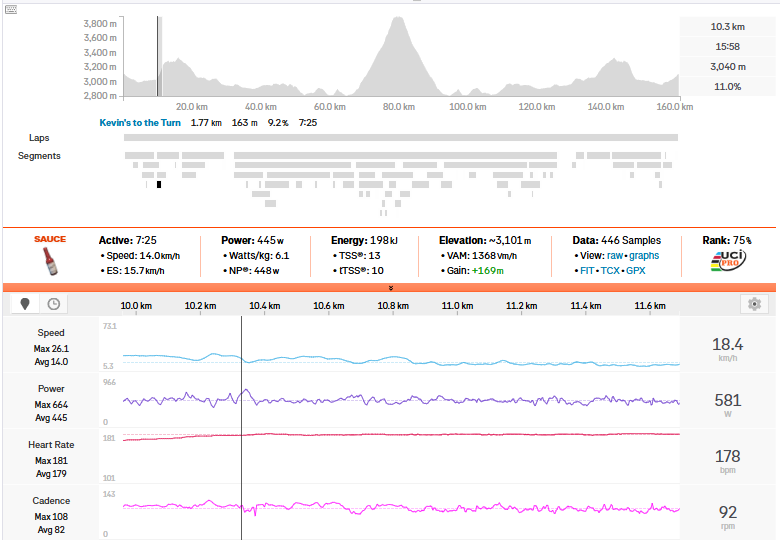
Simmons – St Kevin’s Climb
- Time: 7:25
- Average Power: 445w (6.1w/kg)
- Sea Level Estimated Equivalent: ~520-540w
- Swenson: 7:26 at ~6w/kg
It was only 40°F at this point in the race, and Swenson said he nearly froze on the descent after St Kevin’s. With more than an hour of racing until the next major climb, there was a bit of a stalemate in the peloton. The 2026 reroute also added many miles of pavement to the Leadville 100 route, which made for faster pack speed and more tactical racing. Everyone was waiting for the big one—coming up at the halfway point was the Columbine climb, a 12km climb with an average gradient of 8%, and a summit topping out at more than 12,300 feet.
For the fastest riders in the world, Columbine is nearly an hour-long climb. It is the literal and metaphorical turning point of the race, since riders turn 180-degrees at the top of the climb and descend the same trail they just climbed. Swenson, Simmons, and Wilson were among a dozen or so riders that increased the pace just before the base of Columbine. With such a long, high-altitude climb to come, many riders stuck to their pacing strategy straight from the bottom of the ascent. Simmons was not one of those riders.
The Lidl-Trek rider was here to race for the win, and he was glued to Swenson’s wheel during the first part of Columbine. But eventually, the wheels started to come off, and Simmons’ power dropped from 400w to 300w. Swenson sat on the front and continued climbing at his own pace, and soon there was only one rider who could stay with him. Matthew Wilson was having the race of his life, cresting Columbine only 20 seconds behind Swenson and nearly a minute ahead of the nearest group of chasers.
Swenson’s effort on Columbine is inevitable, and that’s what makes it even more impressive. Everyone knows that it’s coming, but there is nothing they can do about it.
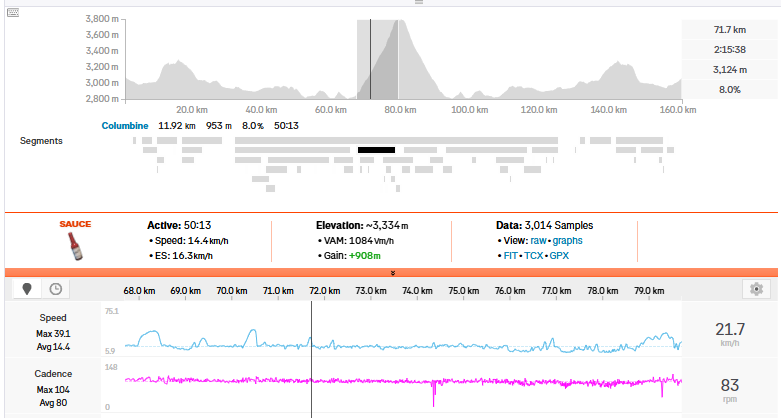
Swenson – Columbine KOM
- Time: 50:13
- Average Power: ~5.2w/kg
- Sea Level Estimated Equivalent: ~6.2w/kg
In the women’s field, Melisa Rollins put on a climbing clinic on Columbine. The US national MTB champion put minutes into her competitors on the climb, clocking a time of 58 minutes and 30 seconds. That makes Rollins’ Columbine ascent the 19th fastest time in all of 2026, according to Strava. Faster than Matt Beers, Lachlan Morton, and Alexey Vermeulen on the longest climb in the Life Time Grand Prix.
Rollins – Columbine QOM
- Time: 58:30
- Estimated Average Power: ~4.2w/kg
- Sea Level Estimated Equivalent: ~5.2w/kg
In previous editions of the Leadville 100, Swenson has been alone from Columbine to the finish. The gaps have been so big, in fact, that Swenson wasn’t even thinking about the race win—he was thinking about going for the course record.
But after 20 minutes of descending, a strong chase group formed behind the five-time defending champion. Wilson was joined by Bradyn Lange, John Gaston, Andreas Seewald, and Cole Paton, with Brendan Johnston and Simon Pellaud a bit further behind. The chasers reeled in Swenson with more than 55km to go, setting up a tactical finale as the course went back to the tarmac.
On a paved climb with 24km to go, Swenson accelerated, with only Gaston able to follow him. The pair worked together while the group disintegrated, leaving just Wilson and Lange chasing behind. When Swenson breaks away at Leadville, that usually means the race is done and dusted. But Wilson had other plans as he closed in on the two leaders.
The Kiwi and Lange regained contact, and it wasn’t long before Wilson attacked himself, with only Swenson able to follow. This is when we saw the true depth of the leader’s abilities. After riding Columbine at just over 5w/kg, Wilson opened up the afterburners and was pulling at 5.5-6w/kg for the final 5km of the Leadville 100. Swenson even said in his post-race interview that it wasn’t the hardest Leadville ever. It was only at the very end of the race that they really started racing hard.
Wilson and Swenson worked together on the final climb to the line, but it was all going to come down to a sprint. The Kiwi hit a peak power of 1,240w, but it wasn’t enough to overhaul Swenson at the line. The marathon MTB world champion took the sprint to win his sixth Leadville in a row, and perhaps his most impressive after a tactical battle on an improvised course.
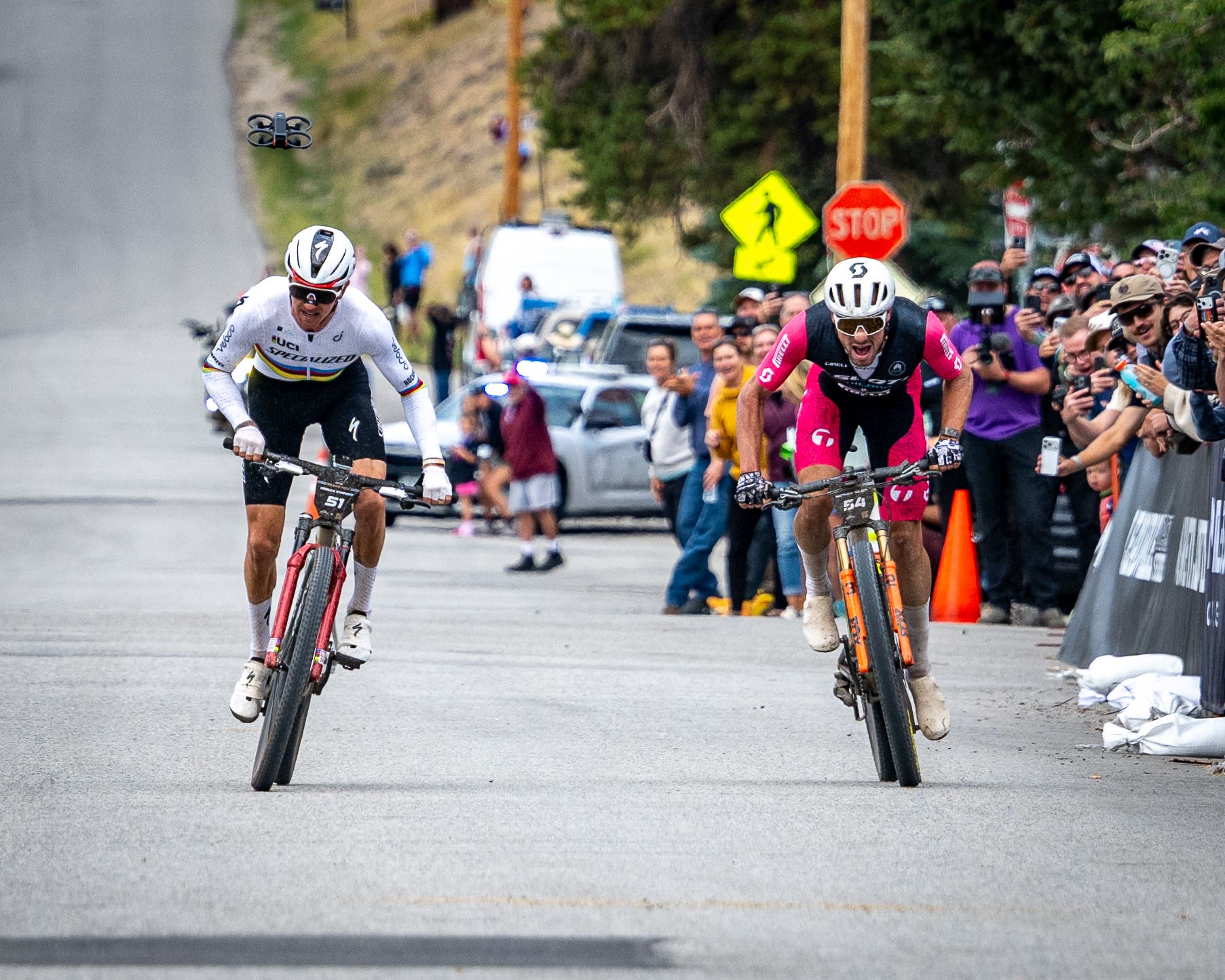
In the final sprint, Wilson averaged over 1,000w for 10 seconds, but it still wasn’t enough to take the Leadville crown from Keegan Swenson.
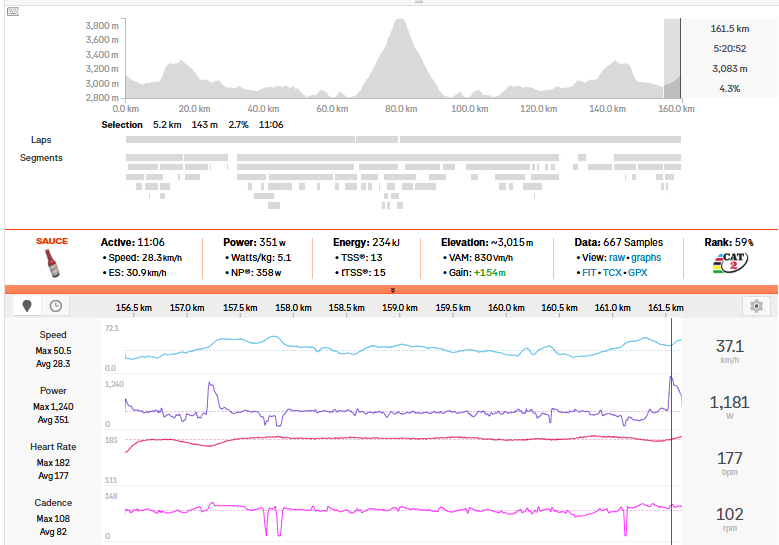
Wilson – Final 5km of the Leadville 100
- Time: 11:06
- Average Power: 351w (5.1w/kg)
- Sea Level Estimated Equivalent: ~6.1w/kg
- Final Sprint: 10 seconds at 1,018w (peak power: 1,240w)
Rollins took the win in the women’s race after breaking away from Cecily Decker with just a few miles to go. It was heartbreak for Decker, but elation for Rollins who has faced serious struggles all season. The US national champion even crashed earlier in the race, but that didn’t stop her from winning the Leadville 100.
Power Analysis data courtesy of Strava
Strava sauce extension
Riders:
- Keegan Swenson
- Quinn Simmons
- Matthew Wilson
- Melisa Rollins
[analyse_source url=”https://velo.outsideonline.com/mountain/power-analysis-leadville-100-mtb-2026-keegan-swenson/”]