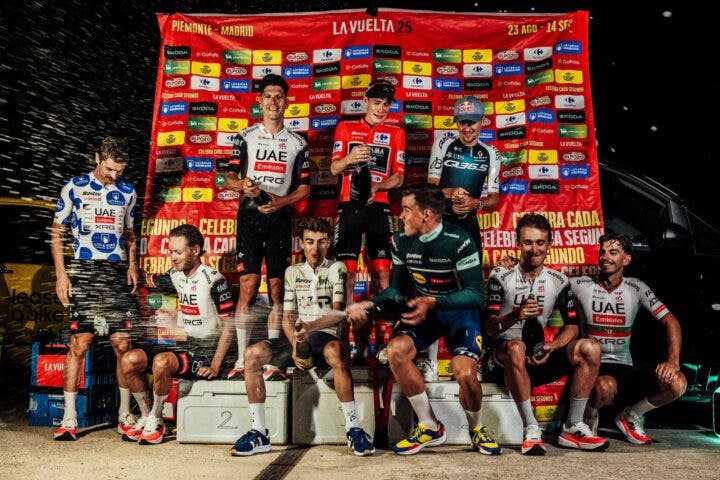
[analyse_image type=”featured” src=”https://velo-cdn.outsideonline.com/wp-content/uploads/2026/08/cyclingimages-2025-Vuelta-Stage-19-822266.jpg”]
Tadej Pogačar is back at the Vuelta a España for the first time in seven years, and the five-time Tour de France winner headlines the season’s third and final grand tour.
Pogačar hasn’t raced the Vuelta since his spectacular grand tour debut in 2019, when he won three stages and finished third overall at just 20 years old.
Today’s cycling superstar returns at the peak of his powers with a chance to complete the career grand tour sweep. A victory in Granada would add the Vuelta to his Tour and Giro titles and make him only the ninth man to win all three.
And this is a Vuelta built for Pogačar.
The 2026 route packs more than 58,000 meters of climbing and seven summit finishes into three weeks. That’s even more vertical gain than the 2026 Tour de France, and reconfirms the Vuelta’s reputation as the climber’s grand tour.
The race starts August 22 in Monaco, practically on Pogačar’s doorstep, and finishes September 13 in Granada.
Here’s everything you need to know about the 2026 Vuelta a España.
Pogačar is back

The big story of the 2026 Vuelta is that Pogačar is back.
Seven years after his spectacular Vuelta a España debut in 2019, the five-time Tour de France winner will be on the start line in Monaco as the overwhelming favorite of the 2026 race.
Pogačar was only 20 when he lined up at the 2019 Vuelta for his first Grand Tour. He left Spain three weeks later with three stage victories, the white jersey and third place overall, an extraordinary debut that provided the first real glimpse of storm that was coming.
A lot has changed since then.
King Pog returns with five Tour victories, the 2024 Giro d’Italia, two world titles and a growing collection of wins. La Vuelta is one of the last blank spots on his palmarès.
The 2026 course gives him plenty of opportunities to change that. Seven summit finishes and two individual time trials are packed into nearly 3,300km of racing before the final stage in Granada.
Pogačar can complete the Grand Tour sweep
Victory in Granada would put Pogačar into one of cycling’s most exclusive clubs.
With the Tour and Giro already on his résumé, winning the Vuelta would make him only the ninth male rider to win all three Grand Tours during his career.
The others are Jacques Anquetil, Felice Gimondi, Eddy Merckx, Bernard Hinault, Alberto Contador, Vincenzo Nibali, Chris Froome and Jonas Vingegaard.
How many stages can Tadej Pogačar win?
As many as he wants. The bigger question is how aggressively Pogačar wants to race La Vuelta.
Pogačar has won 35 stages across nine Grand Tour starts. Even in the 2023 Tour de France, when Jonas Vingegaard beat him for the yellow jersey, a hobbled Pogačar still won twice. Every other Grand Tour he has started has produced at least three stage victories.
His high-water mark is six, a number he hit twice in 2024, first at the Giro d’Italia and then at the Tour de France.
This Vuelta offers enough climbing and time trialing for another huge haul, but there is another calculation in play. The world championships in Montréal arrive only two weeks after the Vuelta finishes, and Pogačar may not want to empty the tank chasing stages every single day.
Count at least three. If he races the Vuelta with the same appetite he has shown at his most dominant Grand Tours, the number could climb much higher.
Key Facts: 2026 Vuelta a España

Dates: August 22 to September 13, 2026
Gran Salida: Monaco
Finish: Granada, Spain
Total Distance: 3,275km / 2,035 miles
Total Elevation Gain: More than 58,000m / 190,289 feet
Total Stages: 21
Rest Days: 2
Flat Stages: 4
Hilly Stages: 5, including one uphill finale
Mountain Stages: 6
Summit Finishes: 7
Team Time Trial: 0
Individual Time Trials: 2
Prize Money: The official total is not yet confirmed, but in 2025, the total prize pool was €1,115,775. The overall general classification winner (red jersey) received €150,000.
Teams: 23
Riders: 184
What’s different about the 2026 Vuelta?
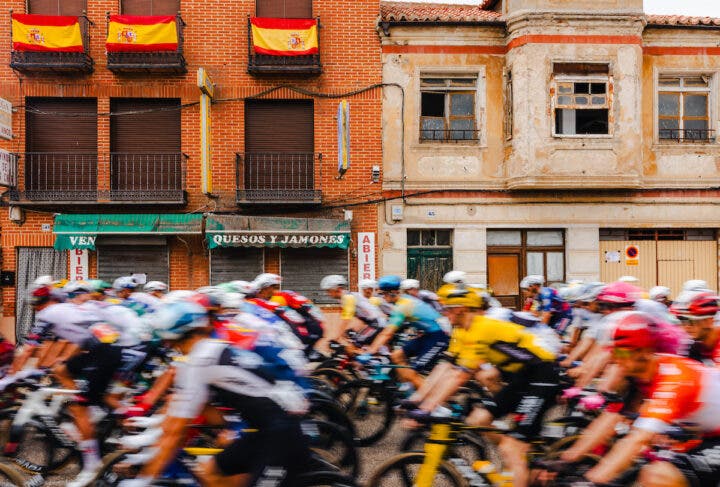
Cycling’s third grand tour, the 2026 Vuelta a España traces roads across Monaco, France, and Andorra before hitting home roads in Spain.
It will start on August 22 in Monaco and finish September 13 in Granada. This will be the 81st edition La Vuelta, the “youngest” of the men’s three grand tours.
April to September
La Vuelta was originally contested in the spring, bouncing between April and May. That always put it on a collision course with the Giro d’Italia in May. In 1995, organizers moved the Vuelta to its current August–September slot.
That changed everything, and helped turn La Vuelta into a race perfect for anyone in the peloton looking to save their season or for rising prospects to earn their spot.
Seventh foreign start
Unlike the other grand tours, La Vuelta was late to the “foreign start” game. Its first was Lisbon in 1997. Monaco marks the seventh “extranjero” start for the Spanish grand tour.
In contrast, the Tour de France started in 1954 in Amsterdam and has started outside France 27 times. The Giro has gone beyond Italy’s boot 16 times, with Bulgaria the latest in 2026.
Monaco ‘triple crown’
According to Monaco officials, the principality is the first city or country to host the opening stage of all three grand tours.
The Giro’s Grande Partenza in 1966 was the first time Monaco played host to start of a grand tour. The 2009 Tour started there with a 15.5km time trial with Fabian Cancellara winning. The 2026 Vuelta completes the treble with a 9.4km time trial.
All 21 Stages: From Monaco to Granada
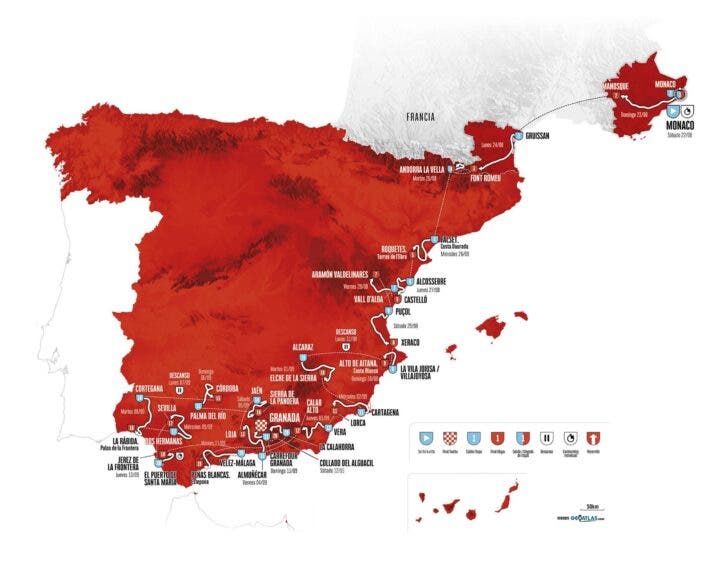
Week 1: Monaco, France, Andorra, and northern Spain
The first week of the Vuelta is interesting because after its start in Monaco, the route sweeps west across France and Andorra and does not hit Spain until stage 5 by entering via Catalunya.
Stage 1 (Aug 22): Monaco-Monaco (9.4 km) – Individual time trial
Stage 2 (Aug 23): Monaco to Manosque (215.2 km) – Hilly
Stage 3 (Aug 24): Gruissan to Font-Romeu (166.7 km) – Medium mountains
Stage 4 (Aug 25): Andorra la Vella to Andorra la Vella (104 km) – Mountain
Stage 5 (Aug 26): Falset to Roquetes (Terres de l’Ebre) – Hilly
Stage 6 (Aug 27): Alcossebre to Castelló – Flat
Stage 7 (Aug 28): Vall d’Alba to Aramón Valdelinares – Mountain (summit finish)
Stage 8 (Aug 29): Puçol to Xeraco – Flat
Stage 9 (Aug 30): La Vila Joiosa to Alto de Aitana (Costa Blanca) – Mountain (summit finish)
Rest Day 1 (Aug 31)
Week 2: Central and Southern Spain
The second week should see consolidation in the GC with two key summit finales as the route drives south along the Mediterranean before hitting the interior of Andalucía.
Stage 10 (Sep 01): Alcaraz to Elche de la Sierra – Hilly
Stage 11 (Sep 02): Cartagena to Lorca – Flat
Stage 12 (Sep 03): Vera to Calar Alto – Mountain (summit finish)
Stage 13 (Sep 04): Almuñécar to Loja – Medium mountains
Stage 14 (Sep 05): Jaén to Sierra de la Pandera – Mountain (summit finish)
Stage 15 (Sep 06): Palma del Río to Córdoba – Hilly/uphill kicker
Rest Day 2 (Sep 07)
Week 3: Andalucía and the Decisive Time Trial
Extreme heat could be on the menu as the route stays centered within sun-parched Andalucía before the historic finale in Granada.
Stage 16 (Sep 08): Cortegana to La Rábida (Palos de la Frontera) – Flat
Stage 17 (Sep 09): Dos Hermanas to Seville – Flat
Stage 18 (Sep 10): El Puerto de Santa María to Jerez de la Frontera (32 km) – Individual time trial
Stage 19 (Sep 11): Vélez-Málaga to Peñas Blancas (Estepona) – Mountain (summit finish)
Stage 20 (Sep 12): La Calahorra to Collado del Alguacil – Mountain (Queen Stage/summit finish)
Stage 21 (Sep 13): Carrefour Granada to Granada – Flat
Who are the favorites for the red jersey?
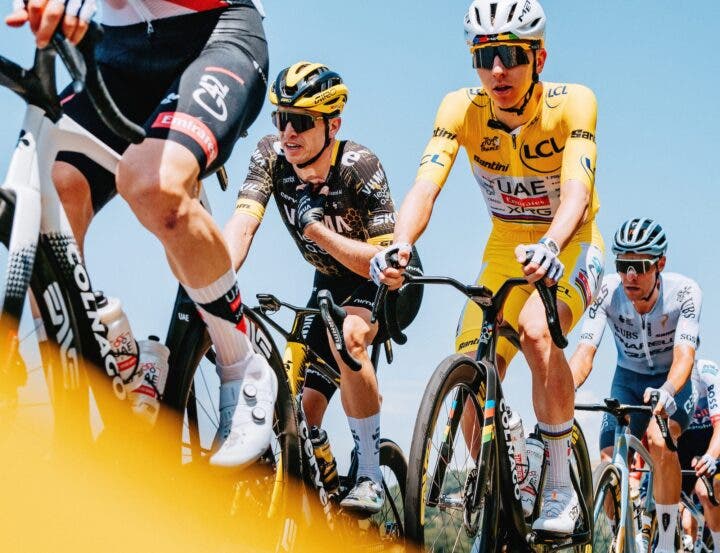
Tadej Pogačar, come on, who’s going to beat him?
King Pog is now at the peak of his powers, and his third at the 2019 Vuelta is his worse grand tour result ever.
A win here makes him the ninth elite male to win all three of cycling’s grand tours. Not that he needs any extra motivation. Pogi always shows up to win.
Of course, a race is a race, and anything could happen, but Pogacčar is in a class of one as the only five-star favorite.
Other podium contenders
There are a whole slew of riders who will race in his slipstream. Almost no one on this list has directly challenged him, so it could be a race for the leftovers very soon.
Still, a podium behind Pogačar is still a place of honor and the Vuelta field is full of riders keen to save their seasons and confirm their spot in the GC hierarchy.
João Almeida (UAE Emirates-XRG): Pogačar’s own teammate and the 2025 Vuelta runner-up. A nasty crash in Poland an injury-plague season might see him on domestique duties.
Enric Mas (Movistar): The local Spanish favorite who’s hit three career podium finishes at the Vuelta. Beating Pog is a stretch, but a podium would save his season after missing the Tour.
Mattias Skjelmose (Lidl-Trek): A rising Danish star who raced to sixth in the Tour and will be chasing his first career grand tour podium.
Cian Uijtdebroeks (Movistar): The Belgian climber will be co-leading alongside Mas and will want a strong Vuelta after abandoning the Tour early.
Carlos Rodríguez (Netcompany Ineos): One of Spain’s best climbers, he will want a solid three weeks after a few rough season. He also skipped the Tour, so it’s all-in at La Vuelta.
Felix Gall (Decathlon CGA CGM): An aggressive climber capable of tearing the GC group apart on high-altitude summit finishes. A big win at the Vuelta a Burgos proves he’s on track.
Mikel Landa (Soudal Quick-Step): A veteran fan-favorite known for launching chaotic, unpredictable, long-range attacks to disrupt the race favorites.
Oscar Onley (Netcompany-Ineos): After missing the Tour de France with injury, he’ll want to prove last year’s Tour breakout was no fluke.
Other big names
Wout Van Aert (Visma Lease-a-Bike), Mads Pedersen (Lidl-Trek), and Stefan Kung (Tudor Pro Cycling) will light up the breakaways, time trials, and classics-style profiles. Four-time Vuelta winner Primož Roglič (Red Bull-Bora-Hansgrohe) is a question mark after being struck by a motorist in late July.
What North Americans are racing La Vuelta?
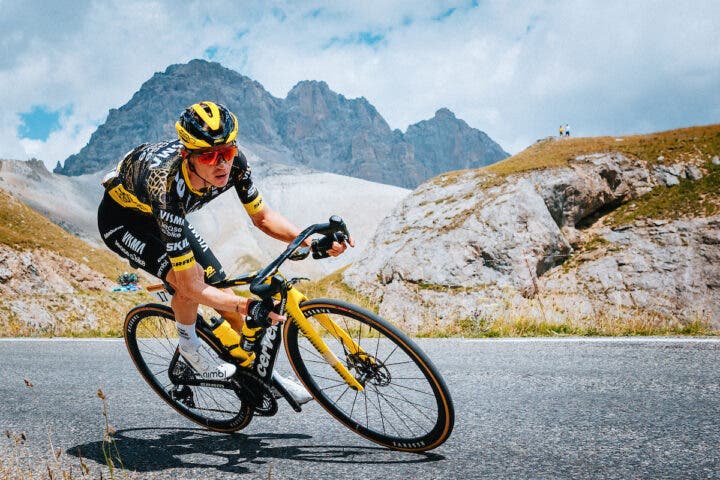
North Americans have always done well at La Vuelta, with Sepp Kuss and his 2023 Vuelta win as the last U.S. grand tour winner.
Kevin Vermaerke is confirmed as part of Pogi’s support crew at UAE. Right now, he’s the only confirmed U.S. starter.
Matthew Riccitello (Decathlon- CMA CGM), fifth last year, is expected to race. Kuss and Matteo Jorgenson are both penciled in for Visma-Lease a Bike and maybe Neilson Powless for EF Education-EasyPost.
The final start list comes out next week.
Every changing jersey
The overall leader of the Tour de France famously wears yellow of the maillot jaune, but the Vuelta’s leader jersey has undergone a colorful transformation over the decades.
In the first Vuelta in 1935, the race leader’s jersey was orange. Over the years it morphed from different color schemes, depending largely on which sponsor was backing the jersey.
After ASO bought into La Vuelta, the jersey switched to yellow and then a golden color. From 2010, La Vuelta now has its iconic maillot rojo (red jersey).
Oldest male grand tour winner
La Vuelta holds the definitive record for the oldest male rider to ever win a three-week Grand Tour. In 2013, American cyclist Chris Horner won the overall classification at 41, defeating Alejandro Valverde and Vincenzo Nibali to take the win.
How to watch 2026 Vuelta a España
No matter where you live, you can get your Vuelta fix. A lot of that depends on if it’s free through-the-air TV or streaming via a subscription.
Major markets:
USA: NBC/Peacock
Canada: FloBikes
UK: TNT Sports/HBO Max
Australia: SBS
Worldwide: Eurosport, RTVE, VRT, TV2, NOS, Supersport, J Sports, ESPN
Stages typically finish between 17:00 CET and 17:30 CET, right at siesta time.
[analyse_source url=”https://velo.outsideonline.com/news/vuelta-a-espana-2026-cheat-sheet-guide/”]