[analyse_image type=”featured” src=”https://images-prod.dazeddigital.com/1191/0-80-1191-794/azure/dazed-prod/1450/1/1451219.JPG”]
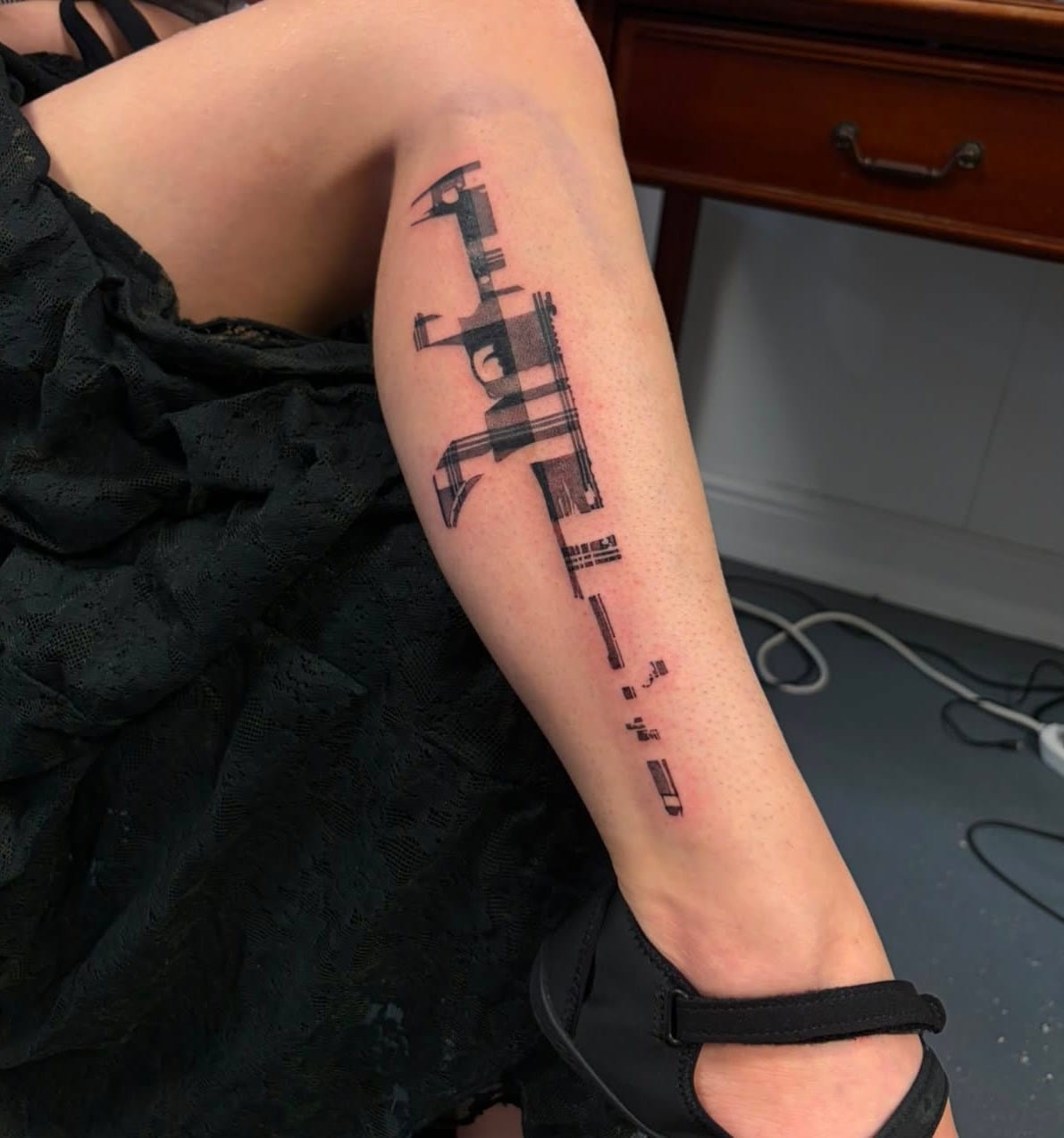
An M4 carbine patterned in plaid, a handgun tucked into a lace garter, a sniper surrounded by anime graphics; these all guntattoos that have gained traction on Instagram in the past months. Their emergence comes at a time when firearms remain one of the most contested topics in contemporary culture, but this isn’t a straightforward case of pro-gun rhetoric finding its way into tattooing. Instead, it tells of a generation whose relationship with firearms is becoming more complex.
To those raised during the height of online gaming, guns were first introduced as accessories to customise in wild prints and camos, or used to cartoonishly wipe out opponents in games like Fortnite, Overwatch and Call of Duty. In this way, games taught us to look at weapons as accessories, as well as objects designed to kill.
This customisation is mirrored in many of the gun tattoos we see. Some are lifted from JRPGs, complete with system messages and anime-style girls; others are tattooed in coded binaries, wrapped in lace or worked into a pattern. For 23-year-old, Sheffield-based tattoo artist Liv (@polka.pokes), that customisation has taken the form of a plaid gun stretched across a client’s leg. One of her favourite weapon designs, it was “a custom design inspired by the quote ‘shot yourself in the foot’ mixed with inspiration from my original plaid style tattoos”. She says she’s tattooed around six weapon designs so far, with many more in the pipeline.
This reframing of guns as accessories is a trend that is sweeping more widely across culture. In fashion, it’s seen in the work of young designers like Kai Ghattaura and his axe-wielding brainrotted A Scattered Dream runway show and Rohan Mirza, the Parisian designer with entire shows like Nuketown and Stonehaven inspired by games like Call of Duty, colliding offline and online worlds.
This trend can be seen in music rollouts too, where artists like Slayyyter and EsDeeKid wave around handguns, and on the merch stands of artists like Snow Strippers. Guns are circulating through the same visual culture which informs any other tattoo trend. This is the case for 22-year old, Atlanta-based tattoo artist Gianna (@meiintattoo), who says she’s seen “lots of gun tattoos recently”, which she puts down, at least partly, to curation platforms like Pinterest.
Guns are hardly the first weapons to find their way into tattooing – Gianna points to a cybersigilism sword she has tattooed in the past. Daggers, swords and blades have cycled through tattoo culture for years. With the proliferation of medieval aesthetics over the last couple of years, we have seen people reach for tattoos of swords and maces with relatively little friction, the historical distance of these objects allowing them to be separated from the violence they once inflicted.
With guns, that distance doesn’t exist yet. With the scale of gun violence in the US and endless clips of warzones appearing across our feeds, it‘s no surprise that reception to the designs is mixed. Gianna says reactions tend to fall between “people thinking they’re sick” (in the positive sense) and others “wondering why someone would tattoo that on themselves.“
There’s a case to be made that guns re-entering the mainstream is another facet of conservatism becoming increasingly visible around the world, and particularly in the US. But alongside the country’s long-standing gun-rights movement, which has mostly leaned Republican, there’s been an increasing engagement with gun culture among some left-wing and marginalised communities, where guns have been reframed through ideas of self-defence and resistance: take the Arm the Dolls movement, or the emergence of left-wing shooting clubs. US foreign aggression over the last few years (and much longer) has created intense feelings of distaste towards symbols of violence, but led many others to embrace the aesthetics of armed struggle.
One artist who sees guns through this lens is 26-year old, Atlanta-based tattooist Adam (@ineedarocketlauncher), who describes his personal views as “staunchly anti-war and anti-fascist.” His recent designs include “an Uzi, a shotgun, a few revolvers, Glocks, AK-47s, RPG-7s, grenades, a minigun, various blades and melee-style weapons, and most recently a tank.”
Of all of them, his favourite is an AK-47 he did on himself while teaching himself to tattoo. “It looks quite shit but I like it for that reason too,” he says. When his dad first saw it, his critique wasn’t that he had a gun on his leg, but of the gun he had chosen. “Why did you choose the terrorist gun [when] you could do something American like a M16 or AR-15?”
But that response is kind of the point. “The AK-47 is the most commonly used weapon for revolutions, insurgencies, civil wars and whatever else,” he says. “I think a lot of people view it as a symbol of rebellion and returning power to the people.” But for all the politics attached to the image, Adam says there’s also a simpler reason he keeps coming back to the imagery: “I also just like guns because they’re cool.”
As associations with guns become more multifaceted, the reasons for getting them become more varied too. There’s likely to be someone getting a gun tattoo out of an affinity with raditional, MAGA-coded gun culture, but there are also those who see it as a symbol of resistance and community self-defence. But for most people the motivation seems to be aesthetic above all, as guns cycle their way into the visual culture. As this trend continues, perhaps gun tattoos will lose their transgressive edge and cease to signify much of anything, becoming no less provocative than a sword-wielding elf.
Escape the algorithm! Get The Drop
Get must-see stories direct to your inbox every weekday.
Thank you. You have been subscribed
Expand your creative community and connect with 30,000+ creatives from around the world.
Trending
‘They were all baddies’: Photos of India’s joyous trans beauty pageant
Under Armour
Under Armour shows what it means to ‘rest less’ at Hotel Armouré
What went down at Merrell’s Parkland walk with Ollie Ranger

Are AI dating apps ushering in the era of swipeless dating?
10 of the hottest Instagram accounts fusing art, sex and erotica
The imaginative artist behind those viral Erling Haaland nails
Masahisa Fukase’s tale of obsessive love, shot through an apartment window
The best Scandi street style from Copenhagen Fashion Week
Escape the algorithm! Get The Drop
Get must-see stories direct to your inbox every weekday.
Thank you. You have been subscribed
An M4 carbine patterned in plaid, a handgun tucked into a lace garter, a sniper surrounded by anime graphics; these all guntattoos that have gained traction on Instagram in the past months. Their emergence comes at a time when firearms remain one of the most contested topics in contemporary culture, but this isn’t a straightforward case of pro-gun rhetoric finding its way into tattooing. Instead, it tells of a generation whose relationship with firearms is becoming more complex.
To those raised during the height of online gaming, guns were first introduced as accessories to customise in wild prints and camos, or used to cartoonishly wipe out opponents in games like Fortnite, Overwatch and Call of Duty. In this way, games taught us to look at weapons as accessories, as well as objects designed to kill.
This customisation is mirrored in many of the gun tattoos we see. Some are lifted from JRPGs, complete with system messages and anime-style girls; others are tattooed in coded binaries, wrapped in lace or worked into a pattern. For 23-year-old, Sheffield-based tattoo artist Liv (@polka.pokes), that customisation has taken the form of a plaid gun stretched across a client’s leg. One of her favourite weapon designs, it was “a custom design inspired by the quote ‘shot yourself in the foot’ mixed with inspiration from my original plaid style tattoos”. She says she’s tattooed around six weapon designs so far, with many more in the pipeline.
This reframing of guns as accessories is a trend that is sweeping more widely across culture. In fashion, it’s seen in the work of young designers like Kai Ghattaura and his axe-wielding brainrotted A Scattered Dream runway show and Rohan Mirza, the Parisian designer with entire shows like Nuketown and Stonehaven inspired by games like Call of Duty, colliding offline and online worlds.
This trend can be seen in music rollouts too, where artists like Slayyyter and EsDeeKid wave around handguns, and on the merch stands of artists like Snow Strippers. Guns are circulating through the same visual culture which informs any other tattoo trend. This is the case for 22-year old, Atlanta-based tattoo artist Gianna (@meiintattoo), who says she’s seen “lots of gun tattoos recently”, which she puts down, at least partly, to curation platforms like Pinterest.
Guns are hardly the first weapons to find their way into tattooing – Gianna points to a cybersigilism sword she has tattooed in the past. Daggers, swords and blades have cycled through tattoo culture for years. With the proliferation of medieval aesthetics over the last couple of years, we have seen people reach for tattoos of swords and maces with relatively little friction, the historical distance of these objects allowing them to be separated from the violence they once inflicted.
With guns, that distance doesn’t exist yet. With the scale of gun violence in the US and endless clips of warzones appearing across our feeds, it‘s no surprise that reception to the designs is mixed. Gianna says reactions tend to fall between “people thinking they’re sick” (in the positive sense) and others “wondering why someone would tattoo that on themselves.“
There’s a case to be made that guns re-entering the mainstream is another facet of conservatism becoming increasingly visible around the world, and particularly in the US. But alongside the country’s long-standing gun-rights movement, which has mostly leaned Republican, there’s been an increasing engagement with gun culture among some left-wing and marginalised communities, where guns have been reframed through ideas of self-defence and resistance: take the Arm the Dolls movement, or the emergence of left-wing shooting clubs. US foreign aggression over the last few years (and much longer) has created intense feelings of distaste towards symbols of violence, but led many others to embrace the aesthetics of armed struggle.
One artist who sees guns through this lens is 26-year old, Atlanta-based tattooist Adam (@ineedarocketlauncher), who describes his personal views as “staunchly anti-war and anti-fascist.” His recent designs include “an Uzi, a shotgun, a few revolvers, Glocks, AK-47s, RPG-7s, grenades, a minigun, various blades and melee-style weapons, and most recently a tank.”
Of all of them, his favourite is an AK-47 he did on himself while teaching himself to tattoo. “It looks quite shit but I like it for that reason too,” he says. When his dad first saw it, his critique wasn’t that he had a gun on his leg, but of the gun he had chosen. “Why did you choose the terrorist gun [when] you could do something American like a M16 or AR-15?”
But that response is kind of the point. “The AK-47 is the most commonly used weapon for revolutions, insurgencies, civil wars and whatever else,” he says. “I think a lot of people view it as a symbol of rebellion and returning power to the people.” But for all the politics attached to the image, Adam says there’s also a simpler reason he keeps coming back to the imagery: “I also just like guns because they’re cool.”
As associations with guns become more multifaceted, the reasons for getting them become more varied too. There’s likely to be someone getting a gun tattoo out of an affinity with raditional, MAGA-coded gun culture, but there are also those who see it as a symbol of resistance and community self-defence. But for most people the motivation seems to be aesthetic above all, as guns cycle their way into the visual culture. As this trend continues, perhaps gun tattoos will lose their transgressive edge and cease to signify much of anything, becoming no less provocative than a sword-wielding elf.
Escape the algorithm! Get The Drop
Get must-see stories direct to your inbox every weekday.
Thank you. You have been subscribed
[analyse_source url=”https://www.dazeddigital.com/beauty/article/70791/1/why-are-people-getting-gun-tattoos”]