[analyse_image type=”featured” src=”https://ichef.bbci.co.uk/news/1024/branded_news/abe3/live/57fcea50-94cf-11f1-8189-057951e10a11.jpg”]

 BBC
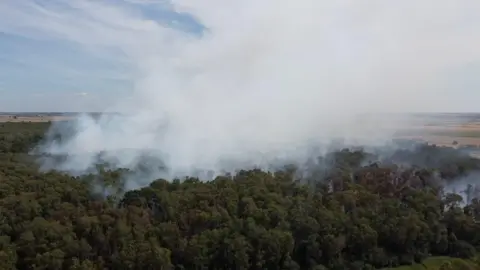
An ongoing blaze has affected about half of a Cambridgeshire nature reserve, a fire chief has said.
The peatland fire broke out at the 660-acre (270 hectares) Holme Fen reserve, near Peterborough, on Saturday.
Cambridgeshire Fire and Rescue Service area commander Wayne Swales said “around about 50%” of the land has been affected.
“We’re working really hard to get water into the ground while dealing with the wind picking up and the increasing risk of fire around here,” he said.
- Why is Holme Fen wildfire lasting days?
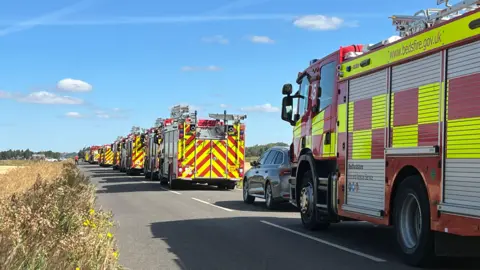
Brigades from Cambridgeshire, Norfolk, Suffolk, Northamptonshire, Bedfordshire, Hertfordshire, Essex and Merseyside joined forces to fight the flames.
Swales said more than 50 firefighters remained at the scene, alongside 12 fire engines, as well as specialist appliances.
“The aim is to keep on top of it, stop it from moving and spreading, and doing more defensive work at night time,” he said.
“[It] means in the day time – when we’ve got clear access, clear weather, more people, more resources and more partners – we can really get stuck into it.
“Like a lot of people, what we’re praying for and dancing for is rain and it doesn’t look like it’s coming anytime soon.”
The fire service said crews were expected to be at the woodland site for the rest of the week.

Swales said: “We are working with other services and our multi-agency partners to plan for the coming week, as we anticipate we’ll need to maintain a large presence at the incident for most of the week.
“I can reassure residents that we will be working hard to maintain our availability to respond to emergencies while this incident is ongoing.”
He said the fire service in some cases would have to “prioritise” incidents depending on their nature.
On Monday, as attempts to put out the wildfire entered the third day, 14 fire vehicles and about 80 firefighters were at the reserve.
Incident commander Vicky Best said falling trees, extreme heat and concerns about water supplies had made it “challenging”.
“It’s a very difficult incident, the access is difficult, a lot of equipment’s having to be carried to the scenes of the fire,” Best added.
“We’re unable to take vehicles down so it’s very challenging.”
More from Cambridgeshire
- How do families with SEND children cope with summer holidays?
- Solar farm set for approval despite abbey concerns
- ‘Lifeline’ ping pong venue temporarily re-opened
More than 40 firefighters first went to the site on 27 July to tackle an initial blaze described as “deep seated in peat”, making it likely to burn for longer.
It is being investigated as suspected arson, and Cambridgeshire Police has appealed for anyone with information to come forward.
During the latest fire, a helicopter was dropping water from Crown Lakes, in Farcet, onto parts of the burning peatland that were difficult to reach.
Anthony Gould, of the Peterborough Volunteer Fire Brigade, said getting water to the incident “was really difficult”.
“We had to get water from a man-made stream using a pump and then [used] several light portable pumps to transport that water from one place to another.”
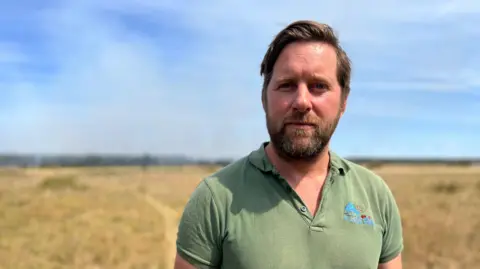
Tom Martin, one of the farmers helping fire crews, described how quickly farmers had mobilised.
“Yesterday, they were worried about running out of water and so within half an hour, there were bowsers turning up, there were sprayers filled with water, farmers laying irrigation pipes as well – so really coming out in force to save this amazing bit of woodland,” he said.
Martin said farmers had gone back on Sunday evening after a call for machinery to help create fire breaks.
“We could see fire starting up again, kind of spontaneously, flames rising up and being put out as this kind of really dry peat, these old trees, were setting back on fire. And as we were cutting a break, we could smell the smoke,” he added.
“We could see just people working phenomenally hard.”
 Tom Jackson/BBC
On Monday, several local roads remained closed, including the junctions of Hod Fen Drove and Holme Lode, Long Drove and the B660, and New Long Drove.
People have been urged to stay away from the reserve, managed by Natural England.
The Wildlife Trust has also asked people to keep dogs on leads until the fire has been fully extinguished.
Do you have a story suggestion for Cambridgeshire? Contact us below.
Follow Cambridgeshire news on BBC Sounds, Facebook, Instagram and X.
[analyse_source url=”https://www.bbc.com/news/articles/c78gv26d8eqo”]