[analyse_image type=”featured” src=”https://velo-cdn.outsideonline.com/wp-content/uploads/2026/08/GettyImages-2289056981-scaled.jpg”]
Preparation is everything for a time-trial. Knowledge is power, even if actual power goes a long way too.
But as Kristen Faulkner knows well from yesterday, the race of truth also comes down to courage.
Take her terrifying 90km/h descent off the decisive climb into Dijon on stage four Tuesday, aware that the Tour de France Femmes avec Zwift stage win was in the balance.
“This was a race where I had to go out of my comfort zone, not just physically, but in terms of mental discomfort as well,” Faulkner told Velo.
“I just kept telling myself the whole time on the descent ‘you can’t have bravery without fear,’” the American says.
“It sounds kind of cheesy, but it’s because I feel like compared to riders that have been racing since they were 15, I get a little bit more nervous on really fast downhills on the skis [TT bars].”
The Olympic road race and team pursuit champion was challenging for victory Tuesday, finishing sixth on the 21km TT between Gevrey-Chambertin and Dijon, 56 seconds behind new race leader Marlen Reusser.
Months of perspiration, inspiration and hardwork were geared towards her 28 minute 24 second effort.
It takes a whole team to support the leader in her big goal. EF Education-Oatly and Faulkner took Velo behind the scenes of the race yesterday to chart everything that goes into maximiszng her effort.
Pizza and preparation
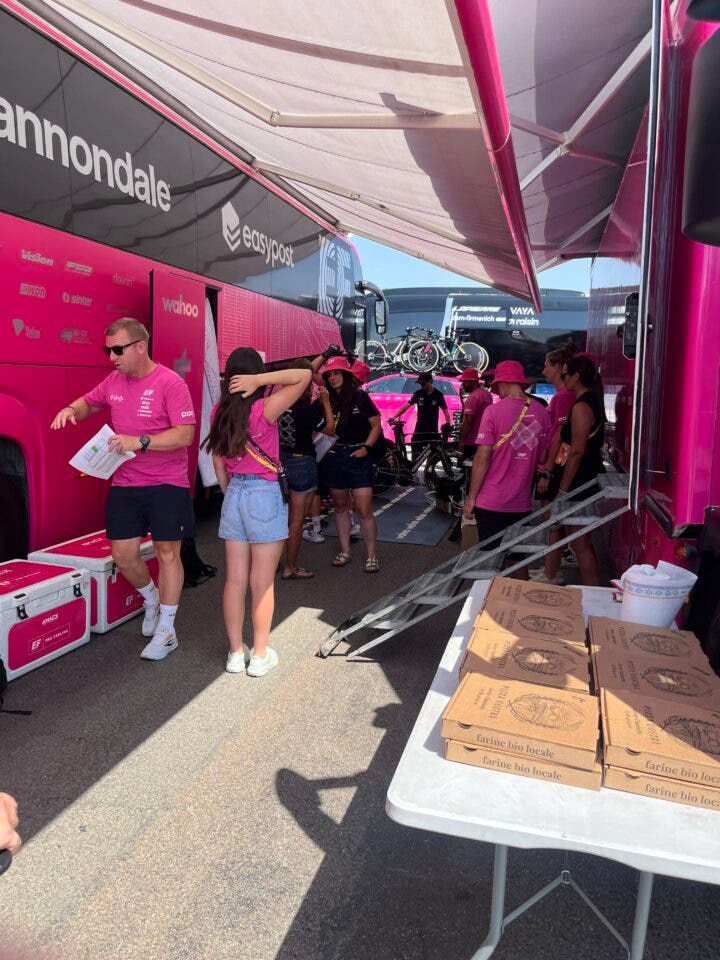
Time-trial day is the longest of the Tour de France Femmes for every team. EF Education-Oatly rolls into the start at around 9:15, overlooking verdant vineyards.
One of their first tasks is taking every Cannondale Lab71 race bike to be checked by the UCI commissaires to make sure they conform with the rules.
Stages such as this involve long moments of waiting and fuelling – I count 13 takeaway pizza boxes on the team bus-adjacent trestle tables around lunchtime – punctuated by moments of action.
Commentators might talk about having good legs or bad legs but Faulkner believes “preparation is far more important than having good legs. I think our performance can be planned out months in advance, and the things we do to prepare are what make or break our race day – a lot more than whether we wake up having a good night’s sleep.”
The team’s schedule has military precision. For Faulkner, everything is noted down, from her arrival time at the team bus area to her 27-minute warm-up start time and the time she should leave the team bus, 18 minutes ahead of starting her race at 4:20 local time.
At 13:15, about 30 minutes after arriving, Faulkner and teammates Cédrine Kerbaol and Noemi Rüegg roll out to do a course recon. This is useful for riders, committing key parts to memory, and staff alike.
Revising strategy after the recon
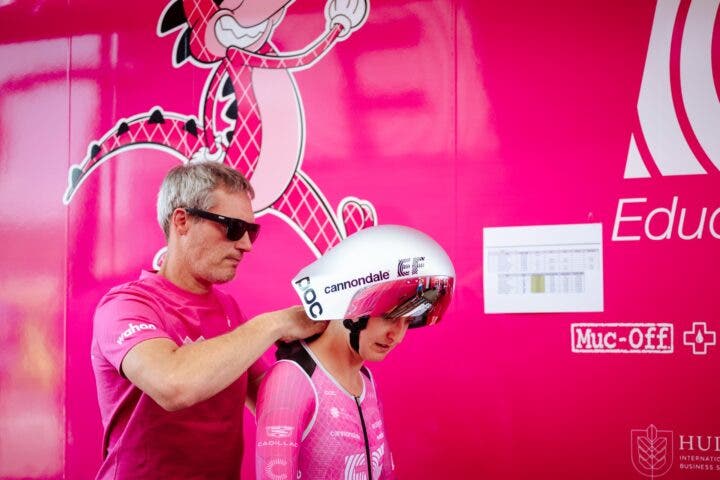
“You have some areas on the route that in the car or on VeloViewer, you think it’s going to be fine, you realise it’s a little bit more complicated to handle it,” EF head of performance Fabien Rabeau says.
He gives the example of going through a town on the route with small cobblestones which he hadn’t flagged before, making the surface a little more slippery.
This TT is the tip of the iceberg. “All the way through the season, we are preparing for specific events,” Rabeau adds. “Every race, every block of training should bring us to some place. It’s like a giant Lego and every time we are doing one, it’s one piece on top of another and at the end, you have the big picture.”
The weather matters too: Rabeau was aware of a possibility of rain but it did not come to fruition. They keep an eye on the wind too, with a tailwind onto the 2-km steeper part bringing more speed onto the hill and influencing the descent off it.
The race is the culmination of winter training getting used to the bike, past races and different pacing strategies, alongside all the R&D partnerships, working with SRAM for gearing, Vision wheels and Vittoria tires.
The recon is a chance for Faulkner to get used to the new POC TT helmet, which she has not worn before. GC contender Cédrine Kerbaol also has a new skinsuit for the race from Assos, tested in the wind tunnel.
As for goals for Faulkner? “Top five will be great today,” he says, an hour and a half before her start time.
Rice, eggs and bicarb to fuel a contender’s race
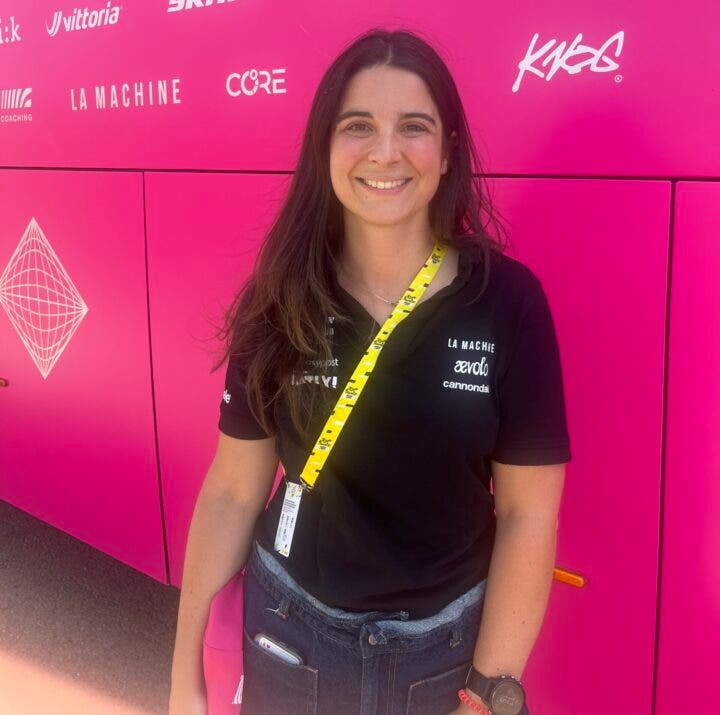
It’s not just tech; a contender has to be fuelled. Faulkner has eggs and rice two hours before the TT, a carbohydrate-packed meal.
“Normally, they take three grams per kilogram before the TT,” team nutritionist Amaia Martioda says. “For the riders that are prioritizing doing well there because of the team’s strategy, we use some supplements to improve their performance a little more.
“We use bicarb an hour and a hour before the start time,” she adds.
Hydrate to be great
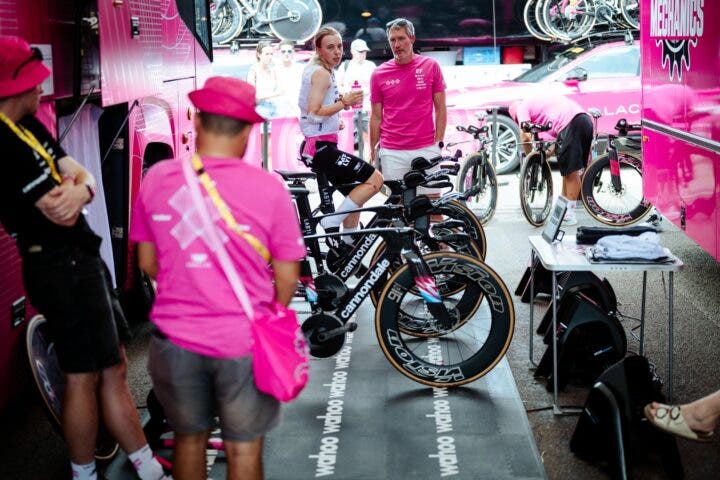
Hydration is also paramount in the 85-degree conditions. Every stage finish is a new start line for returning to optimal levels.
EF Education-Oatly’s medical team test the riders’ hydration daily via urine osmolarity. If it reads 1020 mOsm/kg or over, they could consider them dehydrated and more emphasis might be put on pre-hydration. “But until now [in this race], we are under those numbers,” Martioda says.
Warming up with a black Ego fan on full blast in the shaded area by the team bus, Faulkner says that she found the stage 3 heat much worse than during the TT, given the wind on her going at 45km/h compared to four hours in 35 degrees.
Faulkner: UCI’s rule banning TT ice socks is ‘crazy’
While the riders warm up with cooling vests and ice socks down their neck, they can no longer race with the latter.
Last month, the UCI banned ice socks in skinsuits under article 1.3.032 of the governing body’s regulations, as an accessory which “may not modify the morpohology of the rider”.
It’s safe to say that Faulkner is not a fan of the ruling. “I think it’s very unfortunate and sad that the UCI doesn’t let us wear ice on our backs,” she says.
“There’s a lot of things riders do that are really unhealthy that make us faster. I find it crazy that we’re not allowed to do something that is healthy for us and I wish the UCI didn’t ban things that are extremely healthy for us.”
“Ice is aerodynamic, it is pretty cheap. And it’s not like it’s an unfair advantage because every woman has access to ice, even some of the lower-budget teams.
“If you’re looking at a great equaliser, this is so much less significant than a $1,000 aero bar.”
Faulkner’s race of truth
Faulkner’s last meal pre-race is an Amacx Turbo gel two minutes beforehand.
Then it’s time to race. Pan-American champion Faulkner is quickly into her aero positioned once out of the start village of Gevrey-Chambertin on the 21km race.
As for her TT helmet, Faulkner trusted the process. “It was good, I really like everything POC produces. I’d never trained in it before so it took a lot of trust to wear it.
“I think it was a leap of faith to wear something I’d never trained on, but turns out it worked really well.”
What was she telling herself during the effort? “I really try to focus on the here and now and be really present,” she says. “If I’m going up the climb, I’m not thinking about the descent.
“I focused a lot on my breathing, on staying relaxed, on my head and shoulder position, on maintaining the power I think I should hold at that moment.
In control, on the limit
Faulkner listens to her body and asks herself how she feels, regardless of the numbers she set out to ride.
“What matters is whether I’m in control the whole time from an effort standpoint. It’s uncomfortable, but you should never feel like you’re overreaching.
“I always felt like I was very much in control of the effort the whole time and it wasn’t controlling me, which is a good feeling to have.”
She is not a rider who needs a lot of motivation in the race radio. Faulkner prefers objective feedback, especially given the numerous traffic islands on the route.
“I send some markers and feedback points to the DS [Carmen Small] ahead of time to have her tell me which side of the road to be on, whether there’s a traffic island, things that help me race it more strategically.”
It can also be about knowing how much speed she can take into the corners and their width, the straightest line to race and thinking about how momentum carries from a descent into an uphill influenced how hard she would push going down.
How TT technical skills training helped Faulkner
It was a TT of two halves, the first part dictated by the 2-kilometer climb of the Lacets de Marsannay before a speedy, corner-strewn descent.
Faulkner was “very pleasantly surprised” by how well she climbed, going faster than most GC contenders. While disappointed to lose time on the descent, clocking a top speed of 87km/h there, she expected it.
“Descending on the skis [TT bars] when it’s windy has always been something that makes me a bit nervous,” she said. “The pavement wasn’t super smooth which probably added to my nerves,”
She had spent a couple of days doing TT specific skills at her altitude camp in Utah for several hours, going through tight corners at speed, nailing the technical side.
“I felt more comfortable on my TT bike than I’ve ever felt, just in terms of the smoothness and not braking too hard,” she says.
Faulkner was pleased to come away with sixth, 54 seconds behind stage winner Marlen Reusser.
“I thrive on straight flat TTs and this was none of that so it makes me feel reality motivated going forward.”
Recuperating for another day
Once over the line, the recovery game re-starts. Faulkner had some Amacx cherry juice and two bottles of water.
She drank a recovery protein shake and ate a post-race carbohydrate-rich poke bowl with some rice before focusing on hydrating with iced water and electrolytes, sitting in her air conditioned hotel room – never a given in France – before massage and dinner.
After the last stage, food and drink will not be optimized for recovery. Faulkner has her mind on a cheat meal to celebrate finishing the Tour de France Femmes in Nice.
“I really want a Radler, which is a lemonade beer. I love those, I don’t drink much alcohol, I really like the zero per cent ones.
“And for food, maybe a really good hamburger or gelato.”
[analyse_source url=”https://velo.outsideonline.com/road/road-racing/tour-de-france-femmes/on-the-limit-behind-the-scenes-of-olympic-champion-kristen-faulkners-tour-tt/”]