[analyse_image type=”featured” src=”https://velo-cdn.outsideonline.com/wp-content/uploads/2026/08/GettyImages-2283703437-scaled.jpg”]
The Olympic rings necklace peeking out from the top of Sandrine Tas’ jersey is a dead giveaway to her very recent past.
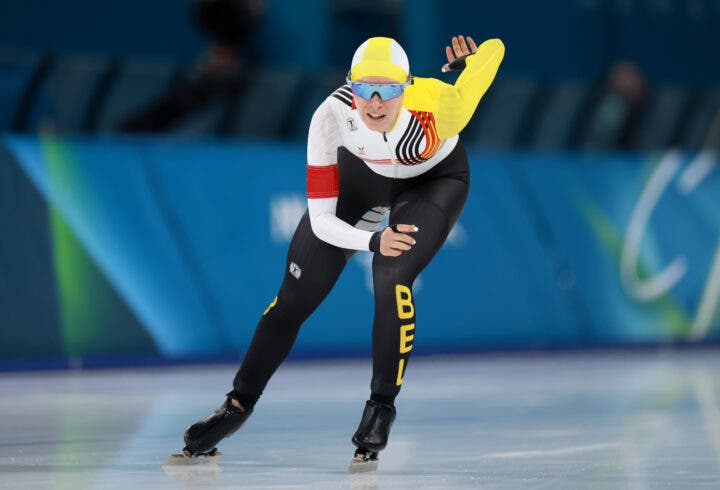
In February, the Belgian was racing all-out on the ice at the Winter Olympics in Milan-Cortina for a speed skating medal. She wept after missing out on bronze by 0.13 seconds in the 5,000 meters, finishing fourth.
This summer sees a different challenge in a different sport. Having signed for Lotto Intermarché Ladies before 2026, Tas is racing the Tour de France Femmes avec Zwift after several stand-out results earlier in the summer.
“It’s still a bit crazy to me. Six months ago, I was at the Winter Games. Now I’m here,” she told Velo on Saturday.
“I’m very excited. It’s an honor to be at the start in the biggest cycling race there is.”
Bridging a vast experience gap
It’s no surprise Tas confessed to feeling a few pre-race nerves. Her first ever WorldTour stage race is the most prestigious and grueling of them all.
This 30-year-old was first an inline skater, winning world and European titles, before moving on to speed skating.
She is far from the first to make this transition from two skates to two wheels: Eric Heiden, Connie Carpenter-Phinney, Connie Paraskevin, and Clara Hughes have all enjoyed success at both sports.
In the modern peloton, Demi Vollering used to be a speed skater, Lidl-Trek rider Riejanne Markus too, albeit not to the same level as Tas.
While speed skating requires more explosive power, there is a clear crossover in terms of a need for a high VO2 max for top performance.
Different training, mindset and decision-making
A lover of cycling since her childhood who dabbled in UCI races over recent years, Tas has made a rapid adjustment in her first full-ish season of road racing.
“Feed zones: it’s very chaotic, you have to grab things while you’re on the bike,” she says. “It’s all very small things, but all together, it’s a lot to learn. I feel like I’m still learning every race I do.”
Going from speed skating, her training has understandably transformed too. There are more technical drills, high-intensity intervals and weight sessions in the winter sport.
Pro cycling requires a lot more hours in the saddle. “My body has had to adapt a bit to that, we’re actually still doing it at the moment. We’ve taken our time to build carefully and not go crazy all in from the beginning,” Tas says.
“Other than that in the races, the peloton feel, just gaining experience. You have to make decisions in split seconds. I’m from inline [skating], so that’s also peloton racing, I think I bring a lot of that already into my cycling, which is why it’s been going quite good already.”
In March, she was still skating and had some rest, therefore missing all the spring Classics apart from the Flèche Wallonne. A fast finisher, Tas earned her place at the Tour, sprinting to two stages at the Bretagne Ladies Tour in late May and finished second and third in the Belgian national TT and road race respectively.
“You can dream of course,” she said of being picked for the Tour. “I knew by July, when the selection is made, I could have a decent level.”
Racing with an open mind
Tas is under no illusions about her debut Tour.
“It’s going to be very hard and very crazy. I’m going to give it my everything and see what that brings me,” she says.
“I don’t have enough experience at this level to think about specific results. It’s going to be a learning curve, I’m a bit open-minded in this race.”
As for the future? Tas says there will “probably” be no more combining speed skating and cycling, though it is he first love.
“I’m a pro cyclist, I’m training and working for this, it’s my main goal.”
A rough start to Tour life
The first two stages have been tough for Tas, crossing the line outside the top 100 and over 11 minutes down both days.
“I need to get better at positioning and being more relaxed, at taking water bottles,” she told Velo by the Lotto Intermarché Ladies team bus after day one.
Tas had been stuck behind a crash and although she didn’t fall, she had to slow down ands was distanced. While she could see the group ahead, she was “gutted” to not be able to catch them.
Nevertheless, Sandrine Tas is not on thin ice– this is just the beginning for this unlikely convert to WorldTour pro racing.
There are seven more chances at this Tour and potentially many seasons ahead to win the catch-up game in a different sport.
[analyse_source url=”https://velo.outsideonline.com/road/road-racing/tour-de-france-femmes/how-top-olympic-speed-skater-became-tour-de-france-femmes-racer-six-months/”]