[analyse_image type=”featured” src=”https://velo-cdn.outsideonline.com/wp-content/uploads/2026/07/GettyImages-2286066616-scaled.jpg”]
Tadej Pogačar is a physiological phenom, an athletic one-of-a-kind.
And we’re not only saying that because he’s just won a fifth yellow jersey at the Tour de France.
A new study suggests Pogačar might have one of the highest VO2 Max scores in the history of endurance.
As a reminder, VO2 Max is the most important marker of performance potential.
It’s a measure of maximum oxygen uptake that summarizes the power of all the most important parts of the engine – the heart, lungs, and the mitochondria.
It’s tested by all top athletes via a heinous indoor step test and ventilation mask. The result is revealed by few.
The forthcoming paper seen by Velo calculated Pogačar’s VO2 Max to be around 96ml/kg/min, or potentially as high as 102ml/kg/min.
Those numbers are off the charts.
The highest Vo2 Max tested under robust lab conditions was 97.5, as set by Oscar Svendsen in 2012. Triathlon crusher Kristian Blummenfelt recently posted images suggesting his VO2 Max was in the triple digits, but few believe it.
For some Tour de France context, Pogačar’s estimated VO2 Max dwarves those of four-time yellow jersey Chris Froome (tested at 88.2), and U.S. legend Greg LeMond (reported to be 92.5).
As the authors of the paper conclude:
“Pogačar must possess extraordinary physiological capabilities and, most likely, is approaching that hitherto insurmountable barrier of 100 ml/kg/min. Are we, then, looking at the greatest endurance athlete of all time?”
To be clear, these estimates of Pogačar’s athletic potential are just that – estimates. There’s no certainty that Pogačar is “the greatest endurance athlete of all time.”
But it would be no surprise if the two-time world champion and five-time Tour de France winner belongs somewhere in the God-Tier. He’s made 7w/kg look normal and 80km attacks a routine.
Putting a number on Pogačar
The Pog Paper (as we’re calling it) is the work of three key thinkers in exercise science – Pedro Valenzuela, Sebastian Sitko, and Ole Kristian Berg.
Sitko is one of the group that masterminded the at-home 5-minute VO2 Max test, for instance.
They teased their new study this week in the Fissac blog and this social media post, and kindly shared a pre-publication copy with Velo.
The paper is due to be published by the International Journal of Sports Physiology and Performance later this year.
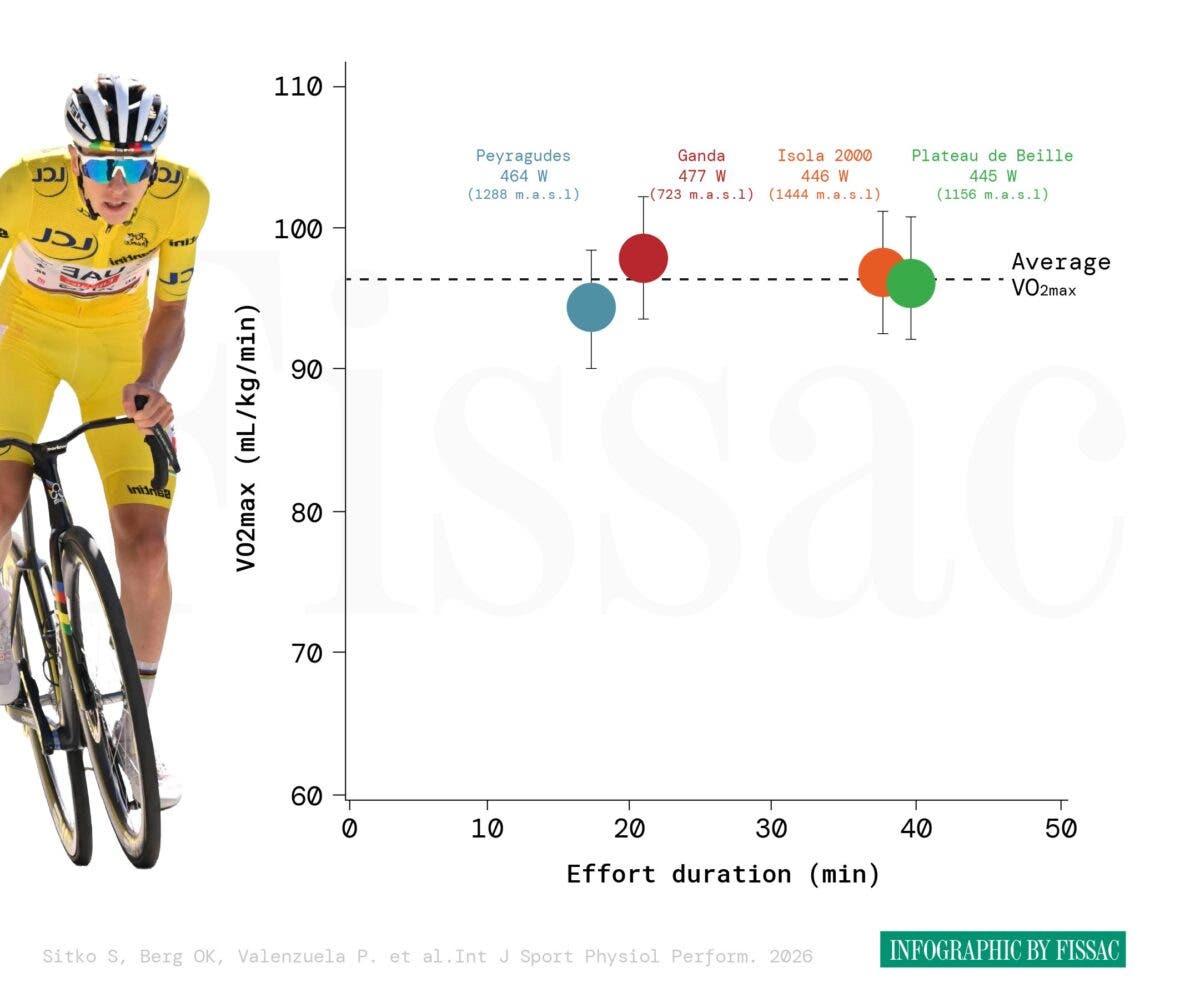
In the study, they calculate the VO2 Max required to produce four of Pogačar’s recent sledgehammer climbing performances.
They chose the Plateau de Beille, Isola 2000 (both from the 2024 Tour de France), Peyragudes (2025 Tour de France), and Passo di Ganda (Il Lombardia 2025) to reflect different outputs over different durations, conditions, and types of race.
Going the long way around to get VO2 Max
The first step of the study was to establish Pogačar’s power output for each climb.
Sadly, Pogačar doesn’t share his numbers to Strava – that kind of juicy intel is kept under lock-and-key by team UAE Emirates-XRG.
Instead, the authors use the verified times and power outputs of other racers on the same climbs to create an estimate. The Strava accounts of several riders who share their data – including Oscar Onley, Derek Gee, and Tobias Johannessen – were mined for information.
The resulting estimates of Pogačar’s power for each climb were then used to derive the required VO2 Max for each performance.
The authors did this by applying well-established theories about how long athletes can sustain certain levels of VO2 Max.
For example, cyclists ride at around 95 percent VO2 Max during an all-out 20-minute effort. Full VO2 Max output is only possible for 3-6 minutes.
Adjustments for body mass, air density, altitude, and wind speed were made throughout the two-part calculation.
The final step of the Pogačar Prediction was to sense-check the model using Froome’s published times and power data, and his tested VO2 Max.
‘Pogačar would need a VO2 Max of between 90 and 102, with an average of 96’
The result of all this?
The study estimates Pogačar pushed VO2 Max scores of 96 on Plateau de Beille, 97 on Isola 2000, 94 on Peyragudes, and 98 on Passo di Ganda.
It’s a shame the study was finalized before Pogačar broke the Alpe d’Huez climbing record with a 35-minute, 7w/kg effort. His ride on stage 19 of this year’s Tour de France is considered alongside Plateau de Beille as his all-time best.
Nonetheless, the authors’ conclusion from their calculations was a mind-blower:
“The results were remarkably consistent. Even under the most conservative assumptions, Pogačar would need a VO2 Max of between 90 and 102 ml/kg/min, with an average of 96 ml/kg/min.”
Who cares about an estimate?
If this all sounds familiar, Berg applied a similar method in 2025 to estimate Pogačar’s VO2 Max to be somewhere in the mid-90s. We wrote about it here.
But what makes the new calculations different is the use of a more robust model and a study that’s been accepted into a more regarded and respected journal.
But all that said, the new calculations still prove nothing.
They’re only a good estimate.
However, it does give us a strong indication that Pogačar’s VO2 Max must be in the mid-90s, minimum – it could be 94, 96, or 98. Heck, it could even break the seemingly impossible barrier of 100 ml/kg/min.
And given that Pogačar keeps his training data a closely guarded secret (except for this carefully timed “leak”), that provides a fascinating new layer of context to help comprehend the world’s greatest cyclist.
We can now say with some certainty that Pog’s FTP is around 430 watts, his zone 2 tops out at around 340 watts, and that his VO2 Max is … insane.
Putting a number on the GOAT
The forthcoming Pog Paper was teased at the perfect time.
Pogačar will win a record-equaling fifth yellow jersey Sunday. After the exit of long-time rival Jonas Vingegaard, the 27-year-old amassed five stage wins and could have taken three more if he wasn’t working for his teammate Isaac del Toro.
It seemed inevitable that Pogačar would win a fifth Tour de France before he retired.
The Slovenian has been redefining what we once thought possible in pro cycling since he hit Peak Pog in 2024.
In fact, he’s barely missed since he switched to a new trainer, Javier Sola, at the start of that year. He learned to love high-carb fueling, heat training, and strength work as part of a new training philosophy that made him near-invulnerable.
His two devastating defeats to Visma-Lease a Bike in 2022 and 2023 on the Col du Granon and Col de La Loze now seem like a footnote.
And of course, this all comes with awkward questions, which we’ll not entertain here.
‘I’m no stronger than I was two years ago’
Speaking Saturday from the Tour de France, Pogačar suggested he might have maxed out his physiology.
Instead, he’s found sustained dominance by improving everything beyond the numbers.
“I don’t feel I’ve been getting much stronger since 2024,” Pogačar said after stage 20 of the Tour. “The numbers are there, but I’ve got more experience. The small things are still improving.
“Maybe the numbers are the same, but details count. My mood and emotions, that’s where I’m improving a lot,” he said. “That’s why I ride good this year.”
If Pogačar’s VO2 Max really is pushing toward three digits, he needn’t worry about raising his endurance ceiling any further – he’s doing just fine as he is.
[analyse_source url=”https://velo.outsideonline.com/road/road-racing/tour-de-france/pogacar-highest-vo2-max/”]