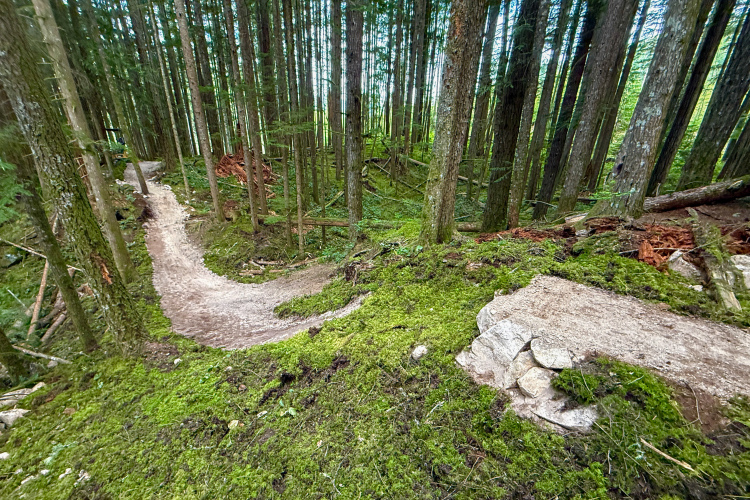
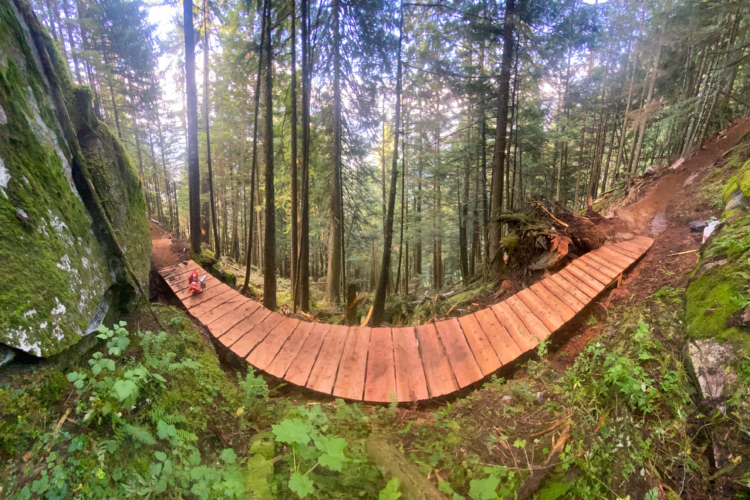
Even without filtering out lift-access bike parks like Whistler, AI software still puts Squamish, BC, as a top “mountain bike destination” in the world – fifth on the list, to be exact. Trails like Half Nelson, Full Nelson, and In-N-Out Burger are often featured on popular brands’ and professional riders’ social media channels.
And all that riding, and all those visitors, takes a significant toll on the area’s trails. So, Tourism Squamish and the Squamish Off-Road Cycling Association (SORCA) have teamed up and are asking visitors to help foot the bill.
More than half of the trail users are visitors
“Squamish’s trail network recorded more than 100,000 mountain-bike rider days between May and October 2023,” Lesley Weeks, Executive Director for Tourism Squamish, shared with Singletracks via email. “Approximately half of that use, about 57,000 rider days, was attributed to visitors.”
Weeks mentioned that the shared data came from a 2023 study conducted by SORCA and specifically targeted mountain bikers. The study also found that 84% of mountain bikers visiting Squamish came for just that — to mountain bike. Riding the trails wasn’t just another activity they would do on their vacation; rather, the trails were the vacation.
It is important to note, however, that “rider days” were tracked and not “unique visits.” This means that a visitor spending a week in Squamish, riding five of those days, counts for five rides, not just one visit. So, “57,000 rider days” doesn’t necessarily mean 57,000 individual mountain biking visitors — obviously, we’re all going to hit the trails more than once on a Squamish trip.
Regardless, 57,000 rider days attributed to out-of-towners is significant. It means that during the six-month window when SORCA conducted the study, more than half of the mountain bikers were from elsewhere.
And all that trail use equals dollars. “Trail maintenance, including SORCA’s trail crew, related expenses, and contractor projects, costs approximately $400,000 per year,” Ian Lowe, Executive Director of SORCA, told us.
And that was just the finance side. Lowe also shared that SORCA’s trail crew puts in roughly 6,000 hours of work into Squamish’s trails annually. On top of that, they also coordinate an additional 2,200 hours of volunteer dig days. Combined, that is nearly one solid year of nonstop maintenance.
“But I’m already spending a bunch of money here…”
Yes, that is true, and it isn’t lost on Tourism Squamish or SORCA. Visitors coming for the trails are also paying for a place to stay and patronizing local restaurants and shops. Without a doubt, that money helps Squamish.
And it isn’t an insignificant amount of money, either.
In 2023, mountain bike visitors generated roughly $26 million in local spending and supported “about 184 local jobs.” Coffee shops, breweries, bike shops, restaurants, and lodging all benefited from mountain bike tourism.
“Visitor spending is extremely important. It supports local businesses, employment, and the broader Squamish economy,” Weeks explained. “The important distinction is that those dollars don’t automatically flow to trail maintenance.”
Unless the owner or employees of an establishment are avid mountain bikers, sales of coffee, scones, beers, and pizza don’t necessarily trickle down to trail maintenance. Weeks said that they hope visiting mountain bikers will see a donation to the trails as “complementary to local visitor spending, not a replacement for it.”
For the Love of the Trails
To help with that six-figure sting, Tourism Squamish and SORCA are asking you, Squamish singletrack sojourner, to do your part on your next visit. To make donating easy, the groups introduced the For the Love of the Trails campaign, creating awareness and an easy way to contribute directly to the trails.
“The campaign grew out of ongoing conversations about the increasing pressure on Squamish’s trail network and the need to create an easy, visible way for visiting riders to contribute directly to the trails they come here to enjoy,” Weeks told us. “At its core, the campaign is about helping riders understand that while the trails are free to ride, they’re not free to maintain. Trails require ongoing maintenance, drainage work, repairs, tools, planning, advocacy, and volunteer coordination.”
While there is no requirement to pay to ride Squamish’s trails, they hope the campaign will begin to normalize the idea of giving back. And they are trying to make it as easy as possible for visitors to do so with links on websites, social media platforms, and QR codes on trailhead signage.
Every little bit counts, with suggested one-time donations starting at $10 CAD, or about $7.13 USD. And as a part of the overall effort, Tourism Squamish will match the donations up to $10,000.
<!–
Related articles
–>
jQuery(function() {
postpayloads._c6304ea04cb0bfbd38b467e6ffb1c249 = {“ids”:”718839,701040,664354,683964″,”posts_per_page”:null,”offset”:0,”style”:”4up”};
postcounter._c6304ea04cb0bfbd38b467e6ffb1c249 = {start: 0, step: 0, end: 0};
});