[analyse_image type=”featured” src=”https://images.euronews.com/articles/stories/09/83/87/26/1200x675_cmsv2_ffb74b3e-ee29-512a-b64c-3b5a7fd2c6e2-9838726.jpg”]

Grand Voyager | Exploring Budapest

Italy: melting ice statues protest heatwave conditions in Rome

Trump urges ICE to continue traffic stops after fatal shootings

The rise of Kazakh skater Mikhail Shaidorov
Grand Voyager | Exploring Budapest
Italy: melting ice statues protest heatwave conditions in Rome
Trump urges ICE to continue traffic stops after fatal shootings
The rise of Kazakh skater Mikhail Shaidorov
Hot nights are stealing people’s sleep, researchers say
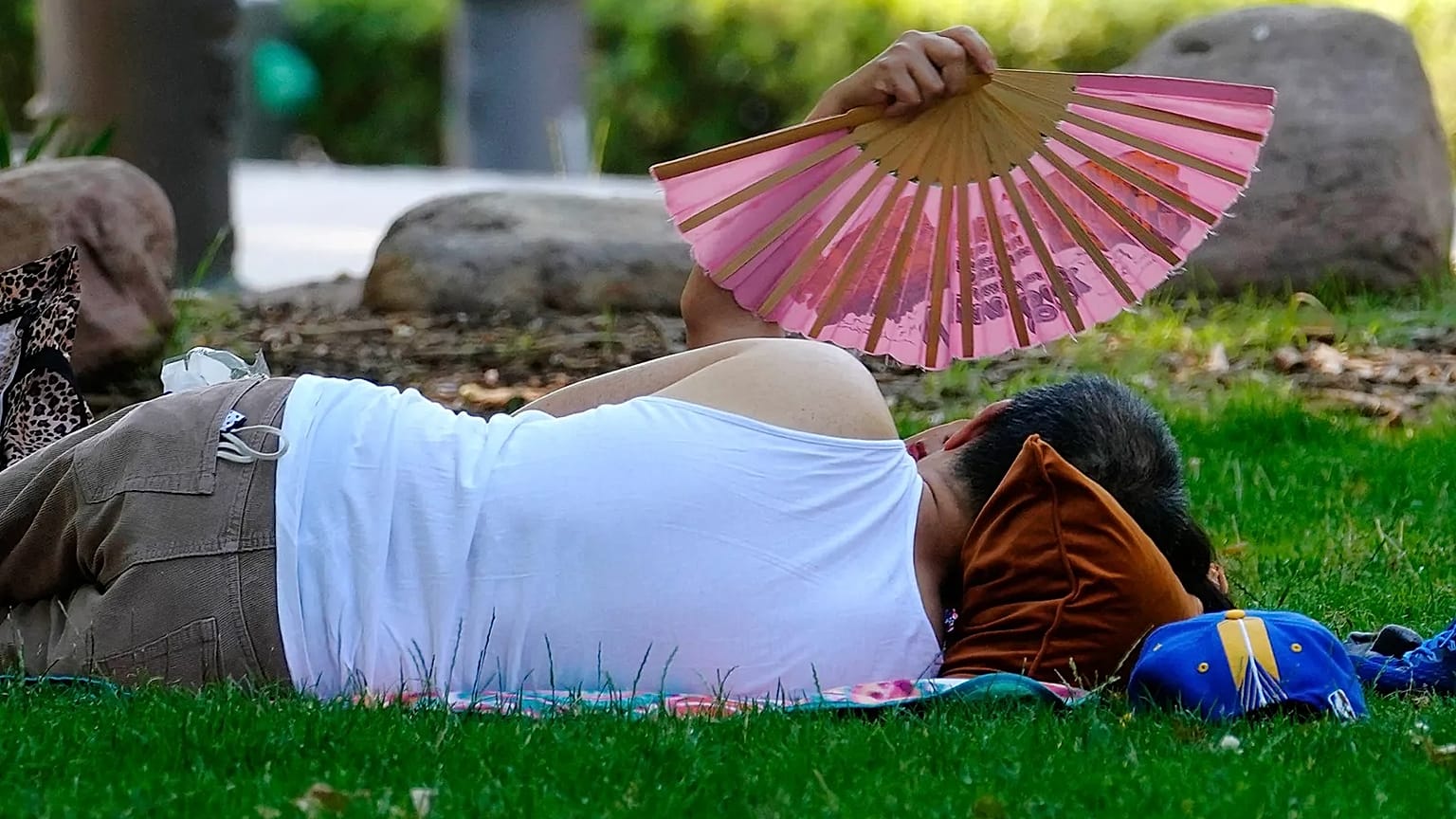
FILE: A woman uses a fan to cool off next to a man lying down in a park in Madrid, Spain.
– Copyright AP Photo/Paul White

 Facebook
 Twitter
 Flipboard
 Send
Send Reddit
 Linkedin
 Messenger
 Telegram
 VK
VK Bluesky
 Threads
 Whatsapp
Rising night-time temperatures driven by climate change are quietly eating into people’s sleep worldwide, with the average person now losing over 50 hours a year, a new analysis has found.
As tropical and hot nights — when the overnight temperature does not fall below 20°C — become more frequent worldwide, people’s sleep is paying the price.
 ADVERTISEMENTADVERTISEMENT
Globally, the average person lost nearly 56 hours of sleep — equivalent to nearly seven nights’ worth of sleep — per year due to high temperatures during the 2020-2025 period, according to a new study by Climate Central.
Across nearly every city out of over 1,300 analysed, the amount of temperature-related sleep loss linked to climate change has at least doubled since the early 1970s. The highest level of sleep loss was in the Middle East and Southeast Asia, where people lost an average of between 55 and 91 hours per year.
In the early 1970s, people living in an average city of 500,000 residents lost about 46 hours of sleep per year due to night-time heat; by the 2020s, that rose to about 50 hours. Between 2020 and 2025, that number rose to 56, and climate change accounts for a larger share of that burden, the analysis found.
Where in Europe are people losing the most sleep?
While extremely warm nights are affecting all cities across the world, the burden is not the same for everyone, and big differences can be seen across continents and within them.
In Europe, the highest sleep losses were seen in the south. People in Naples, Italy, lost 51 hours every year due to heat over the last five years.
In Greece’s capital, Athens, the loss was 45 hours annually, 42 for Valencia in Spain, and 40 in Lisbon, Portugal, and in the French city of Marseille.
However, even in the northernmost countries, while to a lesser extent, people are also suffering from sleep loss due to heat.
People in Edinburgh, Scotland, lost 21 hours, while Stockholm and Helsinki lost 20 hours each. The lowest impact was in Oslo, at 18 hours.
The importance of a good night’s sleep
Sleep plays a major role in the correct functioning of the body during the day.
Night-time is when the body is supposed to recover, but when temperatures fail to cool, this recovery does not happen and the body remains under strain.
Poor sleep has been linked to impacts on mood, cognitive performance, productivity, and cardiovascular and immune health, the authors noted.
While many factors influence sleep, night-time heat is becoming an increasingly important environmental risk as temperatures rise globally and as more people move to urban heat islands, which further amplify heat at night.
Because sleep loss can accumulate over repeated nights, even modest reductions can become harmful over the course of a hot season.
A recent study found that warmer nights affect sleep more than twice as much in adults over 65 as in middle-aged adults, and nearly three times as much in lower-middle-income countries as in high-income countries.
Women and people already living in hotter climates were also more affected — a gap likely to widen as temperatures continue to rise.
Go to accessibility shortcuts
Read more

First portable X-rays taken during spaceflight

First Bundibugyo Ebola vaccine to start human trials in the UK

Ex-footballers show higher depression and anxiety rates, study finds
First portable X-rays taken during spaceflight
First Bundibugyo Ebola vaccine to start human trials in the UK
Ex-footballers show higher depression and anxiety rates, study finds

First portable X-rays taken during spaceflight

First Bundibugyo Ebola vaccine to start human trials in the UK

Blue zone secrets: Why do some Sardinian elders stay so healthy?

Ex-footballers show higher depression and anxiety rates, study finds

Italy’s Calabria region defies US pressure to drop its Cuban doctors
Norovirus outbreak affects over 100 people in Portugal
COVID: Should we fear a new winter wave?
First portable X-rays taken during spaceflight
Blue zone secrets: Why do some Sardinian elders stay so healthy?
Obesity drugs cut weight but don’t improve life quality, study finds
[analyse_source url=”https://www.euronews.com/health/2026/07/15/hot-nights-are-stealing-peoples-sleep-researchers-say”]