[analyse_image type=”featured” src=”https://images.euronews.com/articles/stories/09/83/70/26/1200x675_cmsv2_38662fb5-7c31-5a8e-8fea-b725d01e9cd0-9837026.jpg”]

Almost 60 gored or bruised during Spain’s San Fermín bull runs

Yamal answers Rajoy’s controversial column on France

‘Digger’: Will this film land Tom Cruise his first Oscar win?

Fact check: European Parliament did not call for probe into Infantino
Almost 60 gored or bruised during Spain’s San Fermín bull runs
Yamal answers Rajoy’s controversial column on France
‘Digger’: Will this film land Tom Cruise his first Oscar win?
Fact check: European Parliament did not call for probe into Infantino
Sugar in space? Astronomers find sweet clue to the origin of life
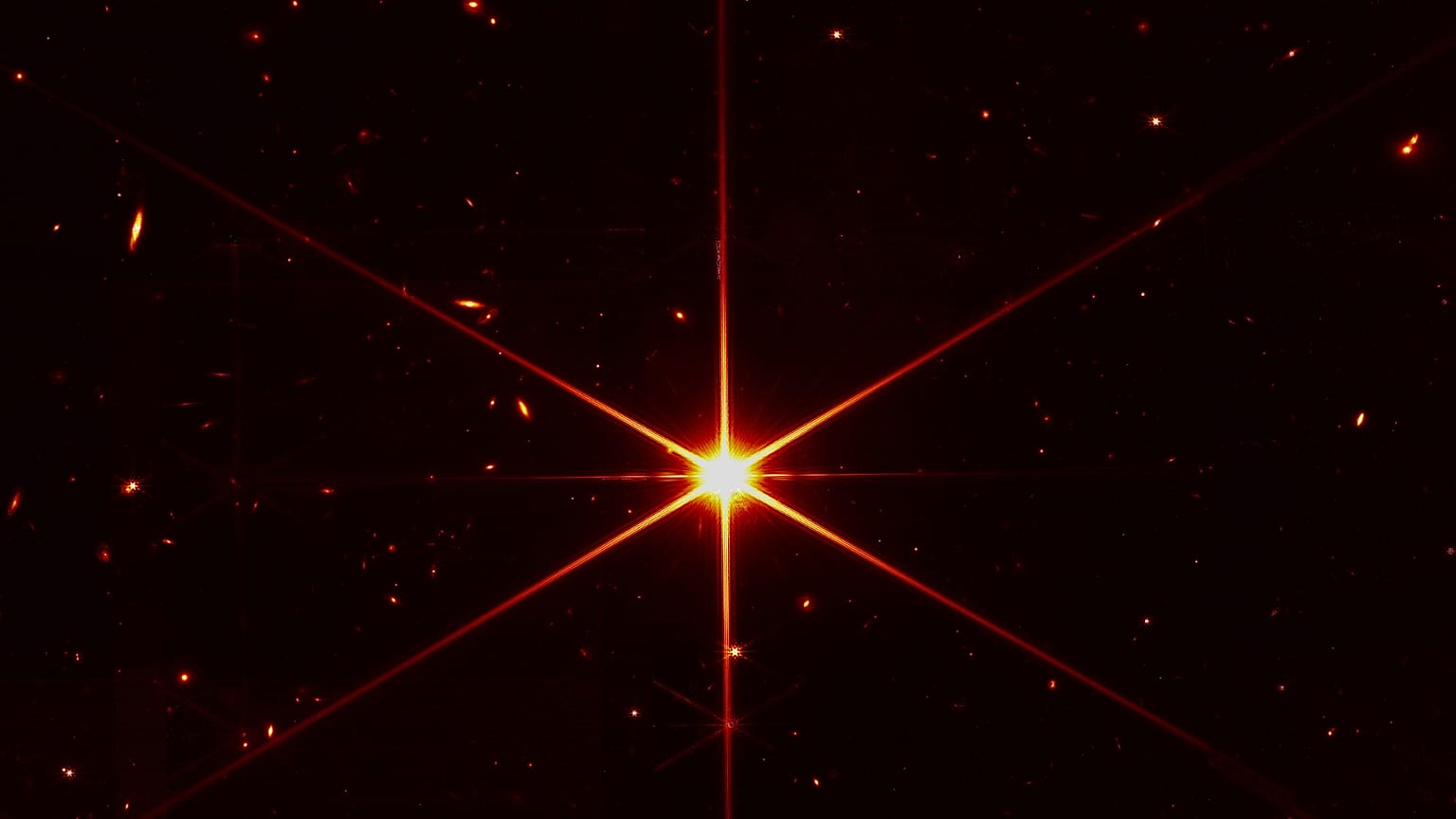
FILE – This image made available by NASA on Wednesday, March 16, 2022 shows star 2MASS J17554042+6551277 used to align the mirrors of the James Webb Space Telescope.
– Copyright AP Photo

 Facebook
 Twitter
 Flipboard
 Send
Send Reddit
 Linkedin
 Messenger
 Telegram
 VK
VK Bluesky
 Threads
 Whatsapp
It turns out the universe has something of a sweet tooth. Astronomers have detected a new type of sugar floating in deep space that may hold clues to how life first emerged on Earth.
The space between stars just got a little sweeter.
 ADVERTISEMENTADVERTISEMENT
Astronomers have detected a type of sugar in space that is also found in raspberries and self-tanners. The sugar, called erythrulose, lurks in what is known as the interstellar medium — thin clouds of gas and dust scattered between stars.
Sugar does more than sweeten tea and coat doughnuts. Different varieties fuel our cells and make up DNA, and scientists are eager to understand how sugars form because they are a key ingredient for life as we know it.
Using two dish-shaped radio telescopes in Spain, researchers collected data from a large gas cloud near the centre of the Milky Way.
They identified the sugar in gas form by comparing telescope signals to samples gathered in a lab. It is the latest variety of sugar detected in space — in a region crossed by NASA’s twin Voyager probes, the farthest spacecraft ever to travel from Earth.
The results were published Monday in the journal Nature Astronomy.
Scientists have found remarkable chemistry in our galaxy before, including building blocks for genetic material and components of the cell.
They spotted a cousin of table sugar near the centre of the Milky Way around 25 years ago, and black grains retrieved from asteroid Bennu by NASA’s Osiris-Rex spacecraft yielded other sugars, among them a key DNA ingredient.
The latest sugar is not essential for life, but can easily convert into a form thought to be crucial to kick-starting it on Earth. It is also one of the most complex sugars spotted in space so far, said astrophysicist Erika Hamden of the University of Arizona.
It is “a pristine example of the stuff that’s just floating out in the galaxy,” said Hamden, who had no role in the new research.
These interstellar investigations are all about understanding how life began. Did distant comets or space rocks deliver the essential ingredients to Earth? Or were the key components already present, eventually giving rise to our solar system?
The new sugar lends weight to the latter theory. Researchers now want to search for more sugars in space and learn how they convert between forms.
Finding them in one location suggests they are likely hiding in distant corners of the galaxy alongside other important molecules, said study author Izaskun Jiménez-Serra, an astrophysicist at the Centre for Astrobiology in Spain.
“The key ingredients for the origin of life could be present in other regions across the galaxy, opening the possibility for life to develop elsewhere in the universe,” Jiménez-Serra said.
Go to accessibility shortcuts
Read more
Artemis II crew reunites with Orion after record-breaking Moon mission
Hyperion GR-1 enters orbit: A new step for Greece’s space programme
Beware space junk: how do ‘space balls’ end up on the beach?
Artemis II crew reunites with Orion after record-breaking Moon mission
Hyperion GR-1 enters orbit: A new step for Greece’s space programme
Beware space junk: how do ‘space balls’ end up on the beach?

Can AI deliver humanitarian aid faster and safer?

Instagram and Facebook fuel ‘addictive’ behaviour, Commission finds

Germany wants Lime and Bolt to foot the bill for e-scooter accidents

Inside the UN AI summit that attracted more visitors than ever

News outlets seek sanctions against OpenAI in copyright battle
Why Chat Control 1.0 is the EU’s most Orwellian law yet
Germany wants Lime and Bolt to foot the bill for e-scooter accidents
Instagram and Facebook fuel ‘addictive’ behaviour, Commission finds
Can AI deliver humanitarian aid faster and safer?
Humanoid robots face off in Beijing’s first high school football final
[analyse_source url=”http://www.euronews.com/next/2026/07/14/sugar-in-space-astronomers-find-sweet-clue-to-the-origin-of-life”]