[analyse_image type=”featured” src=”https://images.euronews.com/articles/stories/09/83/29/41/1200x675_cmsv2_eaeac022-391a-577b-a720-86910204b539-9832941.jpg”]

Oasis and Glasto effect: A record year for UK music tourism in 2025

Greek anti-terror police arrest three after blast kills woman

EU agrees to open new accession phase with Ukraine and Moldova

Met Police investigating donations to Reform UK party, media says
Oasis and Glasto effect: A record year for UK music tourism in 2025
Greek anti-terror police arrest three after blast kills woman
EU agrees to open new accession phase with Ukraine and Moldova
Met Police investigating donations to Reform UK party, media says
Volkswagen unveils four-year plan but lacks backing for overhaul with up to 100,000 job cuts
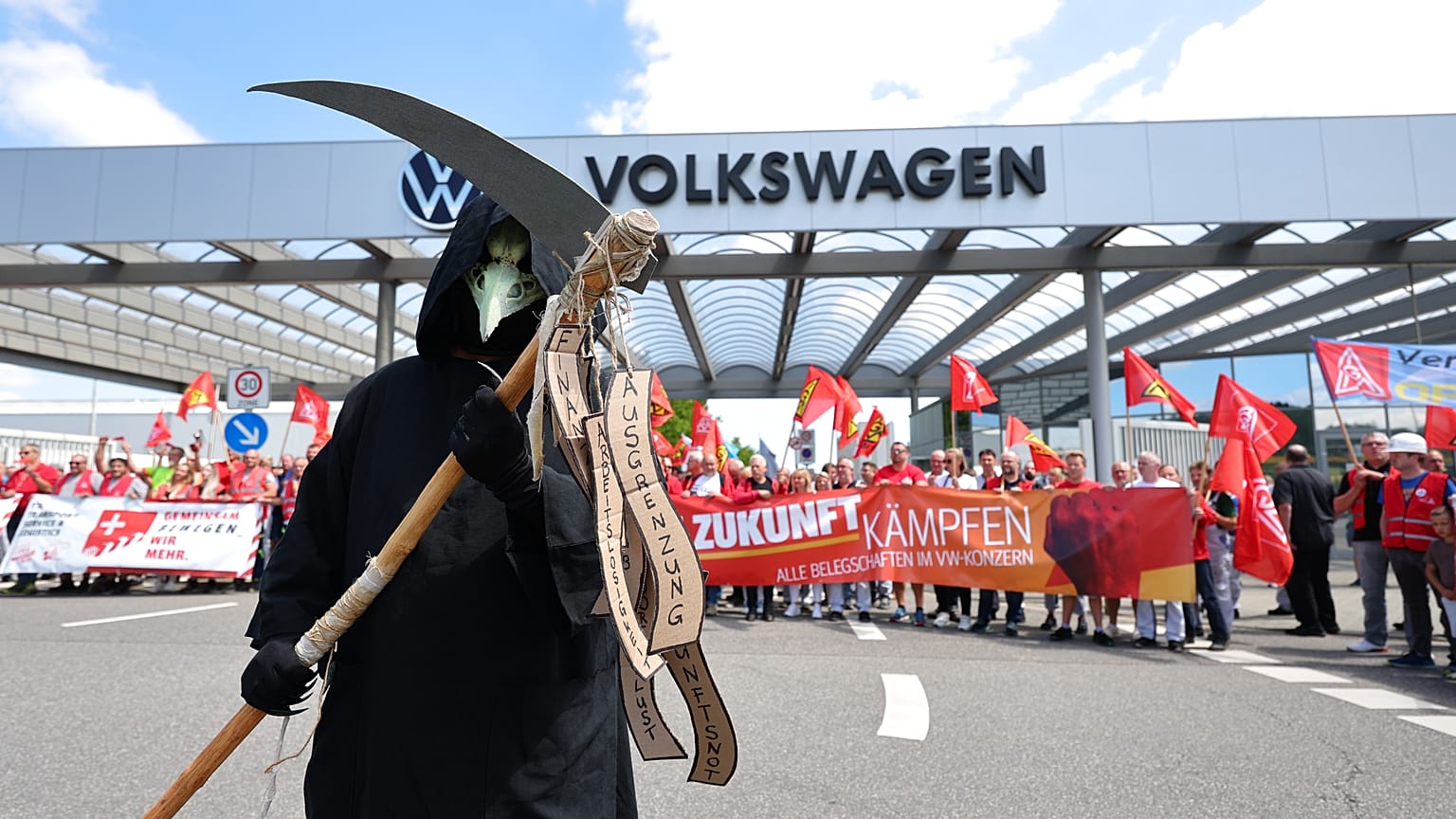
Workers stage a protest in front of the Volkswagen plant in Zwickau, Germany, Thursday, 9 July 2026.
– Copyright Jan Woitas/dpa via AP

 Facebook
 Twitter
 Flipboard
 Send
Send Reddit
 Linkedin
 Messenger
 Telegram
 VK
VK Bluesky
 Threads
 Whatsapp
Volkswagen’s proposed restructuring plan failed to win backing from the labour bloc on the company’s supervisory board on Thursday, leaving uncertainty over additional job cuts and factory closures. The carmaker nevertheless laid out plans to reduce production capacity and simplify its model range.
Volkswagen’s labour representatives on the supervisory board blocked a sweeping restructuring plan at a meeting on Thursday, Reuters reported on Friday, citing company sources.
 ADVERTISEMENTADVERTISEMENT
This comes as Europe’s largest carmaker wrestles with falling profits, rising costs and competition. Volkswagen said on Friday that its global vehicle deliveries fell 8.6% year on year in the second quarter, a steeper decline than in the previous quarter.
The company’s share price was down by 0.6% around noon in Europe. The focus, however, remained on the restructuring proposals that divided the supervisory board.
As the board met at Volkswagen’s headquarters in Wolfsburg on Thursday, IG Metall, one of Germany’s largest trade unions, organised coordinated protests across the country to stop a plan that reportedly includes up to 100,000 job cuts worldwide — more than 15% of its workforce — and closing four plants in Germany: Volkswagen factories in Hanover, Emden and Zwickau, as well as Audi’s Neckarsulm plant.
According to Reuters, citing unnamed company sources, these measures were rejected by the supervisory board on Thursday, which includes labour representatives and representatives of the state of Lower Saxony. The committee voted against management’s proposed restructuring by 12 to seven, after opposition from labour representatives.
Volkswagen made no mention of possible job cuts or plant closures late on Thursday. Instead, after the meeting, Volkswagen unveiled its strategy through to 2030, including plans to halve the number of models it offers and reduce the number of vehicle variants by as much as 75% in an effort to cut costs and complexity, measures that did not require the approval of the supervisory board.
Volkswagen said it would reduce annual production capacity to around 9 million vehicles to respond to “sharply intensified competition”. That compares with capacity of around 12 million vehicles before the Covid-19 pandemic and about 10 million today.
Other measures include tailoring products and technology more closely to regional markets, aligning production capacity to match demand, and simplifying the group’s corporate structure and investment portfolio.
Volkswagen chief executive Oliver Blume said in a video statement that “the global situation has deteriorated over the past 12 months”, pointing to geopolitical tensions, tariffs, high costs, increasing regulation and intensifying global competition.
He also said Volkswagen needed to “get rid of excess capacity”, leaving open the possibility of factory closures in the longer term. Blume added that “digitalisation, artificial intelligence and shared services will help increase productivity and speed”.
Arno Antlitz, Volkswagen Group’s chief financial officer, said the cost reductions already agreed were “not sufficient in the current economic and geopolitical environment”.
He said the company planned to improve vehicle cost structures, “significantly reduce overhead costs”, increase plant efficiency and accelerate technology development and decision-making.
Volkswagen employs about 657,000 people worldwide, but the company has not said how the planned reduction in production capacity would affect its workforce. According to Reuters, Volkswagen’s works council has demanded clarification on management’s cost-cutting plans by the end of Friday.
The group has repeatedly argued that deeper restructuring is necessary after its net profit fell 28% to €1.56bn while revenue declined 2.5% year on year to €75.7bn in the quarter to March 2026.
“The next few years will decide who will play a decisive role in the automotive industry in the future,” Blume said.
Go to accessibility shortcuts
Read more

Global oil demand set for first annual drop since COVID, IEA says
EasyJet backs Apollo’s £5.7bn takeover bid over Castlelake
EasyJet backs Apollo’s £5.7bn takeover bid over Castlelake
Global oil demand set for first annual drop since COVID, IEA says
EasyJet backs Apollo’s £5.7bn takeover bid over Castlelake
EasyJet backs Apollo’s £5.7bn takeover bid over Castlelake

Global oil demand set for first annual drop since COVID, IEA says
EasyJet backs Apollo’s £5.7bn takeover bid over Castlelake

A new millionaire every 15 minutes in France: How does Europe compare?
Spain’s BBVA bank and former chairman to stand trial over spying

Can a new global defence bank unlock £100bn for rearmament?
Digital euro enters final round of EU negotiations
House prices and rents: Where did they rise most in early 2026?
The five fastest-growing economies in Europe over the next five years
A new millionaire every 15 minutes in France: How does Europe compare?
Volkswagen weighs 100,000 job cuts in battle for survival
[analyse_source url=”https://www.euronews.com/business/2026/07/10/volkswagen-unveils-four-year-plan-as-questions-remain-over-jobs-and-plants”]