[analyse_image type=”featured” src=”https://cdn.mos.cms.futurecdn.net/VCjESWYkcb72EwT3kcjjiH-2000-80.png”]
‘Tadej keeps on surprising us’ – The inside view on how UAE Team Emirates-XRG have constructed Tadej Pogačar’s assault on a fifth Tour de France
The High Temperature Protocol, switching dates, racing in the morning – What could the future of the Tour de France look like as summer temperatures continue to rise?
Tips to stay cool and safe when cycling in the heat
Is heat training playing with fire? There are hidden risks, but here’s how to do it safely
MEMBER EXCLUSIVE
By
Zach Nehr
published
Zach Nehr investigates the potentially hidden risks behind heat training – from the obvious to the surprising – and how cyclists can do it safely to reap performance rewards
-
Facebook
-
X
-
Pinterest
-
Email
0
Follow us
There is an overwhelming amount of scientific and anecdotal evidence that heat training works. So why doesn’t every cyclist do heat training? In fact, one could estimate that only 10-20% of competitive cyclists heat train regularly. Perhaps you’ve tried a block or two of heat training before, but it can be difficult to stick to long-term. Science suggests that’s where the greatest performance benefits lie, so why do we stop heat training?
Some athletes are scared of it – in a way, you can’t fault them. The goal of a heat training session is to increase your core body temperature to at least 38.5° C for 30-60 minutes. Some sessions may be even longer or hotter, but the fact of the matter is, you are increasing your core temperature to flu-like levels.
Is this dangerous? I wasn’t sure, so I went straight to the experts to learn about the intricacies of heat training. I spoke to doctors, physiologists, trainers, and athletes about the potential dangers of heat training. Anecdotally, heat training is like magic for many cyclists. But I’ve had many other athletes come to me saying that heat training didn’t work for them, that it made them dizzy or fatigued.
There seems to be a fine line here, the border between physiological gains and pushing it too far. I asked experts about dizziness, fatigue, dehydration, iron levels, and even the effect that heat training could have on sperm count and fertility. The answers I found certainly surprised me.
Dizziness and fatigue
One of the most common concerns I hear about heat training is that cyclists start feeling dizzy partway through their heat training session.
This can be extremely off-putting especially if you’ve never experienced dizziness on the bike. Thankfully, most heat training sessions are done indoors on a stationary trainer, so there isn’t a risk of crashing or riding off the road. However, dizziness is still a concern.
Aline Barre, Endurance Performance Lead at CORE (Body Temperature Sensor), said that “dizziness is a sign of overdoing it.” If you’re feeling dizzy, it likely means that your core temperature is too high, you are dehydrated, or you are pushing at too high of an intensity. When this occurs, lower your power, hydrate, turn on a fan, or step off the bike if you need to.
But sometimes, the fatigue hits after the heat session rather than during. Some riders end up with significant amounts of fatigue after heat training. Because they’re riding in zone 1, they may think that heat training sessions are easy recovery sessions. While this may be true for experienced, heat-acclimated athletes, this isn’t true for everyone. If you’re new to heat training, or you’ve just begun a heat training block, your body might not be fully adapted to the demands of heat training yet.
A post shared by CORE Body Temperature (@corebodytemp)
A photo posted by on
The first adaptations occur after around five heat sessions, said Barre. These adaptations include, “decrease in heart rate, increase in sweat rate, and better performance in the heat. Female athletes may see more changes in heart rate, while males may see more changes in sweat.”
Total heat adaptation takes 10-14 sessions, and Barre provided a beginner recommendation of “three weekly sessions for four weeks.”
It’s important to monitor your recovery and fatigue during and after heat training sessions. Dr. Kevin Sprouse, professional cycling consultant who worked for EF Education-EasyPost for more than a decade, said, “Heat training does have its downsides. Heat is an additional stress,” on the body that, when used in the right dosage, “causes super compensation.” Like any other training protocol, heat stress isn’t necessarily the best thing for your body, but it can certainly improve your performance.
“Most things that are going to help you peak are things we don’t want to do everyday or long term,” said Dr. Sprouse. “If performance is the greatest concern, then you accept the trade off.”
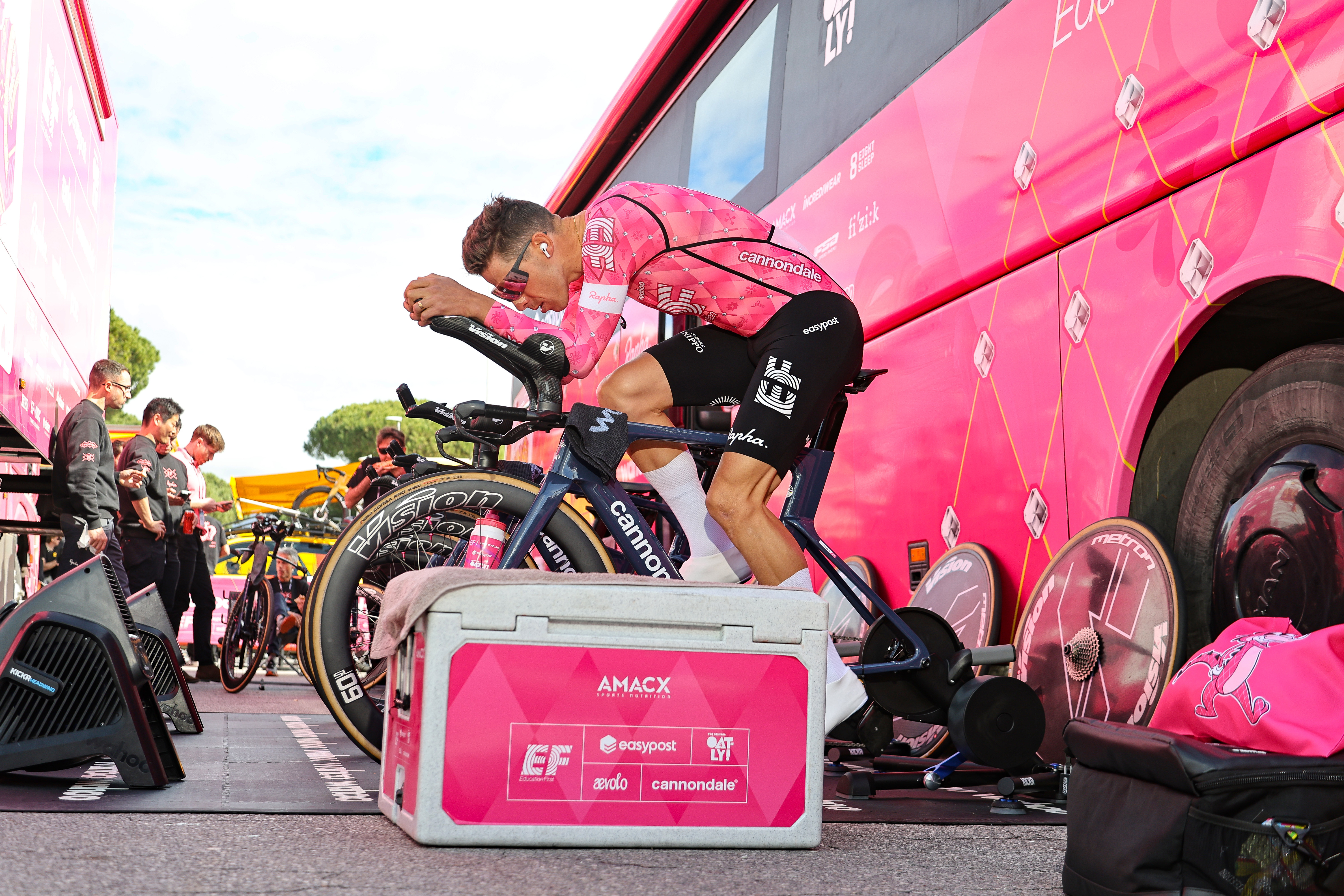
Professional cyclists don’t do VO2 Max intervals and eat 150g of carbohydrates per hour 365 days a year. But in the right dosage, these are the kinds of practices that lead to significant improvements in performance. It all comes back to the basic training principle of progressive overload: you stress the body with a stimulus, then you allow your body to recover, and in that time it overcompensates and builds itself stronger.
Heat training-induced fatigue is not unlike any other form of overtraining. The biggest mistake that riders make, Dr. Sprouse said, is adding heat training on top of the training they are already doing. Heat training is a big stress on the body, so if you are already handling a heavy training load, the addition of heat training could push you over the edge. Instead, it’s best to pull back on other aspects of training to allow room for heat sessions to fit into your plan.
Altitude training is more popular than ever, but still, most WorldTour riders are hesitant to heat train at altitude. Instead, many WorldTour cyclists do a block of heat training before altitude, then continue heat training in maintenance mode at the high-altitude camp. The difference we’re talking about is five weekly sessions during a big heat training block, versus two to three sessions per week to maintain the benefits from heat training.
Another one of the most overlooked effects of heat training is sleep. Heat training can affect the quality of your sleep, and Dr. Sprouse said that he had seen many riders who struggle with sleeping during a heat training block. These riders were “always struggling with falling asleep,” but a cooling mattress could be used to blunt this effect. In fact, Dr. Sprouse recommended a cooling mattress all the time, not only when heat training.
To maximise the benefits of heat training, you wouldn’t want to jump in an ice bath immediately following an active heat training session. But you would want to cool your core temperature down before bed time, maximising sleep quality and day-to-day recovery.
The dangers of dehydration
One of the first things that you’ll notice when you first start heat training is the changes in your sweat rate and volume. These physiological changes will make most athletes start sweating sooner, and end up sweating more in total. Despite the clean up job required, these changes are a good thing. Your body is becoming more efficient at cooling itself, starting that process sooner through sweat, and continuing to keep the body cool for long periods of time.
But with sweat comes dehydration, and this is one of the most common mistakes that athletes make when heat training. You will probably need to drink more than you think. In fact, you might need to drink more than you ever have before. There are no additional physiological benefits associated with dehydration during heat training, said Barre. Not drinking enough is needless suffering.
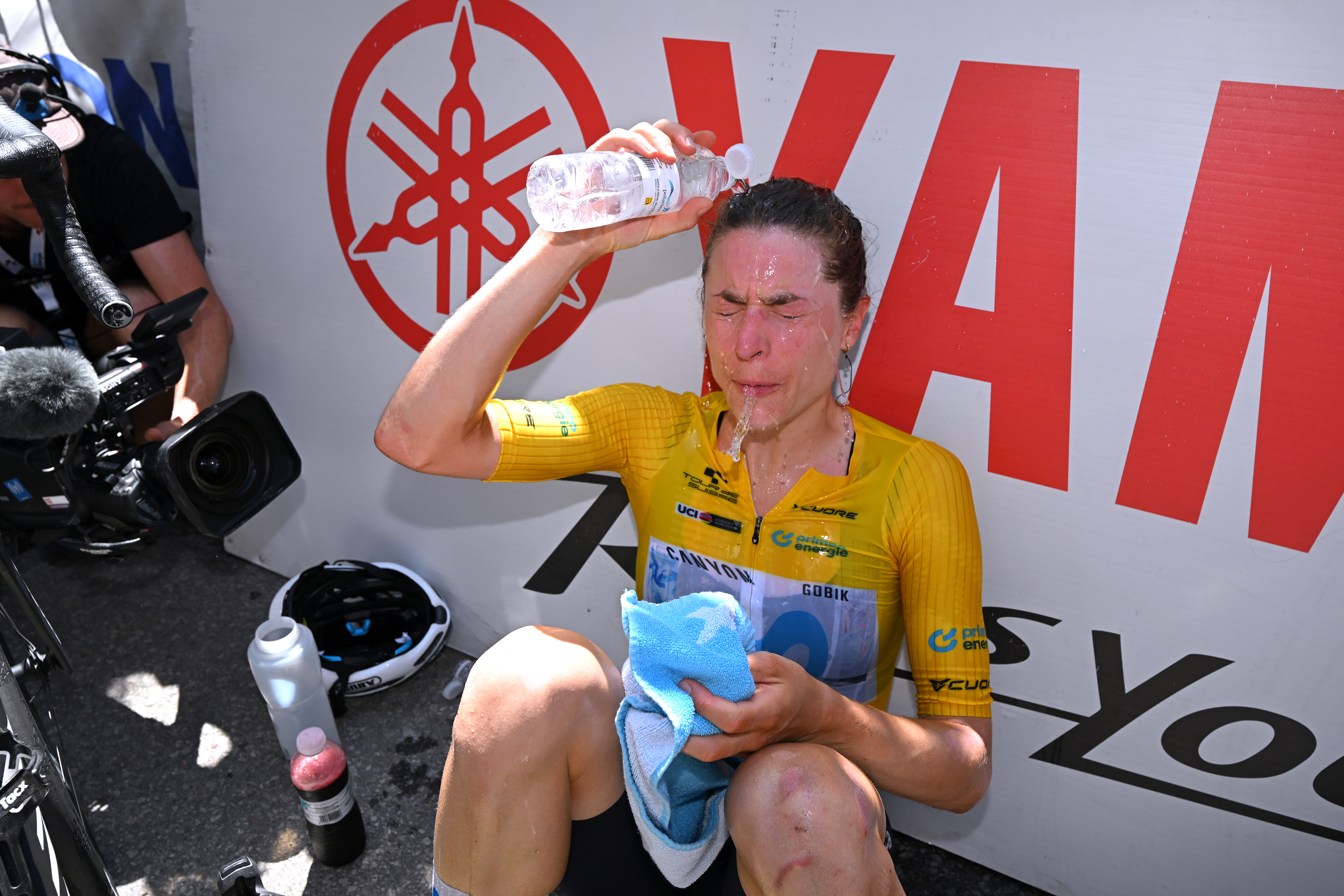
You can calculate your sweat rate in many different ways, and Barre said the best way to measure fluid loss is to “go onto a scale naked and measure how much weight you lost during the heat session.”
Weigh before and weigh after, it’s extremely simple. “Avoid more than 2% body mass loss during heat training,” said Ross McGraw, CEO of CORE. That can take a few practice sessions to calculate, but the math is simple.
Most riders have a sweat rate of 1.5 to 2 litres per hour, but this can vary. During heat training, the “goal is to replace 150% of your fluid loss during and after the session,” McGraw said. That means if you are losing two litres of fluid during a heat session, you should replace it with three litres of fluid over the next few hours.
We cyclists also know the importance of carbohydrates, and that applies to heat training despite most sessions lasting less than 90 minutes. “Carbohydrate needs are higher at higher core temps,” Barre said, and we actually use, “10-20% more carbs in a heat session.” Barre recommends always fueling during and or after a heat training ride due to higher carbohydrate oxidation.
There can be other changes to your physiology as a result of heat training. CEO of Nix Biosensors, Meridith Cass, said that your “sweat can begin having a lower sodium concentration with heat adaptation.” Sweat rate and volume also varies between sports and environments, so you can’t always use the exact same hydration protocol. A pro’s hydration plan at the December training camp will not be effective during the hottest mountain stage of the Tour de France, for example.
If and when you experience dehydration, it’s best to lower your exercise intensity and take on fluids with electrolytes. It’s quite difficult to overconsume electrolytes while sweating and exercising intensely, but the other side of the spectrum is the extremely dangerous threat of hyponatremia. This is caused by under-replenishing electrolytes, mostly likely because you’ve been drinking pure water.
It is a, “safer bet to hedge on the higher electrolytes side,” Cass said.
This made me think about the consumption of salts and potential effects on our overall health. With consistent training and exercise, consuming electrolyte-rich drinks isn’t a concern. But there was one other topic that I had yet to explore. It took me weeks of research to find an expert on the subject, but I’m glad I did.
Does heat training affect fertility?
You may have heard the news that repeated sauna exposure decreases measures of sperm health and motility in men. You may also have heard that multiple weeks of intense cycling training causes similar effects on sperm health. Do you see where I’m going with this?
While we don’t have a study that shows a direct link between active heat training and sperm health, “we can extrapolate from what’s out there. The question is: does that matter?” Dr. Sprouse has seen countless studies on heat training and sperm health, but he did not at all seem concerned about a potential link between the two.
Anecdotally, there are millions of cyclists, men and women, who are having kids. A certain percentage of the population may struggle to get pregnant, but there doesn’t seem to be a strong link between this group and heat training. If there seems to be an issue, the effects of heat and cycling on sperm health are, “entirely reversible. The spermatogenesis cycle is about 60-90 days,” meaning that you can cease heat training or cycling for a few months if you’re having difficulties conceiving, said Dr. Sprouse.
That is good news for any and all cyclists who dream of having kids in the future.
Is heat training worth it?
Heat training is like any other form of competitive sport training – when applied correctly and in the right dosage, heat training can help you smash your PBs and achieve your peak fitness level. But if you happen to overdo it, you will suffer the consequences.
It’s just like strength training, VO2 Max intervals, or altitude training. If you go to the gym twice per week and complete a cycling-specific programme, you will probably make some significant strength gains. But if you start going to the gym every day and lifting the heaviest weights possible, it won’t be long until you are burnt out or injured.
The same goes for heat training. Follow the right protocol at the correct intensity and volume, and it’s more than likely that you’ll make significant fitness gains. There currently isn’t any evidence that going ‘bigger’ with heat training causes additional gains. The sweet spot seems to be three to five heat sessions per week for two to three weeks to build heat adaptations, or two heat sessions per week long-term to maintain those physiological adaptations.

In fact, you could argue that heat training is even better than altitude or strength training. Some riders respond to altitude and gym work better than others. But there are actually some riders who don’t respond at all. Altitude training has actually made some riders worse, so much so that they refuse to go to altitude camps in the future. CORE has tested hundreds of professional cyclists, and there have been plenty of non-responders to altitude. But those same riders were all responders to heat training. Everyone that they have ever tested responded positively to heat training. Mads Pedersen, for example, generally doesn’t train at altitude but can be found riding in a CORE suit.
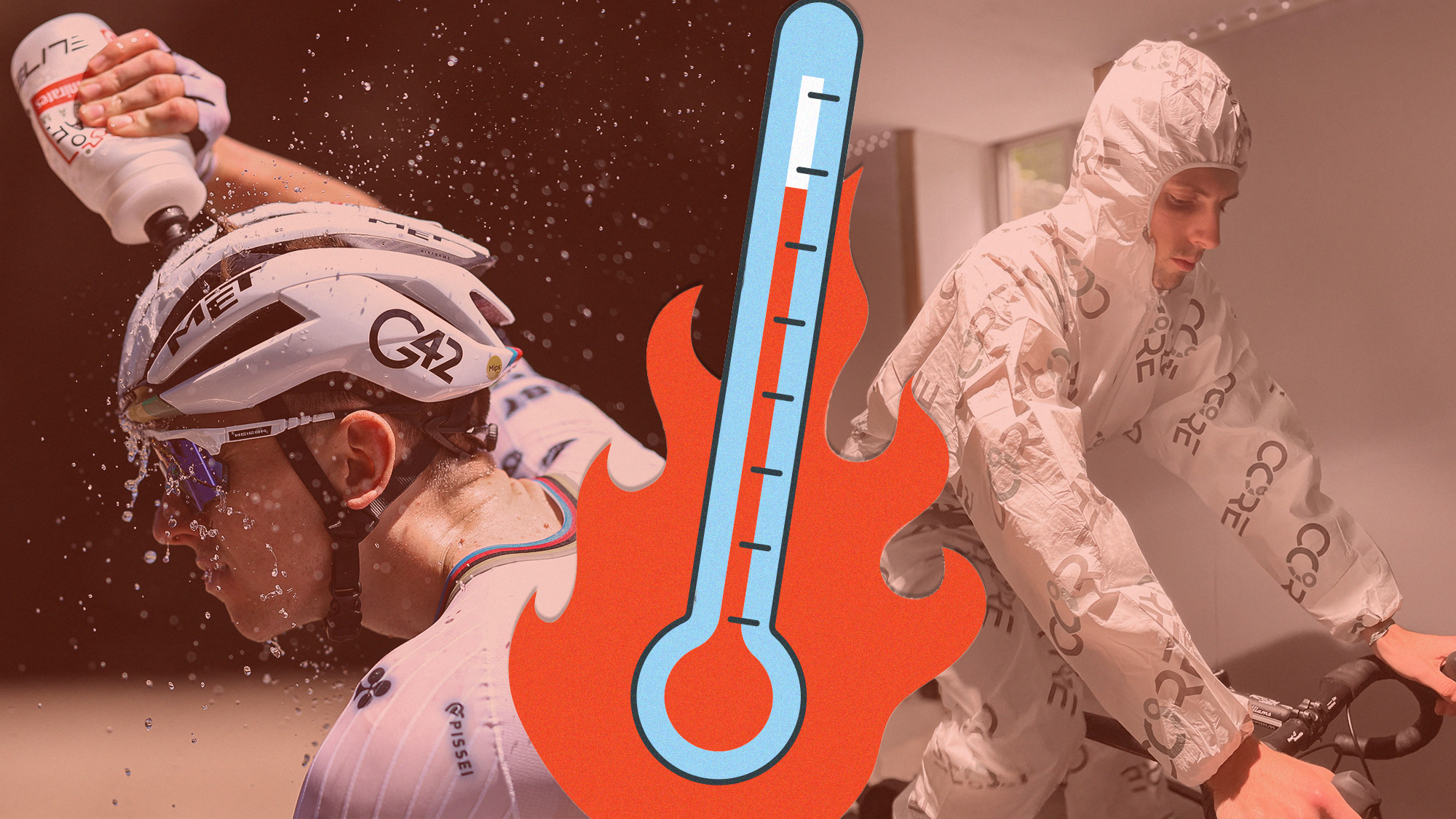
That is the reason that many of the world’s fastest cyclists are heat training. Why else would Tadej Pogačar or Remco Evenepoel be sitting on an indoor trainer on a warm and sunny day in Spain? They could be riding around in the mountains, but instead, they are wearing a sauna suit in the backyard, spinning away at 200w and making gains from heat training.
Zach is a freelance writer, the head of ZNehr Coaching, and an elite-level rider in road, track, and e-racing. He writes about everything cycling-related, from buyer’s guides to product reviews and feature articles to power analyses. After earning a Bachelor’s Degree in Exercise Science at Marian University-Indianapolis, Zach discovered a passion for writing that soon turned into a full-fledged career. In between articles, Zach spends his time working with endurance athletes of all abilities and ages at ZNehr Coaching. After entering the sport at age 17, Zach went on to have a wonderful road racing career that included winning the 2017 Collegiate National Time Trial Championships and a 9th place finish at the 2019 US Pro National Time Trial Championships. Nowadays, Zach spends most of his ride time indoors with NeXT eSport.
You must confirm your public display name before commenting
Please logout and then login again, you will then be prompted to enter your display name.
-
 1Win Fin, Flow Fork, Speed Sniffer: Specialized launches ‘fastest road bike ever made’ in the S-Works Tarmac SL9
 -
2‘We did not design it to win a comparison table’ – Look’s new race bike blends aero with real-world performance
-
3‘Everything can change in the Tour de France on any day’ – Ever-ambitious Juan Ayuso sets podium goal as Lidl-Trek balance leaders
-
4Alpecin-Premier Tech Tour de France line-up provides powerful back-up for leading stage hunters Jasper Philipsen and Mathieu van der Poel
-
5Tadej Pogačar has a million dollar Richard Mille watch for the Tour de France, but what are the chances of him actually wearing it?
Is heat training playing with fire? There are hidden risks, but here’s how to do it safely
MEMBER EXCLUSIVE
By
Zach Nehr
published
Zach Nehr investigates the potentially hidden risks behind heat training – from the obvious to the surprising – and how cyclists can do it safely to reap performance rewards
-
Facebook
-
X
-
Pinterest
-
Email
0
Follow us
There is an overwhelming amount of scientific and anecdotal evidence that heat training works. So why doesn’t every cyclist do heat training? In fact, one could estimate that only 10-20% of competitive cyclists heat train regularly. Perhaps you’ve tried a block or two of heat training before, but it can be difficult to stick to long-term. Science suggests that’s where the greatest performance benefits lie, so why do we stop heat training?
Some athletes are scared of it – in a way, you can’t fault them. The goal of a heat training session is to increase your core body temperature to at least 38.5° C for 30-60 minutes. Some sessions may be even longer or hotter, but the fact of the matter is, you are increasing your core temperature to flu-like levels.
Is this dangerous? I wasn’t sure, so I went straight to the experts to learn about the intricacies of heat training. I spoke to doctors, physiologists, trainers, and athletes about the potential dangers of heat training. Anecdotally, heat training is like magic for many cyclists. But I’ve had many other athletes come to me saying that heat training didn’t work for them, that it made them dizzy or fatigued.
There seems to be a fine line here, the border between physiological gains and pushing it too far. I asked experts about dizziness, fatigue, dehydration, iron levels, and even the effect that heat training could have on sperm count and fertility. The answers I found certainly surprised me.
Dizziness and fatigue
One of the most common concerns I hear about heat training is that cyclists start feeling dizzy partway through their heat training session.
This can be extremely off-putting especially if you’ve never experienced dizziness on the bike. Thankfully, most heat training sessions are done indoors on a stationary trainer, so there isn’t a risk of crashing or riding off the road. However, dizziness is still a concern.
Aline Barre, Endurance Performance Lead at CORE (Body Temperature Sensor), said that “dizziness is a sign of overdoing it.” If you’re feeling dizzy, it likely means that your core temperature is too high, you are dehydrated, or you are pushing at too high of an intensity. When this occurs, lower your power, hydrate, turn on a fan, or step off the bike if you need to.
But sometimes, the fatigue hits after the heat session rather than during. Some riders end up with significant amounts of fatigue after heat training. Because they’re riding in zone 1, they may think that heat training sessions are easy recovery sessions. While this may be true for experienced, heat-acclimated athletes, this isn’t true for everyone. If you’re new to heat training, or you’ve just begun a heat training block, your body might not be fully adapted to the demands of heat training yet.
A post shared by CORE Body Temperature (@corebodytemp)
A photo posted by on
The first adaptations occur after around five heat sessions, said Barre. These adaptations include, “decrease in heart rate, increase in sweat rate, and better performance in the heat. Female athletes may see more changes in heart rate, while males may see more changes in sweat.”
Total heat adaptation takes 10-14 sessions, and Barre provided a beginner recommendation of “three weekly sessions for four weeks.”
It’s important to monitor your recovery and fatigue during and after heat training sessions. Dr. Kevin Sprouse, professional cycling consultant who worked for EF Education-EasyPost for more than a decade, said, “Heat training does have its downsides. Heat is an additional stress,” on the body that, when used in the right dosage, “causes super compensation.” Like any other training protocol, heat stress isn’t necessarily the best thing for your body, but it can certainly improve your performance.
“Most things that are going to help you peak are things we don’t want to do everyday or long term,” said Dr. Sprouse. “If performance is the greatest concern, then you accept the trade off.”
Professional cyclists don’t do VO2 Max intervals and eat 150g of carbohydrates per hour 365 days a year. But in the right dosage, these are the kinds of practices that lead to significant improvements in performance. It all comes back to the basic training principle of progressive overload: you stress the body with a stimulus, then you allow your body to recover, and in that time it overcompensates and builds itself stronger.
Heat training-induced fatigue is not unlike any other form of overtraining. The biggest mistake that riders make, Dr. Sprouse said, is adding heat training on top of the training they are already doing. Heat training is a big stress on the body, so if you are already handling a heavy training load, the addition of heat training could push you over the edge. Instead, it’s best to pull back on other aspects of training to allow room for heat sessions to fit into your plan.
Altitude training is more popular than ever, but still, most WorldTour riders are hesitant to heat train at altitude. Instead, many WorldTour cyclists do a block of heat training before altitude, then continue heat training in maintenance mode at the high-altitude camp. The difference we’re talking about is five weekly sessions during a big heat training block, versus two to three sessions per week to maintain the benefits from heat training.
Another one of the most overlooked effects of heat training is sleep. Heat training can affect the quality of your sleep, and Dr. Sprouse said that he had seen many riders who struggle with sleeping during a heat training block. These riders were “always struggling with falling asleep,” but a cooling mattress could be used to blunt this effect. In fact, Dr. Sprouse recommended a cooling mattress all the time, not only when heat training.
To maximise the benefits of heat training, you wouldn’t want to jump in an ice bath immediately following an active heat training session. But you would want to cool your core temperature down before bed time, maximising sleep quality and day-to-day recovery.
The dangers of dehydration
One of the first things that you’ll notice when you first start heat training is the changes in your sweat rate and volume. These physiological changes will make most athletes start sweating sooner, and end up sweating more in total. Despite the clean up job required, these changes are a good thing. Your body is becoming more efficient at cooling itself, starting that process sooner through sweat, and continuing to keep the body cool for long periods of time.
But with sweat comes dehydration, and this is one of the most common mistakes that athletes make when heat training. You will probably need to drink more than you think. In fact, you might need to drink more than you ever have before. There are no additional physiological benefits associated with dehydration during heat training, said Barre. Not drinking enough is needless suffering.
You can calculate your sweat rate in many different ways, and Barre said the best way to measure fluid loss is to “go onto a scale naked and measure how much weight you lost during the heat session.”
Weigh before and weigh after, it’s extremely simple. “Avoid more than 2% body mass loss during heat training,” said Ross McGraw, CEO of CORE. That can take a few practice sessions to calculate, but the math is simple.
Most riders have a sweat rate of 1.5 to 2 litres per hour, but this can vary. During heat training, the “goal is to replace 150% of your fluid loss during and after the session,” McGraw said. That means if you are losing two litres of fluid during a heat session, you should replace it with three litres of fluid over the next few hours.
We cyclists also know the importance of carbohydrates, and that applies to heat training despite most sessions lasting less than 90 minutes. “Carbohydrate needs are higher at higher core temps,” Barre said, and we actually use, “10-20% more carbs in a heat session.” Barre recommends always fueling during and or after a heat training ride due to higher carbohydrate oxidation.
There can be other changes to your physiology as a result of heat training. CEO of Nix Biosensors, Meridith Cass, said that your “sweat can begin having a lower sodium concentration with heat adaptation.” Sweat rate and volume also varies between sports and environments, so you can’t always use the exact same hydration protocol. A pro’s hydration plan at the December training camp will not be effective during the hottest mountain stage of the Tour de France, for example.
If and when you experience dehydration, it’s best to lower your exercise intensity and take on fluids with electrolytes. It’s quite difficult to overconsume electrolytes while sweating and exercising intensely, but the other side of the spectrum is the extremely dangerous threat of hyponatremia. This is caused by under-replenishing electrolytes, mostly likely because you’ve been drinking pure water.
It is a, “safer bet to hedge on the higher electrolytes side,” Cass said.
This made me think about the consumption of salts and potential effects on our overall health. With consistent training and exercise, consuming electrolyte-rich drinks isn’t a concern. But there was one other topic that I had yet to explore. It took me weeks of research to find an expert on the subject, but I’m glad I did.
Does heat training affect fertility?
You may have heard the news that repeated sauna exposure decreases measures of sperm health and motility in men. You may also have heard that multiple weeks of intense cycling training causes similar effects on sperm health. Do you see where I’m going with this?
While we don’t have a study that shows a direct link between active heat training and sperm health, “we can extrapolate from what’s out there. The question is: does that matter?” Dr. Sprouse has seen countless studies on heat training and sperm health, but he did not at all seem concerned about a potential link between the two.
Anecdotally, there are millions of cyclists, men and women, who are having kids. A certain percentage of the population may struggle to get pregnant, but there doesn’t seem to be a strong link between this group and heat training. If there seems to be an issue, the effects of heat and cycling on sperm health are, “entirely reversible. The spermatogenesis cycle is about 60-90 days,” meaning that you can cease heat training or cycling for a few months if you’re having difficulties conceiving, said Dr. Sprouse.
That is good news for any and all cyclists who dream of having kids in the future.
Is heat training worth it?
Heat training is like any other form of competitive sport training – when applied correctly and in the right dosage, heat training can help you smash your PBs and achieve your peak fitness level. But if you happen to overdo it, you will suffer the consequences.
It’s just like strength training, VO2 Max intervals, or altitude training. If you go to the gym twice per week and complete a cycling-specific programme, you will probably make some significant strength gains. But if you start going to the gym every day and lifting the heaviest weights possible, it won’t be long until you are burnt out or injured.
The same goes for heat training. Follow the right protocol at the correct intensity and volume, and it’s more than likely that you’ll make significant fitness gains. There currently isn’t any evidence that going ‘bigger’ with heat training causes additional gains. The sweet spot seems to be three to five heat sessions per week for two to three weeks to build heat adaptations, or two heat sessions per week long-term to maintain those physiological adaptations.
In fact, you could argue that heat training is even better than altitude or strength training. Some riders respond to altitude and gym work better than others. But there are actually some riders who don’t respond at all. Altitude training has actually made some riders worse, so much so that they refuse to go to altitude camps in the future. CORE has tested hundreds of professional cyclists, and there have been plenty of non-responders to altitude. But those same riders were all responders to heat training. Everyone that they have ever tested responded positively to heat training. Mads Pedersen, for example, generally doesn’t train at altitude but can be found riding in a CORE suit.
That is the reason that many of the world’s fastest cyclists are heat training. Why else would Tadej Pogačar or Remco Evenepoel be sitting on an indoor trainer on a warm and sunny day in Spain? They could be riding around in the mountains, but instead, they are wearing a sauna suit in the backyard, spinning away at 200w and making gains from heat training.
Zach is a freelance writer, the head of ZNehr Coaching, and an elite-level rider in road, track, and e-racing. He writes about everything cycling-related, from buyer’s guides to product reviews and feature articles to power analyses. After earning a Bachelor’s Degree in Exercise Science at Marian University-Indianapolis, Zach discovered a passion for writing that soon turned into a full-fledged career. In between articles, Zach spends his time working with endurance athletes of all abilities and ages at ZNehr Coaching. After entering the sport at age 17, Zach went on to have a wonderful road racing career that included winning the 2017 Collegiate National Time Trial Championships and a 9th place finish at the 2019 US Pro National Time Trial Championships. Nowadays, Zach spends most of his ride time indoors with NeXT eSport.
You must confirm your public display name before commenting
Please logout and then login again, you will then be prompted to enter your display name.
-
1Win Fin, Flow Fork, Speed Sniffer: Specialized launches ‘fastest road bike ever made’ in the S-Works Tarmac SL9
-
2‘We did not design it to win a comparison table’ – Look’s new race bike blends aero with real-world performance
-
3‘Everything can change in the Tour de France on any day’ – Ever-ambitious Juan Ayuso sets podium goal as Lidl-Trek balance leaders
-
4Alpecin-Premier Tech Tour de France line-up provides powerful back-up for leading stage hunters Jasper Philipsen and Mathieu van der Poel
-
5Tadej Pogačar has a million dollar Richard Mille watch for the Tour de France, but what are the chances of him actually wearing it?
Is heat training playing with fire? There are hidden risks, but here’s how to do it safely
MEMBER EXCLUSIVE
By
Zach Nehr
published
Zach Nehr investigates the potentially hidden risks behind heat training – from the obvious to the surprising – and how cyclists can do it safely to reap performance rewards
-
Facebook
-
X
-
Pinterest
-
Email
0
Follow us
There is an overwhelming amount of scientific and anecdotal evidence that heat training works. So why doesn’t every cyclist do heat training? In fact, one could estimate that only 10-20% of competitive cyclists heat train regularly. Perhaps you’ve tried a block or two of heat training before, but it can be difficult to stick to long-term. Science suggests that’s where the greatest performance benefits lie, so why do we stop heat training?
Some athletes are scared of it – in a way, you can’t fault them. The goal of a heat training session is to increase your core body temperature to at least 38.5° C for 30-60 minutes. Some sessions may be even longer or hotter, but the fact of the matter is, you are increasing your core temperature to flu-like levels.
Is this dangerous? I wasn’t sure, so I went straight to the experts to learn about the intricacies of heat training. I spoke to doctors, physiologists, trainers, and athletes about the potential dangers of heat training. Anecdotally, heat training is like magic for many cyclists. But I’ve had many other athletes come to me saying that heat training didn’t work for them, that it made them dizzy or fatigued.
There seems to be a fine line here, the border between physiological gains and pushing it too far. I asked experts about dizziness, fatigue, dehydration, iron levels, and even the effect that heat training could have on sperm count and fertility. The answers I found certainly surprised me.
Dizziness and fatigue
One of the most common concerns I hear about heat training is that cyclists start feeling dizzy partway through their heat training session.
This can be extremely off-putting especially if you’ve never experienced dizziness on the bike. Thankfully, most heat training sessions are done indoors on a stationary trainer, so there isn’t a risk of crashing or riding off the road. However, dizziness is still a concern.
Aline Barre, Endurance Performance Lead at CORE (Body Temperature Sensor), said that “dizziness is a sign of overdoing it.” If you’re feeling dizzy, it likely means that your core temperature is too high, you are dehydrated, or you are pushing at too high of an intensity. When this occurs, lower your power, hydrate, turn on a fan, or step off the bike if you need to.
But sometimes, the fatigue hits after the heat session rather than during. Some riders end up with significant amounts of fatigue after heat training. Because they’re riding in zone 1, they may think that heat training sessions are easy recovery sessions. While this may be true for experienced, heat-acclimated athletes, this isn’t true for everyone. If you’re new to heat training, or you’ve just begun a heat training block, your body might not be fully adapted to the demands of heat training yet.
A post shared by CORE Body Temperature (@corebodytemp)
A photo posted by on
The first adaptations occur after around five heat sessions, said Barre. These adaptations include, “decrease in heart rate, increase in sweat rate, and better performance in the heat. Female athletes may see more changes in heart rate, while males may see more changes in sweat.”
Total heat adaptation takes 10-14 sessions, and Barre provided a beginner recommendation of “three weekly sessions for four weeks.”
It’s important to monitor your recovery and fatigue during and after heat training sessions. Dr. Kevin Sprouse, professional cycling consultant who worked for EF Education-EasyPost for more than a decade, said, “Heat training does have its downsides. Heat is an additional stress,” on the body that, when used in the right dosage, “causes super compensation.” Like any other training protocol, heat stress isn’t necessarily the best thing for your body, but it can certainly improve your performance.
“Most things that are going to help you peak are things we don’t want to do everyday or long term,” said Dr. Sprouse. “If performance is the greatest concern, then you accept the trade off.”
Professional cyclists don’t do VO2 Max intervals and eat 150g of carbohydrates per hour 365 days a year. But in the right dosage, these are the kinds of practices that lead to significant improvements in performance. It all comes back to the basic training principle of progressive overload: you stress the body with a stimulus, then you allow your body to recover, and in that time it overcompensates and builds itself stronger.
Heat training-induced fatigue is not unlike any other form of overtraining. The biggest mistake that riders make, Dr. Sprouse said, is adding heat training on top of the training they are already doing. Heat training is a big stress on the body, so if you are already handling a heavy training load, the addition of heat training could push you over the edge. Instead, it’s best to pull back on other aspects of training to allow room for heat sessions to fit into your plan.
Altitude training is more popular than ever, but still, most WorldTour riders are hesitant to heat train at altitude. Instead, many WorldTour cyclists do a block of heat training before altitude, then continue heat training in maintenance mode at the high-altitude camp. The difference we’re talking about is five weekly sessions during a big heat training block, versus two to three sessions per week to maintain the benefits from heat training.
Another one of the most overlooked effects of heat training is sleep. Heat training can affect the quality of your sleep, and Dr. Sprouse said that he had seen many riders who struggle with sleeping during a heat training block. These riders were “always struggling with falling asleep,” but a cooling mattress could be used to blunt this effect. In fact, Dr. Sprouse recommended a cooling mattress all the time, not only when heat training.
To maximise the benefits of heat training, you wouldn’t want to jump in an ice bath immediately following an active heat training session. But you would want to cool your core temperature down before bed time, maximising sleep quality and day-to-day recovery.
The dangers of dehydration
One of the first things that you’ll notice when you first start heat training is the changes in your sweat rate and volume. These physiological changes will make most athletes start sweating sooner, and end up sweating more in total. Despite the clean up job required, these changes are a good thing. Your body is becoming more efficient at cooling itself, starting that process sooner through sweat, and continuing to keep the body cool for long periods of time.
But with sweat comes dehydration, and this is one of the most common mistakes that athletes make when heat training. You will probably need to drink more than you think. In fact, you might need to drink more than you ever have before. There are no additional physiological benefits associated with dehydration during heat training, said Barre. Not drinking enough is needless suffering.
You can calculate your sweat rate in many different ways, and Barre said the best way to measure fluid loss is to “go onto a scale naked and measure how much weight you lost during the heat session.”
Weigh before and weigh after, it’s extremely simple. “Avoid more than 2% body mass loss during heat training,” said Ross McGraw, CEO of CORE. That can take a few practice sessions to calculate, but the math is simple.
Most riders have a sweat rate of 1.5 to 2 litres per hour, but this can vary. During heat training, the “goal is to replace 150% of your fluid loss during and after the session,” McGraw said. That means if you are losing two litres of fluid during a heat session, you should replace it with three litres of fluid over the next few hours.
We cyclists also know the importance of carbohydrates, and that applies to heat training despite most sessions lasting less than 90 minutes. “Carbohydrate needs are higher at higher core temps,” Barre said, and we actually use, “10-20% more carbs in a heat session.” Barre recommends always fueling during and or after a heat training ride due to higher carbohydrate oxidation.
There can be other changes to your physiology as a result of heat training. CEO of Nix Biosensors, Meridith Cass, said that your “sweat can begin having a lower sodium concentration with heat adaptation.” Sweat rate and volume also varies between sports and environments, so you can’t always use the exact same hydration protocol. A pro’s hydration plan at the December training camp will not be effective during the hottest mountain stage of the Tour de France, for example.
If and when you experience dehydration, it’s best to lower your exercise intensity and take on fluids with electrolytes. It’s quite difficult to overconsume electrolytes while sweating and exercising intensely, but the other side of the spectrum is the extremely dangerous threat of hyponatremia. This is caused by under-replenishing electrolytes, mostly likely because you’ve been drinking pure water.
It is a, “safer bet to hedge on the higher electrolytes side,” Cass said.
This made me think about the consumption of salts and potential effects on our overall health. With consistent training and exercise, consuming electrolyte-rich drinks isn’t a concern. But there was one other topic that I had yet to explore. It took me weeks of research to find an expert on the subject, but I’m glad I did.
Does heat training affect fertility?
You may have heard the news that repeated sauna exposure decreases measures of sperm health and motility in men. You may also have heard that multiple weeks of intense cycling training causes similar effects on sperm health. Do you see where I’m going with this?
While we don’t have a study that shows a direct link between active heat training and sperm health, “we can extrapolate from what’s out there. The question is: does that matter?” Dr. Sprouse has seen countless studies on heat training and sperm health, but he did not at all seem concerned about a potential link between the two.
Anecdotally, there are millions of cyclists, men and women, who are having kids. A certain percentage of the population may struggle to get pregnant, but there doesn’t seem to be a strong link between this group and heat training. If there seems to be an issue, the effects of heat and cycling on sperm health are, “entirely reversible. The spermatogenesis cycle is about 60-90 days,” meaning that you can cease heat training or cycling for a few months if you’re having difficulties conceiving, said Dr. Sprouse.
That is good news for any and all cyclists who dream of having kids in the future.
Is heat training worth it?
Heat training is like any other form of competitive sport training – when applied correctly and in the right dosage, heat training can help you smash your PBs and achieve your peak fitness level. But if you happen to overdo it, you will suffer the consequences.
It’s just like strength training, VO2 Max intervals, or altitude training. If you go to the gym twice per week and complete a cycling-specific programme, you will probably make some significant strength gains. But if you start going to the gym every day and lifting the heaviest weights possible, it won’t be long until you are burnt out or injured.
The same goes for heat training. Follow the right protocol at the correct intensity and volume, and it’s more than likely that you’ll make significant fitness gains. There currently isn’t any evidence that going ‘bigger’ with heat training causes additional gains. The sweet spot seems to be three to five heat sessions per week for two to three weeks to build heat adaptations, or two heat sessions per week long-term to maintain those physiological adaptations.
In fact, you could argue that heat training is even better than altitude or strength training. Some riders respond to altitude and gym work better than others. But there are actually some riders who don’t respond at all. Altitude training has actually made some riders worse, so much so that they refuse to go to altitude camps in the future. CORE has tested hundreds of professional cyclists, and there have been plenty of non-responders to altitude. But those same riders were all responders to heat training. Everyone that they have ever tested responded positively to heat training. Mads Pedersen, for example, generally doesn’t train at altitude but can be found riding in a CORE suit.
That is the reason that many of the world’s fastest cyclists are heat training. Why else would Tadej Pogačar or Remco Evenepoel be sitting on an indoor trainer on a warm and sunny day in Spain? They could be riding around in the mountains, but instead, they are wearing a sauna suit in the backyard, spinning away at 200w and making gains from heat training.
[analyse_source url=”https://www.cyclingnews.com/cycling-culture/training/is-heat-training-playing-with-fire-there-are-hidden-risks-but-heres-how-to-do-it-safely/”]