[analyse_image type=”featured” src=”https://images.euronews.com/articles/stories/09/81/96/22/1200x675_cmsv2_128ce7db-0aa8-5ac5-a1ee-27b250e25f79-9819622.jpg”]

EU set for China trade ‘conflict’ without autumn deal, EPP boss says

Mexico fans celebrate World Cup win over Ecuador

‘We cannot kill our industry due to climate change,’ Weber says

Where do graduates struggle the most to find a job?
EU set for China trade ‘conflict’ without autumn deal, EPP boss says
Mexico fans celebrate World Cup win over Ecuador
‘We cannot kill our industry due to climate change,’ Weber says
Where do graduates struggle the most to find a job?
Kazakhstan looks to boost oil exports via Baku-Tbilisi-Ceyhan pipeline after Georgia talks in Astana
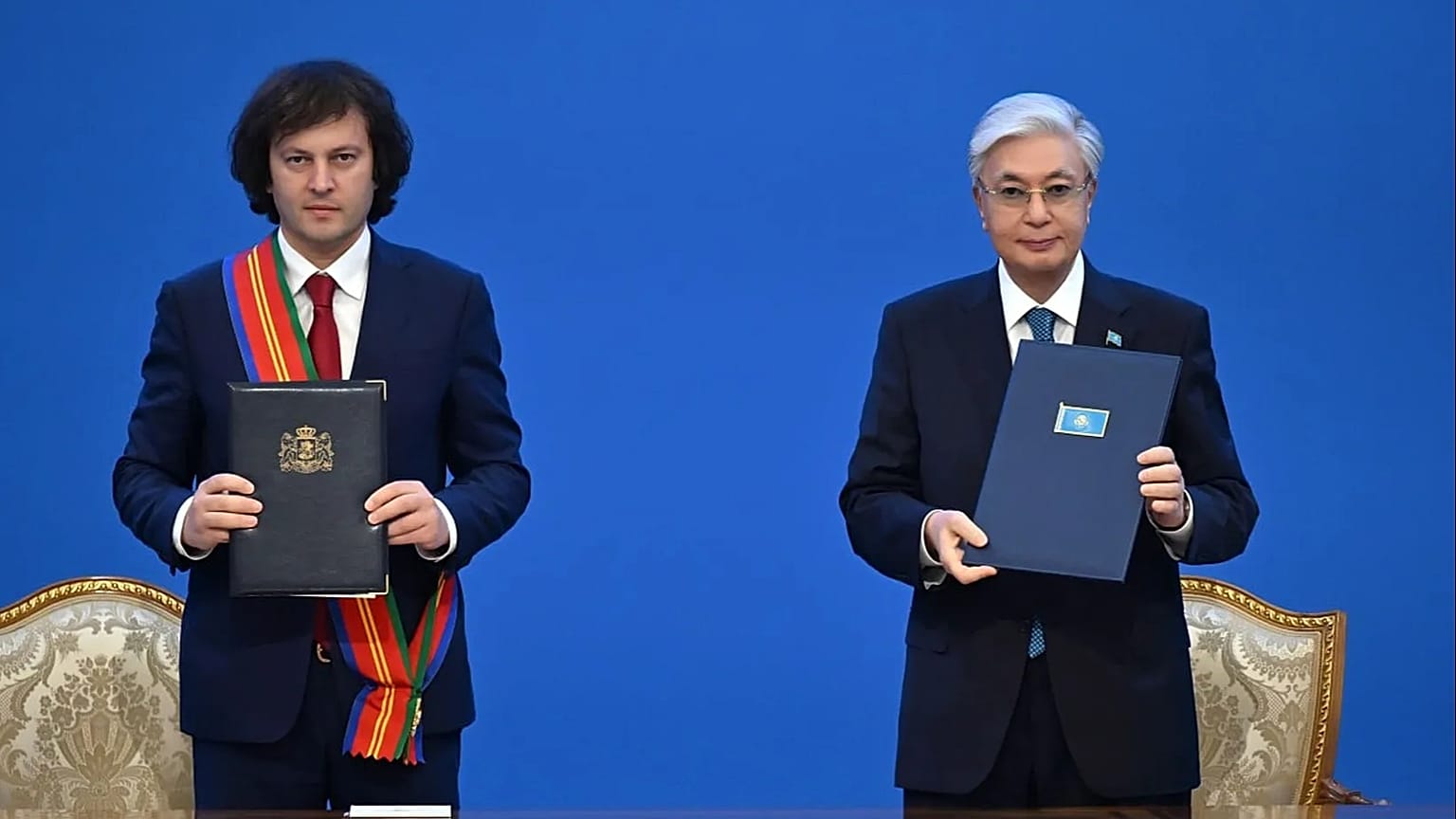
Kassym-Jomart Tokayev held talks with the Prime Minister of Georgia, Irakli Kobakhidze
– Copyright Akorda presidential press service

 Facebook
 Twitter
 Flipboard
 Send
Send Reddit
 Linkedin
 Messenger
 Telegram
 VK
VK Bluesky
 Threads
 Whatsapp
In high-level talks held in Astana, Kazakhstan and Georgia agreed to strengthen economic cooperation, including plans to increase oil shipments via the BTC pipeline. The two countries also discussed agricultural development, investment expansion, and cooperation in digital services.
Kazakhstan plans to increase oil exports through the Baku-Tbilisi-Ceyhan (BTC) pipeline as it deepens strategic ties with Georgia, following talks between President Kassym-Jomart Tokayev and Georgian Prime Minister Irakli Kobakhidze in Astana.
 ADVERTISEMENTADVERTISEMENT
The announcement comes as Kazakhstan continues to diversify its export routes through the Trans-Caspian International Transport Route (TITR), also known as the Middle Corridor.
Transit volumes along the route have grown nearly fourfold over the past five years. By 2029, Kazakhstan expects up to 3,000 container trains to operate annually along the corridor linking China with Europe via Kazakhstan, the Caspian Sea, Azerbaijan and Georgia.
“We plan to increase oil shipments through the Baku-Tbilisi-Ceyhan pipeline. Work is already underway within the intergovernmental commission on trade and economic cooperation, and I hope today’s meeting will help set new priorities for the future,” said Tokayev.
Astana also plans to strengthen its presence in Georgia’s Black Sea ports.
Alongside the Batumi oil terminal, owned by Kazakhstan’s KazTransOil, the country is expanding logistics infrastructure in Poti, where a new multimodal terminal opened last year with Kazakh investment. Officials also identified the future deep-sea port of Anaklia as another promising project.
Economic ties continue to grow
Bilateral trade reached $184.5 million in 2025, while trade during the first four months of 2026 totalled $53 million.
More than 600 companies with Georgian participation currently operate in Kazakhstan, while 14 organisations are registered at the Astana International Financial Centre.
“Trade and investment remain the foundation of Kazakhstan-Georgia relations. Despite global uncertainty, bilateral trade still has significant room for growth,” said the Kazakh president.
“Kazakhstan has invested more than $500 million in Georgia’s economy and remains one of its largest investors,” he added.
Tokayev also proposed developing a bilateral roadmap focused on energy, transport, investment, agriculture, digitalisation and tourism.
The two countries agreed to expand trade in agricultural products and develop joint investment projects in the sector. Trade in agricultural goods increased by 77% in 2025, exceeding $116 million.
Kazakhstan is seeking to increase exports of grain, flour, vegetable oils, pasta, meat, dairy products, chocolate and confectionery to Georgia.
“Kazakhstan is a very important partner for Georgia. We welcome the establishment of a strategic partnership between our countries and look forward to expanding cooperation across all areas,” Kobakhidze said.
Building digital and strengthening cultural ties
The two governments also pledged to deepen cooperation in digital technologies and AI. Officials agreed to exchange expertise in e-government services, GovTech solutions and digital public services.
Kazakhstan also welcomed participation by Georgian start-ups and technology companies in Astana Hub and other regional innovation initiatives.
Tourism was also discussed during the talks. Around 180,000 Kazakh tourists visit Georgia every year, with direct flights operating from Almaty, Astana, Shymkent, Aktau and Atyrau to Tbilisi, Batumi and Kutaisi.
Tokayev proposed organising reciprocal cultural festivals to deepen exchanges between the two countries.
The visit concluded with the signing of the Joint Statement on Strategic Partnership, along with three memoranda covering cooperation in culture, AI and digital development, and tourism.
Go to accessibility shortcuts
Read more
Kazakhstan and UAE launch construction of €1.2bn wind farm
Kazakhstan signs €10bn in deals with Europe as Tokayev wraps Brussels visit
Montenegro’s Adriatic port of Bar eyed as potential Middle Corridor link
Five pressing tasks for Ireland as it takes over EU Council presidency
‘We cannot kill our industry due to climate change,’ Weber says

France sweep past Sweden and Mexico advanced to last 16

EU slaps €3 duty fee on SHEIN, Temu and AliExpress imports

Mexico fans celebrate World Cup win over Ecuador
Where do workers lose the biggest share of their salaries in Europe?
EU ends tax loophole exploited by SHEIN, Temu, and Aliexpress
Monaco blast not being probed as ‘terrorist’ attack, prosecutor says
Europe’s record heatwave shifts east, death toll tops 1,300
Iran prepares largest state funeral in history for slain ayatollah
[analyse_source url=”https://www.euronews.com/2026/07/01/kazakhstan-looks-to-boost-oil-exports-via-baku-tbilisi-ceyhan-pipeline-after-georgia-talks”]