[analyse_image type=”featured” src=”https://velo-cdn.outsideonline.com/wp-content/uploads/2026/06/Z8C_8061.jpg”]
The Tour de France still speaks French.
Sure, English has become the language of the modern peloton, but every July the race slips back into its native tongue.
Some words, like peloton and maillot jaune, are instantly familiar to even the most casual cycling fan.
Others, like bordure, prix citron and souplesse, need a little bit more translation.
The sport keeps getting more global and more teams now operate in English, but the language of the Tour remains unmistakably French.
Here’s your guide to the words and phrases that define cycling’s biggest race.
Words you’ll hear every day
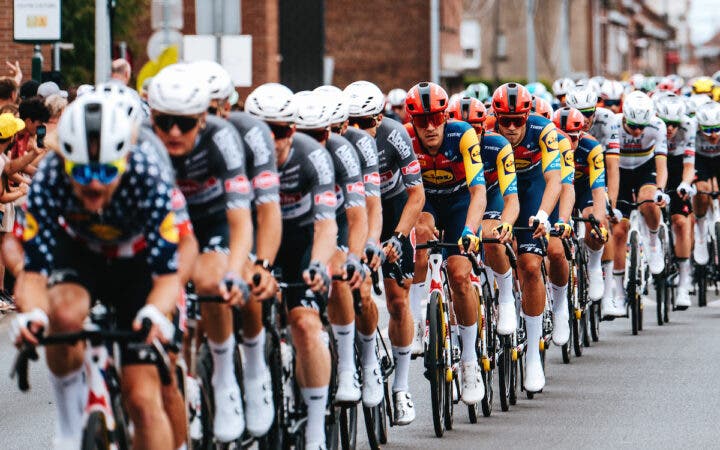
These are the basics that you’ll need to get through the three weeks of racing.
Peloton
This is the main pack of riders at the Tour de France. It moves like a single mass, protects itself from the wind, but can be brutally unforgiving for anyone who can’t keep up.
Bidon
Why do cyclists call a water bottle a bidon? Because French riders do, and it’s one French word that’s definitely stuck. You’d never hear a self-respecting pro say “pass me a water bottle.”
Musette
The small bag handed to riders at the feed zone, usually containing food, gels, and maybe a cold can of Coca-Cola. Fans often scramble for these as souvenirs.
Souplesse
Perhaps one of cycling’s most untranslatable words. It’s that smooth, almost effortless-looking pedal stroke that purists love. Jacques Anquetil had it and so did Bradley Wiggins. Chris Froome did not, so that proves it’s not a prerequisite to victory.
Ravitaillement
The feed zone where soigneurs hand up musettes to riders in the middle of a stage. There are designated feed zones and there’s a set distance in each stage when teams can no longer pass up food at risk of a time penalty.
Col
Simply means mountain pass in French. You’ll hear it dozens of times in every day in Pyrénées and Alps.
Words that explain la tactique
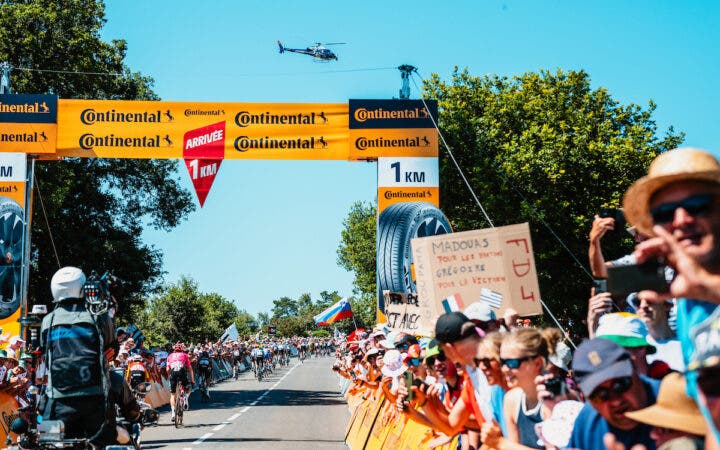
Breakaways, crosswinds, and time bonuses can change the Tour in an instant. Here are the words behind the tactics.
Échappée
The breakaway, a group of attacking riders who break the grip of the peloton. And in a race dominated by sprinters, climbers, or GC specialists, it’s one of the few chances for nearly everyone else in the bunch to go for a stage win. Most are caught, but those who survive and win are heroes.
Départ fictif
The start before the official start. These can be up to several kilometers long, and are typically a rollout from a congested city center. Strange things can happen in the “neutral start,” and punctures, crashes and cheeky attacks all still count.
Bordure (Echelon)
One of the most beautiful — and brutal — spectacles of the Tour when crosswinds split the peloton across the road. French riders call it a bordure, and English speakers usually say echelon. Either way, it can wreck a Tour contender’s chances in minutes if they’re caught on the wrong side.
Bonification
Time bonuses that are awarded at stage finishes and intermediate sprints. A few seconds here and there that can prove decisive by the end of three weeks.
Flamme Rouge
The red kite hanging over the road at the final kilometer. When sprinters see it, their race finally begins.
Contre-la-montre
The official term for a time trial, translating literally to “against the watch.” This year there are two, a team time trial in Barcelona and an individual TT on stage 16.
Hors Catégorie
Beyond category. This is the rating given to the hardest, most extreme climbs that go beyond the original difficulty scale introduced more than a century ago. The Tourmalet and Alpe d’Huez are both HC monsters featured in the 2026 Tour.
Words that explain the suffering
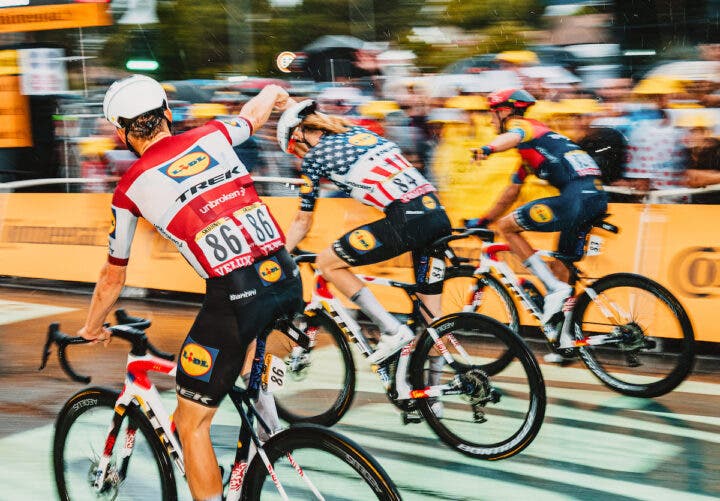
Cycling has developed an entire vocabulary to describe pain.
Fringale
The sudden, total energy crash caused by running out of glycogen, more familiar to weekend warriors as “bonking.”
Gruppetto
Actually an Italian word to describe the group of riders that forms on mountain stages who work together to survive the day within the prescribed time limit. Also called the autobus. There is no shame in the gruppetto and it’s all about surviving for another day.
Crevaison
Puncture or flat. If it happens within 3km or the day’s designated safety zone, no time losses count. A flat at the base of a climb or in the closing kilometers can prove disastrous.
Hors Délai
Outside the time limit. The rule that eliminates riders who finish too far behind the stage winner, based on a percentage of the winning time. This can sink ill or injured riders simply trying to make it one more day.
Voiture Balai
Literally “broom wagon.” The vehicle that sweeps up riders who abandon or finish outside the time limit at the tail-end of a stage.
Weird French expressions every fan should know
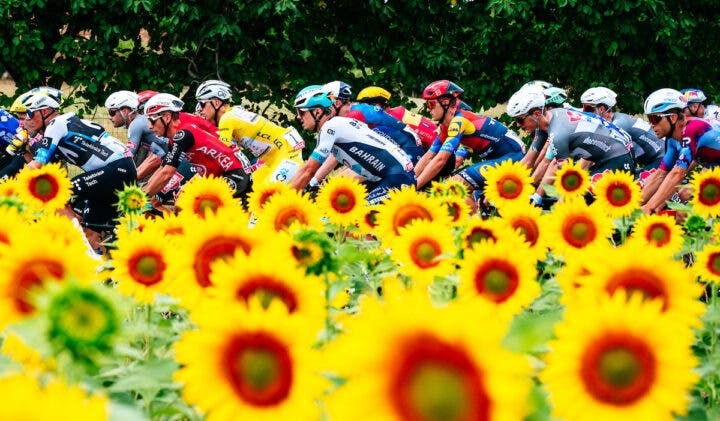
Some expressions don’t translate particularly well, and that’s part of the Tour’s allure and charm.
La Grande Boucle
The Big Loop. The Tour’s old-school romantic nickname, referring to the traditional route that circles around France every summer before returning to Paris.
Prix Citron
The sour lemon award voted by journalists for the most difficult, grumpy, or uncooperative rider of the race. Winning this one is not something to put on your palmarès.
Chapeau
Literally “hat.” Used as in a sign of respect (“Hats off!”) for a rider’s impressive effort.
Chasse Patate
Literally “potato chase.” It’s French for being trapped in “no man’s land” after failing to bridge across to a breakaway. It describes a rider who cannot quite make it across, but who’s spent too much energy to give up yet.
Bidon Collé
The infamous “sticky bottle,” when a rider hangs onto a team car while taking a bottle to get an illegal acceleration.
Patron
The unspoken boss of the peloton. They’re the rider whose authority is respected across the entire pack. Bernard Hinault was the patron des patrons back in the day. Today, it’s Pogačar, in a kinder, more modern way.
Lanterne Rouge
The red lantern, literally the light on the back of a train. At the Tour de France, it’s the rider in last place overall. Historically, riders would sometimes race to finish last on purpose. Race officials don’t like special attention paid to this one.
En Forme
French for “in form.” The phrase every directeur sportif uses when one of their riders is flying.
The jerseys
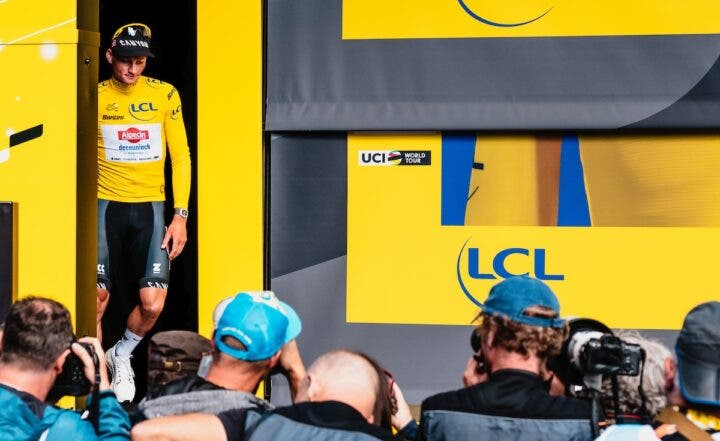
Winning the Tour isn’t just about yellow. Several jerseys and prizes shape the race from the first stage all the way to Paris.
Maillot Jaune
Why is the yellow jersey yellow? Because the race’s original newspaper, L’Auto, was printed on yellow paper. And they never changed it, the jersey that is.
Maillot Vert
The green jersey for the best sprinter, awarded on points rather than time. The sprinters’ equivalent of the yellow jersey.
Maillot à Pois
The polka-dot jersey for the Tour’s best climber, awarded through points earned at categorized mountain summits. The higher and harder the climb, the bigger the tally.
Maillot Blanc
The white jersey for the best young rider aged 25 or under, awarded to the highest-placed rider under the age limit on the GC. This one is often a preview of cycling’s next superstar.
The Tour machine
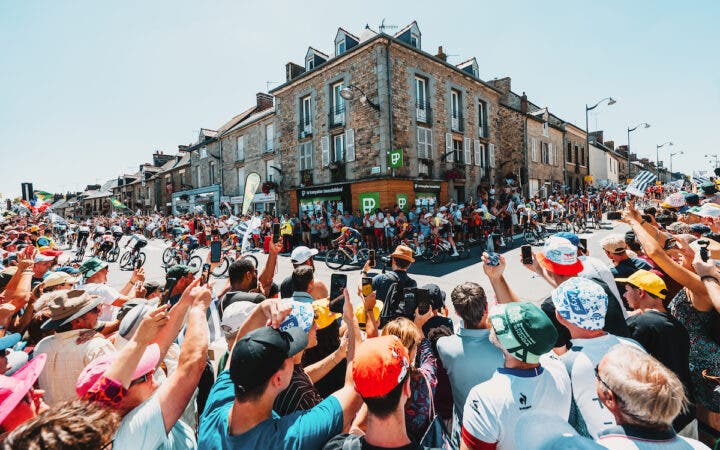
The Tour de France is one of world sport’s biggest annual events, so there’s a lot going on behind the scenes.
ASO
Amaury Sport Organisation. The family-owned company that owns and runs the Tour de France, Paris-Roubaix, and most of cycling’s biggest races. They like to stay out of the headlines, but always pull the strings.
Commissaires
The race officials who enforce the rules, hand out time penalties, and generally make decisions that many will immediately disagree with. They move in the bunch in cars and motorcycles to patrol the action. The post-stage jury report is must-read material.
Carte Jaune
The yellow card, borrowed from football and introduced at the 2025 Tour de France to penalize dangerous riding. Commissaires can issue them for sprinting infractions, illegal aero hacks, or peeing near the public. Too many of these in one race can get you sidelined.
Radio Tour
The official race radio that broadcasts real-time information to team cars with time gaps, crashes, weather, and road hazards. It’s the communication system of the whole operation.
La Caravane Publicitaire
The carnival that precedes the race by about an hour or so and a huge fan favorite. Think part conga-line and part low-grade corporate PR, and you get the idea. Cheap souvenirs are tossed to the crowd from outrageous floats, including everything from keyrings, hats, mini sausages, and foam hands. The Tour would just be another bike race without it.
[analyse_source url=”https://velo.outsideonline.com/road/road-racing/tour-de-france/tour-de-france-french-cycling-glossary/”]