[analyse_image type=”featured” src=”https://images.euronews.com/articles/stories/09/78/90/14/1200x675_cmsv2_fa155b9f-1af5-5eb9-ada5-bbf4fcd8ac4f-9789014.jpg”]
Le Havre: 38,000 pairs of fake trainers smashed to pieces

What is ‘Kushner Island’ and why are Albanians protesting about it?

Saatchi Gallery’s ambitious new summer show turns its gaze to the sky

Soldiers, not talks will decide Russia’s war in Ukraine, Lavrov says
Le Havre: 38,000 pairs of fake trainers smashed to pieces
What is ‘Kushner Island’ and why are Albanians protesting about it?
Saatchi Gallery’s ambitious new summer show turns its gaze to the sky
Soldiers, not talks will decide Russia’s war in Ukraine, Lavrov says
The jet fuel shock wipes out half of the global airline industry’s expected profits
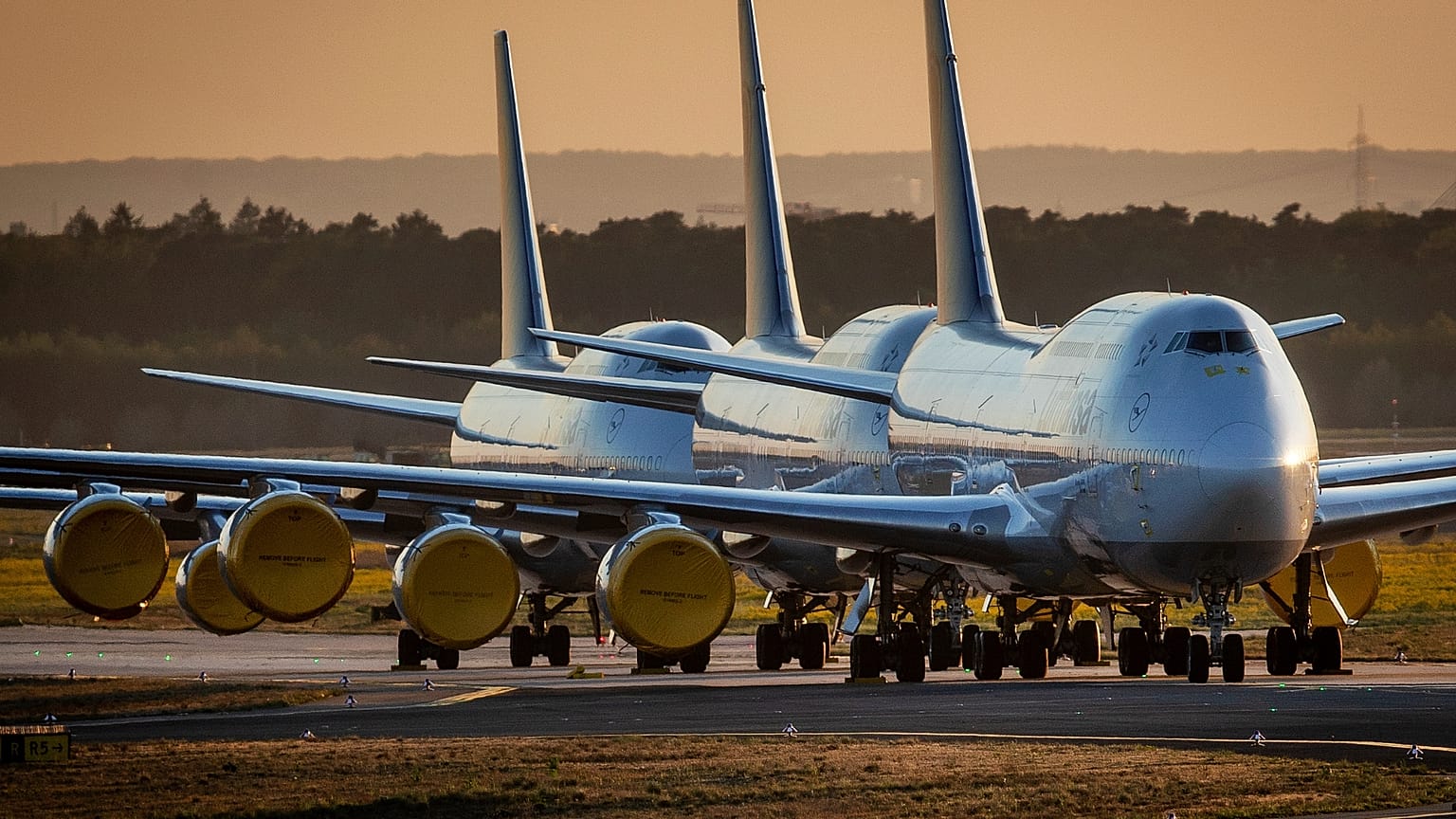
FILE – In this Monday, 20 April 2020 file photo Boeing 747 aircrafts of German Lufthansa are parked at the airport in Frankfurt, Germany.
– Copyright AP Photo/Michael Probst, file

 Facebook
 Twitter
 Flipboard
 Send
Send Reddit
 Linkedin
 Messenger
 Telegram
 VK
VK Bluesky
 Threads
 Whatsapp
Revenues are forecast to rise strongly and passenger traffic to hit new records, yet the global airline industry is seeing profits squeezed by an Iran war-driven jet fuel price shock, according to the industry’s latest outlook.
Air travel demand is strong and revenues are growing across the airline industry, yet profits are expected to halve in 2026 as soaring jet fuel prices hit companies worldwide, according to the International Air Transport Association (IATA).
 ADVERTISEMENTADVERTISEMENT
This is stated in the latest financial outlook of the trade body, which represents 370 airlines accounting for 85% of global air traffic.
Airlines worldwide are expected to generate a combined net profit of $23bn (€20bn) in 2026, down from a previously projected $41bn (€36bn) and roughly half the $45bn (€39bn) estimated in 2025.
This comes despite a record 5.1 billion passengers, up 2.4% year-on-year, and industry revenues reaching $1.165tn (€1.01tn), an increase of 9.4%.
“War-related disruptions in the Middle East and rising fuel costs have worsened the outlook for airlines,” said Willie Walsh, IATA’s Director General.
At the same time, operating expenses are expected to rise by 13% to $1.12tn (€970bn) compared with last year, as the industry’s fuel bill jumps nearly 40% to $350bn (€304bn) in 2026 from $252bn (€219bn) in 2025. Fuel is therefore expected to account for almost a third of airlines’ operating costs.
Despite airlines absorbing part of the increase in jet fuel prices and continuing efforts to improve efficiency, net profit margins are expected to shrink from 4.2% in 2025 to 2.0%.
“While air fares are rising, airlines are still absorbing part of the hike in their bottom lines,” Walsh said. He added that “net profit per passenger is expected to fall to $4.50, half of what it was last year”, which “won’t even buy you a hot dog at most FIFA World Cup venues,” he said, adding that should other costs or taxes start rising, airlines have very little buffer to cope.
Higher aircraft leasing and maintenance costs, alongside spending on cleaner fuels and carbon offsetting schemes, are also expected to weigh on the industry. IATA also cited a slowdown in global growth, rising inflation and weaker world trade as additional pressures on the sector.
Regional comparison
The regional picture is highly uneven. At the centre of the conflict, Gulf carriers are among the airlines facing the biggest financial impact. IATA forecasts that they are expected to slip into loss-making territory amid weaker demand and operational disruption. All other regions are forecast to remain profitable, although at lower levels than in the previous year.
Europe is also expected to come under significant cost pressure because of its heavy reliance on Gulf imports of jet fuel.
“While some of this is mitigated thanks to a pre-crisis hedging ratio covering 70% of fuel needs, higher costs will feed through as hedges roll off,” IATA said.
European airlines have benefited from some passengers switching to direct routes between Europe and Asia, bypassing Gulf hubs. However, airspace restrictions over Russia continue to disrupt operations, while slower economic growth and rising energy costs are expected to weigh on consumer spending.
Airlines in Europe also face mounting costs from environmental regulations, airport charges and air traffic control fees. Combined with recurring industrial action in several countries, these pressures could leave the region’s carriers at a competitive disadvantage even after market conditions stabilise.
Go to accessibility shortcuts
Read more
Le Havre: 38,000 pairs of fake trainers smashed to pieces

Intesa launches bid for MPS, would become Europe’s No 2 bank

Google rents SpaceX/AI supercomputers for $920M a month
Le Havre: 38,000 pairs of fake trainers smashed to pieces
Intesa launches bid for MPS, would become Europe’s No 2 bank
Google rents SpaceX/AI supercomputers for $920M a month

Robotaxis are coming to Europe — and the EU wants to speed things up

Can the market handle SpaceX, OpenAI and Anthropic all at once?

Inflation beating pay in Europe: Where are workers losing the most?

Intesa launches bid for MPS, would become Europe’s No 2 bank

Oil prices rise as Iran and Israel trade strikes in defiance of Trump
Inflation beating pay in Europe: Where are workers losing the most?
Google rents SpaceX/AI supercomputers for $920M a month
Pay transparency: Which EU countries are ready for the new rules?
France or Germany: Where do workers take home more pay?
Oil prices rise as Iran and Israel trade strikes in defiance of Trump
[analyse_source url=”https://www.euronews.com/business/2026/06/08/the-jet-fuel-shock-wipes-out-half-of-the-global-airline-industrys-expected-profits”]