Wonderland
GUERIN PROJECTS STAGE A TIME-SENSITIVE LOVE AFFAIR
London-based painter Gigi Ettedgui and photographer Robin Hunter Blake are testing The Tenderness of Time with their new exhibition.
(Courtesy of Artist)
In an age where images arrive faster than we can properly register them, attention has become radical act. Performance even. With The Tenderness of Time, a new exhibition curated by Marie Claudine Llamas at Guerin Projects, that premise takes shape. Bringing together London-based painter Gigi Ettedgui and British-American photographer Robin Hunter Blake, the show resists the accelerated cadence of contemporary visual culture. Instead, it explores, asks, challenges what happens when our observation becomes slower, more deliberate and, ultimately, more human.
Though working across different mediums, both artists are concerned with the same slippery subject: the passage of time and the traces it leaves behind. Their practices are rooted in the observational, but not passively so. For Ettedgui and Hunter Blake, attention becomes labour. Seeing is something to be in pursuit of – and that requires patience, repetition and an attentiveness that feels increasingly rare.
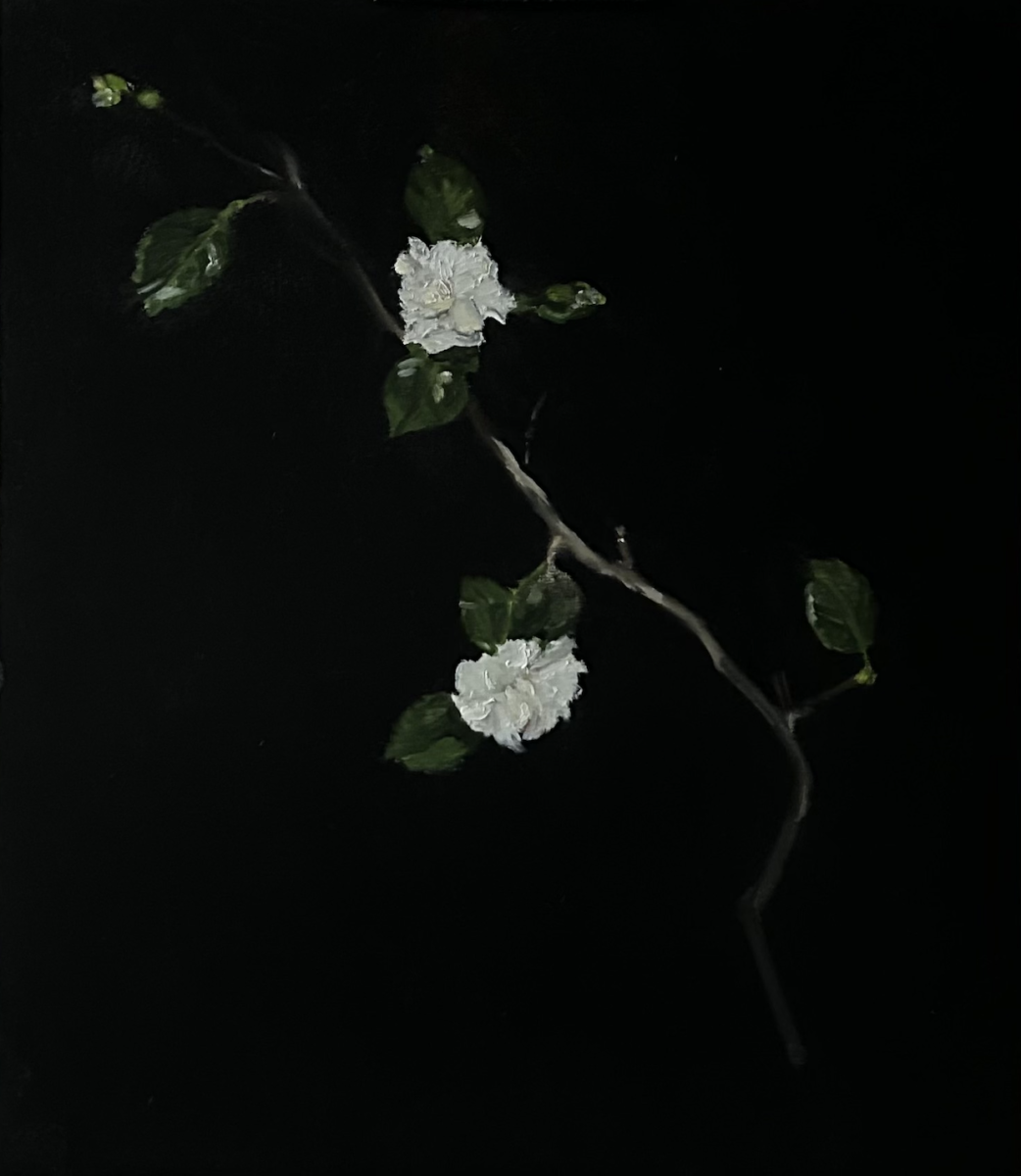
Ettedgui arrives at painting through a distinctly rigorous path. After spending eight years in Paris assisting the creative director of Hermès, working alongside designers and craftsmen, she later trained in classical oil painting at the Charles Cecil Studios in Florence. That discipline sails throughout this new body of work. One series follows a singular flower through its lifespan, documenting the gradual shift from bloom to decay, life to death. Layer by layer, brushstroke by brushstroke, the paintings become records of time – but you had to spend it looking. Drawing on the traditions of Florentine portraiture and still-life paintings, Ettedgui transforms something as simple yet intimate as a flower into something more autobiographical – less so an object than a placeholder for oneself.
Elsewhere, her darker, near-monochromatic paintings explore light itself. Emerging from fields of visually-warping ivory black are elusive Venus figures, visible only through movement and changing perspectives. Depending on where the viewer stands, the image appears and disappears, turning perception into an active encounter.
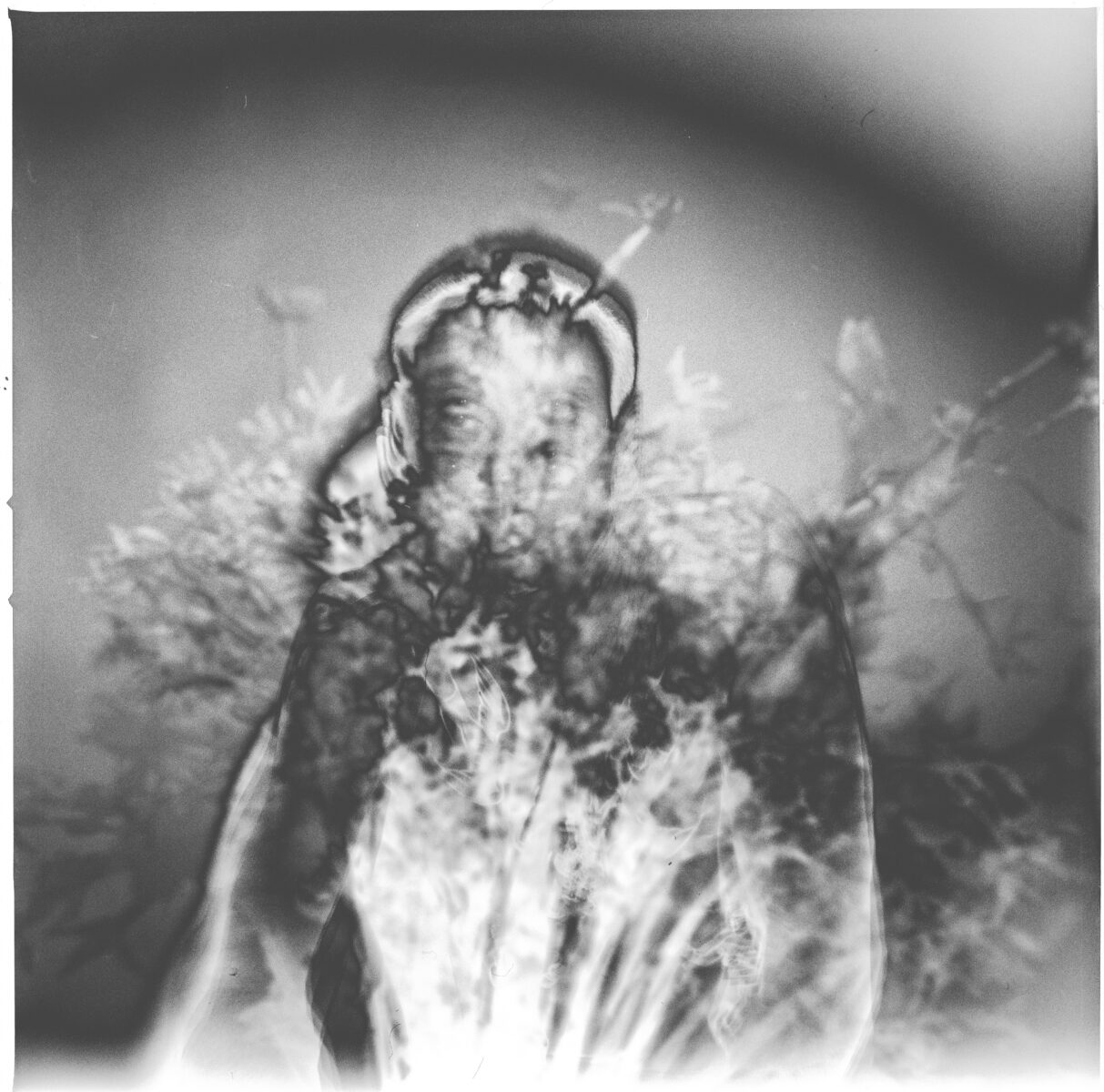
Hunter Blake approaches similar questions through his intimate photography, albeit from the opposite direction. Raised near Barcelona within a world of contemporary dance and theatre, his understanding of form is inseparable from movement. In fact, it’s become a non-negotiable exploration within his practice, even if not explicitly presented as such. Working entirely through analogue processes from his London studio – the shooting, developing and scanning film process executed solo – he constructs images that feel suspended between photography and performance.
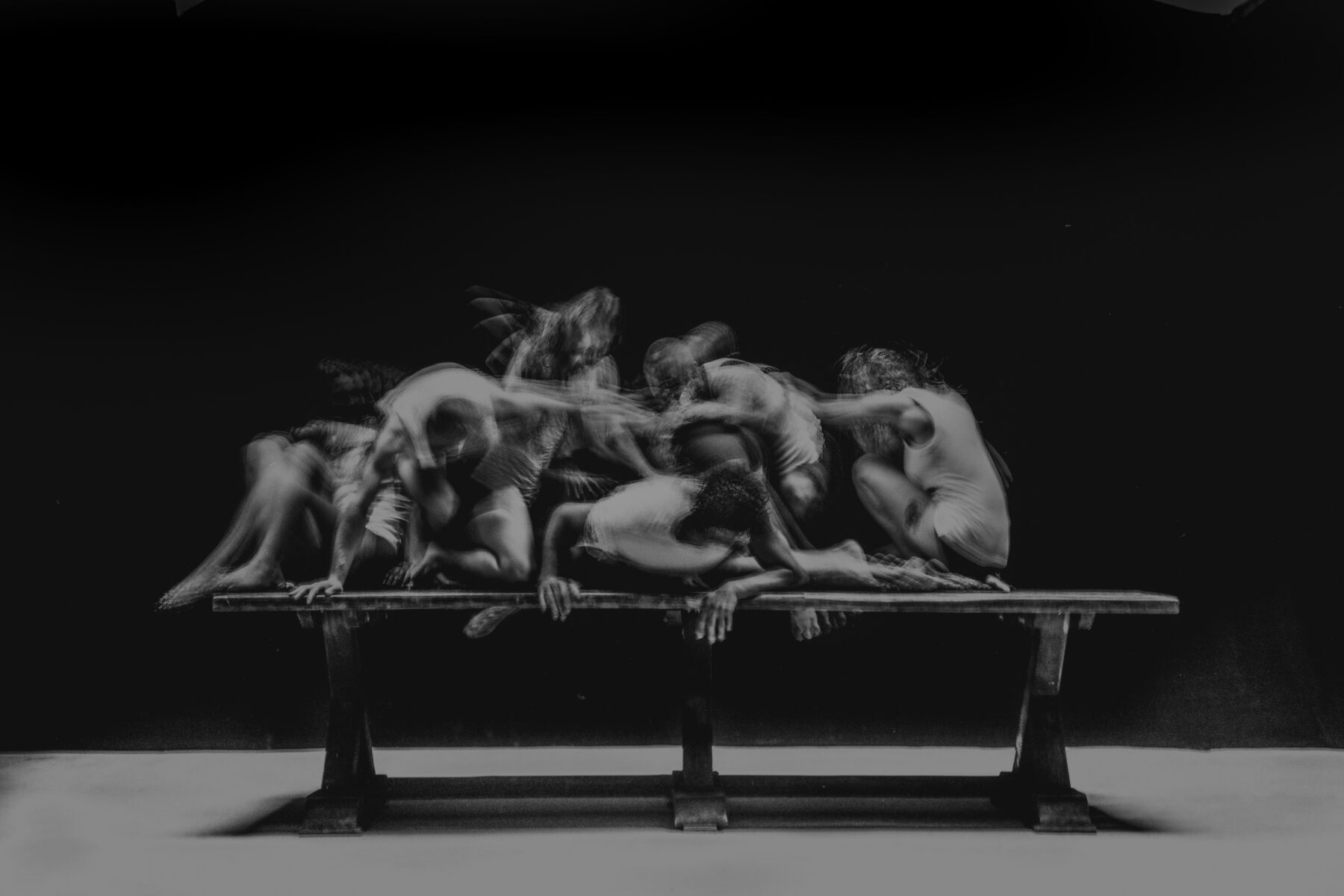
His latest works centres dancers, performers and friends, using stroboscopic and chronophotographic techniques to compress motion into singular frames. Bodies fracture, overlap and reassemble. Emotion becomes efficaciously physical. Inspired by figures ranging from renowned photographers such as Eadweard Muybridge to Jeff Wall, Hunter Blake challenges photography’s longstanding claim to record truth, instead embracing ambiguity, abstraction and projection.
Together, their works occupy a space between presence and disappearance, permanence and impermanence, lingering and fleeting. Whether through the fading petals of a flower or the blurred trajectory of a moving body, The Tenderness of Time reminds us that nothing remains fixed for long – unless we demand it does. Often, this can be done simply if we return to the basics: our hands and instinctual creativity. What endures, however, is the act of paying attention. And in that sense, the exhibition feels less like a meditation on time itself than a quiet argument for how we choose to spend it.
Ahead of its opening, Wonderland touches base with Ettedgui and Hunter Blake to discuss the value of slowing down, the emotional heft that comes with intentional observation, and making art in defiance of immediacy.
Tell us how your relationship began/formed and how you built that trust within your respective creative mediums.
GIGI: Robin and I were introduced by our curator, Marie-Claudine Llamas of Guerin Projects, who immediately sensed there was a conversation to be had between our practices. I have always been a huge admirer of Robin’s work, so there was already a kind of visual familiarity and trust there before we even met. What struck me was how painterly his images are – they’re taken with a very long exposure and centre on movement with figures dissolving and reappearing. They remind me of Francesca Woodman in the way that the work feels both fleeting and timeless at once, blurring the lines between photography and painting, the figurative and the abstract. The trust really came from recognising a shared way of seeing. Even though we work across different mediums, we’re both trying to arrive at a similar emotional space, so the collaboration never felt forced -more like continuing the same conversation in two different languages.
What are the strengths in your partnership? Where do either/both of you shine most?
ROBIN: I think the dialogue between photography and painting is quite interesting. Especially with us both looking to formal techniques as a means of abstraction. The way Gigi has approached these paintings is deeply inspiring, using traditional strokes to catch the light and obscure perception is ultimately in the same vein as using the camera in a way where its scientific nature can be harnessed and approached to create something akin to a painting. Beyond this, there is a depth to these works; they communicate and (I feel) come from the same emotional well.
This new exhibition, The Tenderness of Time, feels like a call to action – to rebel against our current culture of image, speed and demand. Was there a moment of personal reflection between or for you both that sparked a need to present artwork that explored this idea?
ROBIN: Definitely. I think these works invite the viewer to observe and look beyond the immediate. The works ask for time to be spent searching for hidden details. Through their abstract nature, a viewer can spend time examining what lies beneath a first glance of the piece. As a response to today’s culture of immediacy, that kind of work can’t be replicated on a screen.
What are both of your relationships like with time?
GIGI: I think both of us are deeply aware of how fleeting time is and central to our work is the question of how to make a moment permanent. Both photography and painting become ways to hold onto something transient for a little longer — how do you expose its essence and go beyond appearance?
ROBIN: I agree with Gigi, these works aim to hold on to something ephemeral. Time is the backbone of photography. At its simplest, photography is something we trust to preserve a moment. By exploring its temporal qualities, a camera can deconstruct and decode these fleeting moments. That essence is profoundly powerful, offering a window into the traces of our past. For my own work, time becomes the equivalent of a paintbrush, something to be wielded.
The exhibition is centred around ‘attentive encounters’. Can you explain what you meant by this? And what are some of those encounters that have inspired you?
GIGI: For me, ‘attentive encounters’ speaks to the moments where you are totally immersed in someone, an object, or even the atmosphere around you. I think painting demands that kind of attention. I moved back to London in September 2024 when I was offered a space at St Paul’s Studios on Talgarth Road, where I am surrounded by a wonderful community of artists, friends, and former teachers from Charles Cecil Studios (and a studio cat). I don’t think your work can evolve without a community, so those kinds of artistic encounters have always been essential to my practice. I’m also very interested in the encounter between painter and subject. When I paint portraits or still life photos, it is only from life — never from photographs. With portraiture, there’s a real dialogue that develops between the painter and the sitter. There’s something quite psychological that emerges through time, poses, and multiple sittings together. It’s the same with flowers – these, too, in a way, are portraits. I paint them in the same way I do models, placing the flower alongside the canvas, more like a portrait sitting than a still life. There is a greater sense of urgency and intensity when I paint these, as I have a very small window of time before the flower dies. So, these works have to be painted intensely and vigorously. I find the flowers at their most beautiful the moment before they die …when in full bloom. It is the same time pressure when I paint a blossom or a bud because I only paint from life and with natural light.
(Courtesy of the Artist)
Movement is a big part of this exhibition, and Robin, you worked with a lot of dancers and performers. What is it about the body and the medium of dance that you’re drawn to, other than your personal ties?
ROBIN: I’m deeply drawn to how the body moves through space. Especially after understanding stroboscopic photography. It becomes a living brush working in three dimensions. Aside from the literal, there is a deep emotional resonance I feel when watching people move. It’s an unexplainable joy and sadness. There were two truly incredible dancers who made much of this work possible: Violet Savage and George Jennings. I was in absolute awe and admiration watching them move. It was really the highlight of making this work, and I will be forever grateful for their time and support in the creation process.
How do you balance the impact of reference – for example, Titian, Diego Velázquez and Eadweard Muybridge – with making something that feels entirely your own and new?
GIGI: It’s really about a way of seeing, to quote my hero John Berger. To be honest, it’s really a part of my artistic education. At 27, during the Covid lockdown, I watched Kenneth Clark’s Civilisation, which reminded me of an art trip I’d taken as a teenager. I decided to change my life and move to Florence, where I was accepted by the Charles Cecil Studio, and spent three years learning about classical oil painting techniques, painting from life, and sight-size methodologies. I return as often as I can to a city I think of as my spiritual home. I feel very lucky to have been taught by Charles and the other brilliant painters in such a beautiful tradition that traces its roots back to Titian and Velasquez. But for me, that tradition was never about imitation and more about learning how to truly observe. In sight-size painting, the canvas is placed alongside the sitter with the painter standing at a distance under natural light. It’s about knowing where to stand and how to see. And contrary to what many think, incredibly liberating. It’s about the visual impression you create. The discipline actually gives you the freedom to paint as loosely as you can. So rather than feeling weighted down by art history, those references actually free me. They become a foundation from which I can paint what I see and feel now, in the present.
In the preparation for this, what were some of the biggest challenges you faced creatively? And how did you overcome them so that they still made/contributed a significant impact to the core message of the show?
ROBIN: I wanted to approach this show and the overall progression of the work organically. I shot multiple times, and each time I felt it wasn’t authentic, like I was forcing it. That was the biggest challenge for me, at least. It feels wrong if it comes from a place that isn’t honest. To my surprise, it took a long time to get there after the last image I was happy with. The show pushed my boundaries and led me towards doing it at a much larger scale with far more experimentation within the image-making process.
The works were selected in conversation with each other during studio visits. Was there a moment where the direction of the exhibition shifted because of something the other person made?
GIGI: The exhibition really shifted after a long studio visit with Robin and MC when we began discussing an abstract figurative cycle of black paintings I’ve been working on. Painted with only ivory black, these works are actually all about light. They are inspired by the myth of Venus set within a wild seascape. Depending on where you stand and how the light hits the brushstrokes, your eye finds her. Until then, I’d always thought of these works more separately, though we quickly realised they were all speaking to each other through light, shadows and movement.
The show critiques a culture where images are “optimised and glossed.” What do you hope your work gives back to images that you feel have been lost?
ROBIN: What’s often lost in optimised or overly glossed images is the human element. From what I’ve seen around London recently, a lot of the strongest shows have produced very human work – mistakes that take the form of another element of the piece. What I mean is, a scratch, an accident, and elements of imperfection reveal the human who made it. Sometimes mistakes look terrible, but there’s much to be learned from things like scratches and accidents. I say this because, even in my own work, hand-developing and hanging up the negatives in tedious places can really damage them. There’s a beauty to that though. The viewer sees bits of the process within the final piece. I think that’s quite poetic, and there’s some of that in one or two of the pieces on show.
The Rorschach reference suggests that the emotional gravitas of artwork sits more with the viewer than the artist. What are you hoping visitors will take away from the exhibition?
ROBIN: The psychology of these images is that they are born from memory and act as therapy almost. I find people are quick to make a decision of what they’re looking at – I saw this at my last show. For this one, the images go from quite figurative at times to abstract in others. I made it less about observing the viewer’s choice, to finding my own way of connecting the images to my direct emotional experiences. They still carry the Rorschach quality, asking, “What is it that the viewer is looking at?” Since photography wants to show the truth and acts as an ambassador for reality in visual art, these images aim to connect with the subconscious through abstract figures and playing with this idea of truth. They should create questions and still carry a direct, visual connection without too much ambiguity.