Wonderland
LOWERTOWN IS BACK TO BASEMENTS
Olivia Osby and Avsha Weinberg emerged from the DIY underground as unlikely architects of one of the internet’s last genuinely communal cult bands. Now, with their sprawling new record Ugly Duckling Union, the duo return to the strange, homespun experimentation that first defined them. Fresh off the album’s release, they talk about life on the road, surviving codependency, and coming back to the basements that they started in.

“I always found a beautiful sense of community and escapism in a world that is sometimes more beautiful than the one that we’re in,” Olivia Osby says, finishing bandmate Avsha Weinberg’s thoughts on the intention behind their new album under the collective alias, Lowertown. It’s a dance they’re doing constantly: words overlapping, ideas dissolving into inside jokes. The rhythm should be hard to follow, but it’s not. The conversation flows naturally, like they already know what the other will say. “We are super telepathic,” Osby confesses – it feels more fact than hyperbole.
Huddled together on the floor of Weinberg’s New York apartment, Osby and Weinberg crowd in front of the fuzzy laptop camera as they tell me about their fourth record Ugly Duckling Union out May 22 via Summer Shade, which comes with lore, a handbook, plush doll, comicbook, and even an explorable Minecraft world to match. They say the idea of making a conceptual LP, and its many extensions, lit them on fire creatively. “We wanted to become the kind of band we were obsessed with growing up,” Osby admits. “A band that creates worlds people can really invest themselves in.”
Written in the wake of a split with their label, and a freeing loss of the industry expectations that came with, the songs find Lowertown returning to their DIY roots with renewed conviction. “There were a lot of moments with our last record [2022’s I Love To Lie] where we wanted to do all these things and we didn’t have the time to do them,” Osby admits. “I think our early stuff was just spontaneous. Now we have the time to experiment and fail again. We needed that.”
Influenced by the immersive worldbuilding of Gorillaz and the shapeshifting weirdness of freak folk, a noisy subgenre of the indie scene, their new songs stretch and wander before mutating into bursts of noise, tenderness, and wit. With the duo’s unique approach to songwriting, it’s an exploratory sound that marks their entire discography. “The way that I love to write is to be sitting in a place for hours playing guitar and watching TV at the same time. There’s a couple of comfort shows that I’ll always be writing stuff over, like New Girl and 30 Rock,” Weinberg admits. “A lot of the new songs are all The Sopranos ones. You can hear a lot of Italian Americans screaming underneath the demos. It colors them in a really nice way.”
Sharpened by their brush with independence, Lowertown is more self-assured in their willingness to trade the norm for these stranger tactics. Instead of clocking into a 9-to-5, the band now immerses themselves in the music-making process, and finally does the thing that so often gets pushed off until the end: follow what feels right to them. For Ugly Duckling Union, it was all about experimenting with new ways to write songs. “That child-like sense of writing and doing it just for the exploration of writing is easy to lose when you’re on a label. There’s a lot of pressure to produce, like it’s a product. I feel like we made this in a completely artistic way,” Osby says.
“Yeah. Like we wrote ‘Big Thumb’ using newspaper clippings,” Weinberg reveals. Inspired by the blank walls of her new apartment, Osby decided to follow the lead of bands she admires, like Throbbing Gristle and Coil, and try creating her lyrics this way. “I think it’s easy to get in a loop of what’s comfortable for you, lyrically, and taking words from the environment and adding your own meaning is the coolest thing in creating your own story,” Osby remarks. “It breaks you out of your comfort zone completely, and I really didn’t want these lyrics to be a repeat of anything we’ve already written.”
The resulting track is a satisfying haze of harmonica and 12-string guitar. This process became one of the many creative rituals that shaped Ugly Duckling Union. Almost two years in the making, life and label politics kept the record on the shelf, as it often does, but the two say the work still feels ripe. “I still feel so attached to the songs,” Weinberg reveals, triumphantly. “ It’s got such a strong sense of the next phase of us, so it doesn’t really feel like a distant memory of us.” Osby nods beside him. “ A lot of music I make and then I can’t listen to it for years. It’s like I cringe at myself or something. But I’ll run this shit up daily,” she laughs. “I think it’s because we reconnected with how we first started writing together.”
For all the blissful experimentation, Osby and Weinberg say Ugly Duckling Union ultimately feels enlivened by something simple: the making of the album reignited a friendship on the brink. Ugly Duckling Union was intended to bring people together, and that intention began with the very two people who wrote it. “The whole process rebuilt our friendship,” Weinberg reveals.
Lowertown, originally from Atlanta, Georgia, first formed after a formative trip to Canada when the pair were still in high school, a time that left them drunk on the idea of freedom. Since then, they’ve spent nearly a decade growing up in public: signing to Dirty Hit before graduating high school, touring with Wet Leg and Wednesday, and becoming unlikely connective tissue between scenes spanning shoegaze, noise, and internet rap. Fans and collaborators orbit everywhere from King Krule and Frost Children to Julie, They Are Gutting a Body of Water, and Sword II. Success arrived quickly, before either of them fully understood who they were outside the band.
“We had so many opportunities very young,” Weinberg says. “We didn’t really have enough time to develop our creative direction.”
“Or our sense of self,” Osby adds.
Those opportunities were often a whirlwind of DIY shows, which required long stints on the road. Osby says it left little time to foster budding interests. “I can become very one dimensional on the road. A lot of the things that are very important to me can fall away, like the people in my life and my hobbies. The things that make me feel like my full self,” she explains. “It’s very monk-like in that way.”
The highs though, they say, are euphoric, and are what kept the pair travelling. “People will come up to us at the [merch] table and be like, ‘We’re all friends. We met through the Lowertown Discord,’” Weinberg says. “ It’s amazing. When you have nobody who watches your movies and your TV shows and you play your games on your own, meeting that one person can change your life.”
Osby nods. “It feels like you’re on a mission and you’re connecting people and creating a space for people to release energy. That’s such a beautiful, sacred thing that needs to exist forever,” Osby says. “Also, so much of this stuff can feel so abstract. When you’re doing music, it’s such a stretched out timeline. You’ll make an album and then it’ll come out sometimes almost two years later. It’s nice to put in a ton of effort and know that people are seeing this, people are engaging with this, and I’m connecting with them.”
That reward, they insist, is worth it. Still, by the time the pair moved to New York in 2021, living this way had finally caught up to them. For the first time in years, they had the space to look at themselves outside the blur of open roads and realize: Somewhere along the way, the kids who’d started this band had become strangers.
“We’ve been best friends since we were 15. We’ve been through so many crazy things together. I feel like we didn’t even have the time to sit and process who we were because shit was just so quick,” Osby confesses.
“We just pushed it off to the side so that we could keep doing the job,” Weinberg continues.
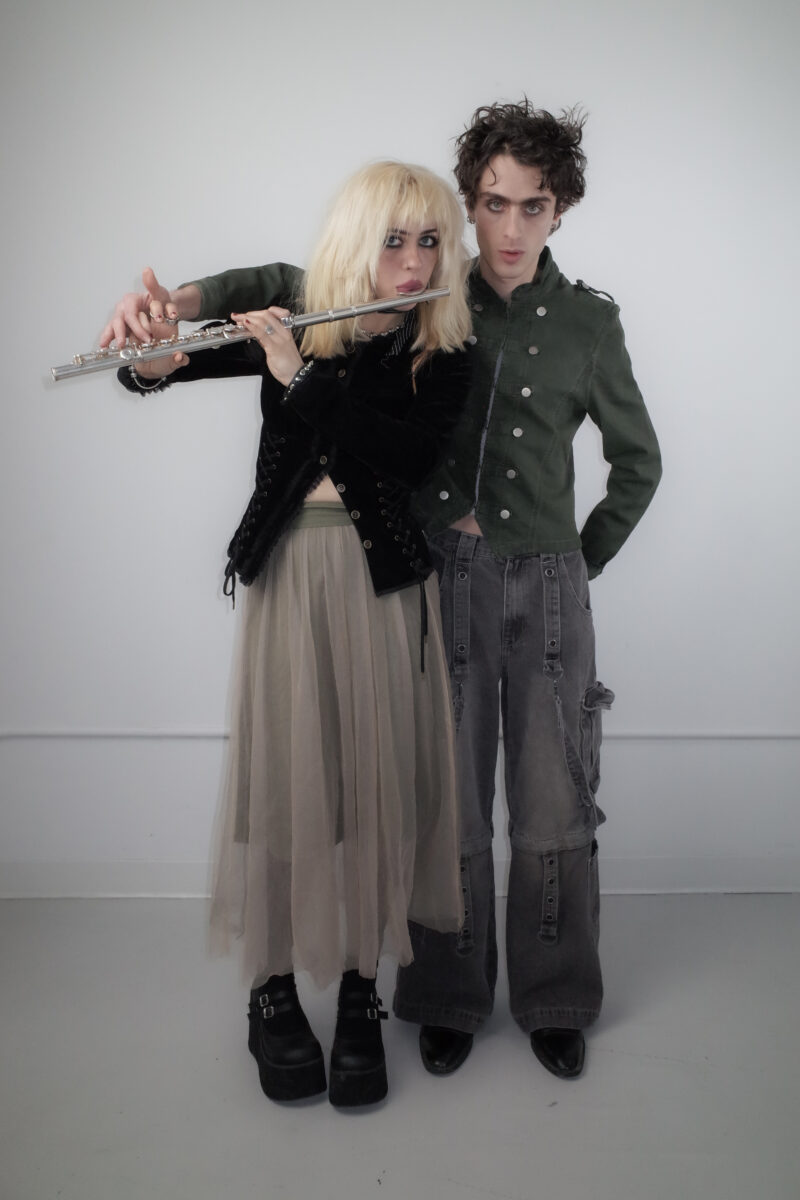
Attached at the hip for over a decade, they felt like one conglomeration of two people, or, as Osby puts it, they were “codependent as fuck.” The former friends were becoming something more akin to the angry Cerberus. “There was a period of time where we were working together, living together, and doing everything together in New York,” Weinberg says. “But it was almost like a marriage. We would come into the apartment and the dishes wouldn’t be done and it would just blow up into something.”
“ And I was like, peak undiagnosed ADHD vibes. So I was annoying as fuck,” Osby chimes in.
Small domestic frustrations turned into larger fights. They realized they wouldn’t be able to survive unless something changed. “We went to this coffee shop, and I could tell she knew what I was gonna say. I was like, ‘I think we need to live in separate places,’” Weinberg says. Osby laughs. “ And I was like, ‘No, you’re my best friend. Why would you wanna move out? We need to be together because of the band and we’re each other’s rocks here.’”
“ Yeah. But in the months leading up to that, it was like we were-”
“Always arguing,” Oliva finishes.
Weinberg nods. “We weren’t even really friends. We were like, the band will not last like this. We need to try and detach a little bit and figure out who we are individually. So we moved out to separate houses. We started to go out into the city on our own. I hesitate to say not texting each other every single day.”
“ Not texting each other every single thought we had,” Osby clarifies.
Despite the little continuities, the move felt strange and heartbreaking. Still, just like any type of tough love, Weinberg says it ended up being the very thing they needed. “We had a couple of months of that and then we were like, ‘Okay, let’s try and rebuild this relationship by writing together.’ We ended up making “Mice protection”.”
Written in the Atlanta basement where the band first started writing songs, the track felt like a full-circle moment. After all the burnout, constant touring, and rebuilding from scratch, they’ve found themselves back there again. Only now, they finally knew who they were. “And then we just transitioned from that basement to my basement in New York,” Weinberg says with a smile.
“Mice Protection”, named after the humble creatures who live in the walls of Weinberg’s apartment (“There is one mouse. It’s mostly like 200,000 rats,” he admits), became the jumping-off point for the entire album and set the emotional tone for everything that followed. “With that first song, we were rebuilding and figuring out what this next phase of us being best friends again would be like,” Osby explains. “It was us coming back together in such a pure way, just like how we first started.” As the duo repaired their friendship, the songs became stranger, looser, and more abstract. “You can hear our relationship evolving through it,” Weinberg says. “The second half gets way freakier. We call it the witch half.
“It’s my favorite part,” Osby says. “It’s really interesting ’cause I’ve never made music like that. It feels fresh.”
That sense of spontaneity runs throughout the record. The duo points to structureless songs like “Dip Shit”, “Big Thumb”, and “Echo of Desire” as spiritual successors to fan favorites like “The Gaping Mouth”. After spending so much time building the album, they’re most excited to finally bring those songs into the real world. “ We’re about to go on our longest tour ever. It’s two months around the country,” Weinberg reminds me.
Lowertown knows the hardships of touring well, but Osby feels they’re more than ready to get back on the road. “I’m excited to get into this next phase. It can feel like you’re in the waiting room for a lot of this. Waiting for the album to come out. Waiting for the tour to happen. I don’t wanna be in the waiting room anymore. I want to be on the road doing the thing. That’s what we’re really good at.”
The confidence feels hard-earned. The pair have spent nearly a decade learning not only how to make music together, but how to grow alongside one another. Looking back on those early days, Osby laughs at how much has changed.
“When we first started I was insanely shy and had horrible stage fright. Making music was something I did alone in my room. Avsha is a very good tough love person and was like, ‘We’re not gonna leave this basement until you record these vocals in front of me.’ I was so mad at him at the time, but he was right. We needed to break the ice, and it made me so much stronger.”
“Now she’s so much better at collaborating than I am,” Weinberg adds, smiling. “She’s such a good collaborator.”
Listening to them, I feel myself looking past the communal spirit and avant-garde bliss of Ugly Duckling Union and feeling that its truly greatest achievement is simply this: it helped two best friends find their way back to each other.
Listen to Ugly Duckling Union…
Words – Camryn Teder