[analyse_image type=”featured” src=”https://ichef.bbci.co.uk/news/1024/branded_news/59f4/live/94cc9060-5a6f-11f1-8954-638c887fc9b3.png”]

 Vikas Kumar
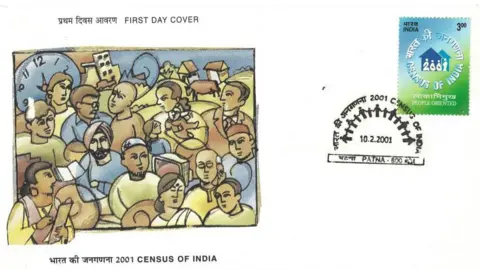
Long before smartphones and government apps, India used its vast postal network to persuade people to take part in one of the world’s biggest statistical exercises: the census.
Now, as India prepares for its 16th census – the eighth since independence in 1947 – a new exhibition revisits that forgotten history through stamps, postmarks and letters once used to rally citizens behind the national headcount.
- India begins huge census
- India’s census: The good and bad news
The exhibition, curated by Vikas Kumar, an economics professor at Bengaluru’s Azim Premji University, explores how India’s postal system became an unlikely instrument of nation-building in the decades after independence.
Independent India urgently needed reliable demographic statistics – both to run elections based on universal adult franchise and to build a planned economy.
The census was considered so central to the new republic’s political economy that the Constituent Assembly passed the Census Act in 1948, even before the constitution was finalised.
 Vikas Kumar
 Vikas Kumar
 Vikas Kumar
But the government faced two immediate challenges: how to persuade people to participate in the census, and how to maintain communication between enumerators and census officials across a vast, poor and largely rural country.
Trust was a particular concern. The colonial censuses of 1931 and 1941 had faced boycotts in parts of India, while the 1941 headcount in Punjab and Bengal was marred by allegations of communal manipulation. Public outreach, therefore, became critical to the legitimacy of independent India’s first census.
That is where the post office came in.
Until a few decades ago, the postal department was the largest unified communications network available to the Indian state.
 Vikas Kumar
 Vikas Kumar
After independence, the postal system expanded faster than most other public networks, including banking. By 1968, more than 100,000 post offices were delivering mail daily to 300,000 villages and weekly to another 300,000 more.
Kumar’s research shows how differently the Indian state once communicated with citizens.
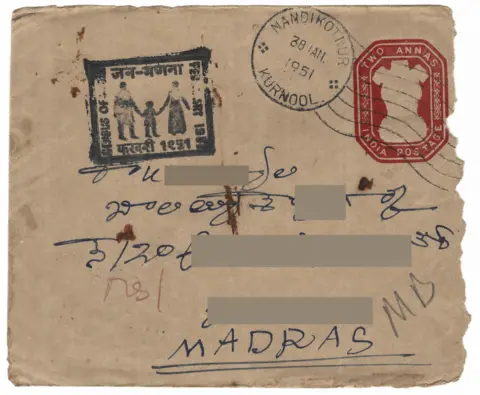
In the run-up to the 1951 census – the first after independence – the government used a bilingual pictorial postmark stamped on letters travelling across the country.
The postmark showed a family of three framed by the words “Census of India” in Hindi and English.
 Vikas Kumar
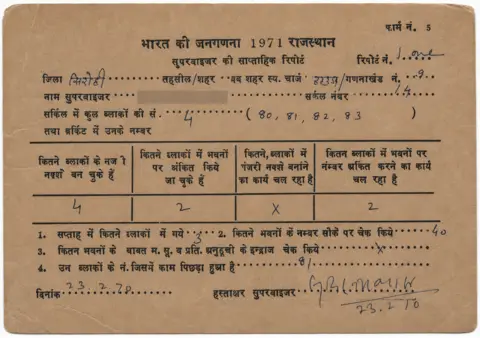
The campaign was carefully calibrated for a country with low literacy rates. Postmen often doubled as readers, scribes and informal state intermediaries in villages, making the postal network an ideal vehicle for public messaging.
Over the decades, the messaging evolved with the nation itself.
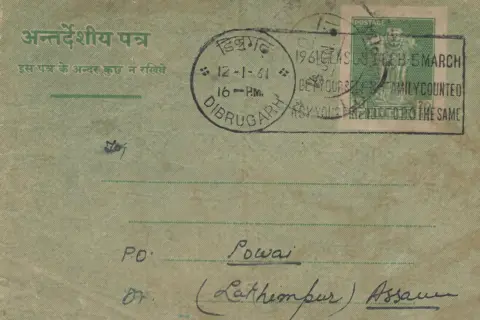
In 1961, postmarks urged Indians to “Get yourself and all the family counted” and “Ask your friends to do the same”.
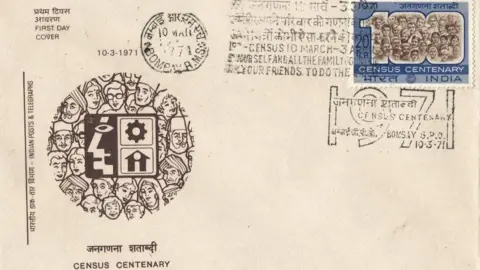
By 1971, commemorative stamps celebrated the census as “one of the largest administrative operations in the world”, proudly noting that population data was now being processed using electronic computers.
The postal material also reveals how governments imagined the census itself.
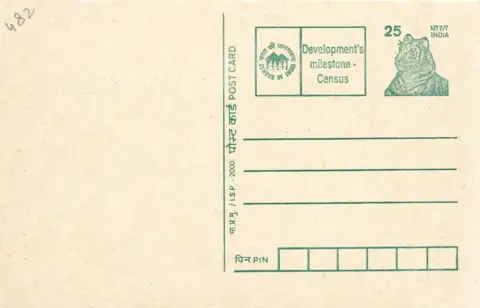
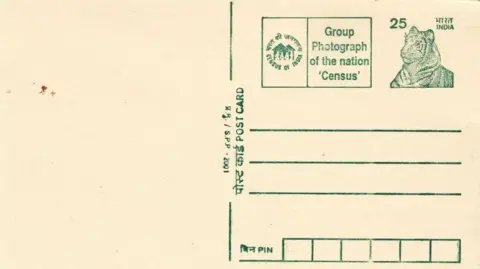
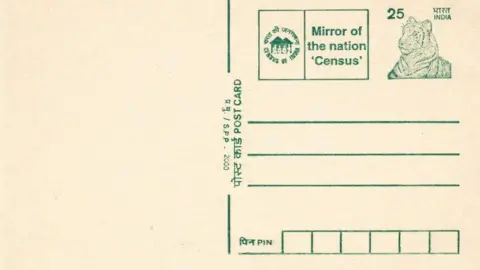
Advertisements in 2000 described it as the “Mirror of the nation” and a “Group Photograph of the nation”, presenting the census less as a bureaucratic exercise than as a collective self-portrait.
 Vikas Kumar
 Vikas Kumar
 Vikas Kumar
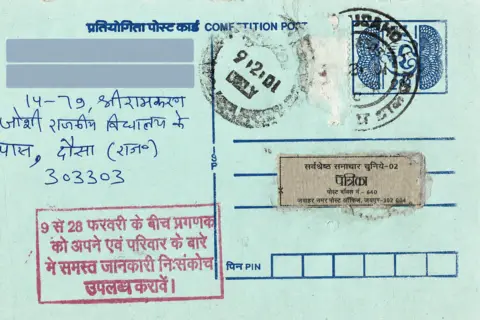
Later imagery increasingly linked counting with population control, prominently featuring the two-child norm – a reflection of the anxieties of the era.
For Kumar, these fragile postal artefacts capture more than bureaucratic history.
They reveal how the Indian state sought to build legitimacy and trust through everyday communication – and how the census became intertwined with ideas of development, diversity and national identity.
That question of trust remains relevant today.
While digital tools may speed up data collection, Kumar argues that technology alone cannot guarantee reliable data.
“Awareness about the census is critical to building trust,” he says, cautioning that the government must find new ways to build public confidence as the reach of the postal system fades.
And yet, the census India is preparing for today is vastly different from the one remembered in these fading postal artefacts.
The new census is seen as crucial for policy planning, welfare delivery and political representation in the world’s most populous country. It will also, for the first time in decades, collect caste data – a politically sensitive exercise in a country where caste continues to shape social and economic life.
The scale remains staggering: the exercise will span 36 states and federally administered territories, more than 7,000 sub-districts, over 9,700 towns and nearly 640,000 villages. Millions of households will be surveyed by enumerators and supervisors – typically teachers, local officials and government staff.
But one thing has changed fundamentally. For the first time, the census will be conducted digitally, with enumerators using mobile apps to collect and upload data in real time.
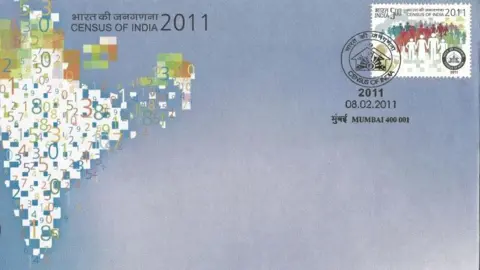
From family-shaped postmarks stamped on envelopes to data uploaded instantly from smartphones, the census has travelled a long way.
Yet the underlying challenge, as the exhibition suggests, remains much the same: persuading more than a billion people to trust the state enough to count themselves into the story of the nation.
[analyse_source url=”https://www.bbc.com/news/articles/c4g4yyxxwp2o”]