[analyse_image type=”featured” src=”https://cdn.mos.cms.futurecdn.net/AoC98XPq7GnHiDY5MFBCXZ-2048-80.jpg”]
A loss of community, two-tier finances, and a tactical conundrum – Are professional teams reshaping the gravel scene?
MEMBER EXCLUSIVE
By
Will Jones
published
In gravel, teams, privateers, collectives, and cabals all race the same course, but how are fully-integrated teams with big budgets going to impact cycling’s most popular discipline?
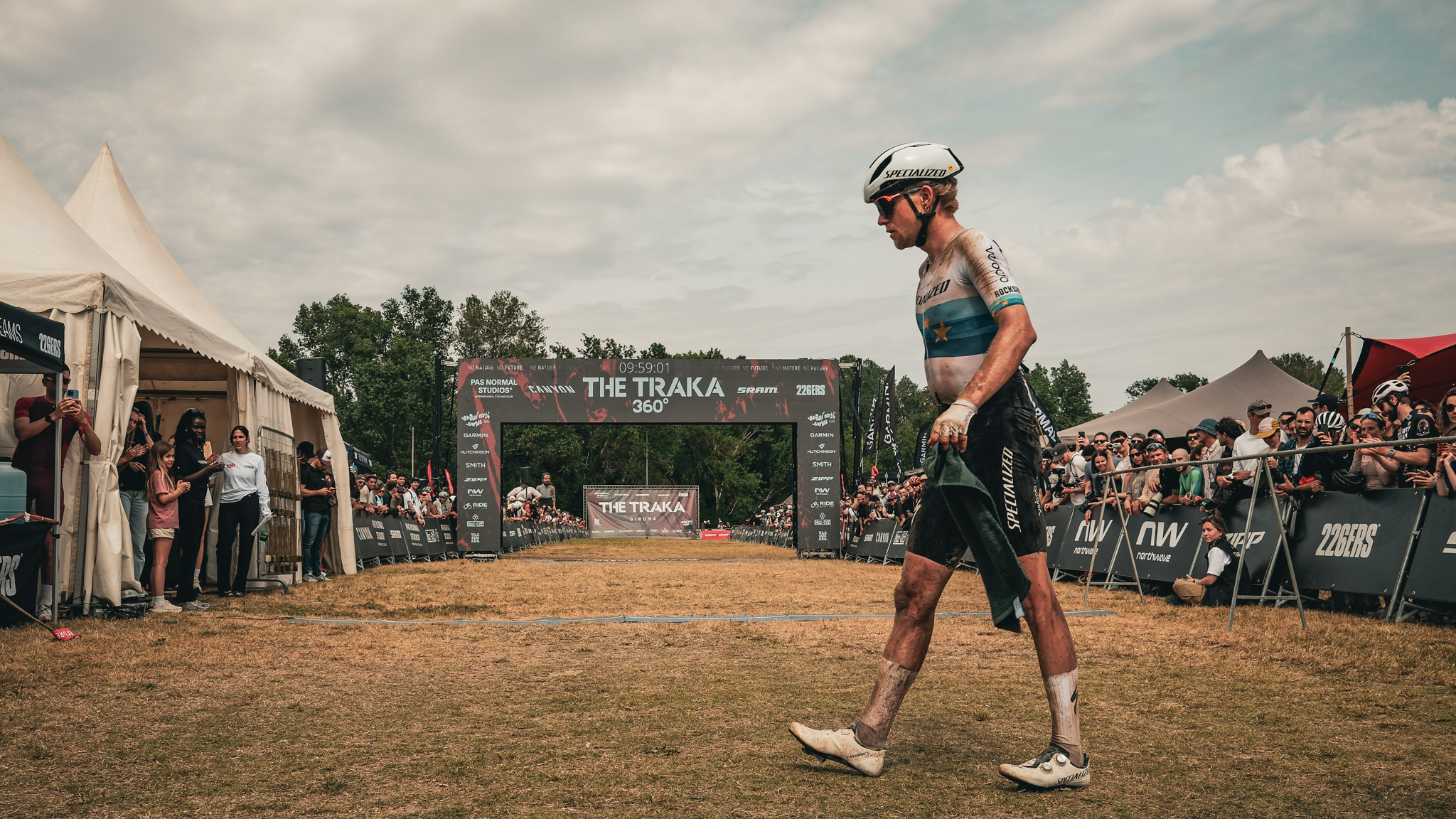
(Image credit: The Traka)
-
Facebook
-
X
-
Pinterest
-
Email
0
Follow us
Gravel seems to have been at a crossroads since its inception, in an ironic nod to the Flint Hills of Kansas that catapulted the discipline into the collective consciousness. Aero bars being banned at Unbound Gravel several years ago now caused quite a stir, but in reality this did little to affect the actual nature of the racing. It remained a privateer model; pros and amateurs racing the same course at the same time, with a spirit of self-sufficiency and community uplift that in no small part made the sport phenomenally popular in a relatively short space of time.
Now, though, with a slightly forlorn predictability, the gravel scene is increasingly professional, with a growing gulf not just between the pros and the amateurs paying their entry fees to participate, but between professional riders backed by big-budget teams and individual privateer athletes.
While in Girona for The Traka recently, I took some time to speak to riders about what they think of the rise of gravel teams, and what it all means for the future of the sport, and the future of the ‘spirit of gravel’.
Privateers, collectives, cabals, and full-on teams
If you scroll through the results of the men’s and women’s Traka races, you’ll see the number of athletes not affiliated with at least a small collective of other riders is very small. In the men’s 360, there are perhaps three or four in the top 40, and it’s similar in the women’s event.
Rosa Klöser bucks this trend, officially classing herself as a privateer off-road, and even going so far as to have ‘PRIVATEER’ written down the side of her back pocket on her skinsuit. This belies the fact that she is also a fully paid rider on the well-resourced Canyon-SRAM zondacrypto Women’s WorldTour team, exhibiting great form early in the season by a long solo breakaway at Paris-Roubaix before turning her focus to the world of gravel for Traka, Unbound, and the Life Time Grand Prix.
Many of these teams, the likes of PAS Racing and the Castelli Spirit of Gravel cabal, run as hybrids, with riders racing in the same jersey but operating to a greater or lesser extent as privateers, engaging their own bike and equipment sponsors.
There are some outfits, however, like the Ribble Outliers, who were set up with a different ethos. Their rider Harry Tanfield explained the differences to me.
“It’s not like the Factor teams, which have the same sponsors; they’re kind of more individual riders. We’re all friends. We look after each other and are always together in the house. It’s just that road team element culture is more what we have that others don’t, but we’re also from the road background.
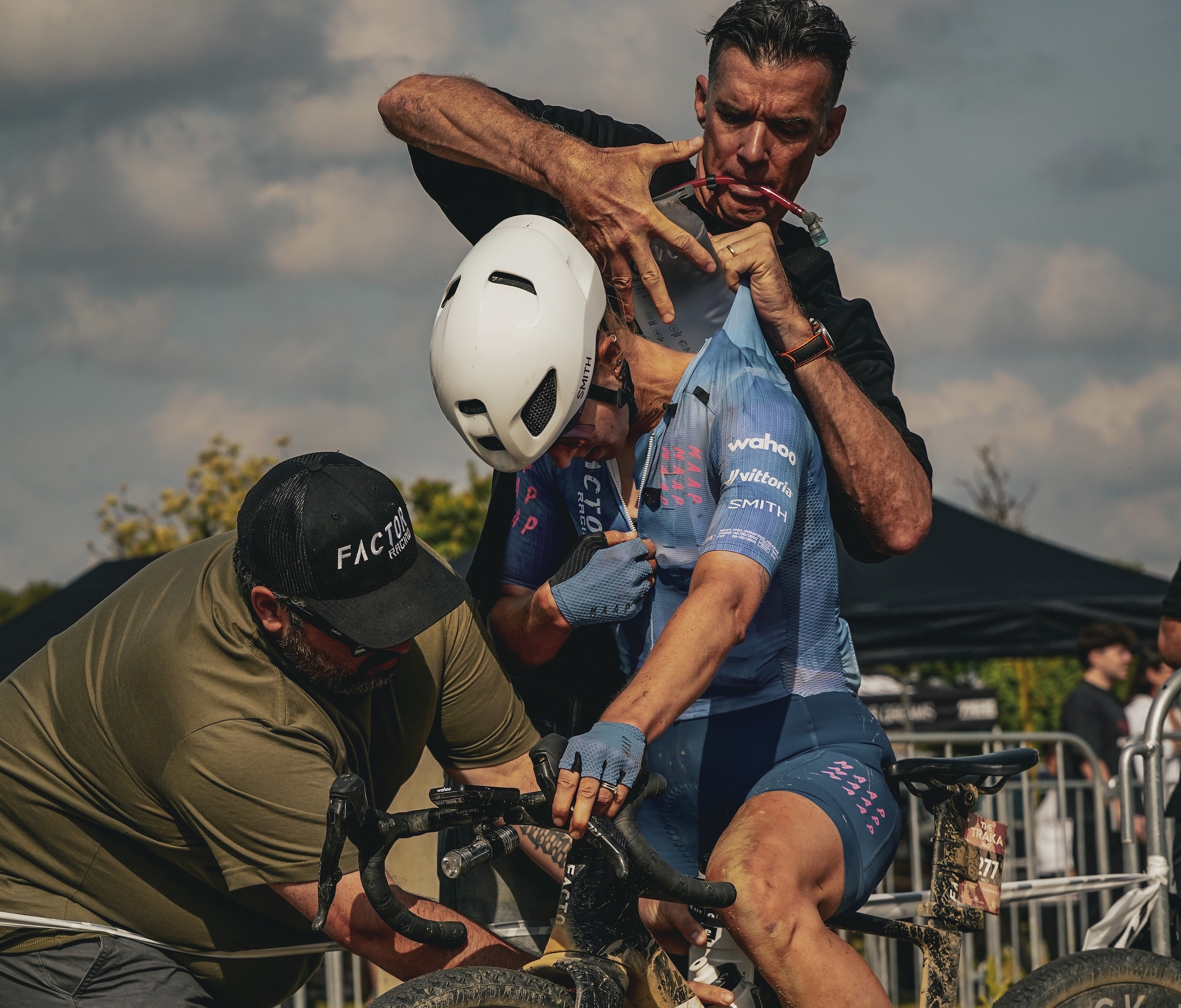
“When we first started, no one really knew what was happening, and it was just a group of individuals all together. It wasn’t until we did a few races together that we kind of worked our way through it, how you know things can work together as a group, mainly off the bike rather than on the bike. Making sure you’re not going to have six people all trying to cook their own dinners and stuff like that there, which in some gravel teams will happen.”
The need for course support is also a clear benefit of being part of a team. Riders like Dylan Johnson have tried to do it alone, Tanfield mentioned, but even he is now part of a Felt team.
“I think support in the races is so important. It depends how hot it is and where it is, but if you’re a privateer and doing a seven-hour race and you’ve got to start with four litres [of water] on you instead of two, it’s a big disadvantage,” he explained.
Sophie Wright, also of Ribble Outliers, was keen to point out the advantages that being a privateer can still offer.
“If you’re good enough to be able to pick and choose your own sponsors, you can build a complete package around you. And if, providing you get a decent salary, you can then say ‘OK, I’m gonna pay this mechanic… I’m gonna pay for a soigneur, and I’m going to pay for a mechanic. Done’, then that person can drive you, and that person can go to the supermarket.”
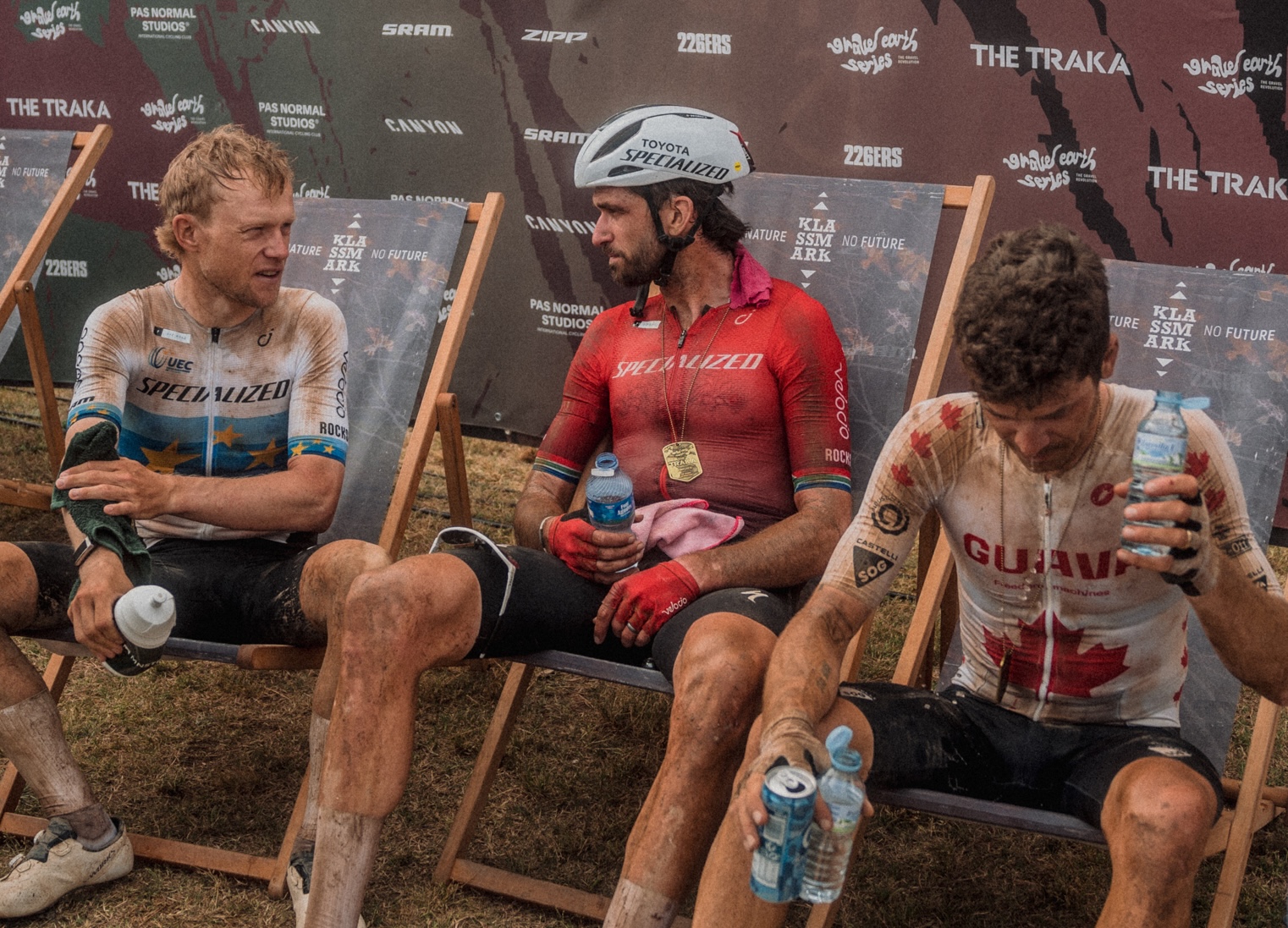
Later, I sat down with last year’s men’s Traka 360 winner, and co-manager of PAS Racing, Tobias Kongstad. He was keen to stress that – despite a hugely dominant performance in the 360 last year for men and women – PAS Racing is a step below the likes of Specialized Off-Road, the six-rider team that features two-time Traka 200 winner Sofia Gomez Villafañe.
“Right now in gravel racing there is, as you mention, three different ways you can do it. There is the full-on team, as you might see from Specialized or Canyon, where everyone gets a fixed salary from the team, and there is a team manager saying how to do the things,” Kongstad said.
“Then there’s us: We are doing everything together. We have mechanics, chefs together. We are sharing the same clothing, but we are not sharing the same bikes.
“Two years ago, when you look at a privateer’s programme, I think they’re struggling a lot because maybe you can earn a little bit more as a privateer, but at the end of the day doing Life Time Grand Prix you do seven trips to the USA, and some of the places like Nebraska, Iowa, they’re not the centre of the world. So I think being together and being able to travel together, I think it’s pretty nice that we’re racing the same days… and we don’t need to think about pleasing seven sponsors and think about housing and a kitchen, because in the USA that’s a big task.”
Team tactics don’t exist – yet
If you watch a livestream of a gravel race as a road cycling fan, you might assume that seeing a handful of PAS riders clad in their trademark brown skinsuits would mean we would see road-like team tactics: breakaways, blocking, chasing as a collective endeavour. but this seems like it’s not possible yet, both from a sponsorship point of view but also due to the dynamics and difficulties of the racing.
“There I think it’ll be a little bit tricky because, from the team side – and I can talk as a manager or sports director or whatever – I cannot say to Karolina [Migoń] that she shouldn’t take a pull if her teammate is in the front, because then Karolina’s bike sponsor will be like ‘hey, why didn’t you do it?’,” Kongstad explained.
“So I think until now what we have been doing is that you don’t race for each other, but we also don’t race against each other. In gravel racing you can have all the team tactics you want, but at the end of the day it’s tough to race… if you’re a good bike rider you’ll be in the top five or ten.”
Migoń, Unbound Gravel 200 winner in 2025, and Traka 360 winner in 2024 and 2025, is more unequivocal.
“We don’t disrupt the race… we don’t talk before the race and say ‘Oh I will race for you’, we just see during the race what’s going on and we adjust.”
After the Traka 360 and 200 had concluded, I sat down at a café with Piotr Havik of Castelli SOG (that’s Spirit of Gravel, if you hadn’t worked that out for yourself). As a former privateer, he shares the concerns of many as to what dedicated teams mean for the sport, though stressed that for the time being the issues haven’t come to pass.
“At this point I didn’t have the feeling like, OK, now the whole race got screwed because we have eight riders from one team all in the front and they are blocking like they are fucking up the race; that didn’t happen yet, but the bigger the teams are, the more riders from one team are in there, the more they can play those nasty tactics.
Tanfield put it with equal frankness: “There’s only a certain amount of races where you can really work together well as a team. If you’re following a wheel in front, you’re following a wheel in front.
“For guys like us, we’re trying to scrape into that top end. We’re not Matt Beers or Mads Würtz Schmidt who can just turn up and wipe the floor… we’re trying to do as little as possible in the groups to try to help ourselves as a team to get the best result, rather than controlling the race.”
The benefits are outside the race course
The traditional benefits of riding in a team – whatever ‘team’ means in this context – drafting, chasing, dedicated leadership simply don’t seem to be possible in the chaos and sheer physical effort of racing over 300 kilometres of off-road, which begs the question as to why so many riders are turning away from the privateer life to join organised outfits.
The reason, primarily, is that while the racing remains almost entirely an individual endeavour, a team affords the riders a degree of mental space that the privateer life simply cannot accommodate.
“The advantage, and the reason why I really like to be part of a team, is because it’s just less stress,” Wright surmised. “Like, if I was a privateer, for example – I did the UCI World Series in Monaco last week, and that wasn’t a team-supported race, but I thought ‘I want to do it anyway, so I’m going to self-support it,’ and my dad flew out to help me in the feed zones, drive me over there, blah, blah, blah… But I just found it much more stressful.
“I had to organise the feed zones, I had to do all the shopping, accommodation, clean my bike, do the chain, communicate with some of my friends who are doing the race and ask if they can help me in the feed zone because I wanted two feed zones per lap, and I was like ‘stuff being a privateer!’”
More than that, more than physically or mentally taking a load off, the collective race lifestyle is just far more sociable. Wright told me straight that the team life is “just a lot less lonely” and this is mirrored by Migoń.
“It’s also nice to not be alone during the races…even like being in a new place on the other side of the world, you are not alone there, it helps a lot mentally.”
Mérida Miller, also of the Castelli SOG crew, is effusive in her praise for the support the team brings to her riding.
“I think we both just loved the general ‘vibes’. But that’s truly what it is, right? So, even just having a WhatsApp group where people are just sharing stupid memes about shit, or like cheering each other on whatever, it feels like you’re part of something. And also what I love about the SOG crew is that it really is celebrating all the different types of riders.
“Even my coach this year was like – it’s my second year racing – ‘wow, I’ve really seen a difference in you’. I could show you our WhatsApp group, but it’s like, so wholesome, right? So it’s like, we’re cheering each other on, we’re checking in.”
There is, of course, a financial aspect to it too. Being a privateer means your costs are shouldered by you alone, whereas a collective setup allows the sharing of resources.
“If you’re fully privateer, it’s super nice that you have all the freedom, but then what comes on top of that you have to think about every single part yourself, from your brake pads to your chain to your mechanics, travelling, feeding, and then it costs a lot of money,” Havik said.
“When I was a privateer, I had a guy following me, which was luckily a videographer but also he knows how to give bottles. Every day he’s there, you have to pay him, and that’s a big investment for a privateer. Basically a person like this can do it for three or four riders and with Castelli SOG you find a nice mid-ground where you can still do things and decide things yourself like the programme, the equipment, but there are people around you who can support you where needed.”
Havik also went on to outline the drawbacks of being on bigger, more professionalised teams. PAS Racing wasn’t explicitly outlined, but between them and Specialized Off-road, they are the most well-oiled and well-resourced outfits in the field.
“A lot of times, in most teams, they lean into the extreme professional side or try to be as professional as possible, but then a lot of times you have a lack of resources. They want to act as one of the big teams, but then it creates pressure because okay, you expect a lot from us, but the environment is not there like with UAE [Team Emirates-XRG].”
As money continues to pour into gravel, the resource grows. However, the ability for the bigger teams to spend big and invest in big results also increases. Migoń, for example, was a software engineer alongside her gravel racing until 2026, something that clearly didn’t hold her back.
Though she was marred at the Traka by a crash with an age-grouper from a different race in the 360, she had come to the race off the back of an altitude camp in Colombia, something that’s extremely common in the WorldTour but almost unheard of in gravel.
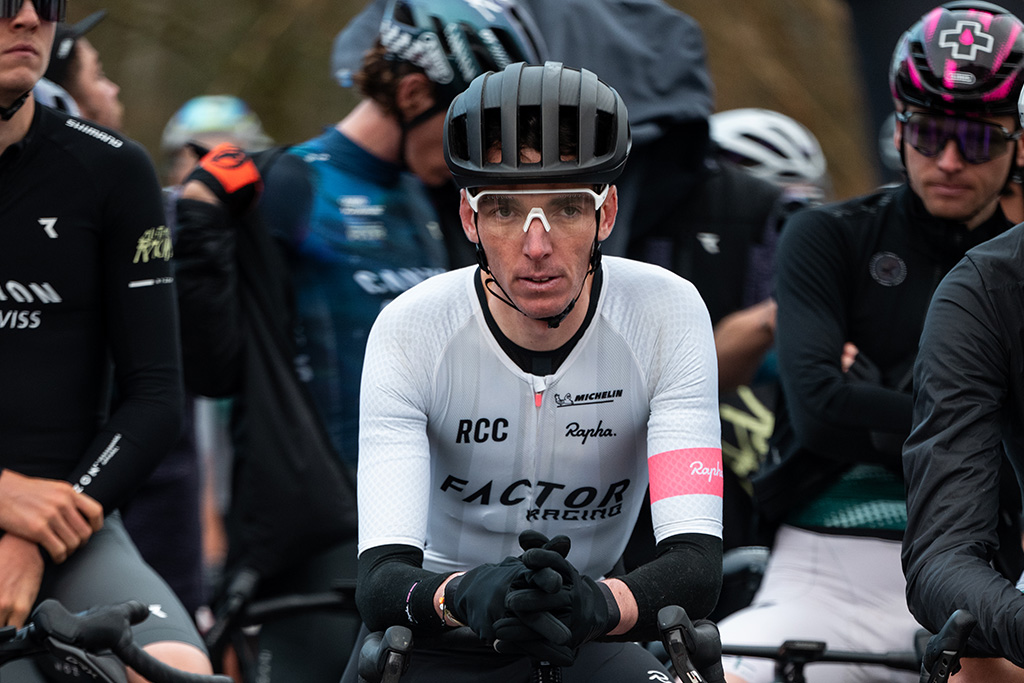
UCI points and the road-gravel continuum
So fresh is the discipline, and sprung up as it has from a disparate series of grassroots events free from the UCI umbrella, it is unusual compared to most other performance cycling disciplines insofar as the UCI-sanctioned races under the UCI Gravel World Series aren’t the pinnacle. They do, however, offer UCI points, giving pro road teams a carrot to bump up their team rankings alongside the road season.
You would think that there would be a reluctance from the gravel pros to see WorldTour roadies mixing it up in the gravel ranks, but I was surprised to find the reception was warm, partially because it would offer further legitimacy to the discipline, but also because the days of recently retired road riders rocking up to gravel events to farm podium spots are very much over.
“The gravel specialists, a lot of them are more focused on Gravel Earth series and other races, so they are not only focused on UCI [points], but they still do a lot of UCI racing. I think for the sport it will be good. Also, road professionals show up, and like Tim Wellens said in Marly Grav when he won there, ‘fuck, this was not an easy win,” Havik explained.
“Let them come and experience, and also show the high level we have in gravel already. We are also professionals, and it doesn’t mean that because we are not wearing a WorldTour kit that we don’t know how to ride our bikes and how to push watts.”
Though we are probably a way off having truly merged disciplines – even if riders like Rosa Klöser are showing that you can do both at the highest level of the sport – that’s something that former road pros like Sophie Wright would welcome.
“It would be sick to go back to a WorldTour team, but have a primary focus on gravel, and then dip in and out of road races,” she said. “You can race Strade Bianche, Flèche Wallonne, blah blah, and then you can come and do Traka [like Klöser]. For me, that’s actually an ideal package personally, so I’m not really opposed to it.”
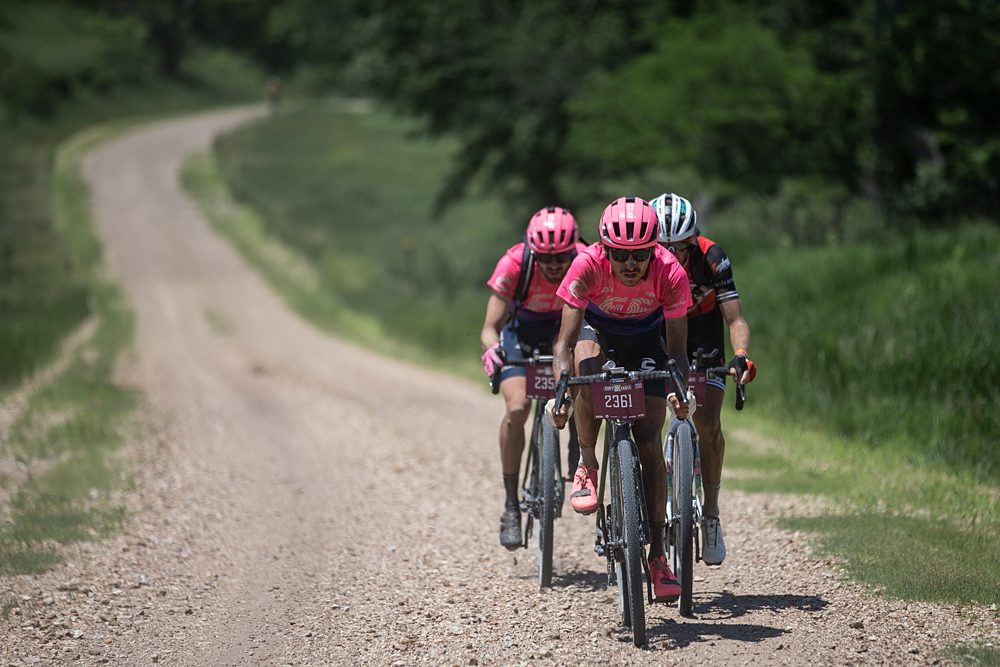
Professionalism, community, and the ‘Spirit of Gravel’ without irony
Teams undoubtedly make riders’ lives easier, but is there an underlying cost to the community as a whole that comes with this growing professionalism? The phrase ‘spirit of gravel’ has been used so often that it’s become a bit of a cliché, but there is a real meaning to it.
Nathan Haas has seen cycling through the lens of the WorldTour and professional gravel, and though he has stepped back from the Castelli SOG crew in some aspects, he’s well placed to outline the reasons for its formation as a counterpoint to traditional teams.
“I sat down with Steve Smith – one of the owners of Castelli – we’d just finished Iceland Rift, and it sort of begged the question: ‘what’s the direction of this sport?’ We were trying to zoom out and see in a glass ball,” Haas said.
“We’ve both been around cycling for long enough to have seen what happened to mountain biking, during the NORBA series when mountain biking was like at its peak and in many ways it exploded. We’ve seen cyclo-cross. We’ve seen the fixie scene. There’s a lot of times where sport has actually come in and out of fashion and grown. This is gravel cycling’s first foray.
“What does SOG represent? Trying to protect the very essence of what gravel is and personally what I feel it should be. It’s the last discipline in cycling that an athlete can still come with their bike bag to an event and still potentially win it without the need for being in a team that’s based around tactics and supporting a specific rider or having the need to have the mechanics, the soigneurs, all the feeders to be competitive.”
It would be very easy to paint this as all a bit ‘back in my day…’ from Haas, but there isn’t a hint of bitterness, or even misty-eyed nostalgia. Gravel seems to cause riders who have a certain level of experience to see how the sport has changed to speak with passion about the heart of the sport that you simply never see on the road.
Haas, again, dived deeper into the value that community adds to the sport.
“I was starting to feel in many ways that the sport was beginning to drift away from what I loved about it… Some people might call me stuck in the past with this, but I’m not scared to share my feeling on it because there’s something beautiful about gravel,” he said.
“And what we’re slowly starting to see with all of these tents, there’s an unequal playing field in the sport now. Riders don’t even have to come to pick up their numbers anymore; they’re staying at home off their legs. They’re having a massage. That’s an advantage to the rider who’s trying to win, but is that actually an advantage to the sport where we don’t have TV coverage? We don’t have non-endemic sponsors. It’s basically 99 per cent sponsored and supported by the bike industry.”
The start and finish area of The Traka is a world away from the pits of a WorldTour race where the riders are hidden away in their buses, doing media interviews out of obligation, staying away from the public gaze as much as possible. In Girona you could rub shoulders with people who have just come top-10 in the biggest gravel race in Europe, and that’s something gravel could lose as the team aspect grows.
“When they’re not turning up to speak to people or to integrate, there’s a loss there, right?” Haas said.
“We’re slowly losing this community feel where riders who are sponsored by different brands were still all travelling together, were the life of the party, forming this community sense that anyone could come up and talk and feel part of something and share the experience of being on the same track as the pros. We’re going to lose that because they’re now sticking to their team houses. They’re staying far away from everybody. They’re not interacting.
“You can’t just say you’re for community; you have to be for community.”
A post shared by Mérida Miller (@mercatmiller)
A photo posted by on
Team riders are more than just results
This, I think, is the crux of it: the lack of TV coverage. While the Traka and Unbound may have livestreams, you simply can’t consume the races in the same way as you can with the WorldTour. This means that, aside from a news article on the pages of Cyclingnews, the vast majority of the media consumed around the races is on social media. It’s about building narratives, storytelling, and having riders that are more compelling offerings than simply what they bring to the results sheet.
Haas, again, outlined to me that the riders selected for the SOG cabal are chosen based not only on their riding prowess, but also on how they conduct themselves, and hope that’s of benefit to the team beyond podium positions.
“If you’re only focused on somebody winning a race, you’re casting a very small net because how many people really resonate with actually coming to Traka it to win? People want to do their best, and we love that, right? But think about the 95% of people that’s not even in their wheelhouse. It might not even be part of their personality traits to be that competitive, but it doesn’t mean that these races and events aren’t for them.
“Is it more important how you won, or how you experienced the event? By the very definition everyone who is paid to ride their bikes in gravel, their job is to make people resonate with the brands that they work with, so if you don’t have a strong personality, or [aren’t] a strong storyteller or strong communicator, or even just somebody who’s really inspiring for their own reasons, if you’re only focused on somebody winning a race, you’re casting a very small net.”
Protect the individual
Gravel will undoubtedly continue to professionalise. That’s the inevitable march of progress, but I was curious to see if there was anything that could be done to moderate the growing dominance of teams, particularly from the organisational standpoint. Havik had a few ideas.
“One thing for sure that’s important is that privateers always should get their space at the start line,” he said. “What can happen is that if you only have 200 spots for the pro field, and the teams already know ahead of time which riders they are sending, they can start asking for start tickets in November when some privateers are still figuring things out.
“No wheel swapping between riders; that’s a very important one because a privateer cannot do it. Maybe a few more rules can be allowed so riders don’t wait for each other, and then maybe at a certain point you say OK, for some races there’s a maximum number of riders you can select because now, at the moment, it’s endless. If you show up with 20 riders from one team you can do it. It’s lucky there’s no team out there who can pay 20 riders, but that’s only a question of time and money before something like that shows up.”
It does seem that some races have already cottoned on to this and are implementing measures to ensure fair competition for all, too, as Haas pointed out to me.
“You have the Belgian Waffle Ride series, where as soon as there’s a lead group in the race, they have motorbikes behind that, and they give everyone gels and bidons, for if you can’t afford to bring over a staff of three or four or five and have three or four or five vehicles that are stationed all across the trail, giving out bidons, spare wheels, etc.
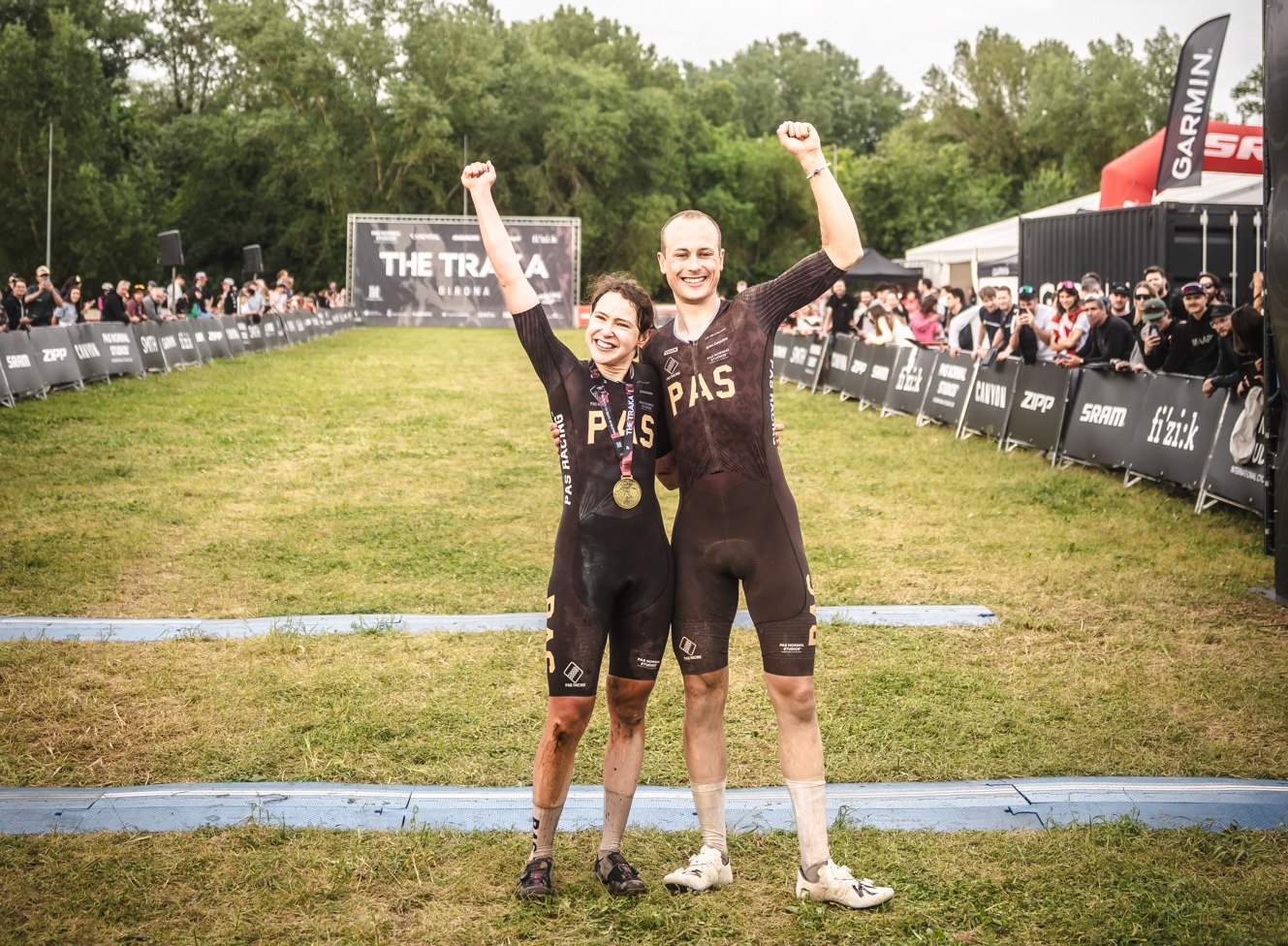
At this point Ben Perry, who rode to fourth in the Traka 360, walked past the deck chair I was slumped in and stopped for a chat with Haas and me before allowing me to take his bike away for some photos, a neat encapsulation of gravel’s community feel that many feel needs protecting as the sport inevitably marches onwards.
Will joined the Cyclingnews team as a reviews writer in 2022, having previously written for Cyclist, BikeRadar and Advntr. He’s tried his hand at most cycling disciplines, from the standard mix of road, gravel, and mountain bike, to the more unusual like bike polo and tracklocross. He’s made his own bike frames, covered tech news from the biggest races on the planet, and published countless premium galleries thanks to his excellent photographic eye. Also, given he doesn’t ever ride indoors he’s become a real expert on foul-weather riding gear. His collection of bikes is a real smorgasbord, with everything from vintage-style steel tourers through to superlight flat bar hill climb machines.
You must confirm your public display name before commenting
Please logout and then login again, you will then be prompted to enter your display name.
-
 1Giulio Pellizzari dropped by his own team, finishes 18 minutes down as Red Bull-Bora-Hansgrohe lose numerical advantage in fight for Giro d’Italia podium
 -
2Giro d’Italia stage 16: Jonas Vingegaard crushes climb to Carì to win his fourth stage
-
3Why I will always love opportunistic breakaway wins, our special guest in Pisa, and more from my second week at the Giro d’Italia
-
4Who will step up to challenge defending champions Karolina Migoń and Cameron Jones? – Analysing the Unbound 200 contenders
-
537,000m of elevation gain in two weeks – How super talent Paul Seixas is ramping up his training ahead of highly anticipated Tour de France debut
A loss of community, two-tier finances, and a tactical conundrum – Are professional teams reshaping the gravel scene?
MEMBER EXCLUSIVE
By
Will Jones
published
In gravel, teams, privateers, collectives, and cabals all race the same course, but how are fully-integrated teams with big budgets going to impact cycling’s most popular discipline?
(Image credit: The Traka)
-
Facebook
-
X
-
Pinterest
-
Email
0
Follow us
Gravel seems to have been at a crossroads since its inception, in an ironic nod to the Flint Hills of Kansas that catapulted the discipline into the collective consciousness. Aero bars being banned at Unbound Gravel several years ago now caused quite a stir, but in reality this did little to affect the actual nature of the racing. It remained a privateer model; pros and amateurs racing the same course at the same time, with a spirit of self-sufficiency and community uplift that in no small part made the sport phenomenally popular in a relatively short space of time.
Now, though, with a slightly forlorn predictability, the gravel scene is increasingly professional, with a growing gulf not just between the pros and the amateurs paying their entry fees to participate, but between professional riders backed by big-budget teams and individual privateer athletes.
While in Girona for The Traka recently, I took some time to speak to riders about what they think of the rise of gravel teams, and what it all means for the future of the sport, and the future of the ‘spirit of gravel’.
Privateers, collectives, cabals, and full-on teams
If you scroll through the results of the men’s and women’s Traka races, you’ll see the number of athletes not affiliated with at least a small collective of other riders is very small. In the men’s 360, there are perhaps three or four in the top 40, and it’s similar in the women’s event.
Rosa Klöser bucks this trend, officially classing herself as a privateer off-road, and even going so far as to have ‘PRIVATEER’ written down the side of her back pocket on her skinsuit. This belies the fact that she is also a fully paid rider on the well-resourced Canyon-SRAM zondacrypto Women’s WorldTour team, exhibiting great form early in the season by a long solo breakaway at Paris-Roubaix before turning her focus to the world of gravel for Traka, Unbound, and the Life Time Grand Prix.
Many of these teams, the likes of PAS Racing and the Castelli Spirit of Gravel cabal, run as hybrids, with riders racing in the same jersey but operating to a greater or lesser extent as privateers, engaging their own bike and equipment sponsors.
There are some outfits, however, like the Ribble Outliers, who were set up with a different ethos. Their rider Harry Tanfield explained the differences to me.
“It’s not like the Factor teams, which have the same sponsors; they’re kind of more individual riders. We’re all friends. We look after each other and are always together in the house. It’s just that road team element culture is more what we have that others don’t, but we’re also from the road background.
“When we first started, no one really knew what was happening, and it was just a group of individuals all together. It wasn’t until we did a few races together that we kind of worked our way through it, how you know things can work together as a group, mainly off the bike rather than on the bike. Making sure you’re not going to have six people all trying to cook their own dinners and stuff like that there, which in some gravel teams will happen.”
The need for course support is also a clear benefit of being part of a team. Riders like Dylan Johnson have tried to do it alone, Tanfield mentioned, but even he is now part of a Felt team.
“I think support in the races is so important. It depends how hot it is and where it is, but if you’re a privateer and doing a seven-hour race and you’ve got to start with four litres [of water] on you instead of two, it’s a big disadvantage,” he explained.
Sophie Wright, also of Ribble Outliers, was keen to point out the advantages that being a privateer can still offer.
“If you’re good enough to be able to pick and choose your own sponsors, you can build a complete package around you. And if, providing you get a decent salary, you can then say ‘OK, I’m gonna pay this mechanic… I’m gonna pay for a soigneur, and I’m going to pay for a mechanic. Done’, then that person can drive you, and that person can go to the supermarket.”
Later, I sat down with last year’s men’s Traka 360 winner, and co-manager of PAS Racing, Tobias Kongstad. He was keen to stress that – despite a hugely dominant performance in the 360 last year for men and women – PAS Racing is a step below the likes of Specialized Off-Road, the six-rider team that features two-time Traka 200 winner Sofia Gomez Villafañe.
“Right now in gravel racing there is, as you mention, three different ways you can do it. There is the full-on team, as you might see from Specialized or Canyon, where everyone gets a fixed salary from the team, and there is a team manager saying how to do the things,” Kongstad said.
“Then there’s us: We are doing everything together. We have mechanics, chefs together. We are sharing the same clothing, but we are not sharing the same bikes.
“Two years ago, when you look at a privateer’s programme, I think they’re struggling a lot because maybe you can earn a little bit more as a privateer, but at the end of the day doing Life Time Grand Prix you do seven trips to the USA, and some of the places like Nebraska, Iowa, they’re not the centre of the world. So I think being together and being able to travel together, I think it’s pretty nice that we’re racing the same days… and we don’t need to think about pleasing seven sponsors and think about housing and a kitchen, because in the USA that’s a big task.”
Team tactics don’t exist – yet
If you watch a livestream of a gravel race as a road cycling fan, you might assume that seeing a handful of PAS riders clad in their trademark brown skinsuits would mean we would see road-like team tactics: breakaways, blocking, chasing as a collective endeavour. but this seems like it’s not possible yet, both from a sponsorship point of view but also due to the dynamics and difficulties of the racing.
“There I think it’ll be a little bit tricky because, from the team side – and I can talk as a manager or sports director or whatever – I cannot say to Karolina [Migoń] that she shouldn’t take a pull if her teammate is in the front, because then Karolina’s bike sponsor will be like ‘hey, why didn’t you do it?’,” Kongstad explained.
“So I think until now what we have been doing is that you don’t race for each other, but we also don’t race against each other. In gravel racing you can have all the team tactics you want, but at the end of the day it’s tough to race… if you’re a good bike rider you’ll be in the top five or ten.”
Migoń, Unbound Gravel 200 winner in 2025, and Traka 360 winner in 2024 and 2025, is more unequivocal.
“We don’t disrupt the race… we don’t talk before the race and say ‘Oh I will race for you’, we just see during the race what’s going on and we adjust.”
After the Traka 360 and 200 had concluded, I sat down at a café with Piotr Havik of Castelli SOG (that’s Spirit of Gravel, if you hadn’t worked that out for yourself). As a former privateer, he shares the concerns of many as to what dedicated teams mean for the sport, though stressed that for the time being the issues haven’t come to pass.
“At this point I didn’t have the feeling like, OK, now the whole race got screwed because we have eight riders from one team all in the front and they are blocking like they are fucking up the race; that didn’t happen yet, but the bigger the teams are, the more riders from one team are in there, the more they can play those nasty tactics.
Tanfield put it with equal frankness: “There’s only a certain amount of races where you can really work together well as a team. If you’re following a wheel in front, you’re following a wheel in front.
“For guys like us, we’re trying to scrape into that top end. We’re not Matt Beers or Mads Würtz Schmidt who can just turn up and wipe the floor… we’re trying to do as little as possible in the groups to try to help ourselves as a team to get the best result, rather than controlling the race.”
The benefits are outside the race course
The traditional benefits of riding in a team – whatever ‘team’ means in this context – drafting, chasing, dedicated leadership simply don’t seem to be possible in the chaos and sheer physical effort of racing over 300 kilometres of off-road, which begs the question as to why so many riders are turning away from the privateer life to join organised outfits.
The reason, primarily, is that while the racing remains almost entirely an individual endeavour, a team affords the riders a degree of mental space that the privateer life simply cannot accommodate.
“The advantage, and the reason why I really like to be part of a team, is because it’s just less stress,” Wright surmised. “Like, if I was a privateer, for example – I did the UCI World Series in Monaco last week, and that wasn’t a team-supported race, but I thought ‘I want to do it anyway, so I’m going to self-support it,’ and my dad flew out to help me in the feed zones, drive me over there, blah, blah, blah… But I just found it much more stressful.
“I had to organise the feed zones, I had to do all the shopping, accommodation, clean my bike, do the chain, communicate with some of my friends who are doing the race and ask if they can help me in the feed zone because I wanted two feed zones per lap, and I was like ‘stuff being a privateer!’”
More than that, more than physically or mentally taking a load off, the collective race lifestyle is just far more sociable. Wright told me straight that the team life is “just a lot less lonely” and this is mirrored by Migoń.
“It’s also nice to not be alone during the races…even like being in a new place on the other side of the world, you are not alone there, it helps a lot mentally.”
Mérida Miller, also of the Castelli SOG crew, is effusive in her praise for the support the team brings to her riding.
“I think we both just loved the general ‘vibes’. But that’s truly what it is, right? So, even just having a WhatsApp group where people are just sharing stupid memes about shit, or like cheering each other on whatever, it feels like you’re part of something. And also what I love about the SOG crew is that it really is celebrating all the different types of riders.
“Even my coach this year was like – it’s my second year racing – ‘wow, I’ve really seen a difference in you’. I could show you our WhatsApp group, but it’s like, so wholesome, right? So it’s like, we’re cheering each other on, we’re checking in.”
There is, of course, a financial aspect to it too. Being a privateer means your costs are shouldered by you alone, whereas a collective setup allows the sharing of resources.
“If you’re fully privateer, it’s super nice that you have all the freedom, but then what comes on top of that you have to think about every single part yourself, from your brake pads to your chain to your mechanics, travelling, feeding, and then it costs a lot of money,” Havik said.
“When I was a privateer, I had a guy following me, which was luckily a videographer but also he knows how to give bottles. Every day he’s there, you have to pay him, and that’s a big investment for a privateer. Basically a person like this can do it for three or four riders and with Castelli SOG you find a nice mid-ground where you can still do things and decide things yourself like the programme, the equipment, but there are people around you who can support you where needed.”
Havik also went on to outline the drawbacks of being on bigger, more professionalised teams. PAS Racing wasn’t explicitly outlined, but between them and Specialized Off-road, they are the most well-oiled and well-resourced outfits in the field.
“A lot of times, in most teams, they lean into the extreme professional side or try to be as professional as possible, but then a lot of times you have a lack of resources. They want to act as one of the big teams, but then it creates pressure because okay, you expect a lot from us, but the environment is not there like with UAE [Team Emirates-XRG].”
As money continues to pour into gravel, the resource grows. However, the ability for the bigger teams to spend big and invest in big results also increases. Migoń, for example, was a software engineer alongside her gravel racing until 2026, something that clearly didn’t hold her back.
Though she was marred at the Traka by a crash with an age-grouper from a different race in the 360, she had come to the race off the back of an altitude camp in Colombia, something that’s extremely common in the WorldTour but almost unheard of in gravel.
UCI points and the road-gravel continuum
So fresh is the discipline, and sprung up as it has from a disparate series of grassroots events free from the UCI umbrella, it is unusual compared to most other performance cycling disciplines insofar as the UCI-sanctioned races under the UCI Gravel World Series aren’t the pinnacle. They do, however, offer UCI points, giving pro road teams a carrot to bump up their team rankings alongside the road season.
You would think that there would be a reluctance from the gravel pros to see WorldTour roadies mixing it up in the gravel ranks, but I was surprised to find the reception was warm, partially because it would offer further legitimacy to the discipline, but also because the days of recently retired road riders rocking up to gravel events to farm podium spots are very much over.
“The gravel specialists, a lot of them are more focused on Gravel Earth series and other races, so they are not only focused on UCI [points], but they still do a lot of UCI racing. I think for the sport it will be good. Also, road professionals show up, and like Tim Wellens said in Marly Grav when he won there, ‘fuck, this was not an easy win,” Havik explained.
“Let them come and experience, and also show the high level we have in gravel already. We are also professionals, and it doesn’t mean that because we are not wearing a WorldTour kit that we don’t know how to ride our bikes and how to push watts.”
Though we are probably a way off having truly merged disciplines – even if riders like Rosa Klöser are showing that you can do both at the highest level of the sport – that’s something that former road pros like Sophie Wright would welcome.
“It would be sick to go back to a WorldTour team, but have a primary focus on gravel, and then dip in and out of road races,” she said. “You can race Strade Bianche, Flèche Wallonne, blah blah, and then you can come and do Traka [like Klöser]. For me, that’s actually an ideal package personally, so I’m not really opposed to it.”
Professionalism, community, and the ‘Spirit of Gravel’ without irony
Teams undoubtedly make riders’ lives easier, but is there an underlying cost to the community as a whole that comes with this growing professionalism? The phrase ‘spirit of gravel’ has been used so often that it’s become a bit of a cliché, but there is a real meaning to it.
Nathan Haas has seen cycling through the lens of the WorldTour and professional gravel, and though he has stepped back from the Castelli SOG crew in some aspects, he’s well placed to outline the reasons for its formation as a counterpoint to traditional teams.
“I sat down with Steve Smith – one of the owners of Castelli – we’d just finished Iceland Rift, and it sort of begged the question: ‘what’s the direction of this sport?’ We were trying to zoom out and see in a glass ball,” Haas said.
“We’ve both been around cycling for long enough to have seen what happened to mountain biking, during the NORBA series when mountain biking was like at its peak and in many ways it exploded. We’ve seen cyclo-cross. We’ve seen the fixie scene. There’s a lot of times where sport has actually come in and out of fashion and grown. This is gravel cycling’s first foray.
“What does SOG represent? Trying to protect the very essence of what gravel is and personally what I feel it should be. It’s the last discipline in cycling that an athlete can still come with their bike bag to an event and still potentially win it without the need for being in a team that’s based around tactics and supporting a specific rider or having the need to have the mechanics, the soigneurs, all the feeders to be competitive.”
It would be very easy to paint this as all a bit ‘back in my day…’ from Haas, but there isn’t a hint of bitterness, or even misty-eyed nostalgia. Gravel seems to cause riders who have a certain level of experience to see how the sport has changed to speak with passion about the heart of the sport that you simply never see on the road.
Haas, again, dived deeper into the value that community adds to the sport.
“I was starting to feel in many ways that the sport was beginning to drift away from what I loved about it… Some people might call me stuck in the past with this, but I’m not scared to share my feeling on it because there’s something beautiful about gravel,” he said.
“And what we’re slowly starting to see with all of these tents, there’s an unequal playing field in the sport now. Riders don’t even have to come to pick up their numbers anymore; they’re staying at home off their legs. They’re having a massage. That’s an advantage to the rider who’s trying to win, but is that actually an advantage to the sport where we don’t have TV coverage? We don’t have non-endemic sponsors. It’s basically 99 per cent sponsored and supported by the bike industry.”
The start and finish area of The Traka is a world away from the pits of a WorldTour race where the riders are hidden away in their buses, doing media interviews out of obligation, staying away from the public gaze as much as possible. In Girona you could rub shoulders with people who have just come top-10 in the biggest gravel race in Europe, and that’s something gravel could lose as the team aspect grows.
“When they’re not turning up to speak to people or to integrate, there’s a loss there, right?” Haas said.
“We’re slowly losing this community feel where riders who are sponsored by different brands were still all travelling together, were the life of the party, forming this community sense that anyone could come up and talk and feel part of something and share the experience of being on the same track as the pros. We’re going to lose that because they’re now sticking to their team houses. They’re staying far away from everybody. They’re not interacting.
“You can’t just say you’re for community; you have to be for community.”
A post shared by Mérida Miller (@mercatmiller)
A photo posted by on
Team riders are more than just results
This, I think, is the crux of it: the lack of TV coverage. While the Traka and Unbound may have livestreams, you simply can’t consume the races in the same way as you can with the WorldTour. This means that, aside from a news article on the pages of Cyclingnews, the vast majority of the media consumed around the races is on social media. It’s about building narratives, storytelling, and having riders that are more compelling offerings than simply what they bring to the results sheet.
Haas, again, outlined to me that the riders selected for the SOG cabal are chosen based not only on their riding prowess, but also on how they conduct themselves, and hope that’s of benefit to the team beyond podium positions.
“If you’re only focused on somebody winning a race, you’re casting a very small net because how many people really resonate with actually coming to Traka it to win? People want to do their best, and we love that, right? But think about the 95% of people that’s not even in their wheelhouse. It might not even be part of their personality traits to be that competitive, but it doesn’t mean that these races and events aren’t for them.
“Is it more important how you won, or how you experienced the event? By the very definition everyone who is paid to ride their bikes in gravel, their job is to make people resonate with the brands that they work with, so if you don’t have a strong personality, or [aren’t] a strong storyteller or strong communicator, or even just somebody who’s really inspiring for their own reasons, if you’re only focused on somebody winning a race, you’re casting a very small net.”
Protect the individual
Gravel will undoubtedly continue to professionalise. That’s the inevitable march of progress, but I was curious to see if there was anything that could be done to moderate the growing dominance of teams, particularly from the organisational standpoint. Havik had a few ideas.
“One thing for sure that’s important is that privateers always should get their space at the start line,” he said. “What can happen is that if you only have 200 spots for the pro field, and the teams already know ahead of time which riders they are sending, they can start asking for start tickets in November when some privateers are still figuring things out.
“No wheel swapping between riders; that’s a very important one because a privateer cannot do it. Maybe a few more rules can be allowed so riders don’t wait for each other, and then maybe at a certain point you say OK, for some races there’s a maximum number of riders you can select because now, at the moment, it’s endless. If you show up with 20 riders from one team you can do it. It’s lucky there’s no team out there who can pay 20 riders, but that’s only a question of time and money before something like that shows up.”
It does seem that some races have already cottoned on to this and are implementing measures to ensure fair competition for all, too, as Haas pointed out to me.
“You have the Belgian Waffle Ride series, where as soon as there’s a lead group in the race, they have motorbikes behind that, and they give everyone gels and bidons, for if you can’t afford to bring over a staff of three or four or five and have three or four or five vehicles that are stationed all across the trail, giving out bidons, spare wheels, etc.
At this point Ben Perry, who rode to fourth in the Traka 360, walked past the deck chair I was slumped in and stopped for a chat with Haas and me before allowing me to take his bike away for some photos, a neat encapsulation of gravel’s community feel that many feel needs protecting as the sport inevitably marches onwards.
Will joined the Cyclingnews team as a reviews writer in 2022, having previously written for Cyclist, BikeRadar and Advntr. He’s tried his hand at most cycling disciplines, from the standard mix of road, gravel, and mountain bike, to the more unusual like bike polo and tracklocross. He’s made his own bike frames, covered tech news from the biggest races on the planet, and published countless premium galleries thanks to his excellent photographic eye. Also, given he doesn’t ever ride indoors he’s become a real expert on foul-weather riding gear. His collection of bikes is a real smorgasbord, with everything from vintage-style steel tourers through to superlight flat bar hill climb machines.
You must confirm your public display name before commenting
Please logout and then login again, you will then be prompted to enter your display name.
-
1Giulio Pellizzari dropped by his own team, finishes 18 minutes down as Red Bull-Bora-Hansgrohe lose numerical advantage in fight for Giro d’Italia podium
-
2Giro d’Italia stage 16: Jonas Vingegaard crushes climb to Carì to win his fourth stage
-
3Why I will always love opportunistic breakaway wins, our special guest in Pisa, and more from my second week at the Giro d’Italia
-
4Who will step up to challenge defending champions Karolina Migoń and Cameron Jones? – Analysing the Unbound 200 contenders
-
537,000m of elevation gain in two weeks – How super talent Paul Seixas is ramping up his training ahead of highly anticipated Tour de France debut
A loss of community, two-tier finances, and a tactical conundrum – Are professional teams reshaping the gravel scene?
MEMBER EXCLUSIVE
By
Will Jones
published
In gravel, teams, privateers, collectives, and cabals all race the same course, but how are fully-integrated teams with big budgets going to impact cycling’s most popular discipline?
-
Facebook
-
X
-
Pinterest
-
Email
0
Follow us
Gravel seems to have been at a crossroads since its inception, in an ironic nod to the Flint Hills of Kansas that catapulted the discipline into the collective consciousness. Aero bars being banned at Unbound Gravel several years ago now caused quite a stir, but in reality this did little to affect the actual nature of the racing. It remained a privateer model; pros and amateurs racing the same course at the same time, with a spirit of self-sufficiency and community uplift that in no small part made the sport phenomenally popular in a relatively short space of time.
Now, though, with a slightly forlorn predictability, the gravel scene is increasingly professional, with a growing gulf not just between the pros and the amateurs paying their entry fees to participate, but between professional riders backed by big-budget teams and individual privateer athletes.
While in Girona for The Traka recently, I took some time to speak to riders about what they think of the rise of gravel teams, and what it all means for the future of the sport, and the future of the ‘spirit of gravel’.
Privateers, collectives, cabals, and full-on teams
If you scroll through the results of the men’s and women’s Traka races, you’ll see the number of athletes not affiliated with at least a small collective of other riders is very small. In the men’s 360, there are perhaps three or four in the top 40, and it’s similar in the women’s event.
Rosa Klöser bucks this trend, officially classing herself as a privateer off-road, and even going so far as to have ‘PRIVATEER’ written down the side of her back pocket on her skinsuit. This belies the fact that she is also a fully paid rider on the well-resourced Canyon-SRAM zondacrypto Women’s WorldTour team, exhibiting great form early in the season by a long solo breakaway at Paris-Roubaix before turning her focus to the world of gravel for Traka, Unbound, and the Life Time Grand Prix.
Many of these teams, the likes of PAS Racing and the Castelli Spirit of Gravel cabal, run as hybrids, with riders racing in the same jersey but operating to a greater or lesser extent as privateers, engaging their own bike and equipment sponsors.
There are some outfits, however, like the Ribble Outliers, who were set up with a different ethos. Their rider Harry Tanfield explained the differences to me.
“It’s not like the Factor teams, which have the same sponsors; they’re kind of more individual riders. We’re all friends. We look after each other and are always together in the house. It’s just that road team element culture is more what we have that others don’t, but we’re also from the road background.
“When we first started, no one really knew what was happening, and it was just a group of individuals all together. It wasn’t until we did a few races together that we kind of worked our way through it, how you know things can work together as a group, mainly off the bike rather than on the bike. Making sure you’re not going to have six people all trying to cook their own dinners and stuff like that there, which in some gravel teams will happen.”
The need for course support is also a clear benefit of being part of a team. Riders like Dylan Johnson have tried to do it alone, Tanfield mentioned, but even he is now part of a Felt team.
“I think support in the races is so important. It depends how hot it is and where it is, but if you’re a privateer and doing a seven-hour race and you’ve got to start with four litres [of water] on you instead of two, it’s a big disadvantage,” he explained.
Sophie Wright, also of Ribble Outliers, was keen to point out the advantages that being a privateer can still offer.
“If you’re good enough to be able to pick and choose your own sponsors, you can build a complete package around you. And if, providing you get a decent salary, you can then say ‘OK, I’m gonna pay this mechanic… I’m gonna pay for a soigneur, and I’m going to pay for a mechanic. Done’, then that person can drive you, and that person can go to the supermarket.”
Later, I sat down with last year’s men’s Traka 360 winner, and co-manager of PAS Racing, Tobias Kongstad. He was keen to stress that – despite a hugely dominant performance in the 360 last year for men and women – PAS Racing is a step below the likes of Specialized Off-Road, the six-rider team that features two-time Traka 200 winner Sofia Gomez Villafañe.
“Right now in gravel racing there is, as you mention, three different ways you can do it. There is the full-on team, as you might see from Specialized or Canyon, where everyone gets a fixed salary from the team, and there is a team manager saying how to do the things,” Kongstad said.
“Then there’s us: We are doing everything together. We have mechanics, chefs together. We are sharing the same clothing, but we are not sharing the same bikes.
“Two years ago, when you look at a privateer’s programme, I think they’re struggling a lot because maybe you can earn a little bit more as a privateer, but at the end of the day doing Life Time Grand Prix you do seven trips to the USA, and some of the places like Nebraska, Iowa, they’re not the centre of the world. So I think being together and being able to travel together, I think it’s pretty nice that we’re racing the same days… and we don’t need to think about pleasing seven sponsors and think about housing and a kitchen, because in the USA that’s a big task.”
Team tactics don’t exist – yet
If you watch a livestream of a gravel race as a road cycling fan, you might assume that seeing a handful of PAS riders clad in their trademark brown skinsuits would mean we would see road-like team tactics: breakaways, blocking, chasing as a collective endeavour. but this seems like it’s not possible yet, both from a sponsorship point of view but also due to the dynamics and difficulties of the racing.
“There I think it’ll be a little bit tricky because, from the team side – and I can talk as a manager or sports director or whatever – I cannot say to Karolina [Migoń] that she shouldn’t take a pull if her teammate is in the front, because then Karolina’s bike sponsor will be like ‘hey, why didn’t you do it?’,” Kongstad explained.
“So I think until now what we have been doing is that you don’t race for each other, but we also don’t race against each other. In gravel racing you can have all the team tactics you want, but at the end of the day it’s tough to race… if you’re a good bike rider you’ll be in the top five or ten.”
Migoń, Unbound Gravel 200 winner in 2025, and Traka 360 winner in 2024 and 2025, is more unequivocal.
“We don’t disrupt the race… we don’t talk before the race and say ‘Oh I will race for you’, we just see during the race what’s going on and we adjust.”
After the Traka 360 and 200 had concluded, I sat down at a café with Piotr Havik of Castelli SOG (that’s Spirit of Gravel, if you hadn’t worked that out for yourself). As a former privateer, he shares the concerns of many as to what dedicated teams mean for the sport, though stressed that for the time being the issues haven’t come to pass.
“At this point I didn’t have the feeling like, OK, now the whole race got screwed because we have eight riders from one team all in the front and they are blocking like they are fucking up the race; that didn’t happen yet, but the bigger the teams are, the more riders from one team are in there, the more they can play those nasty tactics.
Tanfield put it with equal frankness: “There’s only a certain amount of races where you can really work together well as a team. If you’re following a wheel in front, you’re following a wheel in front.
“For guys like us, we’re trying to scrape into that top end. We’re not Matt Beers or Mads Würtz Schmidt who can just turn up and wipe the floor… we’re trying to do as little as possible in the groups to try to help ourselves as a team to get the best result, rather than controlling the race.”
The benefits are outside the race course
The traditional benefits of riding in a team – whatever ‘team’ means in this context – drafting, chasing, dedicated leadership simply don’t seem to be possible in the chaos and sheer physical effort of racing over 300 kilometres of off-road, which begs the question as to why so many riders are turning away from the privateer life to join organised outfits.
The reason, primarily, is that while the racing remains almost entirely an individual endeavour, a team affords the riders a degree of mental space that the privateer life simply cannot accommodate.
“The advantage, and the reason why I really like to be part of a team, is because it’s just less stress,” Wright surmised. “Like, if I was a privateer, for example – I did the UCI World Series in Monaco last week, and that wasn’t a team-supported race, but I thought ‘I want to do it anyway, so I’m going to self-support it,’ and my dad flew out to help me in the feed zones, drive me over there, blah, blah, blah… But I just found it much more stressful.
“I had to organise the feed zones, I had to do all the shopping, accommodation, clean my bike, do the chain, communicate with some of my friends who are doing the race and ask if they can help me in the feed zone because I wanted two feed zones per lap, and I was like ‘stuff being a privateer!’”
More than that, more than physically or mentally taking a load off, the collective race lifestyle is just far more sociable. Wright told me straight that the team life is “just a lot less lonely” and this is mirrored by Migoń.
“It’s also nice to not be alone during the races…even like being in a new place on the other side of the world, you are not alone there, it helps a lot mentally.”
Mérida Miller, also of the Castelli SOG crew, is effusive in her praise for the support the team brings to her riding.
“I think we both just loved the general ‘vibes’. But that’s truly what it is, right? So, even just having a WhatsApp group where people are just sharing stupid memes about shit, or like cheering each other on whatever, it feels like you’re part of something. And also what I love about the SOG crew is that it really is celebrating all the different types of riders.
“Even my coach this year was like – it’s my second year racing – ‘wow, I’ve really seen a difference in you’. I could show you our WhatsApp group, but it’s like, so wholesome, right? So it’s like, we’re cheering each other on, we’re checking in.”
There is, of course, a financial aspect to it too. Being a privateer means your costs are shouldered by you alone, whereas a collective setup allows the sharing of resources.
“If you’re fully privateer, it’s super nice that you have all the freedom, but then what comes on top of that you have to think about every single part yourself, from your brake pads to your chain to your mechanics, travelling, feeding, and then it costs a lot of money,” Havik said.
“When I was a privateer, I had a guy following me, which was luckily a videographer but also he knows how to give bottles. Every day he’s there, you have to pay him, and that’s a big investment for a privateer. Basically a person like this can do it for three or four riders and with Castelli SOG you find a nice mid-ground where you can still do things and decide things yourself like the programme, the equipment, but there are people around you who can support you where needed.”
Havik also went on to outline the drawbacks of being on bigger, more professionalised teams. PAS Racing wasn’t explicitly outlined, but between them and Specialized Off-road, they are the most well-oiled and well-resourced outfits in the field.
“A lot of times, in most teams, they lean into the extreme professional side or try to be as professional as possible, but then a lot of times you have a lack of resources. They want to act as one of the big teams, but then it creates pressure because okay, you expect a lot from us, but the environment is not there like with UAE [Team Emirates-XRG].”
As money continues to pour into gravel, the resource grows. However, the ability for the bigger teams to spend big and invest in big results also increases. Migoń, for example, was a software engineer alongside her gravel racing until 2026, something that clearly didn’t hold her back.
Though she was marred at the Traka by a crash with an age-grouper from a different race in the 360, she had come to the race off the back of an altitude camp in Colombia, something that’s extremely common in the WorldTour but almost unheard of in gravel.
UCI points and the road-gravel continuum
So fresh is the discipline, and sprung up as it has from a disparate series of grassroots events free from the UCI umbrella, it is unusual compared to most other performance cycling disciplines insofar as the UCI-sanctioned races under the UCI Gravel World Series aren’t the pinnacle. They do, however, offer UCI points, giving pro road teams a carrot to bump up their team rankings alongside the road season.
You would think that there would be a reluctance from the gravel pros to see WorldTour roadies mixing it up in the gravel ranks, but I was surprised to find the reception was warm, partially because it would offer further legitimacy to the discipline, but also because the days of recently retired road riders rocking up to gravel events to farm podium spots are very much over.
“The gravel specialists, a lot of them are more focused on Gravel Earth series and other races, so they are not only focused on UCI [points], but they still do a lot of UCI racing. I think for the sport it will be good. Also, road professionals show up, and like Tim Wellens said in Marly Grav when he won there, ‘fuck, this was not an easy win,” Havik explained.
“Let them come and experience, and also show the high level we have in gravel already. We are also professionals, and it doesn’t mean that because we are not wearing a WorldTour kit that we don’t know how to ride our bikes and how to push watts.”
Though we are probably a way off having truly merged disciplines – even if riders like Rosa Klöser are showing that you can do both at the highest level of the sport – that’s something that former road pros like Sophie Wright would welcome.
“It would be sick to go back to a WorldTour team, but have a primary focus on gravel, and then dip in and out of road races,” she said. “You can race Strade Bianche, Flèche Wallonne, blah blah, and then you can come and do Traka [like Klöser]. For me, that’s actually an ideal package personally, so I’m not really opposed to it.”
Professionalism, community, and the ‘Spirit of Gravel’ without irony
Teams undoubtedly make riders’ lives easier, but is there an underlying cost to the community as a whole that comes with this growing professionalism? The phrase ‘spirit of gravel’ has been used so often that it’s become a bit of a cliché, but there is a real meaning to it.
Nathan Haas has seen cycling through the lens of the WorldTour and professional gravel, and though he has stepped back from the Castelli SOG crew in some aspects, he’s well placed to outline the reasons for its formation as a counterpoint to traditional teams.
“I sat down with Steve Smith – one of the owners of Castelli – we’d just finished Iceland Rift, and it sort of begged the question: ‘what’s the direction of this sport?’ We were trying to zoom out and see in a glass ball,” Haas said.
“We’ve both been around cycling for long enough to have seen what happened to mountain biking, during the NORBA series when mountain biking was like at its peak and in many ways it exploded. We’ve seen cyclo-cross. We’ve seen the fixie scene. There’s a lot of times where sport has actually come in and out of fashion and grown. This is gravel cycling’s first foray.
“What does SOG represent? Trying to protect the very essence of what gravel is and personally what I feel it should be. It’s the last discipline in cycling that an athlete can still come with their bike bag to an event and still potentially win it without the need for being in a team that’s based around tactics and supporting a specific rider or having the need to have the mechanics, the soigneurs, all the feeders to be competitive.”
It would be very easy to paint this as all a bit ‘back in my day…’ from Haas, but there isn’t a hint of bitterness, or even misty-eyed nostalgia. Gravel seems to cause riders who have a certain level of experience to see how the sport has changed to speak with passion about the heart of the sport that you simply never see on the road.
Haas, again, dived deeper into the value that community adds to the sport.
“I was starting to feel in many ways that the sport was beginning to drift away from what I loved about it… Some people might call me stuck in the past with this, but I’m not scared to share my feeling on it because there’s something beautiful about gravel,” he said.
“And what we’re slowly starting to see with all of these tents, there’s an unequal playing field in the sport now. Riders don’t even have to come to pick up their numbers anymore; they’re staying at home off their legs. They’re having a massage. That’s an advantage to the rider who’s trying to win, but is that actually an advantage to the sport where we don’t have TV coverage? We don’t have non-endemic sponsors. It’s basically 99 per cent sponsored and supported by the bike industry.”
The start and finish area of The Traka is a world away from the pits of a WorldTour race where the riders are hidden away in their buses, doing media interviews out of obligation, staying away from the public gaze as much as possible. In Girona you could rub shoulders with people who have just come top-10 in the biggest gravel race in Europe, and that’s something gravel could lose as the team aspect grows.
“When they’re not turning up to speak to people or to integrate, there’s a loss there, right?” Haas said.
“We’re slowly losing this community feel where riders who are sponsored by different brands were still all travelling together, were the life of the party, forming this community sense that anyone could come up and talk and feel part of something and share the experience of being on the same track as the pros. We’re going to lose that because they’re now sticking to their team houses. They’re staying far away from everybody. They’re not interacting.
“You can’t just say you’re for community; you have to be for community.”
A post shared by Mérida Miller (@mercatmiller)
A photo posted by on
Team riders are more than just results
This, I think, is the crux of it: the lack of TV coverage. While the Traka and Unbound may have livestreams, you simply can’t consume the races in the same way as you can with the WorldTour. This means that, aside from a news article on the pages of Cyclingnews, the vast majority of the media consumed around the races is on social media. It’s about building narratives, storytelling, and having riders that are more compelling offerings than simply what they bring to the results sheet.
Haas, again, outlined to me that the riders selected for the SOG cabal are chosen based not only on their riding prowess, but also on how they conduct themselves, and hope that’s of benefit to the team beyond podium positions.
“If you’re only focused on somebody winning a race, you’re casting a very small net because how many people really resonate with actually coming to Traka it to win? People want to do their best, and we love that, right? But think about the 95% of people that’s not even in their wheelhouse. It might not even be part of their personality traits to be that competitive, but it doesn’t mean that these races and events aren’t for them.
“Is it more important how you won, or how you experienced the event? By the very definition everyone who is paid to ride their bikes in gravel, their job is to make people resonate with the brands that they work with, so if you don’t have a strong personality, or [aren’t] a strong storyteller or strong communicator, or even just somebody who’s really inspiring for their own reasons, if you’re only focused on somebody winning a race, you’re casting a very small net.”
Protect the individual
Gravel will undoubtedly continue to professionalise. That’s the inevitable march of progress, but I was curious to see if there was anything that could be done to moderate the growing dominance of teams, particularly from the organisational standpoint. Havik had a few ideas.
“One thing for sure that’s important is that privateers always should get their space at the start line,” he said. “What can happen is that if you only have 200 spots for the pro field, and the teams already know ahead of time which riders they are sending, they can start asking for start tickets in November when some privateers are still figuring things out.
“No wheel swapping between riders; that’s a very important one because a privateer cannot do it. Maybe a few more rules can be allowed so riders don’t wait for each other, and then maybe at a certain point you say OK, for some races there’s a maximum number of riders you can select because now, at the moment, it’s endless. If you show up with 20 riders from one team you can do it. It’s lucky there’s no team out there who can pay 20 riders, but that’s only a question of time and money before something like that shows up.”
It does seem that some races have already cottoned on to this and are implementing measures to ensure fair competition for all, too, as Haas pointed out to me.
“You have the Belgian Waffle Ride series, where as soon as there’s a lead group in the race, they have motorbikes behind that, and they give everyone gels and bidons, for if you can’t afford to bring over a staff of three or four or five and have three or four or five vehicles that are stationed all across the trail, giving out bidons, spare wheels, etc.
At this point Ben Perry, who rode to fourth in the Traka 360, walked past the deck chair I was slumped in and stopped for a chat with Haas and me before allowing me to take his bike away for some photos, a neat encapsulation of gravel’s community feel that many feel needs protecting as the sport inevitably marches onwards.
[analyse_source url=”https://www.cyclingnews.com/pro-cycling/racing/a-loss-of-community-two-tier-finances-and-a-tactical-conundrum-are-professional-teams-reshaping-the-gravel-scene/”]