[analyse_image type=”featured” src=”https://velo-cdn.outsideonline.com/wp-content/uploads/2026/05/BONKING-IS-ALL-IN-YOUR-HEAD.jpg”]
I remember the first time that I ever bonked. It was a 60-mile road race in 2015, and I was so early in my cycling career that my nutritional knowledge was limited – extremely limited. I thought that a gel an hour (about 30 grams of carbs) was enough to fuel my effort, and boy was I wrong.
Halfway up the final climb, about 50 miles into the race, I remember looking to the side of the road and seeing a tree spinning. Its bark was melting like lava falling off a volcano. I remember thinking, “That doesn’t seem right.” A moment later, I looked down and I nearly rode off the road. My legs felt empty, and I suddenly lost all my power. I couldn’t even hold Zone 2 anymore. So I pulled over to the side of the road, ate everything in my pockets, and crawled to the finish line. I had bonked, and from that day forward, I learned my lesson.
Every cyclist has a bonking story.
You know the feeling— deep into your ride, the legs are still turning, but the lights are starting to go out. Tunnel vision, empty muscles, an inability to push any hard. This is bonking. For decades, sports science had a clean explanation for this: you ran out of muscle glycogen. Your muscles burned through their sugar stores, and now there’s nothing left to burn other than fats and proteins, which means your body (and performance) grinds to a halt.
But what if that explanation is wrong?
A new paper published in Endocrine Reviews has combed through more than 160 studies spanning over 100 years of research, and it arrives at a surprising conclusion: bonking isn’t necessarily a muscle problem. It’s a blood sugar problem, and it might be your brain that’s slowing you down.
What the study says about bonking
The paper is titled “Carbohydrate Ingestion on Exercise Metabolism and Physical Performance,” published in 2026 by a team of researchers from the Universities of Cape Town, Ohio State, Florida, and South Florida. After reviewing thousands of pages of research, they suggest that fatigue during prolonged exercise is not caused by muscle glycogen depletion. Instead, it’s triggered by exercise-induced hypoglycemia (EIH) — falling blood glucose levels — which the brain detects and responds to by dialing back muscle recruitment.
Translated: when your muscle glycogen stores are close to empty, your legs still have gas in the tank. But your brain senses the low stores and chooses to shut them down before you do serious damage.
Think of your legs like a car on a road trip. When the gas tank is full, you are good to go. But as you drive and drive and drive, that gas gets used and you need to refill the tank. If you don’t refill the tank, you will eventually run out of energy. Your brain is like the warning light that comes on when your gas tank is nearly empty. It’s signaling that if you don’t refuel soon, you will do serious damage by completely emptying the tank.
Interestingly, this theory has been around for a long time. Authors from a 1930s Scandinavian study said, “Fatigue must be regarded as a hypoglycemic symptom of cerebral origin.” But for whatever reason, the notion never really caught on. Why?
Probably because it’s very difficult to decipher its meaning. They say that bonking is all in your head – so what? How does this impact us as cyclists, and what could we possibly learn from this?
The implications for how much you actually need to eat
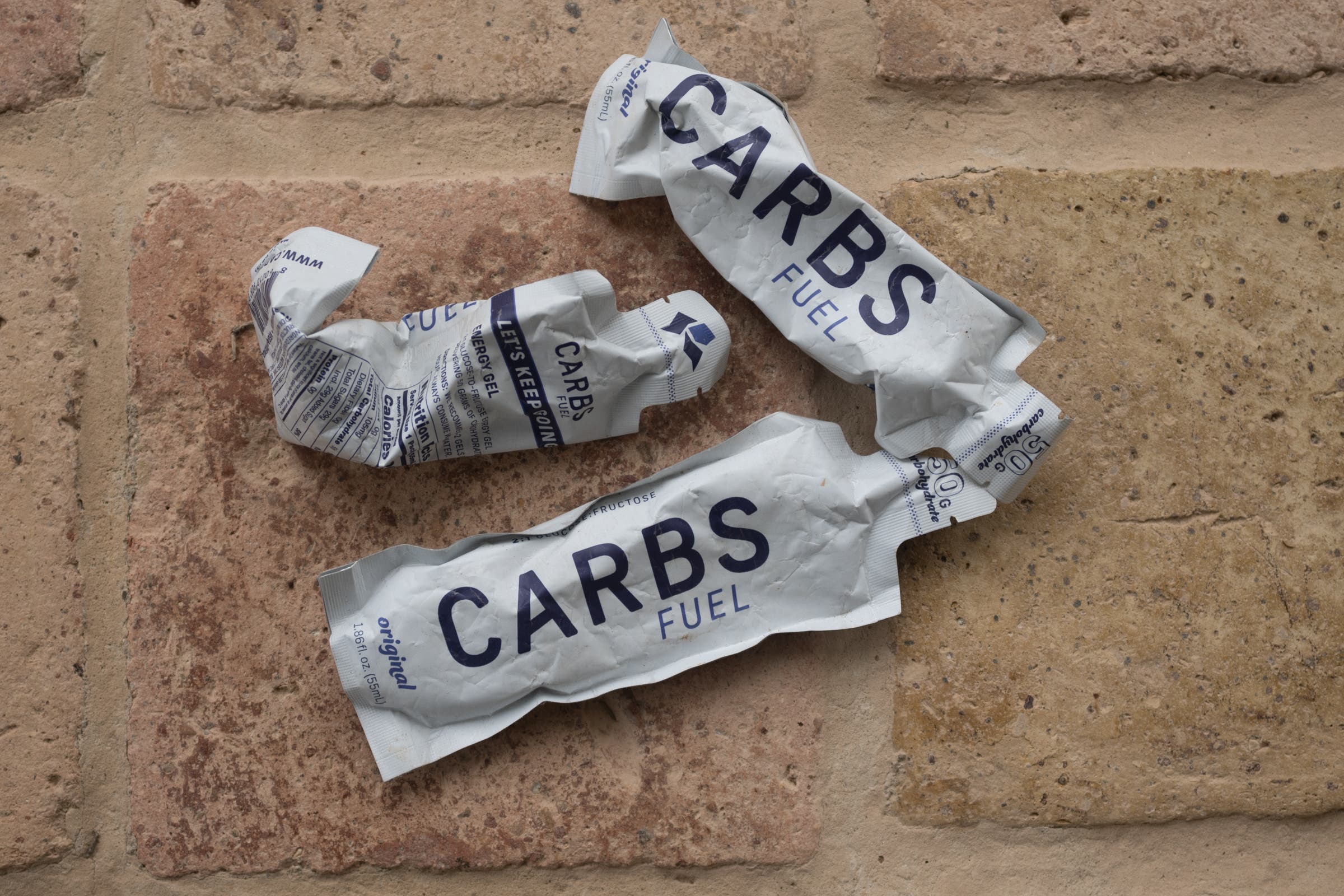
The carbohydrate revolution is probably the #1 innovation we’ve seen in the past decade of cycling. Riders are going faster than ever, and fatiguing less despite the higher-power efforts. They are consuming upwards of 130 grams of carbohydrates per hour, and some riders push the boundaries even further.
It seems like bonking is a thing of the past, but there are still situations we can find ourselves in where fuel is not in surplus. Perhaps you dropped a bottle in the feedzone, the gels fell out of your pocket, a pothole ejected your high-carb mix, or the one gas station on your 100-mile training loop is closed. When you start to run out of fuel, what should you do?
Remember that, according to this review, fatigue in endurance exercise is less about the muscles running dry; it’s more about the brain turning the warning light on.
Now let’s apply this to you: If your brain is shutting down muscles due to falling blood glucose levels, you don’t necessarily need to stuff yourself with carbohydrates to keep the fuel tank topped up. As the study’s authors suggest, you just need to keep blood sugar stable.
The review actually tested this with bonking athletes. Participants ingesting just 10 grams of carbohydrate per hour during prolonged exercise saw performance improve by 12 to 20 percent — primarily by eliminating exercise-induced hypoglycemia.
Interestingly, ingesting far more carbohydrate still improved performance, but it didn’t produce proportionally better results. This calls into question the “need” to ingest over 100g of carbs per hour. For the average cyclist, performance improvements can be significant with just 10g of carbs per hour, so don’t be worried the next time you can’t find 100g of gels for the last 90 minutes of your endurance ride.
The study suggests that 10g/hr doesn’t replace high-carb fueling for peak performance — it can be seen as the minimum effective dose for endurance training, not necessarily the optimal one.
Note: Most of these data apply to average-to-elite cyclists and long endurance rides. When you start talking about professional cyclists racing 200km, you open up a whole different conversation about nutrition and fueling when you’re burning over 1,000 kJs per hour.
What this information means for you
None of this means you should stop eating on long rides. Quite the opposite. The review recommends eating consistently on long rides rather than waiting until you feel yourself fading. A steady trickle of carbohydrate fuel — even as little as 10 grams per hour — may be enough to keep your blood glucose levels stable and prevent your brain from triggering the warning light (i.e. fatigue).
The obsession of maximizing sugar intake isn’t for everyone. While Tadej Pogačar needs plenty of sugar to perform on the bike, you don’t need an equal amount to get through a three-hour endurance ride. Performance isn’t just about the amount of glycogen in your leg muscles. It’s also about the amount of glucose circulating in your blood, and your brain is monitoring those levels very closely.
If you want to dive deep into the mechanisms described in the study, you can find the full review online. The short version is that, during prolonged exercise, the hypothalamus begins reducing the recruitment of skeletal muscles to slow glucose consumption. This ultimately prevents glycopenic brain damage, and presents itself as physiological fatigue.
[analyse_source url=”https://velo.outsideonline.com/road/road-training/new-study-suggests-bonking-is-mostly-all-in-your-head/”]