Wonderland
APRIL + VISTA ARE KEEPING THE FLAME ALIVE
On their debut album Traditional Noise, duo April + VISTA turn memory into reality. The acclaimed duo talk collaboration, archiving, and sharing their sonic soul.
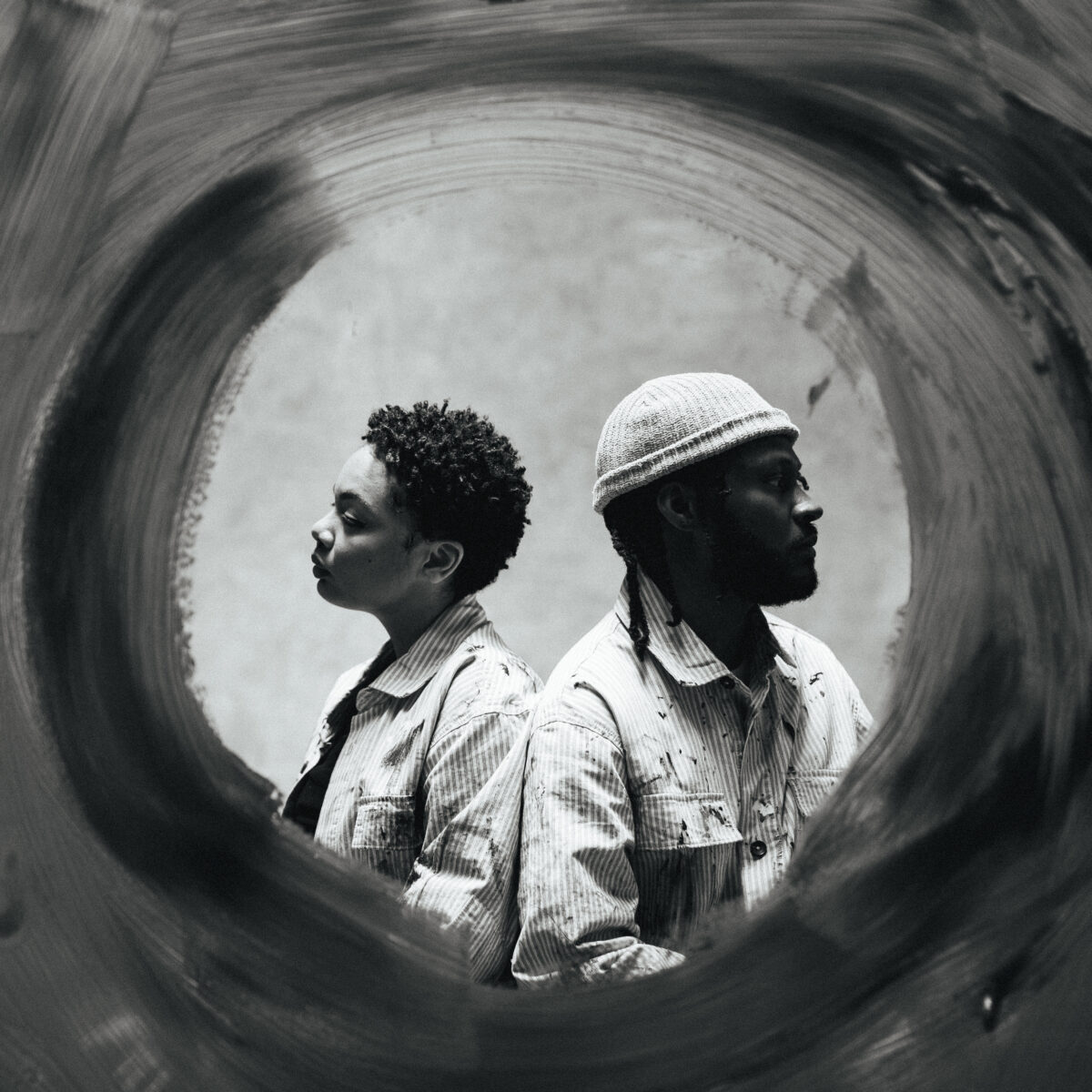
April and Matt build on each other’s ideas. Thoughts are passed back and forth, gently affirmed and expanded in ongoing dialogue, mirroring the way their music takes shape: instinctive and rooted in a shared language. Collaborations and touring alongside artists such as Little Dragon, Mura Masa and Little Simz have offered wider recognition, but their process has remained deliberately insular. Their work is often built at home, guided by emotion and what they describe as “sound experiments” over a pre-defined structure.
The Virginia-Maryland duo first began working together in their late teens, forming what would become April + VISTA through a shared fixation on sound and emotional texture. What started as an informal creative partnership gradually became a long-term project defined by experimentation and a refusal to settle into a fixed identity. Before their debut album, Traditional Noise, released on 22nd April, they spent over a decade building that world independently, releasing earlier projects like “You Are Here” and “Pit of My Dreams”, which began sketching out the contours of their now fully realised sound.
Written in the wake of the pandemic and across a period of creative burnout and industry uncertainty, Traditional Noise turns inward, assembling itself from fragments of home recordings and warehouse sessions. April’s classical training folds into Matt’s textural production approach, with melody dissolving into atmosphere and nostalgia repurposed as a tool for introspection, shaped in part by the pair’s fascination with amber fossils and preservation. Across the record, April + VISTA return to the idea of an archive as something that protects and transforms. Rather than taking a purely retrospective approach to the past, they ask what it means to carry it forward.
The result is a record that feels both wholly personal and astonishingly expansive, like stepping into an alternate universe. Or, as the duo describes it, a portal.
Listen to Traditional Noise…
Read the interview…
How are you feeling now that the album is finally out in the world?
Matt: It’s surreal. We spent nearly three years on it, so to suddenly be done feels strange. But seeing people’s reactions this morning made it real, we were glued to our phones.
April: It still hasn’t fully sunk in, we haven’t even unpacked from Sunday’s [NYC album listening session] show yet!
You’ve been working together for over a decade now. Does releasing music ever get easier emotionally?
April: I don’t think it ever goes away, it’s vulnerable and emotionally taxing. You just hope that people understand what you’re trying to say and connect with it.
Matt: It comes in waves. First I’m excited, then nervous. Then once it’s out, there’s relief – we survived it.
What defines April + VISTA for someone hearing you for the first time?
April: We’re dedicated to experimentation. We embrace flaws, that’s a common thread in everything we make.
Matt: Sincerity is at the core. We build around whatever ideas feel alive in the moment. Traditional Noise pulls from everything we’ve absorbed over ten years, but we never really know what’s next.
You’ve collaborated and toured with artists like Little Dragon, Mura Masa and Little Simz. What did that teach you?
April: Confidence. We’ve always been DIY, so being in spaces with artists we admire felt really affirming. It made me realise we belong here too. And the crew are such an underrated part of touring: the sound engineers, lighting techs, tour managers. We learned a lot from them.
Matt: It also taught us to slow down and enjoy the process. Touring also taught us efficiency – We used to go on stage with a tote bag of tangled cables before realising it was cutting into soundcheck.
There’s a physical, tactile quality to Traditional Noise. Where does it begin?
Matt: It always begins with something unnamed. We mostly write and record at home, so it’s very insular and it starts instinctively. Percussion is the hardest part for me, so it tends to come last. We start with what we call “sound experiments,” just messing around with noises – sampling, warping, pitching until something emotional appears. On ‘Grotto,’ for example, we used the sound of water pouring into a cup. I like sounds that scratch my brain!
At what point did Traditional Noise stop feeling like a collection of songs and start feeling like an archive or fossilised moment in time?
April: In 2023, I found an image of an amber fossil I became obsessed with. It made me think about archiving memories in a more introspective way. The cover art is a real fossil Matt photographed. We started asking: what do we want to leave behind? If someone hears this in 100 years, what do we want them to understand about us and also about themselves?
You’ve spoken about the album existing almost like a portal between worlds. If you were to describe its internal alternate universe, what would it look like?
April: It’s a portal, that’s how we came up with the short videos around the album. We had a limited budget, so we were thinking about how to translate the ideas in a way that felt intentional. There’s an elevator in our warehouse where a curator puts on art shows, and it became this idea of the elevator as a portal into different worlds for each single.
April, your classical training clearly threads through the record. How did that inspire you?
April: I started playing violin in fourth grade, and I instantly connected with it. I’m grateful for my classical training, but it can be quite restrictive. You’re meant to play everything exactly as written. We couldn’t afford a full ensemble, so all the strings you hear are just me and a friend who plays cello – but Matt made it sound much fuller.
Matt: She recorded all of those strings right there on the floor. You can’t see it now, but she just decided one Saturday, “we’re going to knock all of these out,” and she did!
What are your most unexpected musical influences that people might not pick up on first listen?
April: Probably Primus. The first time I heard Pork Soda, it blew my mind. It felt like I was at a concert on Mars. We don’t make gritty, bass-forward rock, but their angst helped us conjure those emotions.
Matt: Fuel and their song ‘Hemorrhage.’ I went through a Creed phase as a kid — that was the first concert I went to. The chords were expressive, the voices gritty and scratchy, but with a tender emotion underneath.
If Traditional Noise is an archive, what has it actually preserved?
Matt: Our love for music. It’s so easy for that love to become a tool to pay the bills. With this project, we gave ourselves the space to be passionate again. I’ll never stop making music because it’s how I express myself.
April: I wrote this when making the album:
“Ancient civilisations believed amber had healing properties. They called it elektron, meaning beaming sun. Just as a fly trapped in amber finds a purpose renewed, so have I. The world as I knew it needed to end to make room for new possibilities.”
We have our own little beaming sun in our hands. It’s about what we choose to protect. We started this during the pandemic, when things were shutting down and the industry felt like it was changing for the worse. This project reminds me that I need to protect my peace and leave space for fulfilment.
Words by Hannah Breen