[analyse_image type=”featured” src=”https://velo-cdn.outsideonline.com/wp-content/uploads/2026/04/Copy-of-pogi-progress-2.jpg”]
Tadej Pogačar just set the fastest ever average speed, broke the record time on La Redoute, and reportedly set a historic power PB at Liège-Bastogne-Liège.
At 44.43 kph, La Doyenne on Sunday was more than 2kph faster than any other edition in history.
Pogačar’s lightning-fast fourth win in Liège put a big red exclamation point on the end of what must be the speediest spring in history.
Best times were set at Strade Bianche, Paris-Roubaix, Gent-Wevelgem, La Flèche Wallonne [when excluding the eyebrow-raising 2004 edition won by Davide Rebellin – ed], and Liège.
It was an obliteration of the record books powered by physiological freaks.
Pogačar, Mathieu van der Poel, Wout van Aert, Remco Evenepoel, and Paul Seixas pressed the turbos on what’s now a multi-year acceleration of pro cycling.
This year, the four spring monuments were raced an average 0.8kph faster than in 2025.
Milan-San Remo, Tour of Flanders, Roubaix, and Liège rocketed along at 45.61kph compared with 44.79kph in 2025.
That’s four clicks faster than as recently as 10 years ago when the average trundled along at 41.57kph. Yes, four K P H in a decade.
The carbohydrate revolution, a devotion to aero, and a new breed of aggression are widely acknowledged to be the engines of cycling’s new warp speed. We’ve covered all the topics in depth here at Velo.
This year, an elephant might have made it into the room.
The influence of camera motos.
Spring monument speeds compared to 2026
| Record before 2026 | 2016 (kph) | 2025 (kph) | 2026 (kph) | |
| MSR | 46.11 (set 2024 – not broken in 2026) | 42.39 | 45.28 | 45.17 (7th fastest on record) |
| RVV | 44.98 (set 2025 – not broken in 2026) | 41.28 | 44.98 | 43.91 (4th fastest on record) |
| P-R | 47.80 (set 2024) | 43.91 | 46.92 | 48.91 (fastest on record) |
| LBL | 41.98 (set 2025) | 38.70 | 41.98 | 44.43 (fastest on record) |
[On mobile? Scroll the chart right – ed.]
‘If you get the motorbike, they can’t catch you’
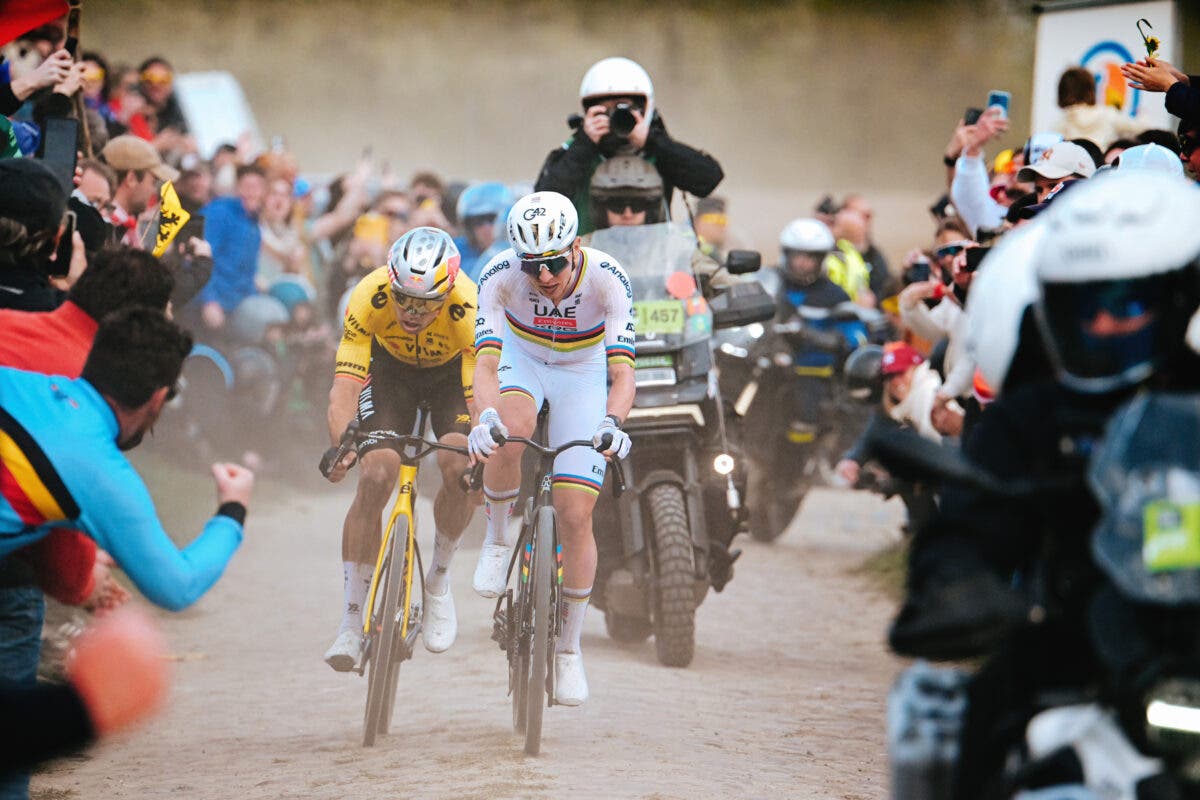
Riders have been exploiting the aero gains offered by camera motorbikes for years.
And why wouldn’t they?
It’s not banned by the UCI and has become woven into the dark arts of the pro peloton.
This landmark 2020 study by Belgian aerodynamicist Bert Blocken found that a rider who’s even 10 meters behind a moto would benefit from 23 percent less drag – a gain of around 5 seconds per kilometer.
There’s also proven to be a significant “pushing” impact created when a vehicle is close behind a small group of riders.
The presence – and impact – of the media motorcade was more widely acknowledged this spring than any other in memory.
As former LBL winner Jakob Fuglsang put it bluntly in a recent interview – first rider into the draft wins.
Even a few seconds spent choking on exhaust can be instrumental in carving the winning gap.
“It’s about attacking first. If you do that, you get the motorbike, then they can’t catch you, even if they are four riders chasing together,” Fuglsang told Feltet.DK.
“Mathieu van der Poel probably wouldn’t have won E3 if he hadn’t had a motorbike in front,” Fuglsang said. “It was one rider against four [and he still won].”
Classics veteran Oliver Naesen gave his account of cycling’s modern moto madness in a recent appearance on the Het Laatste Nieuws podcast.
Naesen recounted his wild motorpaced ride ride in a group with Pogačar after the Slovenian’s bike change meltdown at Paris-Roubaix.
“The motorbikes formed a wall in front of our group,” Naesen said. “Because of that, we were riding 15 kilometers per hour faster, together with Pogačar and his teammates.”
The convoy is having an influence, from the lead attacks to the mid-pack.
In search of the money-shot
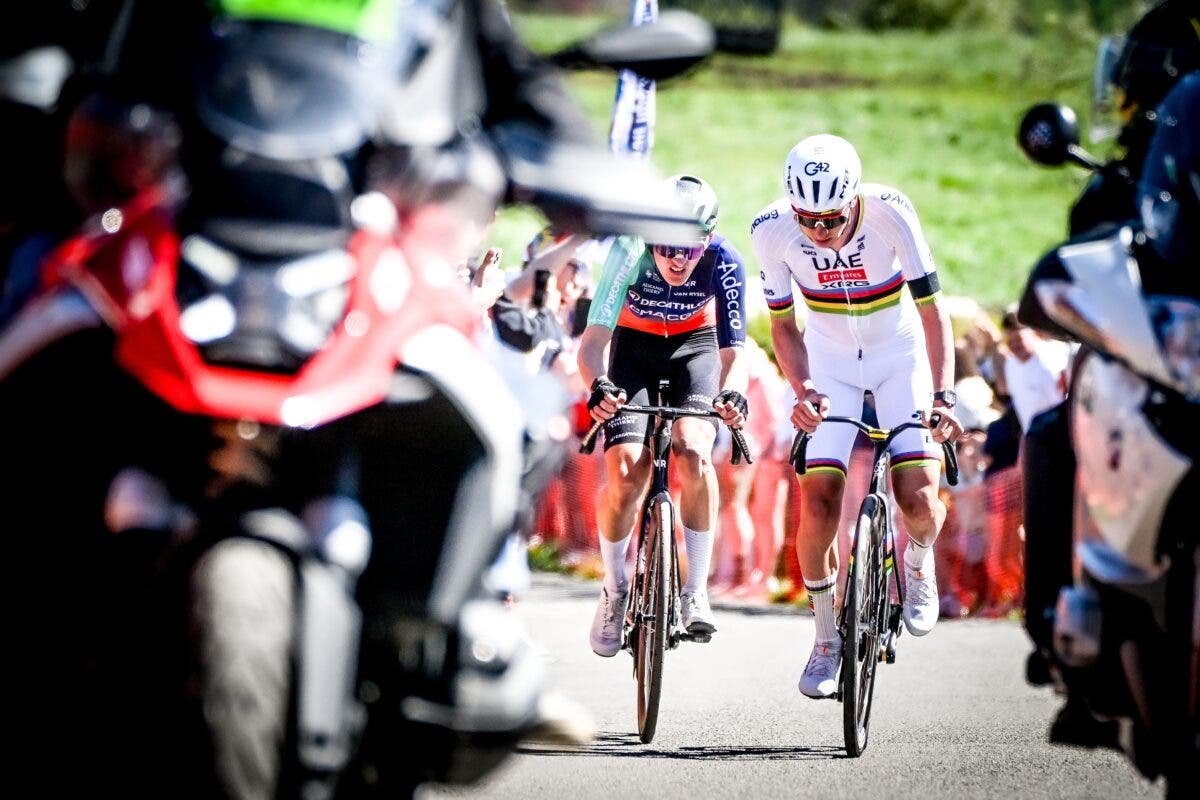
The UCI imposes limits on the number of team vehicles in a race convoy.
But it seems that the swarm of media and neutral-service motos grows as fast as Pogačar’s palmarès.
This necessary evil won’t likely diminish in an era when teams, sponsors, and journos demand all the content possible.
This year, the world’s biggest classics looked like derny races as TV and press cameras swarmed superstar riders, waiting for their money shot.
The crash, the attack, the mid-race tantrum.
Naesen saw the impact first-hand when Pogačar’s chance at cracking the San Remo code seemed in peril after his uncharacteristic crash on the Italian Riviera.
“Pogačar and his group arrived at the foot of the Poggio with just five or six seconds. I remember seeing 10 motorbikes riding 20 meters in front of him,” Naesen said on the HLN podcast.
“That’s the difference between winning and losing.”
Vehicles are having more impact on racing with every season, and anecdotally at least, they definitely did this spring.
Only tighter UCI regulation or a mass rethink of how cycling is filmed and photographed will solve it.
Three key factors in the high-speed evolution of pro cycling
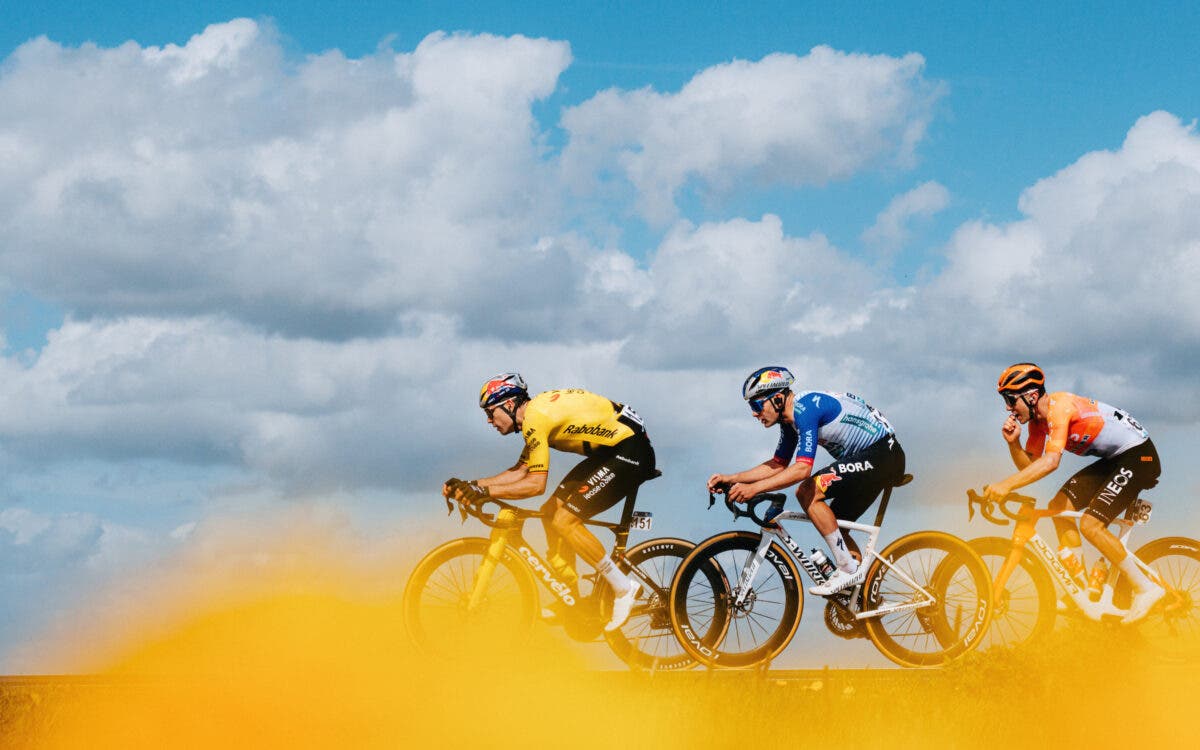
But to pin racing speeds on the impact of motos does a disservice to the peloton and the bubble of scientists, engineers, and physiologists that surrounds it.
“Motopacing” is just the cherry on top of a continual evolution of training, tech, and nutrition that’s blown up every niche of endurance sport.
Fueling
Fueling is one of the most widely discussed contributors to cycling’s high-speed evolution. We’ve cataloged our in-depth coverage of the “carbohydrate revolution” in one handy place, here.
Eye-catching social media posts from team sponsors revealed Van Aert and Pogačar fueled at 120g and 130g carbohydrate per hour in their titan showdown at Paris-Roubaix earlier this month.
Across the athletic divide, Sabastian Sawe broke the mythical 2-hour mark at the London Marathon this weekend while he guzzled a total of 230 grams of carbs.
Those fueling numbers are some 50 percent higher than as little as five years ago.
Athletes who are gorged with glucose (and fructose) can race harder, for longer, and are liberated to attack almost whenever they want. The bonk is all-but gone.
And they train like they race – on a pipeline of carbs.
This opening of the fueling faucet has put training and recovery into an upward spiral of progress. It’s pushing power numbers north every month, and made itself more than evident Sunday at La Doyenne.
According to Domestique, Pogačar set a world best four-minute power of 8.7 w/kg when he and Seixas shattered the climbing record on La Redoute.
Try doing that for one minute, dare you.
Tech
If the convoy seems to expand as fast as Pogačar’s palmarès, then bike tech is evolving as fast as the hype around Paul Seixas.
Tire technology has been re-thought to drive a trend toward wider and faster tires. 1x drivetrains and wide-spanning cassettes are now de rigeur for all but the steepest spring classics.
Simultaneously, cobblestone bikes have gone extinct, and everything is integrated into bikes devoted to speed rather than comfort.
Of course, the UCI is all too aware of the impact of technology on racing speed and rider safety.
That’s why it wants to limit gear ratios, has made wacky tire-measuring jigs, and is on a mission to make road bike handlebars as wide as the monsters found on downhill MTB.
The Pogačar-effect
But of course, “it’s not all about the bike,” as a certain someone once said.
Speeds are being accelerated by a peloton that’s dense in superstar talent. In the classics, Pogačar, Seixas, Van der Poel, Evenepoel, Van Aert, and their superteam henchmen drag races forward from the front.
Super-durable monsters like Pog and MVDP demand a high pace from kilometer zero that shells the weak before they’ve even had a chance to go pee.
This rewriting of the tactical rulebook tips the scales to those who pedal as hard when they’re fatigued as when they’re fresh, and pushes overall paces higher.
The peloton averaged 54kph for the first hour of Paris-Roubaix earlier this month. On Sunday, the peloton cantered across more than 90km in the first two hours of Liège.
There’s no time for gossip and sandwiches in a modern peloton that competes across every kilometer.
The Giro d’Italia and Tour de France are the next major dates on the pro cycling calendar.
Don’t blink, or you’ll miss them.
[analyse_source url=”https://velo.outsideonline.com/road/road-training/record-speed-classics-motos-carbs-pogacar/”]