Wonderland
FINN ASKEW’S AZURE UNDERTONES
One of British pop’s freshest faces, with Bieber and SZA co-signs in tow, Somerset-born, London-raised Finn Askew puts his hat in the mainstream ring with an introspective and immersive six-track.
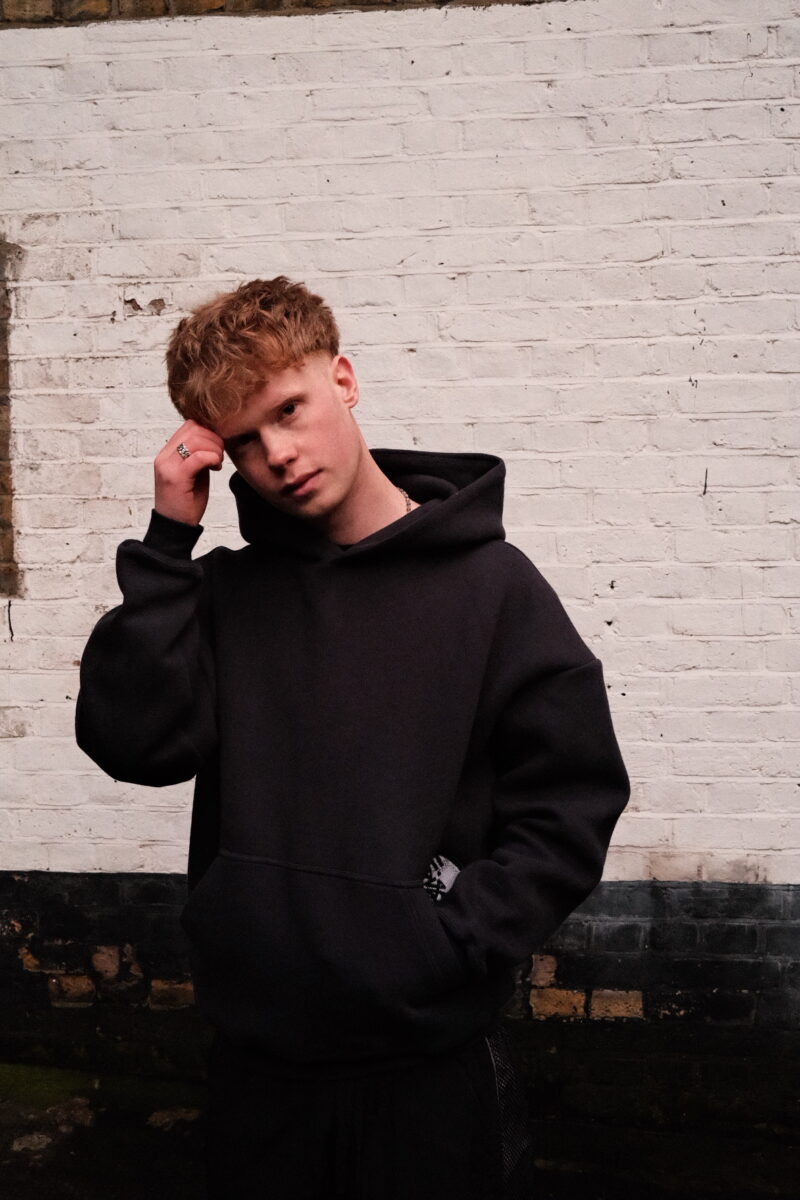
What do you get when you blend the melodic pull of Justin Bieber with the textured intimacy of Mk.gee and Dijon, and raise it in a quiet corner of Somerset? You get Somerset-born singer, songwriter, and multi-instrumentalist Finn Askew, and his new mixtape “BLUEBOY” – a project that feels less like a reinvention and more like an artist putting out a body of work that is reflective of his knowing who he is amid an industry that can often feel oversaturated.
Finn Askew has quickly become one of the UK’s most compelling young voices. Co-signed by the likes of SZA, Kehlani and Bieber himself, his rise has been both organic, while having a reach that is global. From early breakout moments with “Roses” to selling out London headline shows and building a fiercely loyal fanbase, Finn’s trajectory has been defined by instinct and a sonic model that isn’t afraid to experiment and draws from a wide palette.
“BLUEBOY”, the six- track mixtape, sees Finn lean into a stripped-back and intimate honesty, musically shaped alongside his close collaborator and producer, Ezra Skys. The result is a tape that feels immediate, where imperfections are left in, and emotion leads. At its core, “BLUEBOY” is deeply personal: named after a childhood nickname given by his father, it signals an acknowledgement of the truest version of who he is.
Listen to “BLUEBOY”…
Tell me about what inspired the title of this mixtape!
My Dad paints, he’s an artist. I have two sisters, and growing up, he would call us each by a different colour. One of my sisters is Peachy, the other one is Pinky, and he called me Blue Boy. I’ve got it tattooed on me in Korean on my arm, and it’s always been my nickname. I feel like this new mixtape is kind of like the rebirth of what I’m trying to do – It’s really me, and that’s what Dad sees me as, Blue Boy. This mixtape embodies the truest version of myself.
“Distance” is one of your most successful tracks; it got over 11k presaves. Is it the song you thought would resonate with people the most from “BLUEBOY”?
I didn’t think too much of it. When it did get the kind of attention that it got, it was a bit of a surprise. I remember talking to Ezra (Skys). I put out a first post about it, and usually, luckily for me, I feel like every time I post something about a song, the first post gets crazy interaction, and helps me realise that people do resonate with it – I can always tell off the rip. I remember we posted something about this song, and it did all right, and I didn’t think too much of it. The next video I posted went crazy, and I thought, “Oh, wow, people really, really resonate with this.” I feel like the song is kind of toxic in a sweet way – like it’s not in your face toxic, but maybe a lot of people are toxic. Regardless, people resonate with it, and I’m not complaining that they do.
You’ve been co-signed by SZA, Justin Bieber, Taeyong of NCT 127, Jungkook from BTS, Kehlani, and more – do you feel pressure when receiving co signs from these fellow artists who are so experienced in the game?
It doesn’t put any pressure on me, but obviously, it’s great to hear these artists that I look up to showing their support. Justin Bieber was definitely a crazy one. I couldn’t name anyone bigger than that, right? He was my idol growing up. That is definitely one of the biggest co-signs you could ever have today. Justin Timberlake hit me up yesterday, telling me to keep going, to keep making music. Justin is literally one of the epitomes of music I’m doing right now. It’s crazy. Getting all of this love and support is great, but it’s all online at the same time, so it feels a bit less than what it should feel like. I feel like when I start getting my flowers and doing more shows and tours, and maybe I can meet these people, I’ll be like, ‘Wow, that’s insane.’ The support does help solidify what I already know. I don’t quite get what I’m doing, but it’s good to hear from people that you really respect – it’s inspiring.
“Move On” explores letting go – what’s something from the “BLUEBOY” creation process that’s stayed with you, whether that’s a mindset, habit or way of working? Something you’ve held onto, consciously or not?
The simplicity of it. With the vocal takes, everything we recorded wasn’t through headphones. We played the beat through the speakers, and I’ve just sung with an SM7B. If you listen to the track and solo the vocal, there’s so much bleed. I don’t know why it resonates with people, but it does feel like you’re in the room a little bit more, and it has more of a sense of inclusion. For every track I’ve done it with, it’s done well. I went into the studio with someone else and was excited to go in with headphones – and it didn’t feel right. There’s just something about writing in the room with this mic. The SM7B is the only mic I want to use forever now, just recording in the room.
During the creation of “BLUEBOY”, what did you stumble across that surprised you?
The more I created within the sound you hear on the mixtape, the more I realised how natural it felt. I remember we did the first R&B song, because I hadn’t really made R&B before, and never really grew up listening to it – I’m not going to try and make out I’m this R&B guy. The first one made me think, Oh, that’s really cool. People are resonating with it, people are saying this is great R&B. The second was good, and I’m surprised at how good I can make R&B. It feels really natural – it just feels right. Especially because I’m not intentionally trying to write R&B at the same time. That’s why I think it works, because the music is natural. I’m surprised at how well people are taking it.
Working so closely with one producer can really shape an artist’s identity, and you do so with Ezra Skys. How do you recognise a creative chemistry that’s worth pursuing?
I’ve always wanted to have that one person to make music with. It’s always been about coherence for me. When you work with lots of different producers, it’s fun, don’t get me wrong, and it elevates you. But when all you’re trying to do, especially for me, is different sounds in different genres, I always wanted to lock in with someone and create something harmonious. And I was lucky enough to find Ezra, and he’s literally like my twin. We look the same, we wear the same kind of clothes, we have similar tastes, and we are both from the south west of England. I’m so lucky to have found that in someone who’s a great friend, especially in the context of making music.
Growing up outside of a major music scene, do you think that distance protected your creativity in some way?
There are pros and cons to it all. I wouldn’t change where I ever lived, and I would never say I wish I grew up in the city, because there’s a sense of freedom that I had, which is rare for people in the city. There was practically no one doing music around me, and if they were doing music, they weren’t really pushing it. I was in a band before I went solo; it was nothing crazy, just a few mates making indie music. There’s no one really pushing it and aspiring to do as I did. I never met anyone who really wanted to be an artist. I don’t think a lot of people have the drive where I live. It meant I just had to kind of work by myself and figure things out on my own, which definitely helped build my uniqueness and authenticity. I’m jealous of people who grew up in a city like London, though, because I feel like most musicians that I know who grew up in London have their communities and friendships with other musicians. That’s something that I never had.
When I moved to London, that was the issue. I’m not an anti- social person, but I’m not the sort of person who’s going to go meet random people or other artists on a whim. On one hand, I wish I had grown up with these people and had a little clique, but maybe that would have changed me as an artist and what I am today. I wouldn’t change anything. I felt like growing up in the countryside was good for me, but a lot of artists rush to the city. And on the other hand, when I moved back home, I was doing the best I ever have. I definitely thrive in the countryside.
If your current sound had a visual world, what would it look like?
Sunset-like colours – some nice oranges, some purples here and there. I feel like I could ask my Dad to paint a really good painting to my music. He used to actually do my own album artwork on my oldest tracks. He gets it. But the music sits within those sunset colours, something quite pastel would work, I think. In the future, it might change, but I feel like that’s the palette for now.
What’s next for you?
I want to do another tape by the end of the year. I was doing singles for so long, and waiting for something to pop, now I’m at a point where, because I’ve honed in on the sound, tapes seem way more feasible. So I want to get another tape out, hopefully by the end of the year, with a bit more of a winter vibe to it, something a little darker. I’d love to do more shows this year, too. That sounds like a plan – more shows, and another mixtape.
Words – Mapesho Kyakilika