[analyse_image type=”featured” src=”https://velo-cdn.outsideonline.com/wp-content/uploads/2026/04/Roubaix-bikes-history-cover.jpg”]
The history of bike tech at Paris-Roubaix is almost as iconic as the racing. For decades, the top pros have been chasing the right mix of speed and durability for the world’s toughest road race. While other areas have been a progression, Paris-Roubaix has a more circuitous route. Its technological legacy has many spurs, dead ends, and overcompensations.
Recently, many tech enthusiasts have lamented the lack of audacious tech choices among the Roubaix peloton in recent years. The bikes are essentially standard aero road bikes, with a few tweaks around the edges.
Yet, we have only made it to this point because of the tech swings that helped define the race for generations. While it would be nearly impossible to track all of the changes, there are a few key moments in history that track some of the big movements in the race’s technology.
To celebrate the best day in road bike tech, here are some of the most important Roubaix moments through the years.
From the beginning, through 1990: the steel years
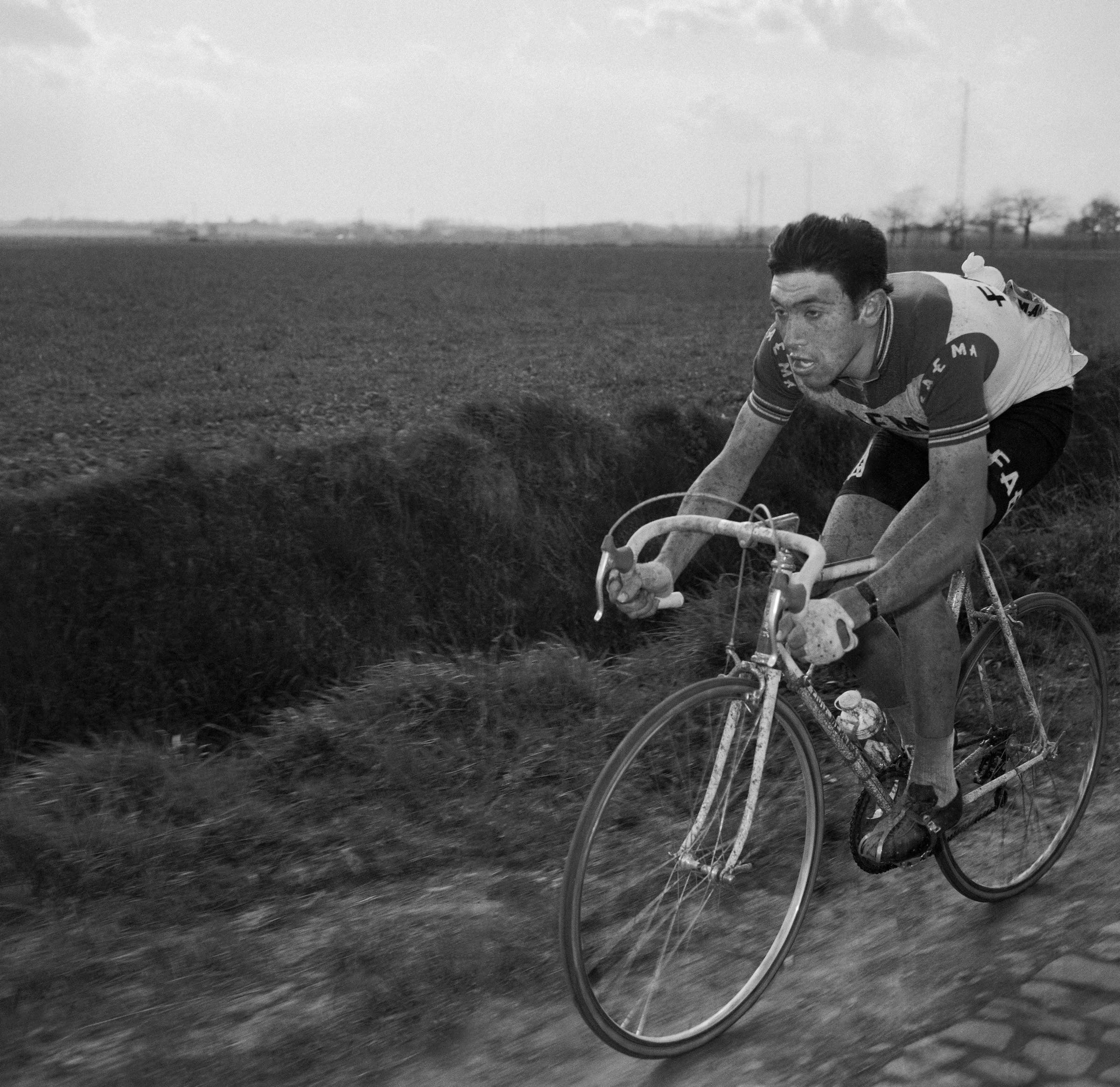
For the vast majority of the history of Paris-Roubaix, the bikes were the same, with the changes mostly around the durability of tires and subtle tweaks like extra handlebar tape. Until the 1990s, most bikes were steel, groupsets had the same general gears, and most of the components were variations of the same conventional wisdom.
There were plenty of custom frames, however, and top riders would have bikes with particular geometry to add stability or durability to key aspects of the bike for Roubaix. In the 1960s and 70s, it is rumored, although we cannot definitively verify, that Eddy Merckx won his three Roubaix titles on bikes that were custom-made. Merckx was known for his neurotic relationship with his bike, constantly tinkering with his bike’s fit and geometry, and his wins at Roubaix were certainly victim to the same fiddling.
1991: RockShox debuts a front suspension fork that defines the race for the next three years
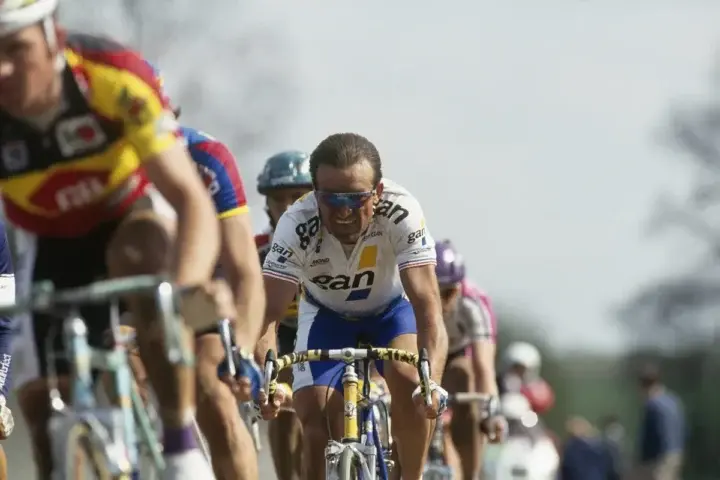
The first big tech change that started to shape the fate of the race was the RockShox Roubaix-inspired road suspension fork, which debuted in 1991 by Greg LeMond and Gilbert Duclos-Lassalle.
The fork had 30mm of travel and was designed to dampen the hits and bounce from the Roubaix cobblestones, similar to the gravel suspension forks of today. While it wasn’t successful straightaway, in 1992 and 1993, Duclos-Lassalle piloted bikes equipped with the RockShox Roubaix to back-to-back wins, before Andrei Tchmil made it three for three for RockShox.
1994: A short-lived full suspension Bianchi takes the bike tech as far as it will go
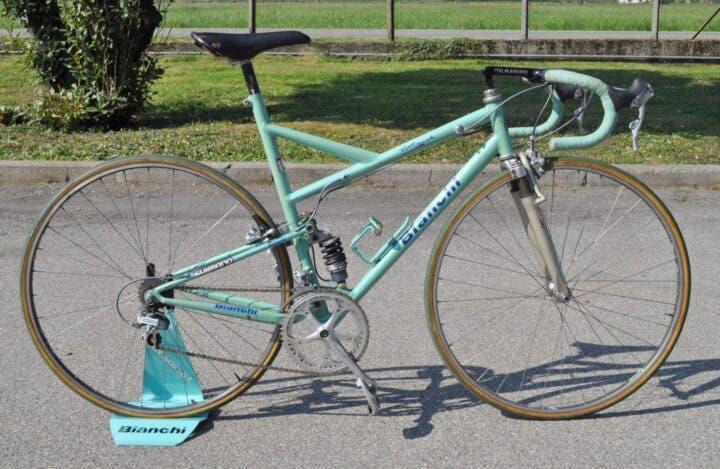
Inspired by the suspension innovations from RockShox, Johan Museeuw doubled down on that trend, literally, in 1994 with a full-suspension Roubaix bike built by Bianchi. The bike was truly one of one, with three triangles instead of two to try and give more structural integrity to the bike, while incorporating a vertically oriented rear-suspension system.
The bike ended up failing 15-miles before the finish of the race, and the rear suspension system as a whole was clunky. The technology was, after all, only pioneered on mountain bikes a few years prior. That clunkiness was part of why the bike failed — it broke at the chainstay where the aluminum rear triangle needed to be bent to accommodate the chainrings — and it was not returned to the next year.
1995-2004: A new normal sets in as suspension fades
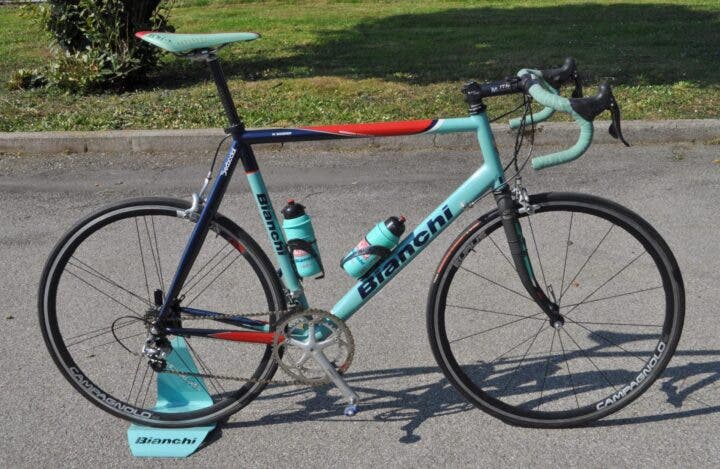
In fact, after the 1994 edition suspension was quickly ushered out of the winners’ circle, as it was deemed too heavy and too specific to be viable tech. While it returned later, suspension was replaced with predominantly carbon frames, strong box-section wheels, and subtle additions to avoid equipment failures.
1995 saw the first carbon bike to win the race with Franco Ballerini and his Colnago C40. While the frame was carbon, the fork was steel, a typical breakdown for the time, as carbon was not as sophisticated and strong as it is now. That would slowly change over the next few years, but generally it was the same kind of mix that generated success at Paris-Roubaix.
One fairly interesting exception was Magnus Backstedt’s winning bike in 2004. The tall Swede won the race on a custom-made titanium Bianchi frame. The bike had specific geometry and tube construction for the race, which he won from a sprint in the Roubaix velodrome.
2005: Suspension returns in more subtle ways
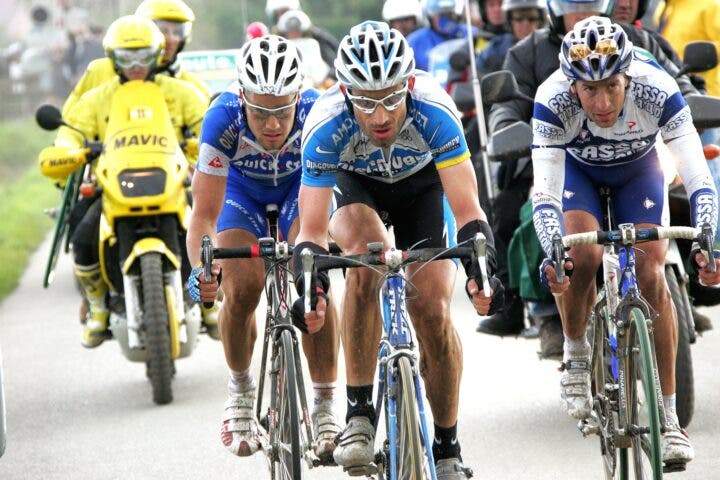
After the conventional wisdom of the late 1990s and early 2000s, suspension started to creep back into the peloton in 2005 with the introduction of the Specialized Roubaix and the Trek soft-tail.
A far cry from Museeuw’s full-suspension Bianchi, the Roubaix used Zertz inserts to try to add compliance through the fork and seat stays. The Roubaix didn’t win on its first appearance, but it did start to pick up victories over the next few years and become a popular bike for recreational riders.
The Trek soft-tail that George Hincapie rode to a second-place finish that year didn’t have as long of a legacy, but it was perhaps the start of Trek exploring damping around the rear of the bike that culminated in the IsoSpeed system that has been a part of many Trek bikes since the prototype-only soft-tail Roubaix special.
2010: Carbon wheels nab their first win
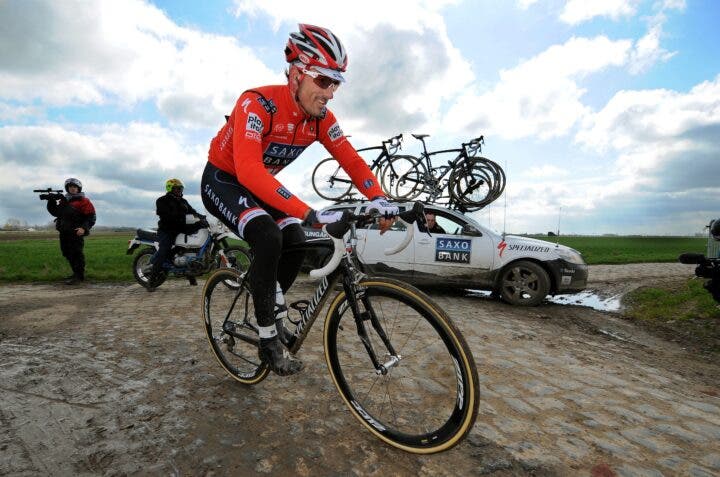
Perhaps this was the beginning of the end for Roubaix-specific-type bikes, or perhaps it just made Roubaix bikes start to look like the bikes for the rest of the calendar. Fabian Cancellara demolished the field in a long-range solo victory that was aided by deep-section carbon wheels, the first time a rider won Paris-Roubaix on carbon rims.
Even though carbon rims were ubiquitous in 2010, Paris-Roubaix was seen as too rough for the lightweight material. Cancellara smashed that notion, and by 2013, carbon wheels were almost universal on Roubaix bikes.
Wheel tech is very much still evolving at Roubaix. Whether it is hookless rims, tire inserts, or gravel widths, wheels are still constantly shifting. Nevertheless, it is all carbon and has been since Cancellara stormed to one of his most dominant victories.
2016: Aero bikes are in, while shifting goes electric
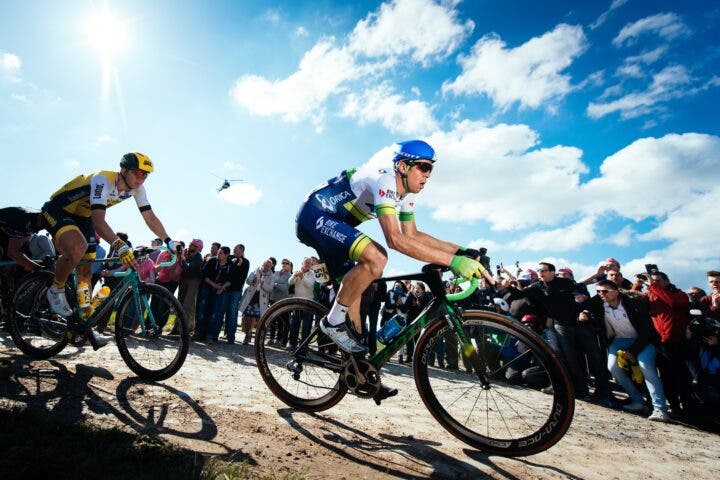
In 2016, Matthew Hayman shocked the cycling world. We went in-depth with a story on the tech behind that day, but the TLDR version is this: Hayman won on an aero bike, and that set the table for the aero revolution that has fundamentally changed Roubaix bike tech. Additionally, after years of back and forth, Shimano Dura-Ace Di2 was the groupset of choice for the entire podium, cementing electronic groupsets as the way of the future.
2019: Disc brakes official takeover
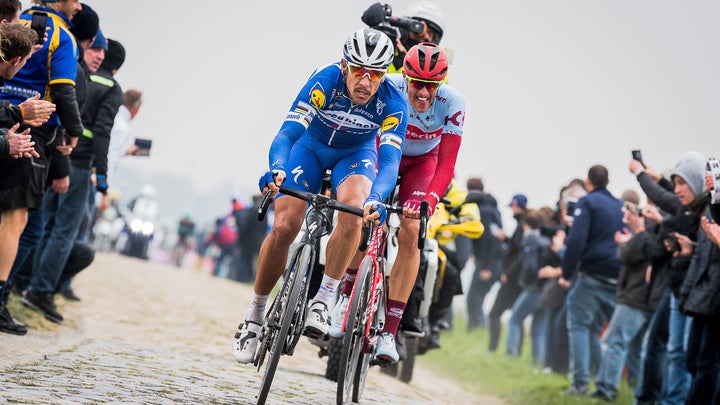
If the carbon wheels that made their way into the Roubaix peloton in 2010 started the demise of wacky tech at the Hell of the North, the full-throated adoption of disc brakes in 2019 cemented it.
While disc-brake bikes were not universally adopted in 2019, they have been on every bike that has won since. Starting in 2021 (the race was cancelled in 2020 due to the COVID-19 pandemic), disc brakes were universal among the rest of the peloton, as well. That pivot to disc also unlocked tires that could be wider than the 30mm width that was the largest riders could run with rim brakes.
The downstream effect of that change was 30-32mm tires becoming the standard choice for Roubaix, which seems to provide enough suspension to do away with the tech that was introduced to manage all the bumps and imperfections of the race. Disc brakes, more than any other tech choice, have changed the technical consideration of Paris-Roubaix bikes and have made the bikes “normal.”
2021: The women are here, and with them, 1x gearing becomes a new convention
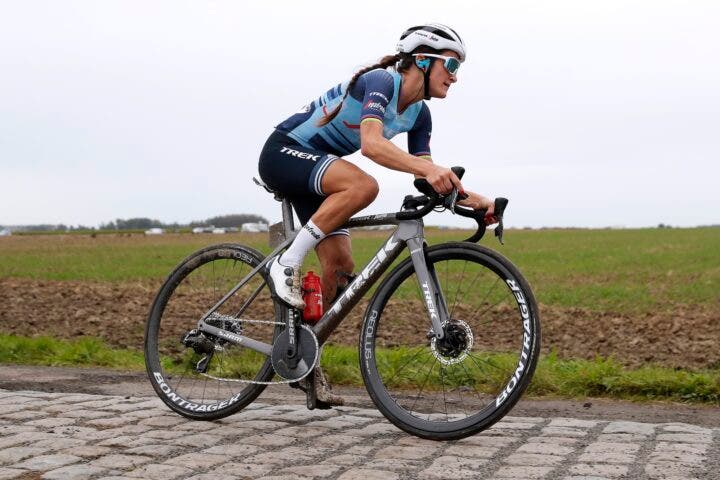
It took far too long, but when the Women’s WorldTour finally got its own start at the race, they not only brought more of the same great cobblestone racing, they also brought innovation.
Lizzie Deignan used her team-issued Trek Domane endurance bike equipped with a 1x SRAM groupset, a 50t chainring, and a 10-33t. In retrospect, it seems strange it took so long for the tech to get to the 1x end. The race has never had much elevation change, and for years, riders have had much larger inner-chainrings to minimize the jumps between the two front chainrings, reducing the chance of a chain drop during shifts.
Yet, removing that shift altogether would seem to be even better.
Perhaps it was the infamous meltdown of Aqua Blue Sports’ use of 1x road bikes in 2018, or perhaps it is just due to brands like Shimano being hesitant to move to 1x groupsets, but the 1x trend stayed away from Paris-Roubaix really until 2021 and Deignan’s success. Now, just five years later, SRAM athletes are almost universally riding 1x setups, and more and more Shimano athletes are also making the jump, including on Tadej Pogačar
2026: 35mm tires for those who can, and that is about it
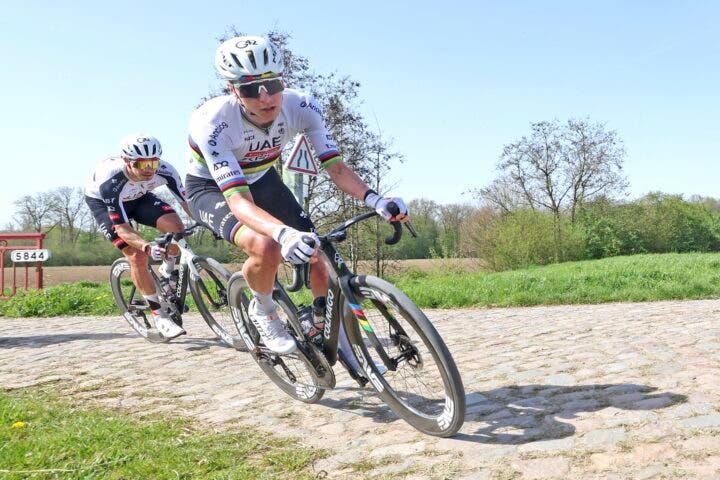
Speaking of Pogačar, as we sit on the eve of Paris-Roubaix 2026, it is the Slovenian campeonísimo who is dominating the dialogue. While he prepares to do battle with Mathieu van der Poel, the three-time defending Roubaix champion, speculation has been rampant about what he will do to modify his Colnago bike to try to beat one of the greatest Roubaix riders of all time.
It turns out, not that much.
From spy shots, Instagram posts, and stories in the media, it appears that Pogačar will be riding almost the same setup for Roubaix as he did for his landmark with Milan San Remo. The only change will come in the form of new 35mm Continental GP 5000 tires.
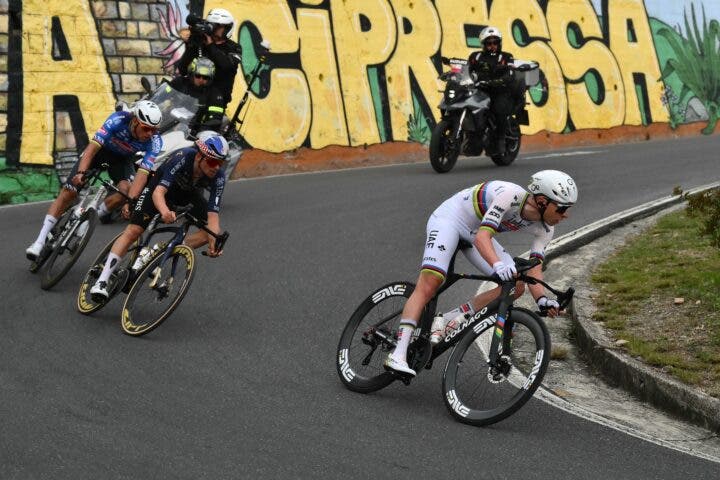
He will have his tried and true world champion edition Colnago Y1Rs, with deep Enve 4.5 wheels, and a large Carbon-Ti 1x chainring. Last year, he rode the Colnago V5RS for the race, but since the Tour de France last year, Pogačar hasn’t raced on anything but the Y1Rs. In theory, the Y1Rs is also the logical call for a modern Paris-Roubaix with both the elite aerodynamics and extra vertical compliance offering the perfect fast, comfortable platform for Pogačar to race with.
The wide 35mm tires are new for Pogačar, and for Roubaix in general, since most riders have maxxed out at 32mm before this year, but that seems set to change as more and more 35s are spotted on recons around the cobbles of Roubaix. A big reason for this is Continental adding a new GP5000 S TR 35mm option. Previously, Continental only had the GP 5000 available in 35mm with the All-Season casing, a tire that was far below the weight and rolling resistance standards of even Paris-Roubaix.
Given how prominent Continental is in the peloton, there will be significantly more teams racing Roubaix on 35mm tires, if they can fit in their frames. Arguably, the Y1Rs won’t fit 35s either, but Team UAE seems poised to push the limits on race day to try and reap the benefits of the last Roubaix-specific modification.
[analyse_source url=”https://velo.outsideonline.com/road/road-gear/roubaix-bikes-suspension-geometry-max-clearance/”]