Wonderland
CAMERON PICTON IS MAKING IT UP AS HE GOES ALONG
black midi might be over, but Cameron Picton is only just getting started. With a raft of new (and old) collaborators in tow, anything goes in his brand new project, My New Band Believe.
I meet Cameron Picton in a low-key but well-loved Italian cafe, just around the corner from his regular studio space. He immediately comes across as a little shy, sitting at a slight angle to me with his eyes regularly downcast. He orders a soup consisting of a pork and beef broth paired with tortellini parcels, which I worry about keeping him from as he answers my questions. Later, I find out that this is the first in-person interview he’s done for this press run, which in itself is the first he’s done as a semi-solo musician. It’s been two years since black midi – the band that he grew up in – came to an abrupt end.
We’re here to discuss Picton’s new semi-solo project, My New Band Believe, and their eponymous debut album. The venture debuted last autumn as a series of ‘workshop’ shows at small venues around London, a term that Picton employed partly in fear that “It might be a bit shit.” For the shows, an open invite was extended to potential collaborators to join “for one song, one show, one night, or maybe even more,” an attitude that Picton explains extended to the entirety of the production process.
“If you want to start a band, you only really have one lineup. So I kind of just thought, why not make it open to anyone?,” he posits. “It means that people come in, see what it’s like to play with me, and if they like it or not. And then once it comes to actual touring, then you’ve played with each other quite a bit. It’s not really a contrived decision. It feels quite natural to just keep playing with these people, because it feels good when you do it.”
Some of the early sounds of My New Band Believe can be heard in the three mixtapes that Picton released under the moniker Camera Picture, a low-key set of CDs available only on Bandcamp and titled after their lengths. Picton explains that these were created partly out of financial necessity: “Obviously, I wanted to make it as good as possible, but the motivation was really, I need about 5 grand [laughs].” He’d committed to being the tour opener for his friends, Windmill scene contemporaries Black Country, New Road, but was hit with an eye-watering visa sum that had to be paid in order for him to work abroad. So, he started selling the Camera Picture CDs at shows to make it work.
Created over a two-year period, My New Band Believe involved numerous friends and collaborators. The record was co-produced with two members of the folk rock band caroline, Mike O’Malley and Jasper Llewellyn, whom at one point Picton had been speaking about “doing a collaborative album with,” “but also kind of half knowing that they wanted to do their own thing and finish their album, which I knew would take a long time.” It was in these early conversations that the idea for the workshop shows was born, as a way for Picton to “try playing out with different people.”
This off-the-cuff quality is central to the record, which brings in field recordings, twenty-two different musicians, and sounds captured in Picton’s own kitchen. Picton suggests that he sees My New Band Believe not as a fully-formed band, per se, nor a solo record made with session musicians, but instead something that exists in the space in-between. “The ambition for it, longer term, is for it to be a band for a certain period that operates like a band … When black midi was breaking up, I didn’t want to do a solo record. I didn’t want to have a solo career.”
There’s a refreshing, albeit surprising, openness in how Picton gestures to the dissolution of black midi, the band that he acted as a vocalist and bassist in with fellow vocalist Geordie Greep, drummer Morgan Simpson, and bassist Matt Kwasniewski-Kelvin, who passed away at the beginning of this year. It’s no exaggeration to suggest that black midi defined a moment in British indie music, becoming synonymous with the Windmill scene and a certain style of experimental, oddball rock: it’s also clear that by the end of their time together, they seemed to have little desire to continue. Although the split was initially described as a “hiatus” by the band’s label, Picton speaks about the group in the past tense.
black midi formed almost accidentally when the members were nearing the end of their time at the Brit School. Their debut album, Schlagenheim, hit the charts and went on to be nominated for a Mercury prize, ushering in the start of a progressive rock revival in its wake. Picton describes their success as fundamentally unexpected, even with the Brit school’s reputation for producing platinum-record musical talent: Adele and Olivia Dean are both alumni. “Once the band had done six or seven gigs or something, and had interest from management, it was a bit like, oh, might as well just give this a go,” he recalls. “And then that turned into six years of touring and three albums.” All of this took place during the period when the band might have gone to university. Instead, they were on global tours.
The final days of black midi were marked by a fundamental breakdown in communication: “It was just functionally not possible to do anything…it was impossible to work in a group scenario,” Picton explains. “Not full stop, but I was just not having joy working in a group scenario. So I was like, well, why don’t I try working solo? And then I’m just kind of only really answering to myself, in terms of writing, in terms of practising, when the gig happens, what songs we play. I’d only ever played music – apart from in my bedroom – with other people.”
After the whirlwind success of black midi, Picton wanted a break, and he also wanted to spend an extended period of time on a single record, starting work on the project that eventually became My New Band Believe. “The third black midi record [Hellfire], we had to do it basically all in three weeks, because that was the first time we could get into a studio, and then after that we were going on tour.” By contrast, this was a project in which he’d only have to answer to himself, with “no deadline.”
While there’s fast-paced moments on My New Band Believe – echoed in the standalone single “Numerology” – Picton’s not afraid to dive into lengthier, more sprawling tracks. “Heart of Darkness” is a standout, clocking in at eight minutes with a climax that dissolves into upright bass and guitar harmonics. Picton explains that the titular reference to Joseph Conrad’s 1899 novella was partly chosen by the need to replace a previous, “really terrible” name, but came to feel appropriate.
“Something reminded me of the book, and I realised that it kind of works,” he reflects. “In terms of both the themes, there’s a journey in the lyrics, [which] parallels Marlow going to meet [Mr. Kurtz]. And lots of nature references.” The track began as an interpolation of “Rosslyn,” a track by the British folk revival icon John Renbourn, but incorporating sounds from America, “where you have a more soulful feeling verse and a transatlantic vibe.”
Steve Noble – at 66, the oldest collaborator on the record, who started his career working with Nigerian drumming master Elkan Ogunde – came in as a final touch to the track, adding improvised percussion as an overdub. This was layered with a second overdub contributed by bassist Caius Williams, one of the contributors that’s become most closely tied to the project. The end product is a track that is dense and lived-in, filled with fragmentary images that operate on the dream logic that the record’s lyricism employs.
In this vein comes the question of whether Cameron Picton can be defined as a believer of some form. The group’s name came to him in a fever dream: while travelling in China, Picton was seriously under the weather in that way that verges on hallucinatory. Picton seems surprised by how much significance has been piled onto it since, pointing out that what started as an “innocuous” choice has been overblown, “and then you’re left answering questions as if it’s some foundational part of your existence.” That’s pretty much all there is to it: a phrase that appeared in a haze and stayed tucked in his back pocket.
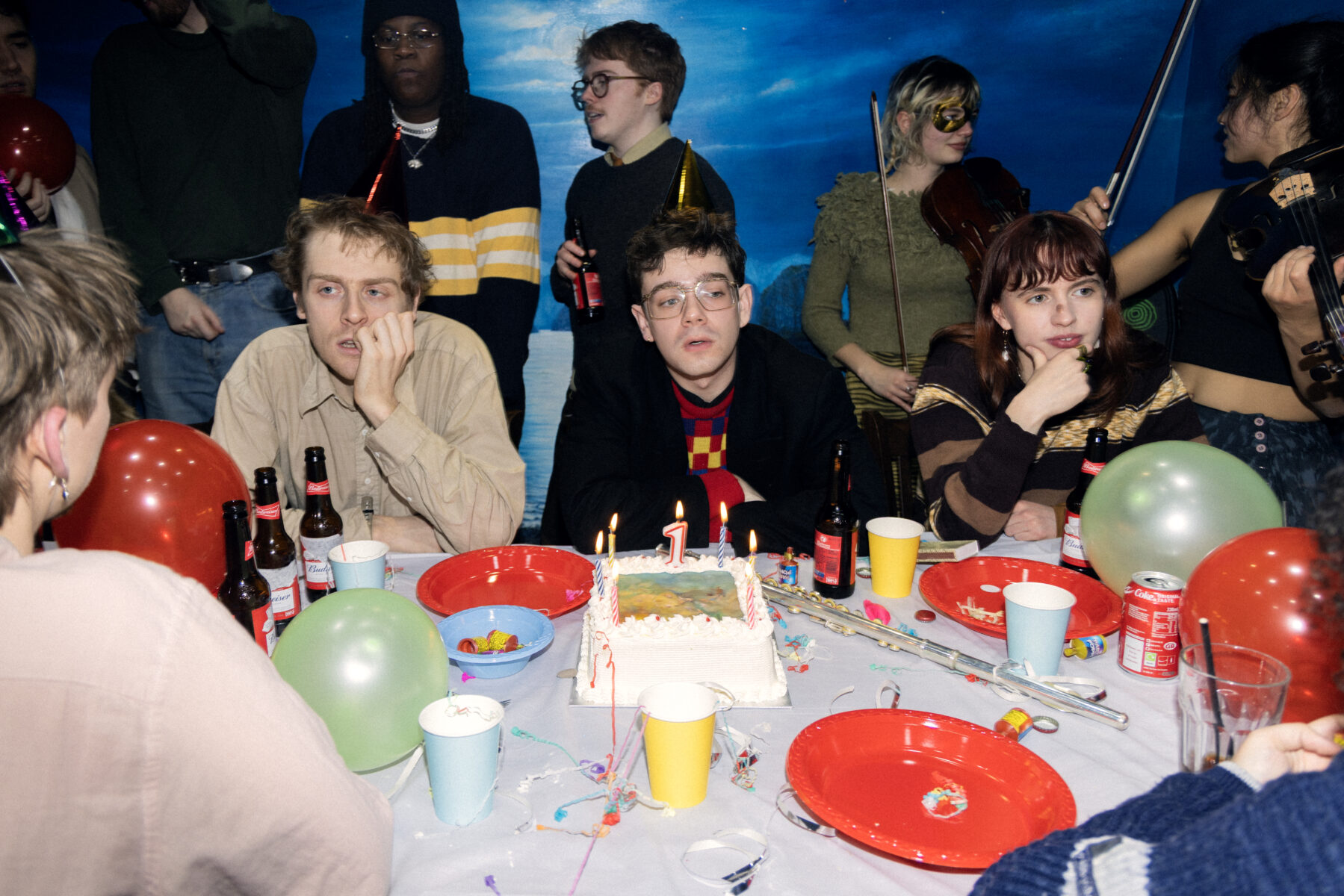
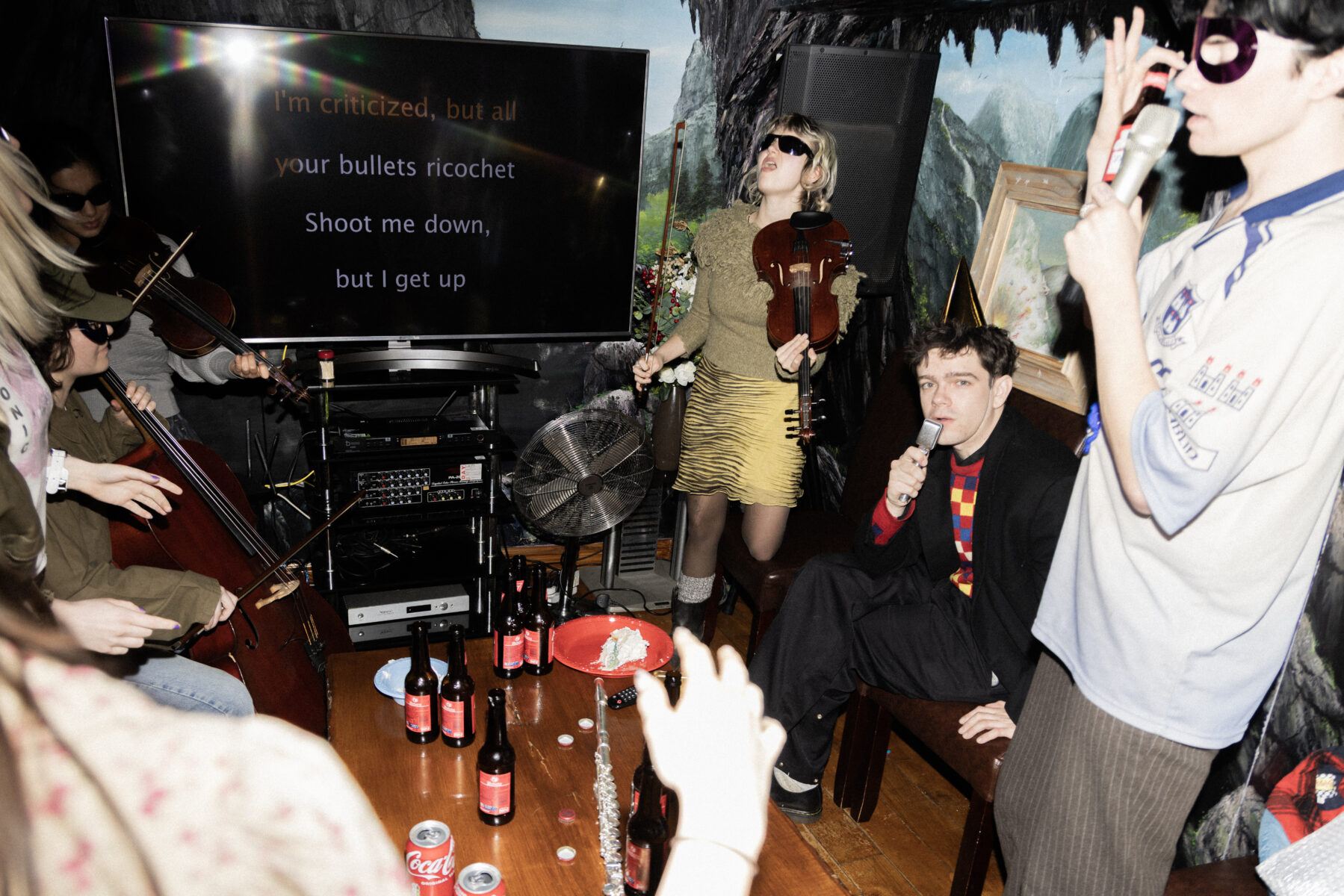
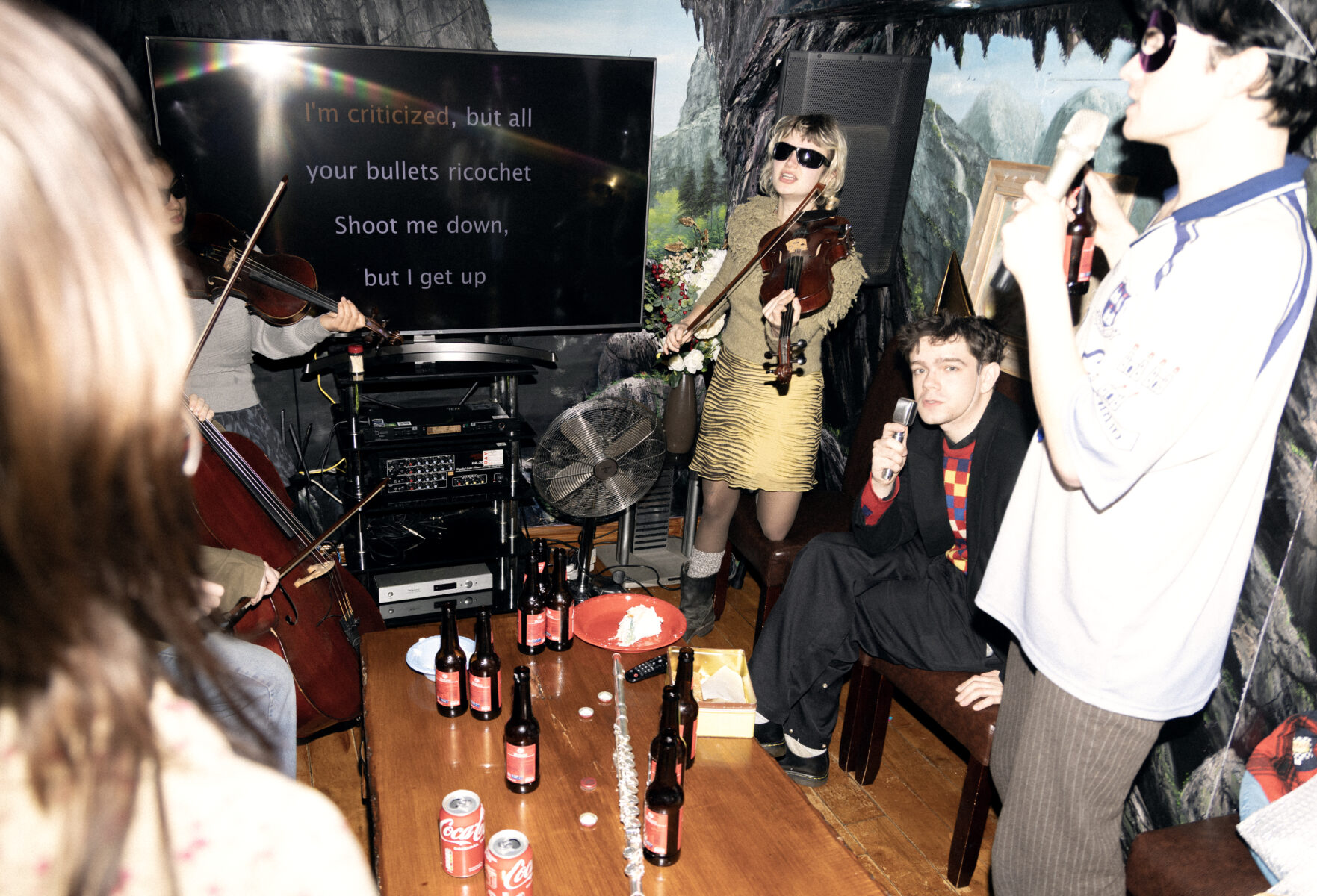
If not via belief, then, perhaps My New Band Believe can be described as a project between friends and peers, which, in a way, is not so different from black midi. As we wrap up our conversation, Picton describes the struggle to get their press photography done. One shot was captured through his flat windows by a close friend who happens to live directly across the street from him, another, showing a fake karaoke night, came together so last-minute that Picton worried that they’d end up with no extras.
“We did it in a karaoke bar, and I was just frantically texting people four hours before. And I’m like, fuck, I actually haven’t texted anyone about this, no one’s going to come, it’s going to look like a shit party,” Picton gesticulates. “It was just come, come, come, I’ll buy you a beer. And that just turned out to be the best photo!”
Listen to the album here…
Photography – Daisy and Tomos Ayscough
Words – Sasha Mills