Wonderland
IN THE SHUSHU/TONG UNIVERSE, NO GIRL IS JUST A GIRL
Ahead of their AW26 presentation at Shanghai Fashion Week, the duo answers Wonderland’s questions on their evolving vision of womanhood and girlhood, and how that vision unfolds through their clothes.
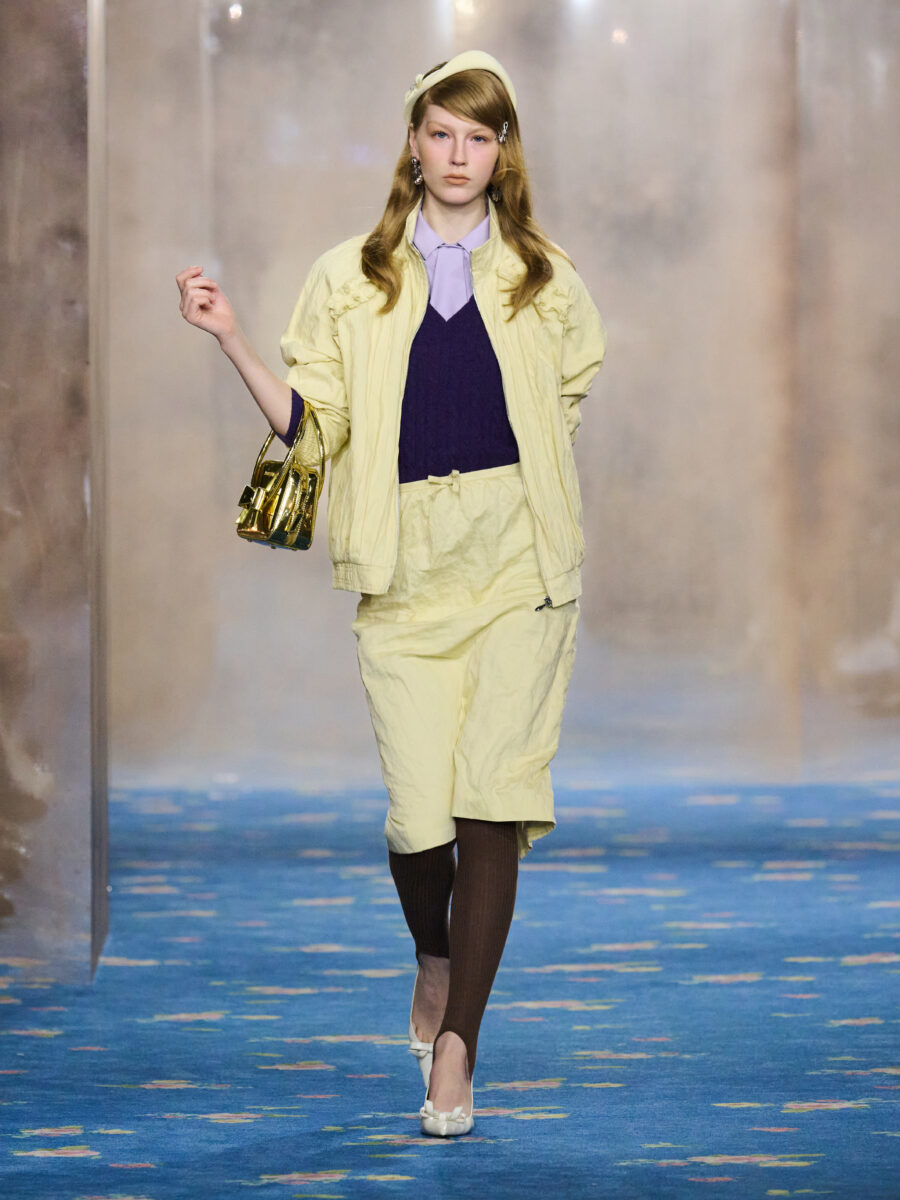
From Elle Fanning, Jennie, Dua Lipa or Ayo Edebiri, to the crowds gathered outside their shows every season wearing the brand head to toe, it’s clear Shushu/Tong’s world is one people want to step into. Ruffles, bows, hyper-feminine silhouettes, the brand’s signatures are instantly recognisable, and desired by A-listers and fans of the brand alike.
The creative minds behind the brand, Liushu Lei and Yutong Jiang, both grew up in Chengdu, in China’s Sichuan province, attending the same high school before meeting while studying in Shanghai. The pair then moved to London to study the fashion design womenswear MA at the London College of Fashion, before joining the teams of Simone Rocha and Gareth Pugh, and later relocating back to Shanghai to work on their joint brand Shushu/Tong, named after both of their nicknames.
Since founding the Shanghai-based label in 2015, the duo have become one of the main events during Shanghai Fashion Week, mostly because the duo have a strong pulse on what’s currently resonating with their audience, delivering trendy, flattering designs with real customer appeal for a generation fluent in image and self-styling.
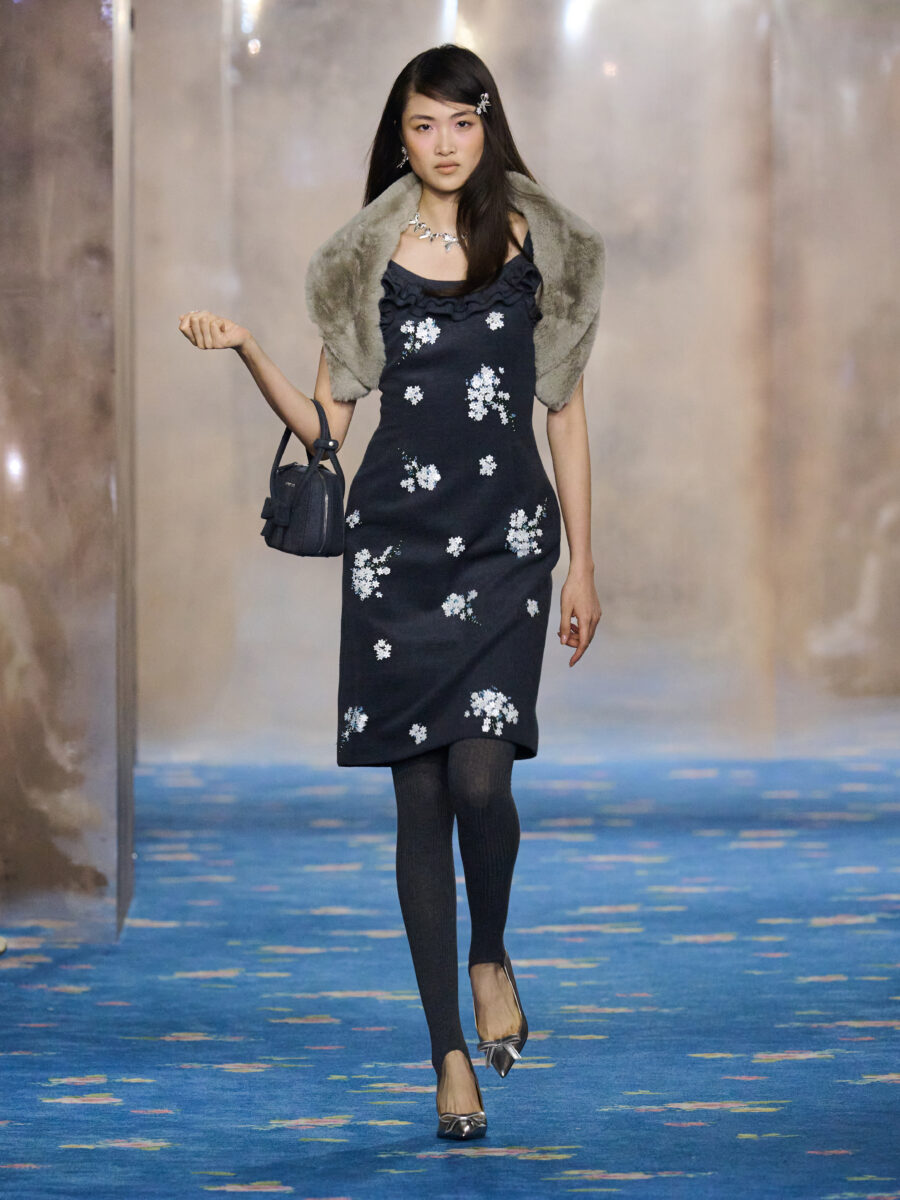
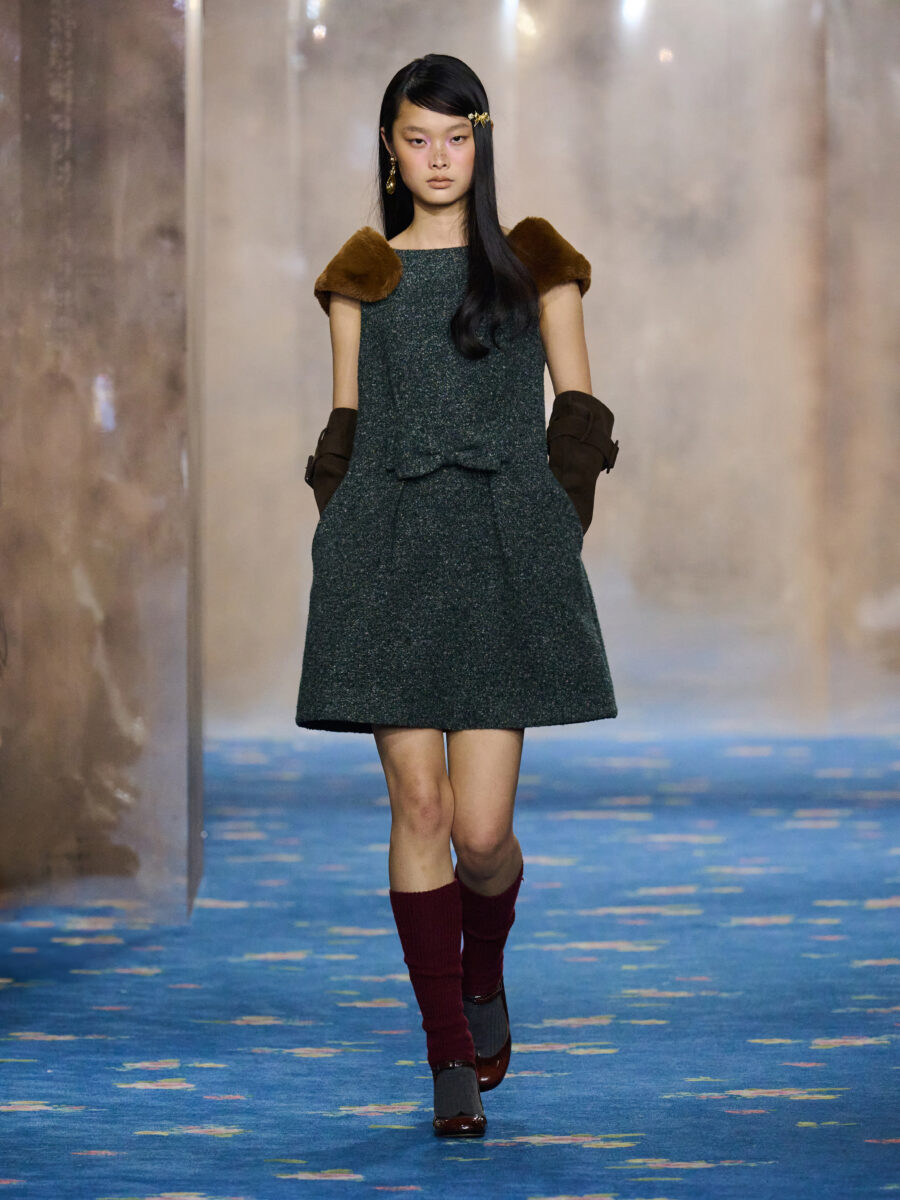
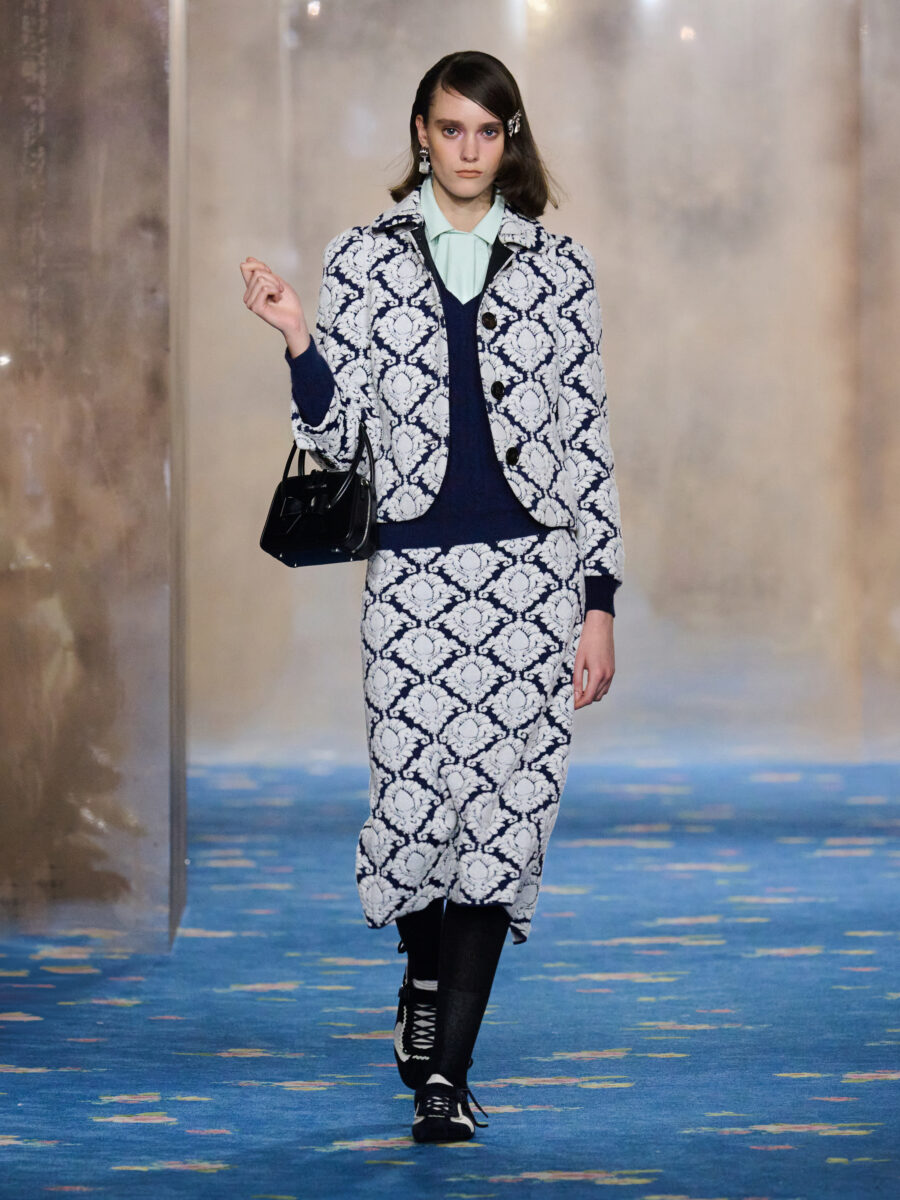
At its core, the brand resists any singular definition of femininity. For Lei and Jiang, girlhood isn’t only soft, sweet or passive, but something more layered, and at times, contradictory. This tension carries into their AW26 collection presented this week in Shanghai, inspired by Violette Nozière and its complex protagonist, played by Isabelle Huppert.
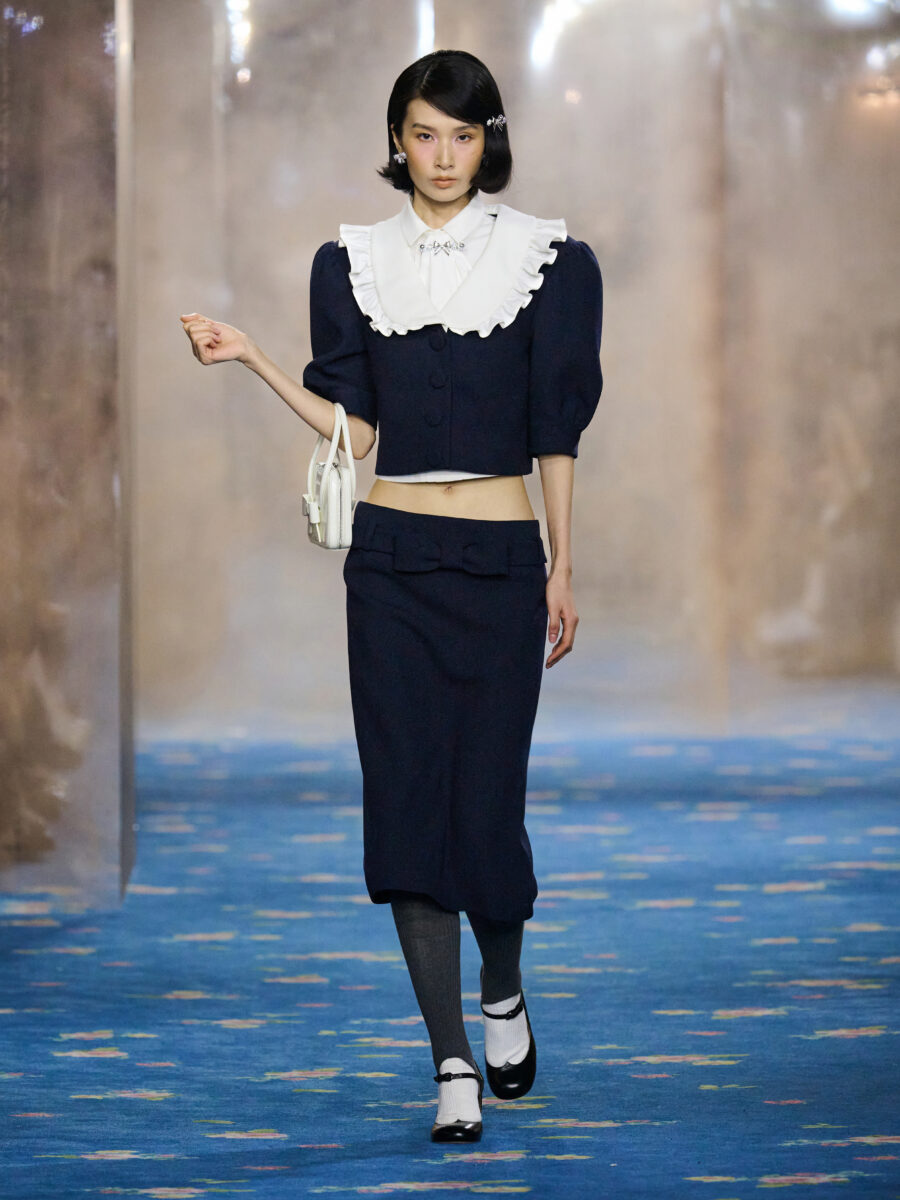
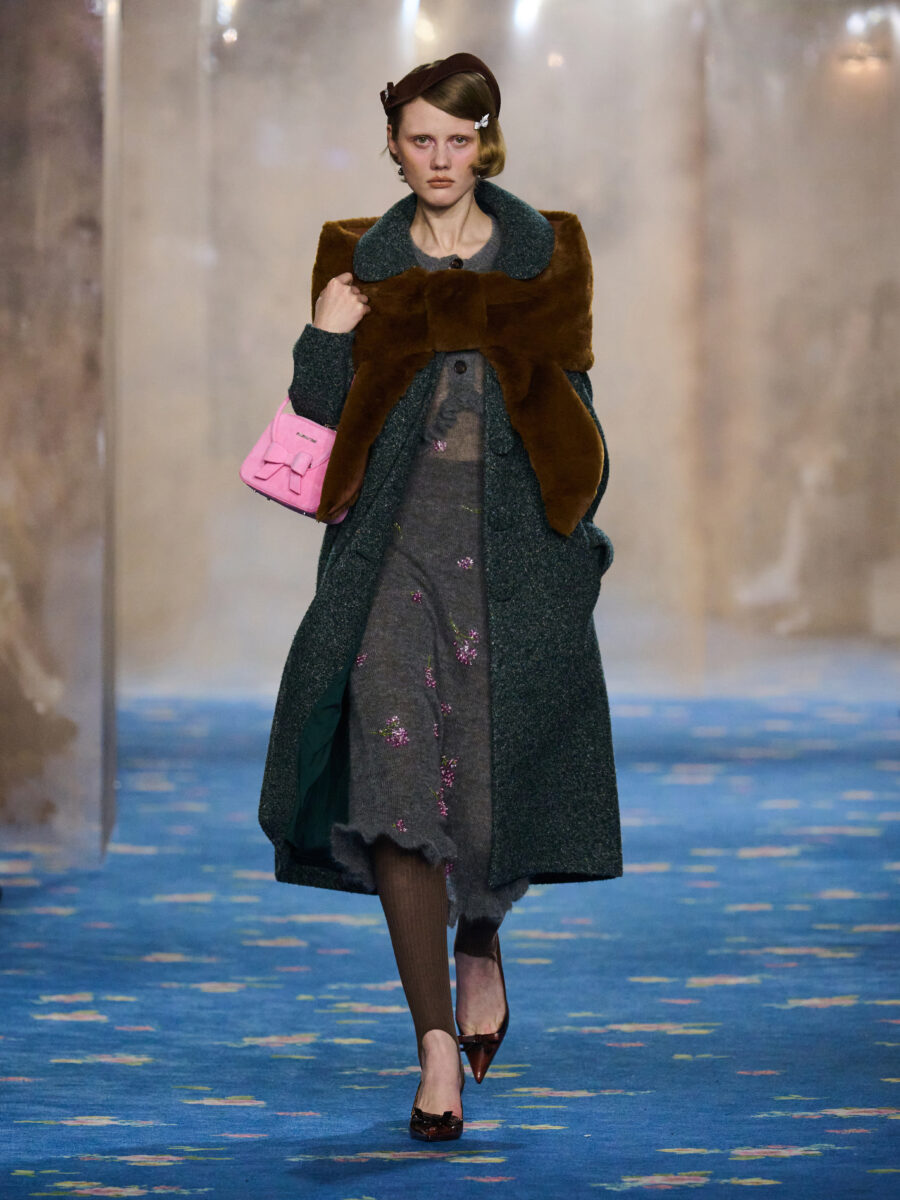
This season, the duo explore the idea of “inventing oneself” outside of pre-given constraints of class, family, and moral order, as early 1930s silhouettes and drop waists are combined with deconstructed silhouettes, argyle knits and plaid pencil skirts are worn with faux furs and Peter Pan collars and styled with stirrup leggings and knee high socks, with, mostly, all models carrying their signature bag on their elbow.
Below, the duo tells us all about their idea of femininity, the references behind their latest collection and what they call “girlish tension”.
Your brand, SHUSHU/TONG, has built a very distinctive visual language around femininity. How has your understanding of femininity evolved since the brand began?
Our understanding of femininity has become much more layered over time. We have always been fascinated by the sweetness and rebelliousness associated with girlhood, but in the beginning, our expression was rooted more in a kind of binary narrative — a direct merging of two emotionally charged but opposing forces. After exploring this subject for more than a decade, we have uncovered many subtler and more complex expressions within the space between “sweetness” and “rebellion.”
In AW25, we explored girls’ quiet resistance against social rules throughout the process of growing up. In SS26, we examined why, under the shadow of death, women might use beauty as a weapon against nihilism. In AW26, our perspective shifts toward the psychological analysis and self-construction of a “bad” girl who commits patricide.
For us today, femininity is no longer a fixed stylistic label, but a state that is constantly being reinterpreted and rewritten. What truly interests us is the complexity girls reveal across different emotions and different circumstances.
The internet has embraced coquette core and hyper-feminine aesthetics in a big way. How do you feel seeing elements like bows and girlishness become a global trend?
I find it very interesting, because these elements are not new in themselves — they have always existed. It is just that each era rediscovers them in a different way. The fact that bows, girlishness, and highly decorative visual languages keep returning to the conversation also suggests that people continue to project their imagination of femininity through these symbols.
But for us, what matters more is not whether these elements become a trend, but what they mean in a specific context. SHUSHU/TONG has never used them simply to create an impression of cuteness or romance. We are more interested in placing them in different contexts in order to explore broader possibilities of feminine imagery. So while it is certainly interesting to see them become a global trend, what matters more to me is whether the brand can continue to redefine these symbols in its own way.
Your work often balances sweetness with something more subversive. Why is that tension important to you?
Because that tension feels closer to reality. No person has only one side, and girls are not simply sweet, soft, or passive. What we have always wanted to express are those seemingly contradictory qualities that coexist truthfully: sweetness and sharpness, order and transgression, vulnerability and resistance.
How does this idea of “girlish tension” manifest differently this season?
This season, that “girlish tension” is no longer simply expressed through the surface contrast between sweetness and rebellion. Instead, it moves more explicitly into the realm of identity and performance. She is no longer just a girl with a girlish sensibility, but a woman trying to invent another self through dressing, role-switching, and imagination.
So the tension this season is more psychological in nature. Lace, sailor collars, and bows are still present, but they are no longer merely cute symbols. They are placed within a more complex narrative structure, where they interact with order, desire, restraint, and transgression to shape the character as a whole.
This collection draws from Violette Nozière. What initially drew you to this film?
What first drew me to the film was its portrayal of a deeply complex female psychology, and the way the character is constantly pulled between class, family, moral order, and desire. She is not someone who can be easily defined. She exists in a position of being watched and shaped, while also trying to actively rewrite her own fate.
That complexity felt very close to this season’s theme, The Invented Self. What we wanted to explore was not a fictional identity in itself, but how a person, within the structures of reality, fights for the agency to decide who she becomes through role-playing and self-revision.
Isabelle Huppert’s performance is psychological and ambiguous. How did that complexity translate into the collection?
That complexity entered the collection more as a psychological atmosphere than as a direct recreation of any specific character. We wanted the collection to inhabit a state that moves between reality and fiction: she appears elegant, composed, even marked by a kind of old-world refinement, yet beneath the surface there is always a latent sense of unease, fragmentation, and the desire to transgress.
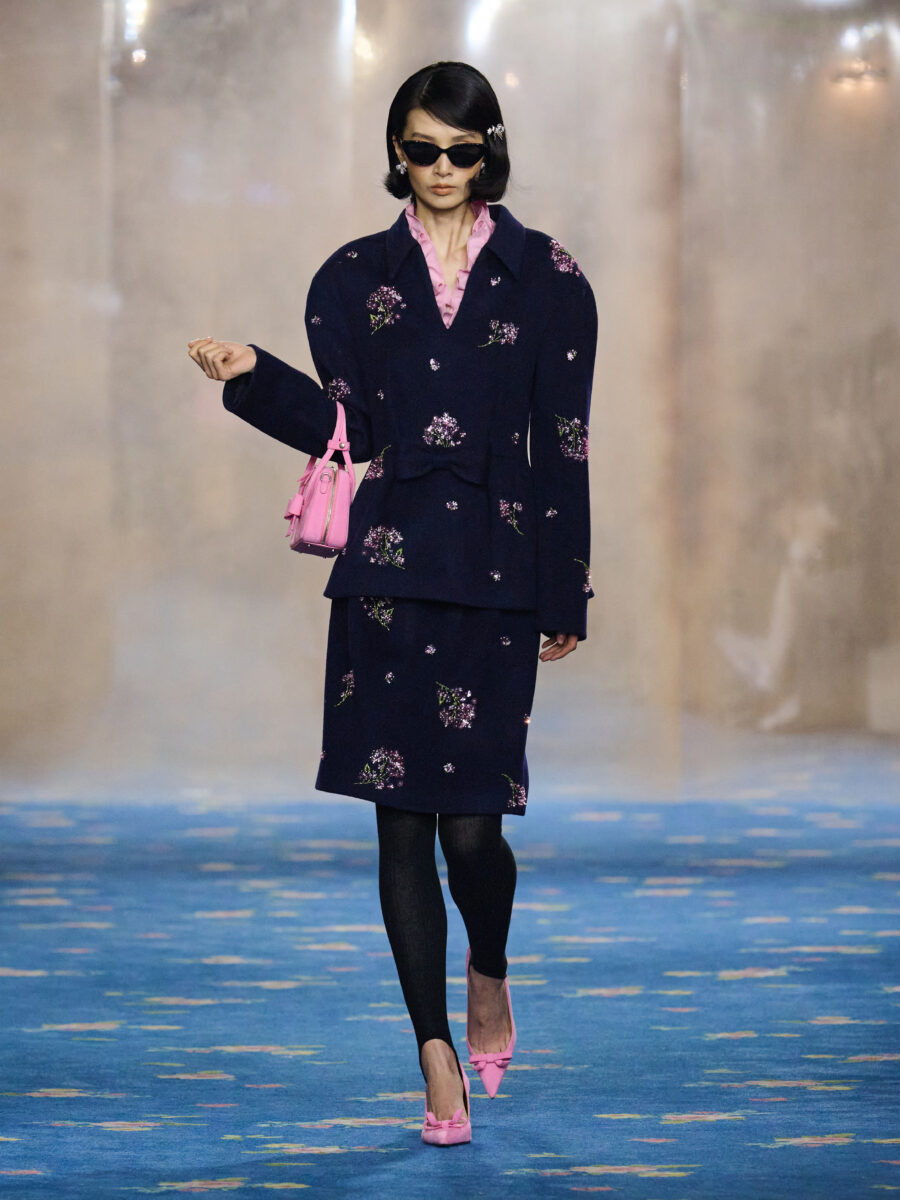
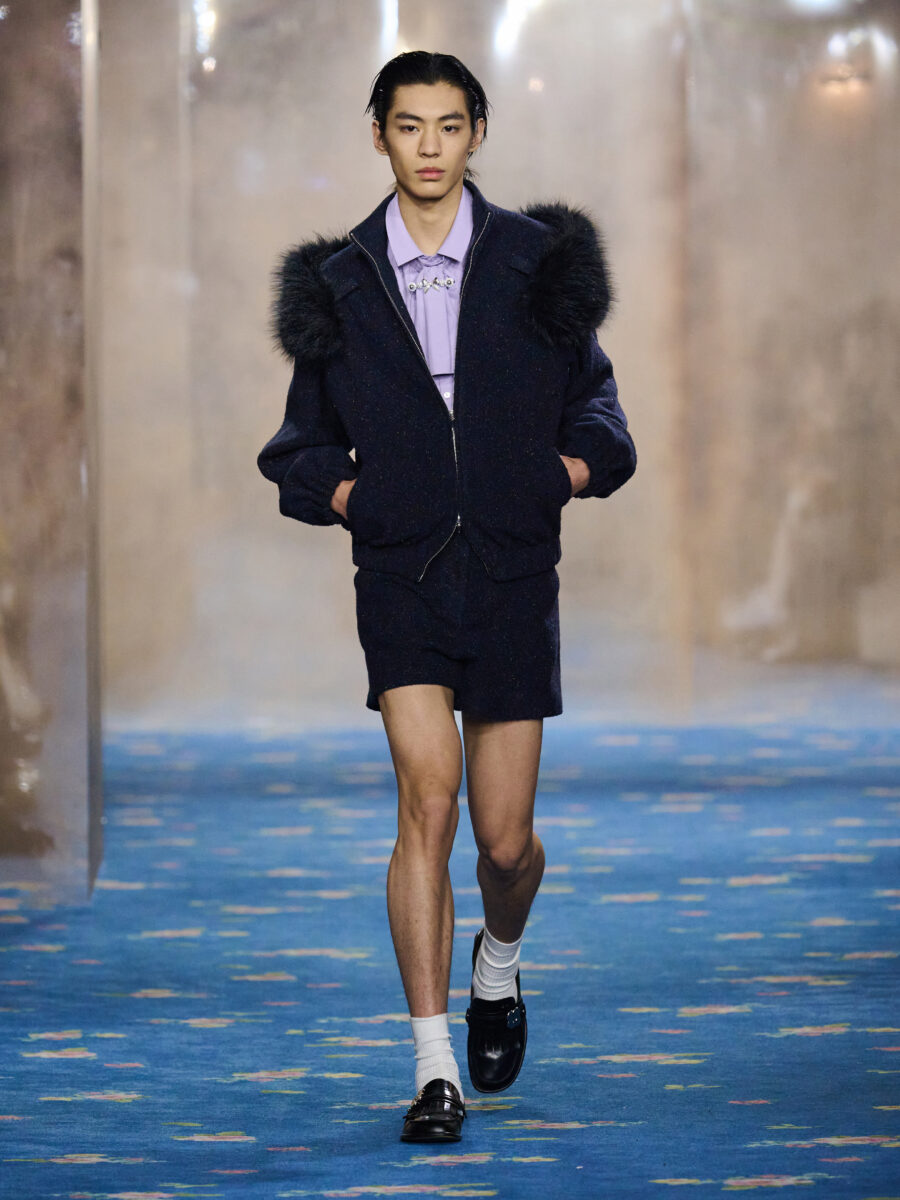
This feeling was translated into the silhouettes, materials, and details. The drop-waist dresses, off-shoulder necklines, knotted shoulders, and sculptural floral elements all carry a certain theatricality, as though meant to be seen. Meanwhile, fractured floral prints, crinkled colorful fabrics, and the contrast between restrained tones such as grey, navy, and flesh all echo the character’s psychological and emotional split.
You describe the collection as existing between structure and transgression. Can you talk about how that plays out in specific silhouettes, techniques, or styles?
We love working with highly structured silhouettes in our autumn/winter collections. Look 38 is a good example: the upper part of the dress borrows from the silhouette of a tailored suit, with broad shoulders, a cinched waist, and straight sleeves, creating an architectural, restrained, and rational emotional foundation.
But on the lower half, we introduced a sculptural bow construction at the hips, using a softer feminine language to blur the boundaries of that structure. In the styling, we paired it with pink suede pointed heels, which creates instability within the order of the look, producing a sense of displacement, fluidity, and tension.
There are references to 1930s fashion. What elements from that era felt most relevant to reinterpret?
[Faux] fur. The 1930s were elegant, restrained, and deeply concerned with propriety, yet they also looked back — nostalgically but cautiously — toward the desire, theatricality, and fluidity of identity associated with the pre-Depression era. In fashion terms, this created a narrative framework that appeared inward, controlled, and distant on the surface, while remaining emotionally charged underneath. Fur became a perfect carrier of that framework.
How do you define the SHUSHU/TONG woman of today?
She is still that girl — cute, rebellious, and real — but more complex.
Showing during Shanghai Fashion Week, how does the city influence your work? How is the fashion industry there different from other cities?
Shanghai moves quickly. Its strong local supply chain allows us to realize our creative ideas at great speed, and the feedback from the commercial environment is very direct, which also requires us to respond quickly. It is a city that suits designers who are able to keep generating ideas and who need an industry environment with strong execution.
Shanghai Fashion Week has grown very rapidly. We believe it has become one of the most important fashion weeks in Asia. It is highly attuned to changes in the current market, while also continuing to project the creativity and ideas of contemporary Chinese designers.
What excites you most about the future of the brand? What’s ahead for the brand over the next year?
We do not tend to think too far ahead. What excites us most is always the next collection and what we want to create next.
Words — Moira González