Wonderland
THE BITTERSWEET HIGHS OF LAUREN AUDER
In her first new music since 2023, the avant-garde artist flips from baroque to dance-pop. For the release of her album Whole World As Vigil, she reflects on what it means to truly experience the world and how love unveils its potential.
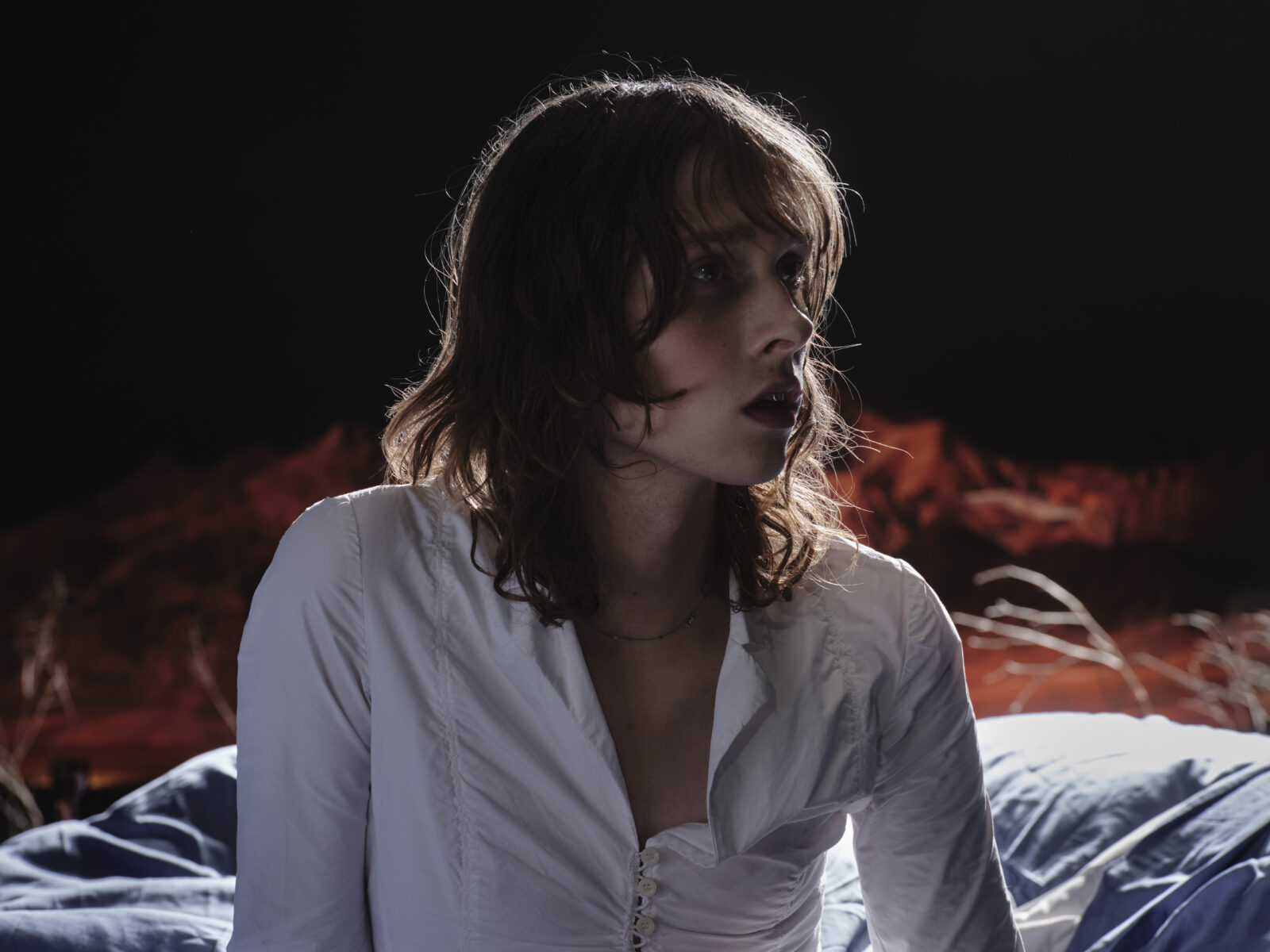
Pop isn’t the first thing that comes to mind when you encounter Lauren Auder. The British-French musician’s moody aesthetic, profuse lyrics that reference poetry and philosophy, and soul-searching orchestral baroque pop have set her apart since the release of her first single, “The Baptist”, in 2017. But despite her hyper-literacy and roots in left-swinging styles like underground rap and emo, Auder’s the antithesis of an intellectual snob. Her affiliation with pop music may have been picked up by those watching closely – she’s previously collaborated with Celeste and Caroline Polachek, after all. But with the release of her new album Whole World As Vigil, pop’s influence is undeniable.
The work is her first music in three years, since the release of her debut album The Infinite Spine, a rich, fascinating record where she explored the depths of her identity and otherness. Auder’s Whole World As Vigil represents, if not a sharp turn, a burst in growth. Rather than twisting inward, Auder finds herself inspired by burgeoning love and the changes in perception – of the world, of self and of others – that a new relationship can instigate. No track better exemplifies this than the shiny dance-inspired single “yes”, which sees the artist “breaking new ground” with a full-chested foray into pop in the form of a love song. “The record is about realising that, through that lens, it feels like the world has absolutely changed,” she says.
As Auder shares Whole World As Vigil’s today (27th March), followed by a spate of tour dates throughout the UK and US over the coming months, she sits down with Wonderland to talk about love and connection, sampling Ghostface Killah (plus a random industrial drill on TikTok), and what true experimentalism means to her.
Listen to the LP…
Read the interview…
Starting at the beginning, in the first chorus of Whole World As Vigil, you have this declaration of “let greed in”. I’m guessing that you’re not telling us to be consumerist pigs. What are you communicating?
That is exactly what I was getting at. No, obviously not! The thing that I was getting at is, on some levels, some anti-Puritan thing, where it’s like, enough self-flagellating. A lot of the first record was about constructing yourself in the world, and how to be, how to endure, how to make it through living and become yourself and live in that way. On this second record, I was like, “Okay, well, if I feel like I have a solid enough backbone, like “the infinite spine”, then what does it mean to search for more?” It’s already a huge task to be able to be present. Then once you feel like you’re part of the world, surely you can ask for more of it? That’s what I was getting at, this idea of it shouldn’t be enough to just survive.
What inspired the shift in tone to this more dancey, at times ravey, sound on Whole World As Vigil?
My life changed a lot from infinite spine onwards. I was experiencing things that called for me to make more joyful music, or at least more hopeful. The infinite spine is a very hopeful record, but it definitely comes from a place of distress, a lot of it. And on this one it was just about experiencing plentiful things and, in terms of sonics. It felt like I’m going back to my roots. Because I started out making electronic music, dance and rap music, and those are things that I wanted to bring back into the fold. I think I had a bit of a chip on my shoulder with some earlier records where I felt the need to really prove that I could make some grandiose baroque pop full of orchestral flair. It felt good to be more free and open with influence and sound.
You’ve packed so many emotions into each song – it feels so textured. How did emotion come into your songwriting?
It’s got to be the layer cake. There’s no one true experience. I think that the album is a celebration of life and of being in the world, but all of that comes as this bittersweet thing. On every song on the record, I wanted to complicate on some level and have that nuance, and on the first two singles, “yes” and “praxis”, they’re both really joyous songs and really celebratory. But I always feel like it’s only true to life to have a moment of doubt, or vulnerability, or fear, and on both those tracks the bridge section introduces something a bit more complicated. Because a lot of my music is written aspirationally, it feels important that there are those moments of removing the mask. Where, although I’m presenting some kind of clear manifesto, it’s never simple.
You used a really interesting sample on ‘praxis’, a clip of an industrial drill found on TikTok. What about that appealed to you?
I think that it works on two levels: it sounds good, that’s the main one. But also there was some kind of meta level on which I found it interesting and fun. I think one of my most successful songs, by some metric, is “june 14th” from two caves in, and that is built off a similar chugging violin section. And it felt really fun because I let go of the feeling that I needed to prove something artistically. It felt like quite a neat way to exemplify that by going, “Oh, I can make something that sounds quite similar by sampling TikTok.” That felt really amusing to me.
There’s a lot of humour in the record, especially musically – I don’t think so much lyrically, it’s quite earnest on that level – there are a lot of winks in the production and in the choice of samples, and that feels like one of the main ones, where it’s like, I can still make music that sounds like a big string section, but it’s really born of me scrolling through the internet.
There’s also a really fun familiar sounding sample on “orchard” that’s in the background and I made a note to ask what was that…
Ghostface Killah on “Mighty Healthy” is the track on which the little line appears. Ghostface has the best voice ever; it’s instantly memorable and takes up so much space on the track. I’ve loved Ghostface Killah’s music for years and years. His album Fishscale is, like, my mum’s favourite album, so I have a real connection to Ghostface in general. When I was writing that final section in ‘orchards’, which is a quote by [Rainer Maria] Rilke, a poet whom I love (“There’s no place that does not see you, you can change your life.”), I thought that there was a really interesting contrast between these two lines. Effectively, they say the same thing, because the Ghostface line is, “Rock that body, party that body”. It’s like, let’s get it moving. Let’s make stuff happen! Let’s live, you know? It felt like a really wonderful clash of time and place and, on some level, of perception – high and low art, which is the opposite to how I feel about those things. I feel like they exist on the same plane, and so I wanted to put them on the same plane. It felt exciting to bring that in as a nod to the things I care about.
More widely, I was wondering about your approach to experimentation. What does experimentalism mean to you?
Some of the moments on the record that are the most experimental are probably not the ones that people would think, because there’s an idea of experimental music as a genre, and then there’s actual experimentation. A lot of noise music that ostensibly is supposed to be experimental music is not experimental at all… not to throw shots at anyone or anything specifically. But a lot of supposedly avant-garde or experimental music is neither of those things. It fits under an umbrella of what was once considered experimental. I think a lot of the experimental parts of this record come from just throwing shit at the wall.
It sounds like being playful?
That’s a huge part of this record, and there are a lot of playful elements of the production. Even using those samples, just trying things. “pier” ends with a completely distorted wall of sound, and it kind of all falls apart. But that wasn’t experimental, I knew exactly what was going on at that moment; I knew I wanted it to end and all burn out in that way. The more experimental moments come from me trying out some of the more dancey rhythms, or on “701” trying to make a flamenco beat.
The album, in part, was inspired by a relationship, the development of it, and the break-up. How did that affect your writing and influence you creatively, emotionally?
It’s one of those things that connects you to every other human being in history, when you fall in love really deeply. It changes everything. It forces you to look at yourself and look at the world, and how you want to move through it. These are the things that make people want to sing, because that’s the most human thing ever, both falling in love and having your heart broken, or breaking someone’s heart – or doing all of the above. It’s some of the most intense emotions that you’re ever going to feel.
The record is about realising that, through that lens, it feels like the world has absolutely changed. All the things and all the beauty that you’re suddenly aware of in those moments are actually where they always were, which is what I was saying on that chorus of ‘yes’, which is “To see all things like I see you.” That’s what I want to take away from a romantic experience, to be reminded that all the world is full of potential. The colours are more vivid, but nothing’s changed materially. It’s all there in potential.
Can you tell me about the meaning behind the Whole World As Vigil’s title?
I had this title before anything else, which was the same with the infinite spine. It’s a really intense and evocative image. It came from a story that a friend of mine told me; they underwent psychosis and had a vision of seeing everyone on Earth in one go. That felt so insane, because it was impossible to imagine. That felt so powerful, and it evoked the feeling I was trying to get on this record – what I was going through.
The thing to take away from a romantic relationship is that everything in the world looks at you while you look back at it, and everyone’s here, and everyone’s present, and you can’t lock yourself off, not in yourself, not in a singular romantic relationship, not in an idea of yourself, or a political belief, or an identity. It’s all connected, and that’s what it means: connection. It all goes back to the start. You can spend hours thinking about these complicated ideas and end up with something pretty “live, laugh, love”. That’s what the album’s about.
I see what you mean. The essential human desires and drives…
Real shit. It’s all connected. We’re all here together. The Whole World As Vigil is that – we’re all here.
Words – Henrietta Taylor