Wonderland
IN FRANKENSTEIN, KATE HAWLEY CREATES ANATOMICAL COSTUMES
We sit down with the BAFTA winning costume designer ahead of the Oscars, to talk about her collaborative process with director Guillermo del Toro and the beautifully complex costumes that made the film.
What does it take for someone to turn one of our time’s biggest heartthrobs into a creature? For Kate Hawley it took years of extensive research and a complete trust on Guillermo del Toro’s vision. On a brisk afternoon in London, I make my way to one of the many hotels in Soho. As I approach the building, what must be at least a 40-foot poster of Frankenstein, featuring the Creature, aka Jacob Elordi, greets me just opposite the hotel doors.
Fresh from winning a BAFTA for Best Costume Design for her work on Frankenstein, Kate Hawley, the New Zealander who has already carved a remarkable path in blockbuster cinema such as The Hobbit, Crimson Peak and The Suicide Squad greets me with immediate friendliness and warmth. It must feel surreal, I think, to see your work displayed at such a scale, but this is far from her first time navigating the pressures and triumphs of a major production.
For the past two decades, Hawley has consistently demonstrated an ability to create beautifully complex costumes that tell a story. Hawley’s career trajectory makes her approach all the more compelling. Growing up immersed in opera, with a father who was an opera singer and a mother involved in wardrobe, she began painting sets and assisting with props at a young age, skills that influenced her approach to her craft: costumes do not exist in isolation, but as part of a director’s universe as a whole.
Her latest project, and most ambitious yet, Frankenstein reunites for the third time the costume designer with Guillermo del Toro, the Mexican director known for his poetic, visually rich storytelling. The pair have previously worked together on Crimson Peak and Pacific Rim, Their collaboration is one of shared vision and deep creative shorthand. They operate with a similar work philosophy, constantly pushing the limits of the work, and asking: “What else could this be?”
As we settle into the hotel’s bar, I get immersed in Hawley’s meticulous design process; she speaks about it with the precision of an architect. For her the process began isolating herself with the script, letting the narrative and the characters’ inner lives guide her, writing down her emotional response as she reads, allowing that initial instinct to lead her. From there comes extensive research and reference collection, often spanning centuries of painting and color-saturated cinema, which she translates into garments that feel as interesting in construction as they are in appearance.
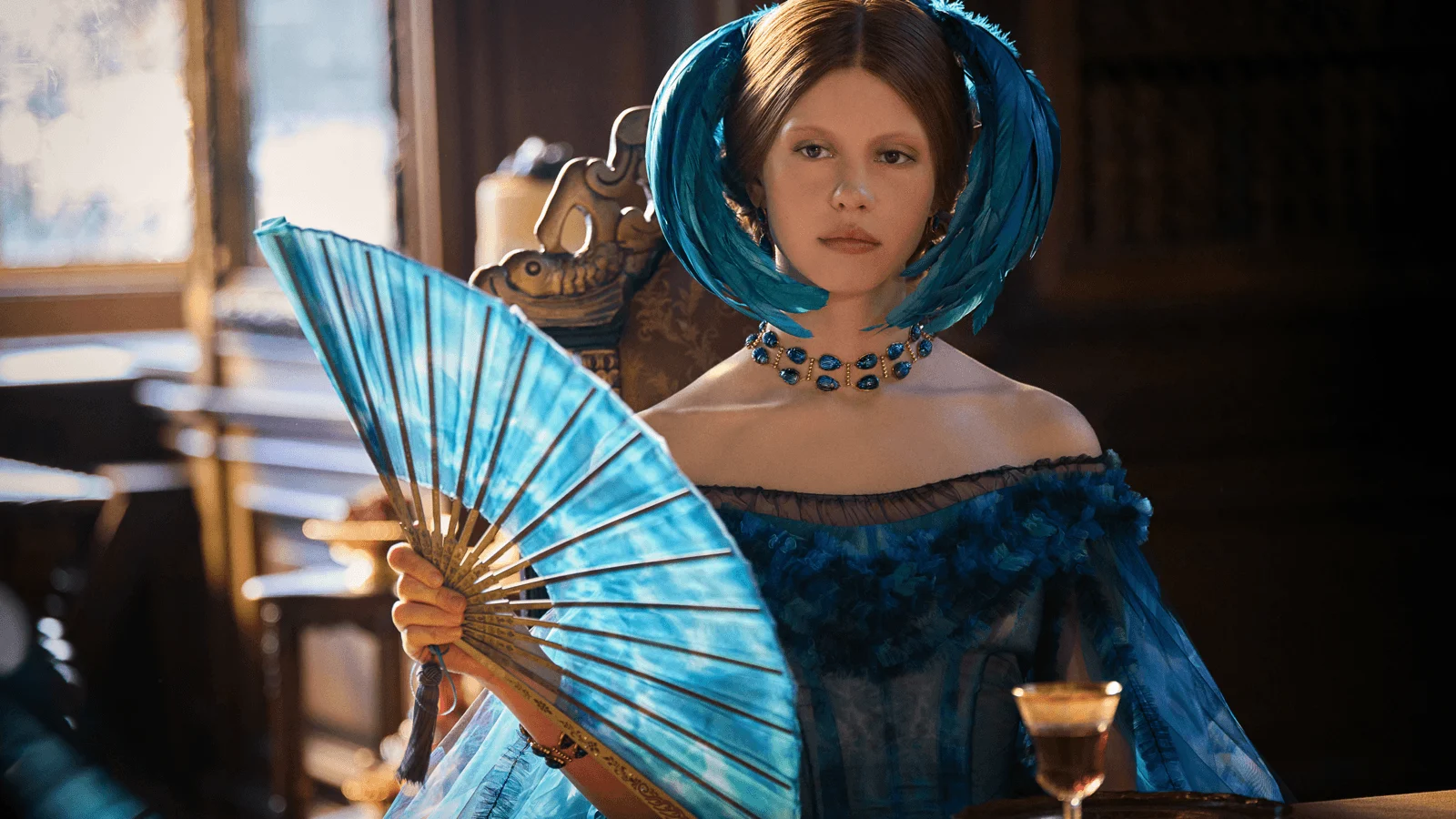
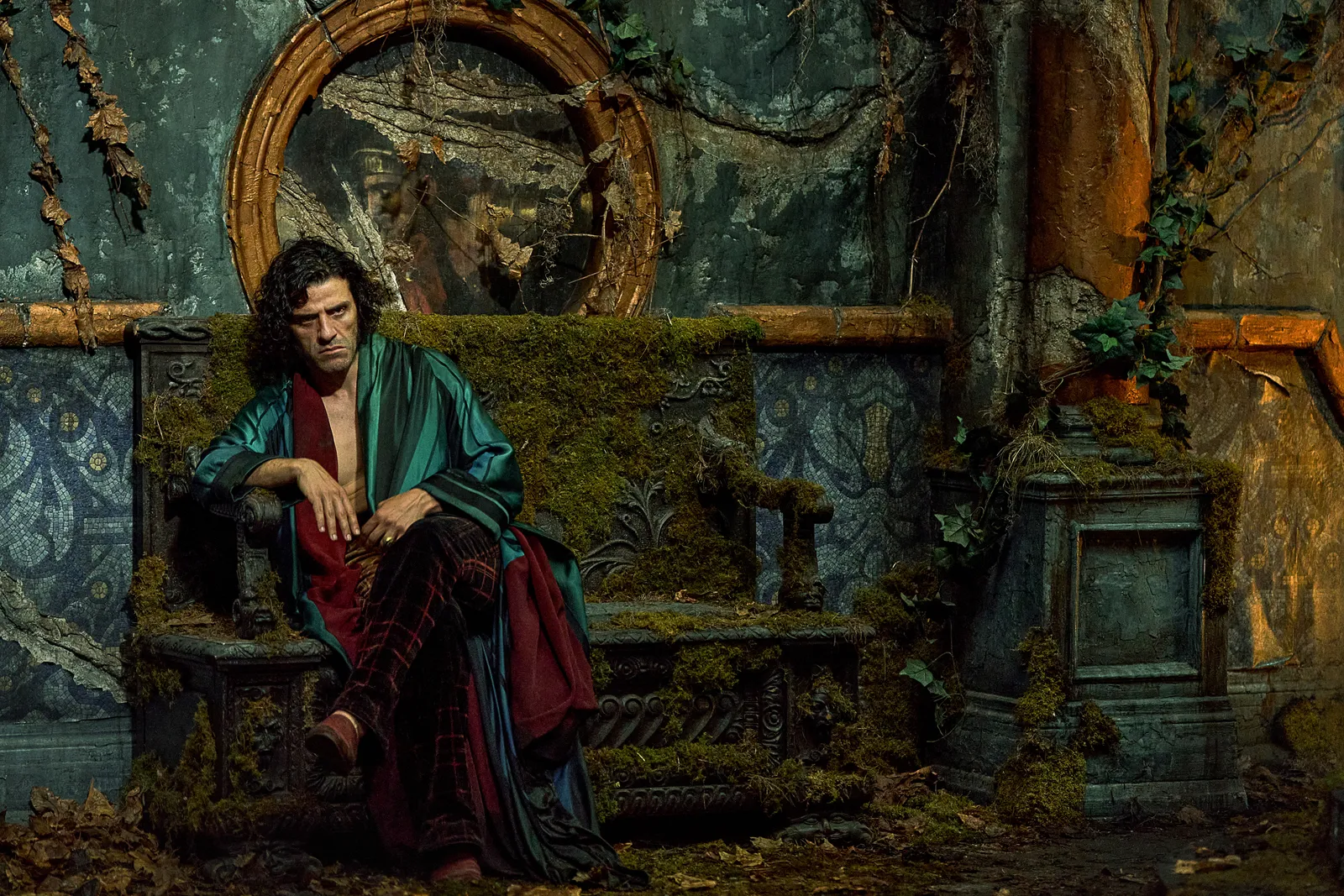
For Frankenstein, the challenge was to elevate a familiar story into a visual and emotional experience unlike anything audiences have seen before. Elizabeth Harlander’s blue dress, niece of industrialist Henrich Harlander and fiancée to William Frankenstein, worn by actress Mia Goth and paired with a beetle necklace designed by Louis Comfort Tiffany, came after Tiffany & Co. opened its archives to Hawley. The piece was a nod to Elizabeth’s connection to the natural world and has already become engraved in public consciousness, repeatedly shared online for its beauty. It worked perfectly within the gothic, operatic world del Toro envisioned, standing in contrast to the monumental presence of the Creature himself, played by Elordi, an immortal partwork of corpses with immortality who finds solace in Goth’s character. Oscar Isaac’s Victor Frankenstein, meanwhile, was more romantic, with images of rockstars like Mick Jagger appearing on the mood board.
Hawley’s work on Frankenstein has already been met with immense recognition, a BAFTA win and an Oscar nomination, and now, she sits with us ahead of the awards to talk about the project.
You are nominated for an Oscar for Best Costume Designer. What was it like being recognised for this project?
There’s a part of it that feels slightly overwhelming, and trying to navigate it all is… a lot. But when I look back, I think: whatever happens, I’m enjoying meeting my colleagues who are also nominated. I’m loving meeting all the people we’re meeting. That’s a wonderful place to be. And whatever happens, Guillermo has made his impact, and the work has been appreciated. So whatever comes after that is just what it is. People talk a lot about how they feel and their response to the film. I find it incredibly interesting that they’re moved by the atmosphere and the world that was created. So many times I hear kids, particularly, say they’ve watched it four or five times, and I think that’s amazing.
The costumes in this film have received a lot of attention. Why do you think they resonate?
I think it’s because when you have a director like Guillermo, who appreciates art and artists, and he’s an artist himself, you’re in a world where art really is the objective. It’s supported by the director. You don’t have a whole lot of other opinions telling you what to do; it’s his opinion, his vision. That means we can all just do our jobs, get stuck in, and work toward that. You’re not distracted by politics or noise. That’s a challenge and a weight, a burden, but it’s also exciting, because it’s permission to really go for it.
He pushed all of us. There were definitely moments of tears, but it was exciting, too. When an idea comes, it comes back to the screenplay he wrote. All the elements are there. Whenever you get lost, you go back to that world and it’s all there. When a visual idea is being unlocked, Guillermo has a very strong linear vision, we all know the journey we’re going on. We know what the main visual structure is. There’s a defined colour palette, a tonal language.
How did you first meet Guillermo and how did you start working together?
Through Peter Jackson in New Zealand, when Guillermo was preparing The Hobbit. I had already admired Pan’s Labyrinth and thought, “If only I could work with that director one day.” Peter introduced us, and Guillermo said he liked the books I was reading and liked that I come from opera, which gave us a shared language. There’s also an alchemy in a relationship like that. He’s such a well-read person, literature, art, history…those are my passions as well. Every time I’ve worked with him, similar themes appear, reinterpreted each time. Even on Pacific Rim, the giant robots had a painterly quality reminiscent of Goya’s “The Colossus”.
What made you get into costume design?
I grew up around opera, my father was an opera singer and my mother worked in the wardrobe. From a young age, I gravitated to creative work, painting sets, and helping with props. Through school, I basically ran away to the theatre. I failed a lot of classes, but I had teachers who supported me. I can only look back now and say thank you to them. In a world where everyone supports young sports people, if you have physical attributes, you’re going to be an Olympian, and that’s recognised early. But for kids who are creative and hide in those worlds, it’s harder, it’s not as supported. My teachers did support me.
At twelve, someone jokingly suggested I could make a career from [my passion for the arts], and it clicked. I studied graphic design, then went to Motley Theatre Design School. I often failed and had to start again, living on a shoestring, but people gave me chances. My parents and teachers supported me, and I learned by doing. All along my life, there’ve been moments where people trusted me enough to give me a go. Enthusiasm and passion pulled me through, and opportunities led me to Guillermo.
Where do you start your research for a project like this one?
Always with the script. I lock myself away, letting images and ideas form subconsciously. I research period, context, and history, but I’m not bound by reality. We’re creating a dreamscape. I also collect things around me: materials, fabrics, images that might mean something. I’m also drawing at that point, and my team is dyeing or collecting fabric samples as we shape it. At the beginning, you’re not totally clear where you’re going.
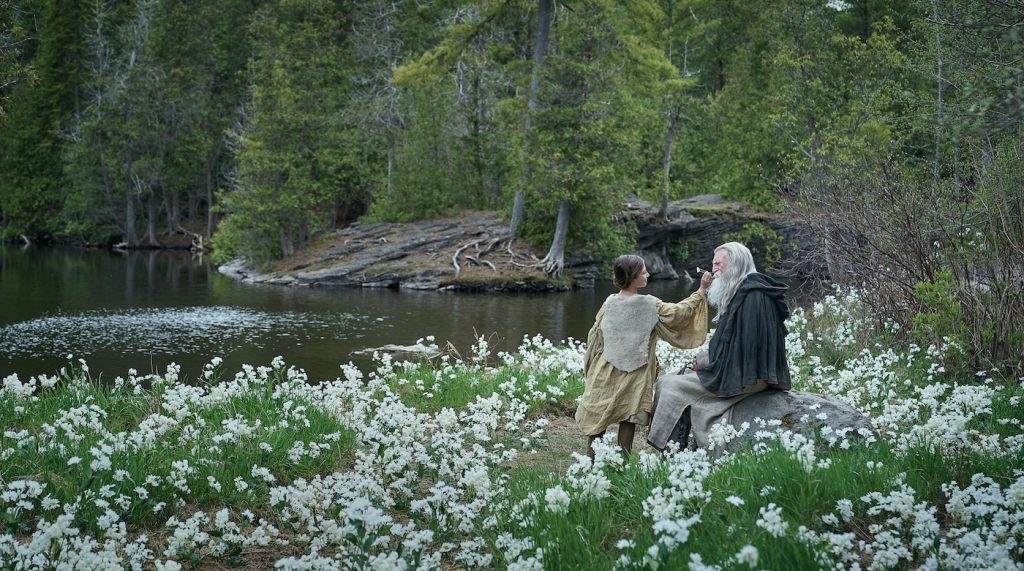
I also did the whole timeline in relation to the first Gothic novels and researched the year to see what the silhouette was. And then you put that aside and ask, “What is the story I’m telling? What is the character? What is the world we’re creating? How do those things translate? Am I pushing or exaggerating certain elements?” Historical research lets you discover things, but particularly with Guillermo, we’re not doing something like Downton Abbey or a Jane Austen adaptation, where it’s about detailed social manners. We’re talking about a big dreamscape in this world, so it’s a different set of rules.
How did you collaborate with the crew to build the Frankenstein world?
Throughout the process, I’m always trying to visualise the completion of the “painting”: when the actors are cast, lit, and moving in the space. I have to think ahead a lot, how will this work, what will the lighting be like? Guillermo wanted to use a lot of single-source lighting, candlelight, which changes how colours and fabrics work.
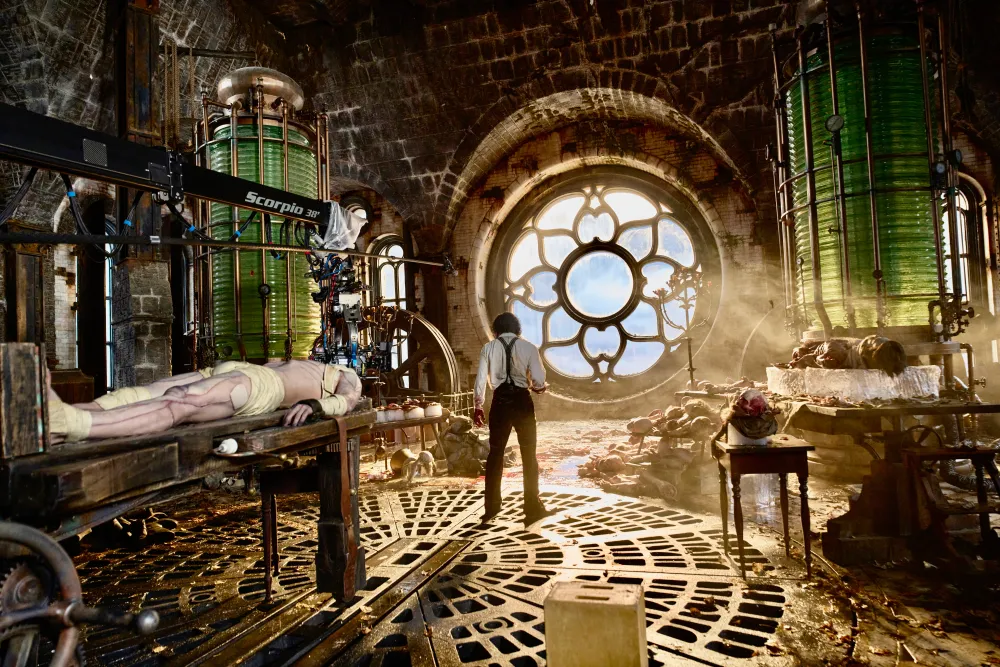
It’s all one picture. Sets and costumes exist in the same world. Every piece of furniture or set dressing affects what I do. I think about a character’s relationship to space, silhouette, and lighting. We build a shared visual language, and we all understand it. There’s trust and openness, and collaboration continues even in fittings. The character is not complete until hair, makeup, costume, and set all come together. Motifs, architecture, and colour are repeated across elements, creating a poetic, musical quality.
Was this project different from previous collaborations with Guillermo?
With Frankenstein, Guillermo had a vision he’d lived with for decades. He wanted something heightened, operatic, and melodramatic. He pushed us further than on Crimson Peak, yet maintained balance, telling us when to bring things up or down. He was incredibly accessible in prep, in the office every day. Communication was exceptional, discussing colour, images, and every detail. Even on set, we could watch cuts of previous scenes. This constant feedback informed costume and visual choices while maintaining the world’s rules.
The colour palette feels very intentional. How did that start?
Guillermo had a very specific colour tone in mind from the outset, one that shaped the world he was envisioning. We studied Gothic references, Hammer Horror, and films like Suspiria. Red was critical, pigeon-blood red, Caravaggio-inspired, evoking romantic tragedy and biblical themes. For Elizabeth, we explored beetle colours, greens and blues. Colour became character, tied to script, mood, and atmosphere. We layered sheer fabrics like brushstrokes of color, avoiding pure black and white. Lighting and fabric tests were essential for interior and exterior shots. In the workroom, I create lots of mood boards. I had images of anatomy, beetle wings, X‑rays, blood cells. It’s a very instinctive thing. Then we look at all that imagery and start distilling it, pulling out the reds. There’ll be images where you can go, “That’s our world,” or “That’s not,” and I keep shaping it as we go.
How do you think the choice of what the creature was wearing through the whole film differed from the usual Frankenstein tropes?
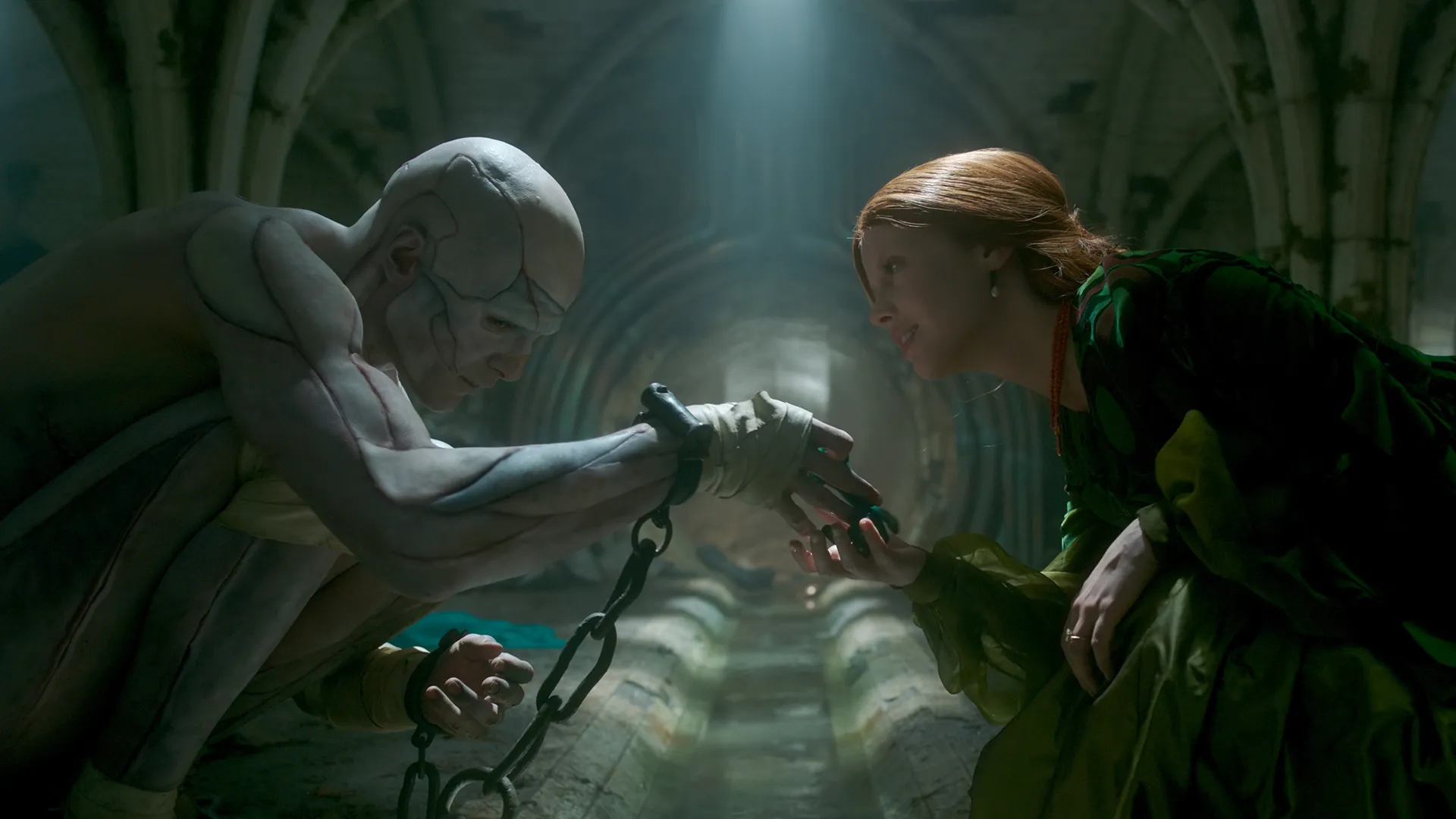
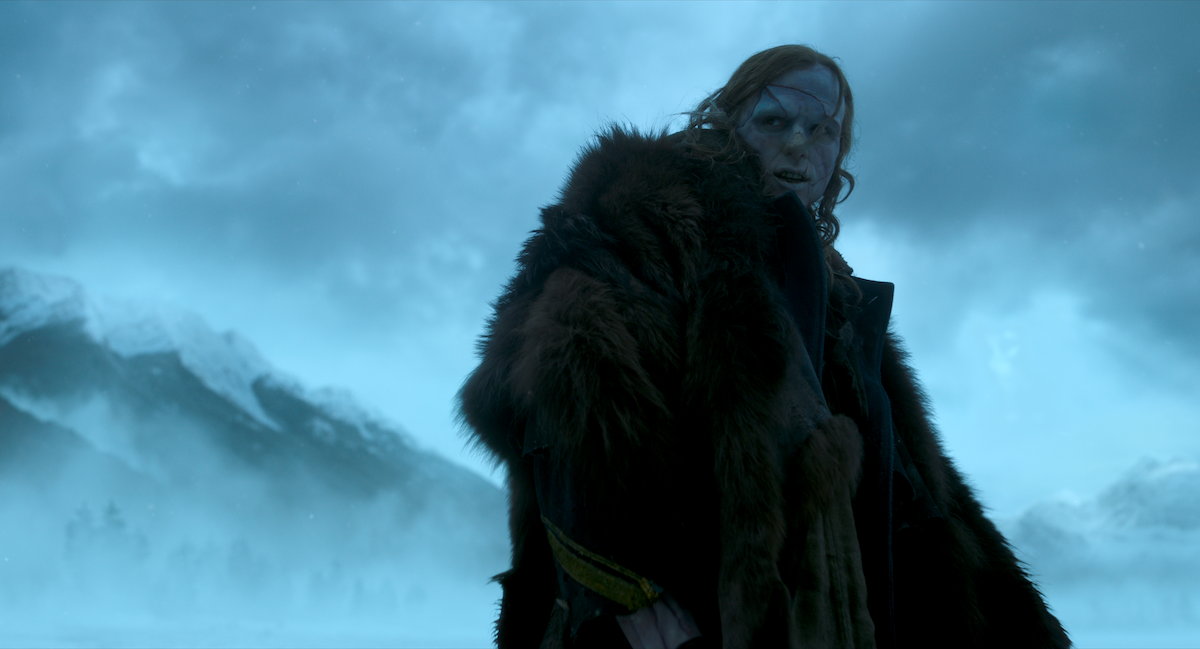
Because this is Victor’s story, who wanted to create beauty and something extraordinary, like Michelangelo’s David. The creation is almost Christ-like, when he first appears you can see a cross. I started looking at the prosthetic design and Jacob’s movements, building outward to costume layers. The creature’s clothing evolves: first from battlefield remnants, then protective warmth, then princely nobility. He mirrors Victor, and every choice, costume, memory in clothing, and layering, communicates that evolution. In the end, Victor becomes more like the creature was: prosthetic leg, broken face, the wild man. And the creature gains nobility. He has eloquence and language. He becomes the prince.
Elizabeth’s costumes are beautiful. Can you tell us about them?
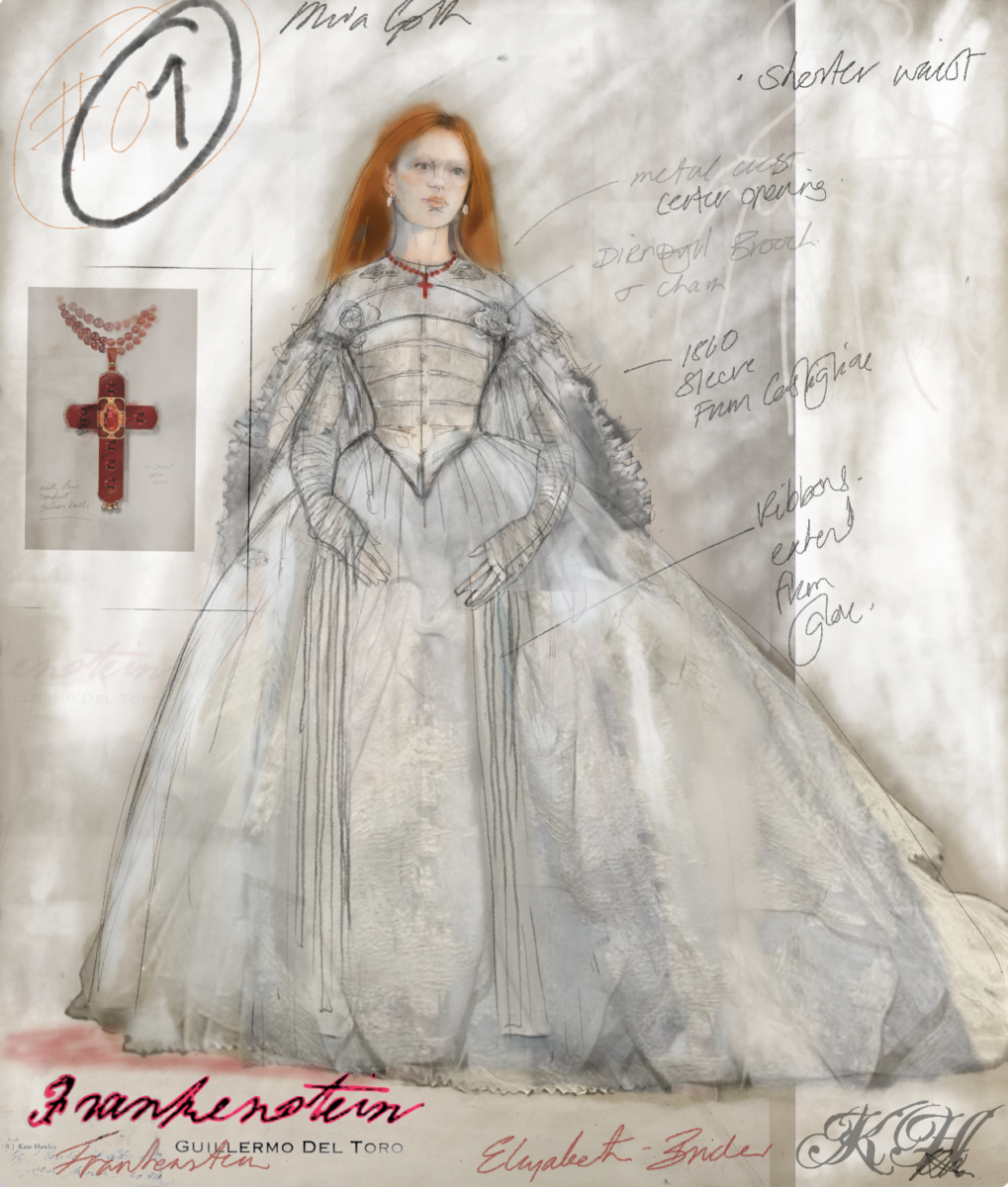
Every dress was layered with meaning. The blue dress incorporated anatomy, wings, and X-ray motifs. The wedding dress echoed the creature, ribbon corsets formed ribs, ethereal and transformative. The malachite dress was technically a favourite: fractal patterns, layered inspiration from blood cells, beetle wings, and anatomy. Each garment was tested extensively, considering movement, colour, and actor interpretation. Even the jewellery, some pulled from the archive and some in collaboration with Tiffany, reflected Elizabeth’s world and the broader themes of the film. For her wedding dress, I built the dress like layers of an X‑ray, so that when the bleeding happened, it transformed the look: all the ribbons became ribs. It became very anatomical.
There seems to be more discourse about costume design in film than ever before. With Wuthering Heights costumes receiving so much attention online, what’s your take?
You don’t always have to like something for it to be good. It doesn’t always have to be perfect to be good. Nowadays it’s always like, “It has to be perfect,” or, “It has to be this,” and everything’s black and white. But we’re not in a world of black and white; there are so many layers between. Once we know the language someone’s using, then you can have a discussion and a debate. Isn’t it great that they’ve done something that causes discussion and debate?
I wouldn’t judge them without seeing the film. Each director brings their own vision, and each generation reinterprets stories. Art is layered and open to debate; it doesn’t have to meet everyone’s taste to be meaningful. Costume designers serve the director’s vision. If you don’t like it, that’s a choice, but let someone be brave and try something. Otherwise, do we want exactly the same thing all the time? No.