[analyse_image type=”featured” src=”https://velo.outsideonline.com/wp-content/uploads/2026/02/SKIMO-4.jpeg”]
Skimo requires a massive VO2 Max, good power-to-weight, and a capacity for suffering.
Sound familiar?
What if we told you a good skimo athlete needs to be a gear nerd with little concept of self-preservation?
That’s right. Skimo, or ski mountaineering, is cycling’s wild winter cousin.
And it’s poised to bring its punk rock, 300bpm take on skiing to the Italian Alps next week in its debut as a Winter Olympic discipline.
But while casual sports fans who tune in to the Games might never have heard of skimo, it’s already a favorite of the elite endurance community.
Quinn Simmons loves it so much that USA’s champion cyclist wants to qualify for the national skimo team at a future Winter Games.
Recently retired pros Michael Woods and Joe Dombrowski have been lured to competitive skimo by its physiological and emotional similarity to cycling. They’re so hooked they’re already targeting the world’s biggest events.
And ski mountaineering’s crossover appeal doesn’t stop there.
Elite runners and riders across Europe and the U.S. strap on skimo gear every winter for a snowy cross-training boost.
In fact, the two athletes representing Team USA next week in Cortina run as much as they ski.
Cam Smith is a 13-time U.S. ski mountaineering champion with a slew of major trail-running victories to his name. Anna Gibson is a running prodigy who’s such a physiological outlier that she was selected for the Games after dabbling in skimo for only a few months.
Two last names to mention? Kilian Jornet and Rémi Bonnet. These world-topping mountain runners are ski mountaineers at heart.
Here’s why skimo is so beloved by the endurance elite, and why it might be your new favorite winter sport:
What is Skimo? Introducing the new Olympic discipline
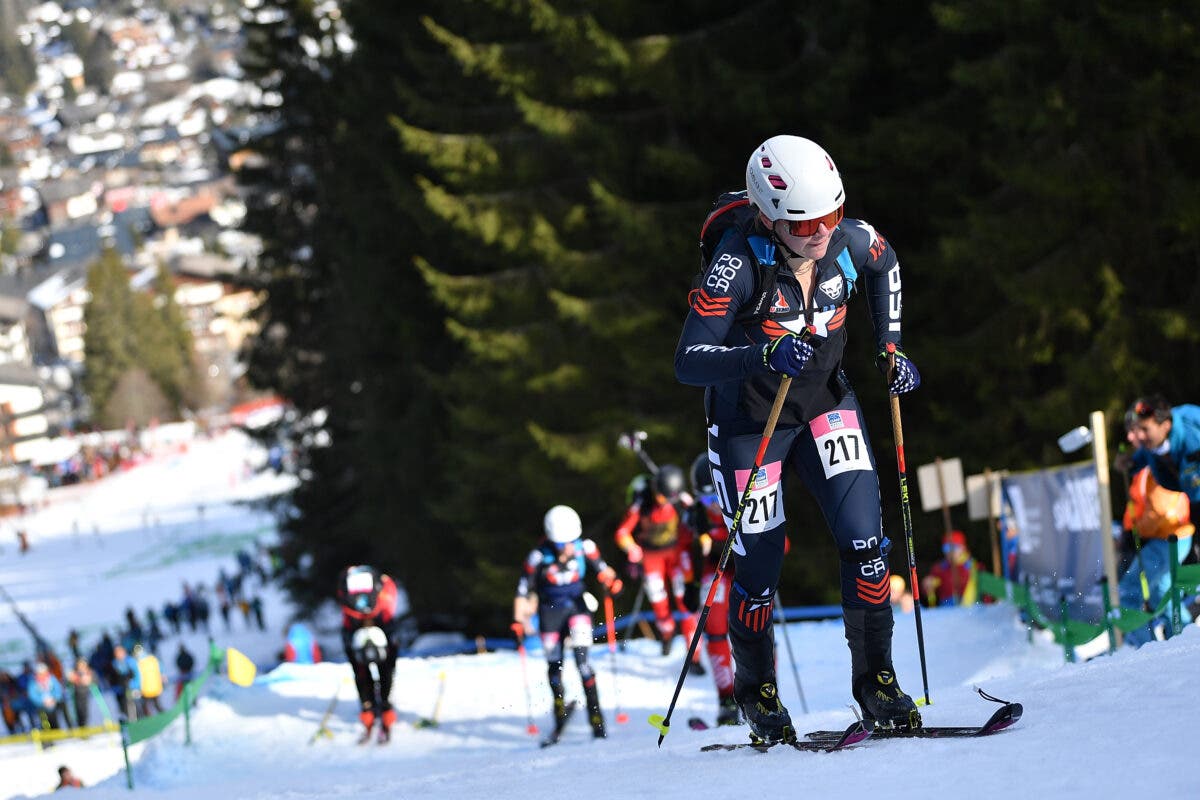
Ski mountaineering races are mass-start lung-busters that test fitness, technique, and nerve.
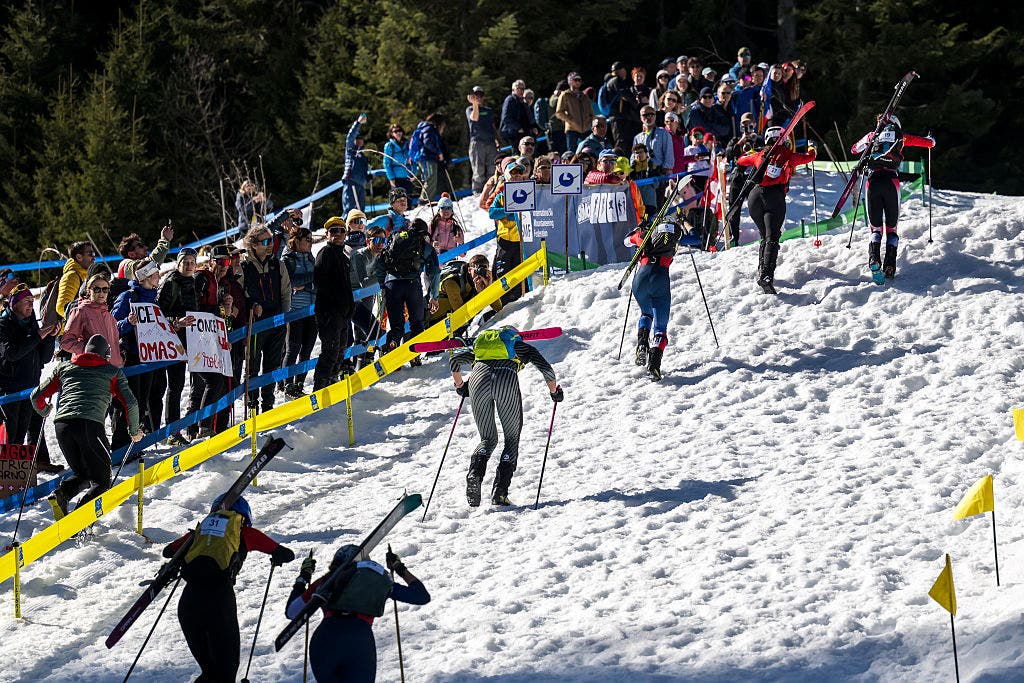
Competitors face a gravity-defying wall of snow as they stand at the start line. When the gun goes off, they sprint up the hill with rubbery “skins” attached to their skis for traction.
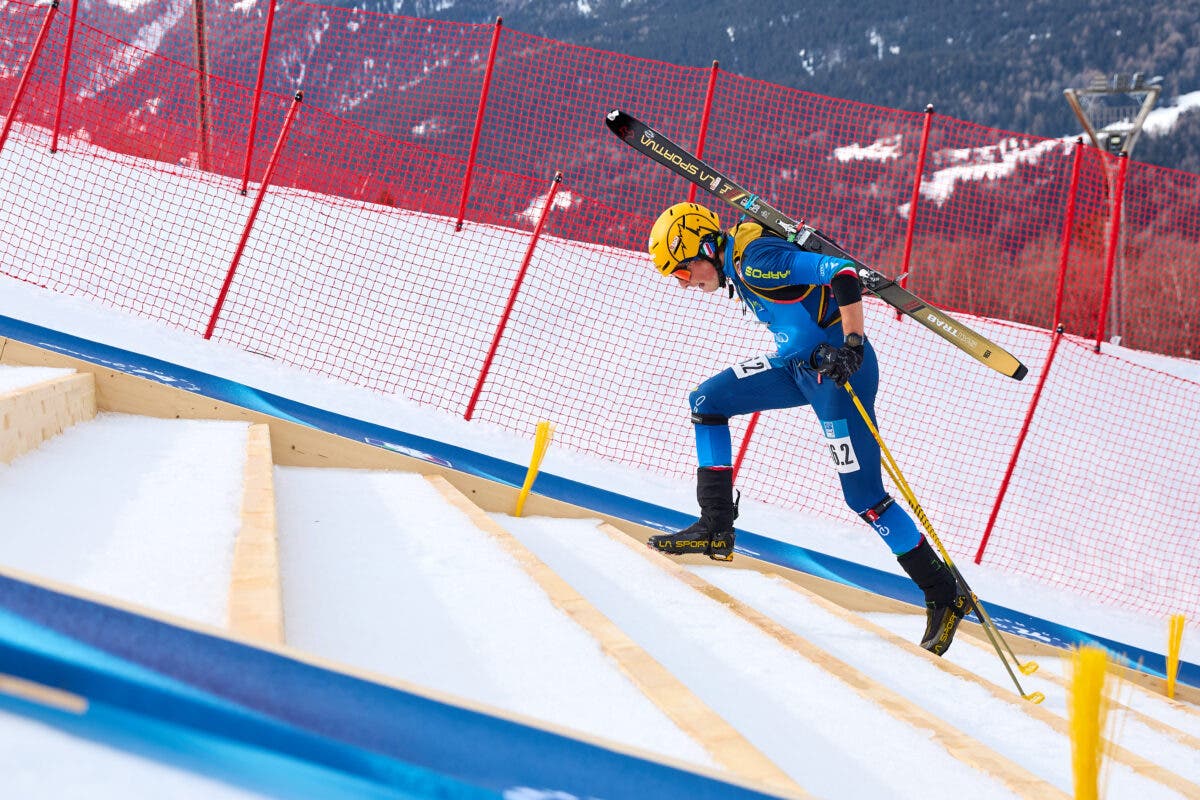
They’ll strap their skis to their backs to navigate the steepest and most technical sections on foot.
This uphill segment of a skimo race is a vomit-inducing effort.
But there’s little reprieve at the summit.
Athletes crest the slope, strip the skins from their skis, and clip in for a heart-pounding, knee-jarring descent to the finish line.
Skimo is traditionally staged across sprint, team relay, and long-format individual events.
The 2026 Winter Olympic program only includes the spectator-friendly sprint and team relay formats. These fast and furious bombs of adrenaline are easy to stage, easy to film, and perfect for today’s doomscrolling era. The four-minute sprints must be a social media team’s dream.
Sprint and relay races next week hurtle out of the Stelvio Ski Center in Bormio on Thursday, February 19, and Saturday, February 21, respectively.
And if the name sounds familiar, yes, it’s that Stelvio of Giro d’Italia legend. We did tell you skimo is a cyclist’s dream, didn’t we?
Massive VO2 Max, minimum mass: a physiological demand that suits cyclists
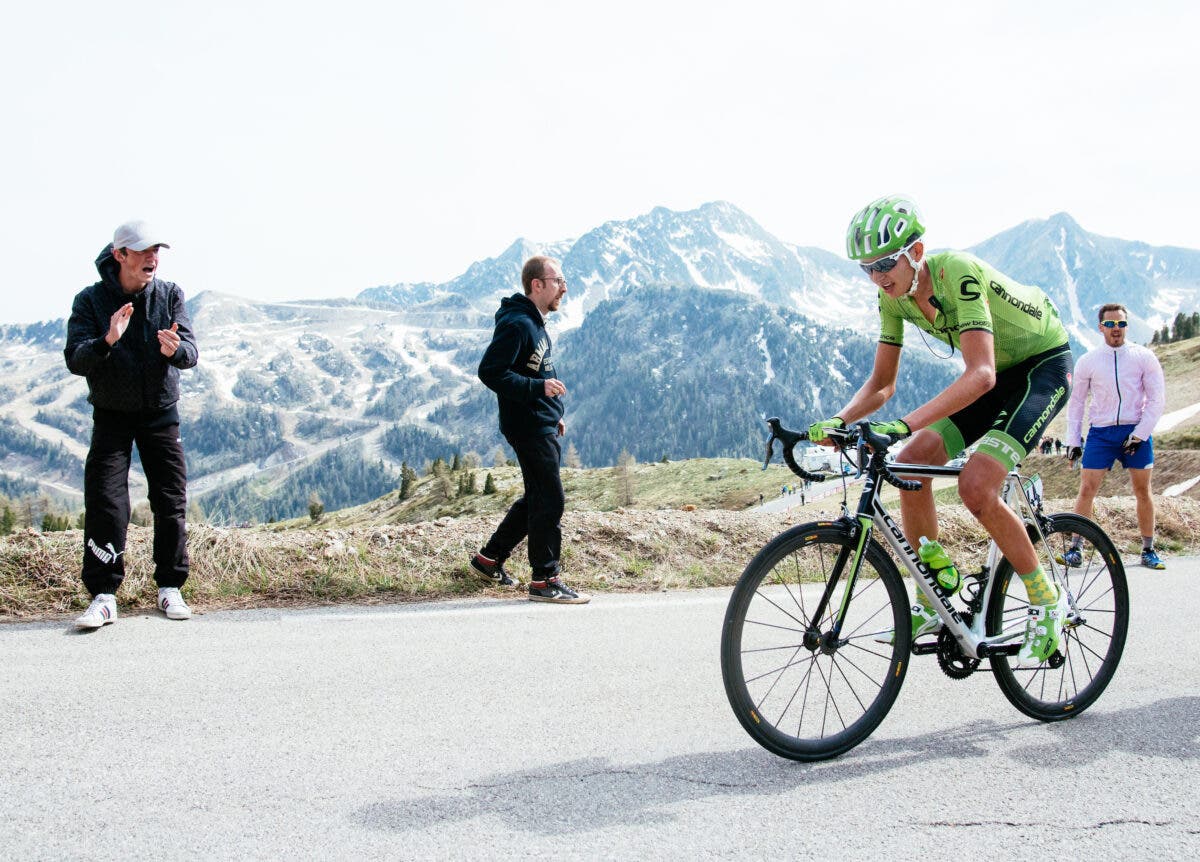
A cyclist who thrives on the 20-kilometer slope of the Stelvio should flourish in the crucial uphill segment of a skimo race.
The vertical sprint that’s so decisive in ski mountaineering is a blood-boiling, quadrupedal effort that pushes heart rate to the max. As this study proved, successful skimo racers boast VO2 Max figures that would make your average WorldTour pro blush.
On that note, remember Anton Palzer? In 2021, the ski mountaineer’s crazy performance values convinced Bora-Hansgrohe to give him a WorldTour contract.
But power-to-weight counts, too. The gradients of ski mountaineering are so severe that every kilo counts.
Multiple papers have shown that skimo athletes need both a Pogačar-esque VO2 Max and the same svelte stature of the Slovenian superstar.
It’s perhaps no surprise, then, that former WorldTour pro Dombrowski is rapidly finding success in skimo. The long, lean Virginian was as pure a climber as you could get.
‘It’s kind of a watt test’
Dombrowski barely let his heart rate settle when he retired from his long and successful career in 2023. He’s been training like a wild man ever since, albeit to fuel his new passions for trail running and skimo.
And while Dombrowski has found the mechanics and impact of running to be problematic, his huge engine soon tuned itself to ski racing.
The now-34-year-old finished third in his very first race in March 2024, an all-uphill “vertical” event.
Just last month, the skimo noob hit a career-best second at the French national cup race in Arêches.
“I would say most high-level, WorldTour-level cyclists can be competitive against specialists in a vertical skimo race,” Dombrowski told Velo. “The fitness demands are similar, and in an uphill-only event, the technical part doesn’t matter.”
The cyclical motion and high cadence of a “vertical” isn’t far removed from what Dombrowski did for more than a decade in the pro peloton.
“If it’s a super steep race, there’s relatively limited ski-glide involved, so it’s less technique-oriented,” he said. “It’s like a watt test, or running on an uphill treadmill. That’s where I can be most competitive.”
But sadly for Dombrowski, ski mountaineering isn’t only a power test.
The bits beyond power to weight
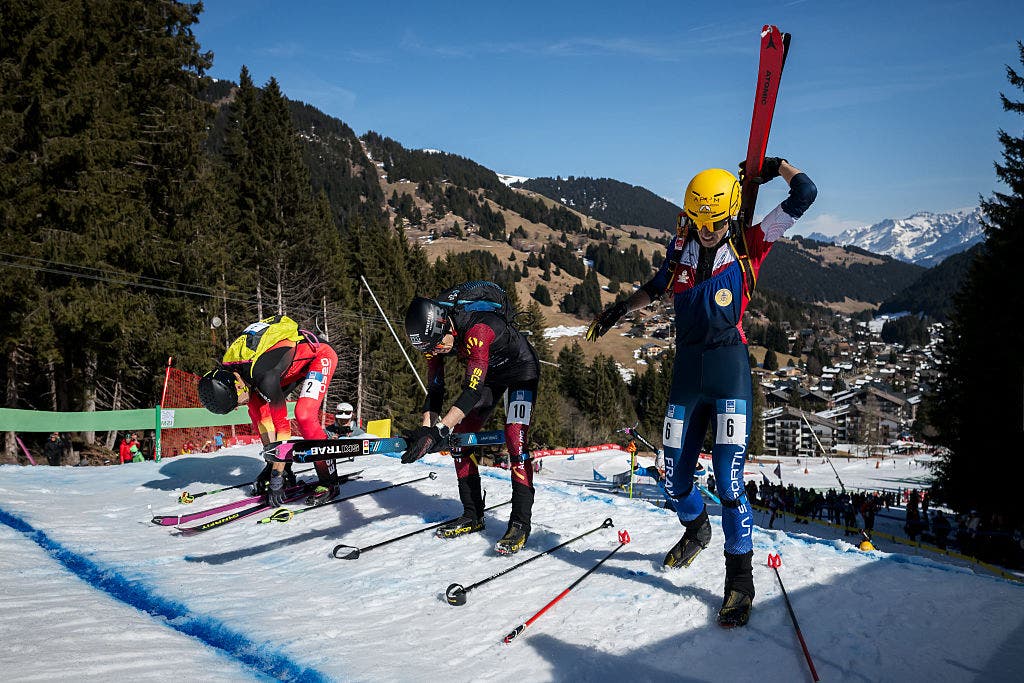
The transitions between skiing, “booting,” and skiing mark definitive phases of a skimo race, and require meticulous practice.
Like in triathlon, a short-format skimo race can be won or lost in the time athletes spend gearing up for the next modality. And for cross-sport athletes, that can be a limiting factor versus a seasoned ski mountaineer.
Team USA’s trail-running convert and skimo rookie Gibson said she spent hours refining her routine to boost her chances for Milano-Cortina.
“The good bit about the transitions is you don’t need snow to do them,” she told the Freetrail podcast. “I started learning these skills in my yard on a yoga mat or in my living room.”
Dombrowski has likewise been tuning his transitions and familiarizing himself with his equipment from his front room.
Technical proficiency and mountain savvy count for more than uphill physiology in the long-format events both he and Woods are targeting.
Pierra Menta – the so-called “Tour de France of ski mountaineering” – sends athletes to the wildest, most rugged ridges of the French Savoie in a race ruled by hardened cross-country skiers and Alpinists, not upstart cyclists.
An obsession with equipment to satiate the gear nerds
This attention to technical detail carries over to equipment choices. Skimo shares the obsession with optimization that preoccupies elite cycling.
Ski mountaineers are gear nerds who seek the elusive balance of weight, reliability, and strength in a setup that costs thousands of dollars.
The most notable element of a skimo store cupboard is the skis.
They’re significantly skinnier and shorter than their burly cross-country cousins, and weigh less than a kilo per ski.
These spindly carbon strips are light, fast, and, as Dombrowski described, “sketchy and swirly” on descents.
In fact, the weight of a skimo “system” of poles, boots, bindings, skins, and skis became so feathery that the International Ski Mountaineering Federation mandated minimum weights and measures to ensure safety. Remind you of anything?
But even then, the gear is as liable to breakage as a brittle carbon bike frame and gram-saving premier groupset.
“The big challenge for me has been learning the equipment piece,” Woods told Velo on a recent call. “My strike rate with mechanical issues, especially on my proper skimo racing skis, has been huge.
“Using [skimo skis] rather than cross-country skis is like riding a fully specced Dura-Ace carbon bike rather than a steel frame. You pay a lot more money for something that’s light, but far more breakable,” Woods said.
In Olympic skimo, there’s no room for gear failure or transitional tardiness. In a race as short as four minutes, a “mechanical” could be as costly as a double-flat on the Carrefour de l’Arbre.
There’s more room for error in the endurance races that captivate Woods and Dombrowski, but didn’t make the Olympic program.
Olympic skimo: Delivering adventure and adrenaline to your armchair
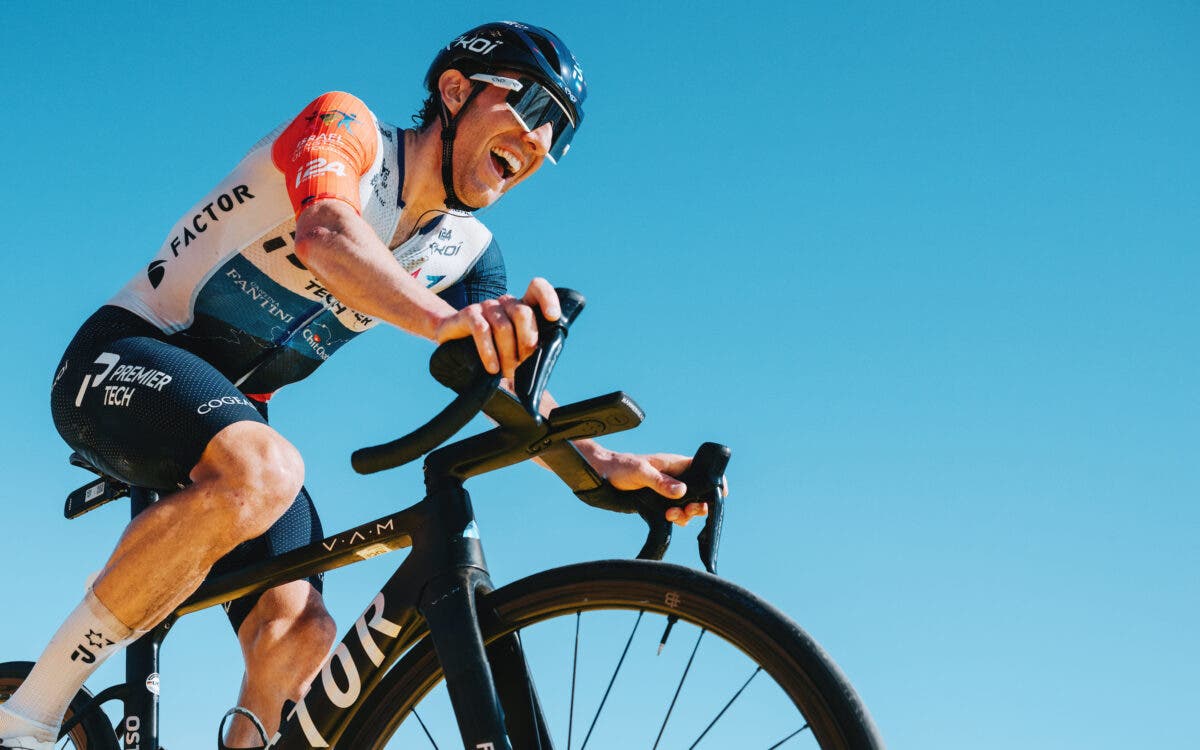
As Woods wrote in his latest blog, the Canadian’s unconventional retirement plans encompass a full spectrum of sports.
But after only a few months out of the pro peloton, the runner-turned-rider already has a new favorite.
“If I had to get rid of everything else and choose one sport to focus on right now, it would be skimo. I love it. It’s super fun,” Woods told Velo.
“I love riding the bike, but this is something that I’m really enjoying right now. I loved skiing as a kid, I love being in the mountains, and I love going on adventures,” he said. “The snow has been so good here in Andorra over winter that it’s been hard to pull myself away from skiing to do anything else.”
Woods has the physiology; skimo has the excitement.
They’re the perfect match.
[analyse_source url=”https://velo.outsideonline.com/road/road-training/skimo-olympics-cyling/”]