[analyse_image type=”featured” src=”https://ichef.bbci.co.uk/news/1024/branded_news/2495/live/cca15f30-032f-11f1-b7e1-afb6d0884c18.jpg”]

 BBC
BBCJeff King was recovering from an unexpected procedure to fix his irregular heart rhythm when he received shocking news.
The hospital had given him a $160,000 (£119,000) bill for the treatment. King, a former pastor, did not have standard health insurance from his employer, only a cost-sharing alternative plan that said it would not cover the procedure.
“It was pretty traumatic,” said the 66-year-old from Lawrence, Kansas. “Who knew that less than a one-day procedure in and out of the hospital could destroy us financially?”
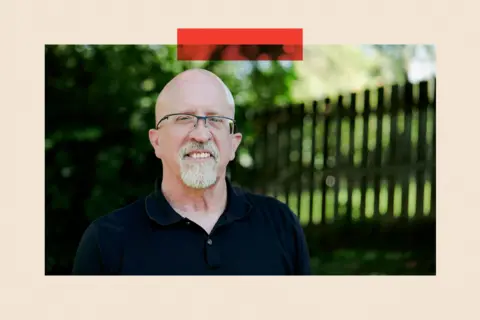
King is one of around 100 million people who are estimated to struggle to pay off their medical and dental healthcare debt, according to recent data. The healthcare company King was a member of have previously said it’s important that members understand its cost-sharing model and membership guidelines.
The US has one of the most expensive health systems in the world, with spending on health care estimated to reach $5.9tn (£4.3tn) in 2026, according to the Centers for Medicare and Medicaid Services. But despite spending twice as much per capita on healthcare compared with wealthy nations of a similar size, the US has a lower life expectancy than those other nations, according to health research nonprofit KFF.
As costs have continued to grow, so have Americans’ frustrations with the US healthcare system.
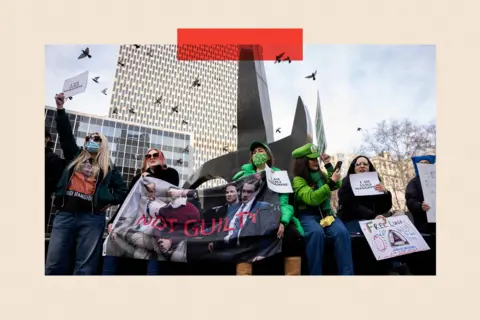
In December of 2024, a gunman fatally shot UnitedHealthCare CEO Brian Thompson, a father of two, on a busy street in Manhattan. Some took to social media after the murder to celebrate the alleged assassin, Luigi Mangione, as a kind of folk hero, believing Thompson’s killing to be a reaction against the system.
Supporters of the murder suspect flock to stand outside the courthouse in New York for his hearings, wearing backpacks and shirts saying “Free Luigi” and carrying signs protesting the healthcare industry.
Last Friday, a judge threw out a federal firearms murder count against Mangione, which was punishable by the death penalty. Karen Friedman Agnifilo, one of Mangione’s lawyers, thanked his fans after the judge’s decision, saying: “We really appreciate all the support.”
Mangione has pleaded not guilty to federal and state charges.
 Reuters
For years, both Republicans and Democrats have recognised a need for reforms to a costly and convoluted system, but have disagreed on the best solutions to fix the problem.
The Great Healthcare Plan
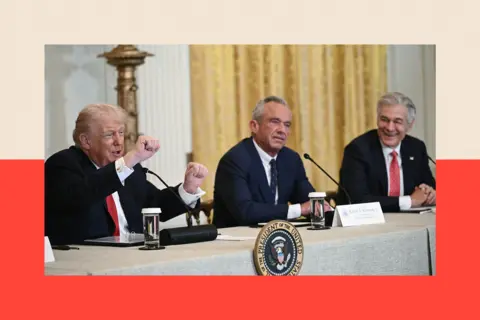
President Donald Trump recently proposed his own solution, the “Great Healthcare Plan”, which suggests sending citizens money directly to help pay for health insurance.
The plan includes a pledge to remove “kickbacks” to middlemen.
He added: “The Great Healthcare Plan… It’s great healthcare at a lower price, mandates unprecedented accountability and transparency from insurance companies and all healthcare providers so that special interests can no longer profiteer at your expense.”
But experts say the plan is light on actual details – including how much money Trump wants to send people and how he would fund his plan – and that the recent expiration of subsidies and cuts to government health programmes under Trump could make healthcare even less affordable.
Large publicly-traded health companies have tripled their profits over the last two decades, paying out shareholders over $2.6tn from 2001 to 2022, according to a study in the Journal of the American Medical Association.
“We are the only major [health] system in the world that allows the free market to run loose,” said John McDonough, Harvard TH Chan School of Public Health professor.
“We have lots that really could be fixed and changed, and what’s mostly missing in the US is the political will to achieve that change.”
Despite its shortcomings, the majority of Americans prefer the private healthcare system the US already has to the idea of a government-run system, according to a recent study from Gallup, which found 53% prefer a private system.
But for all the acceptance that the US healthcare system is broken, is there the political will to fix it? Or will fresh attempts at reform fall short of ending the health horror stories that everyone agrees are unacceptable?
Rising frustrations
The US does not guarantee health coverage for its citizens. Instead, it has a largely private insurance system with government-funded programmes to fill in some gaps.
Healthcare costs are unaffordable for millions, even after sweeping healthcare reforms substantially reduced the number of uninsured Americans.
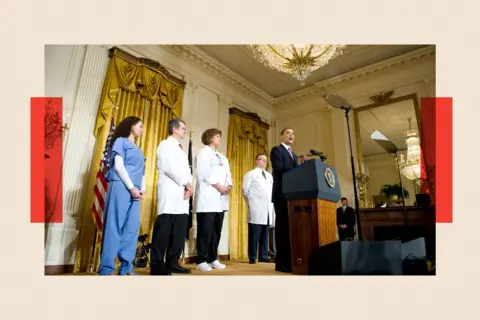
Democratic President Barack Obama signed the Affordable Care Act (ACA) – also known as Obamacare – in 2010, despite objections from Republicans, many of whom view the legislation as government overreach.
 Getty Images
The policy helped tens of millions of Americans get access to healthcare, in part by expanding eligibility for insurance paid for by the state.
The ACA was a patchwork of policies aimed at moving the US closer to universal coverage, though it stopped short of doing that.
A decade after the ACA was fully implemented, frustrations with the system remain.
Roughly one in five Americans covered by private health insurance reported their provider refused to pay for care recommended by a doctor in 2023, according to a survey by KFF.
In the wake of Thompson’s shooting, companies pledged to improve the process of getting claims approved – but many Americans still struggle to afford health insurance.
‘A constant worry’
Stacy Cox’s health insurance was set to quadruple – from $500 a month to $2,100 – from 2025 to 2026. Cox is one of millions of Americans who has seen her healthcare premiums – or monthly insurance cost – double or triple because health insurance subsidies, expanded during Covid to help more people afford private insurance, ended last year.
So Cox, who runs a small photography business in Utah, and her husband decided to go without traditional insurance for the first time in years, instead opting for a plan that covers emergencies only.
When I spoke to the couple last year, they were on the brink of having to cancel their health plan because of the dizzying price rises. And now they have taken the plunge.
Cox, who is at a high risk of breast cancer, said she will now skip mammograms because she cannot afford an MRI test without insurance.
“I’m scared. What do we do?” she said. “Right now, we’re just going to try to get by.”

Around four million people could no longer have insurance in the coming years as a result of the Covid subsidies ending, said Leighton Ku, a health policy professor at George Washington’s Milken Institute School of Public Health. Health insurance costs are expected to increase 114% on average – or by around $1,000 annually, according to KFF – for those receiving the subsidies, though the price increase varies greatly depending on income.
The number of overlapping health care systems in the US – Medicare, Medicaid, the marketplace, employer-sponsored insurance and veteran’s health, among others – creates a confusing and sometimes wasteful system, said McDonough.
“We have so many, each of them with their own set of rules, their own system, their own bureaucracy,” he said. “We really do need some system consolidation.”
Other smaller solutions could help affordability, such as the White House negotiating to reduce the price of more drugs provided by government insurance programmes, as well as regulating competition within the health care industry to help keep prices lower, said Jonathan Zhang, an assistant professor at Duke University’s Sanford School of Public Policy.
Finding consensus on this issue has been elusive.
“While there’s strong bipartisan agreement I think across the board that we have a problem, people can’t seem to come together for the solution,” Stahl said.
In the absence of federal reforms, some state governments have tried to help, banning medical debt from being included in credit reports so people can access loans to help pay off the healthcare providers, and providing separate subsidies for monthly health insurance costs.
Costs continue to rise
Mike Short, a self-employed graphic artist in Tennessee, is also having to go without insurance despite previously racking up thousands of dollars in medical debt when he spent a week in hospital in 2021 with Covid-induced pneumonia.
Even six months later, he struggled to breathe just walking across the room. The stress was compounded by an $8,000 bill he got for his hospital stay, even after insurance coverage.
As he comes from a family of diabetics, the 42-year-old is now concerned another medical issue could force him into debt once again. “I’m trying to keep myself fairly healthy, but things sometimes get out of your control. It’s a constant worry,” he said.
Short is one of many hit hard by the end of the subsidies. Republicans said the subsidies were an ineffective part of the ACA, leading many to vote against renewing them last year.
After years of Republican frustrations with Obama’s healthcare reform, Trump has taken other steps to dismantle parts of the landmark legislation, while pitching his own initiatives, including in his new healthcare plan, to reduce the price of drugs and other healthcare costs.
His other ideas include the government negotiating directly with drug companies to lower the cost of expensive treatments such as weight-loss drugs and IVF.
 Getty Images
As conservative lawmakers faced pressure for some solution to mounting health care costs, the Republican-controlled House of Representatives last month passed a bill renewing the ACA subsidies, which senators have now been discussing for weeks.
“I think there’s a recognition that [Republicans] have to do something, because they are feeling particularly vulnerable on this issue,” McDonough said.
Charities fill in the gaps
As a senior executive of a nonprofit that buys people’s medical debt and pays it off, Eva Stahl constantly sees the anxiety medical debt causes, sometimes forcing Americans to eat less and make other sacrifices, she said.
Her organisation, Undue Medical Debt, has paid off about $25bn of medical debt for almost 15 million people over the past decade, including Short’s hospital bill from when he had pneumonia.
“What’s so saddening is just essentially, people don’t either seek the care that they need or return to get the care that they need for something that’s ongoing,” she said, adding that such stressors and delaying care could worsen Americans’ health outcomes.
Jeff King, with his $160,000 bill for heart treatment, said he tried to ask the hospital how much his procedure would cost before it was done, but they would not give him a clear answer. His research suggested that other hospitals were not charging nearly as much for the procedure, and with persistent negotiation while recovering, he was able to get the bill down to $90,000.
“Our health system is super confusing,” he said. “It’s way more complicated than I think that it needs to be.”
King was eventually able to pay the hospital back $500 a month at a time. But his family saw the stress the payments were causing him and set up a crowdfunding page, where they raised roughly $25,000 to cover the rest of his payments.
After years of the hospital bill hanging over his head like an “ominous dark cloud”, King finally felt relief when he called the hospital to pay off the rest of what he owed.
“Most bankruptcies are caused by medical bills,” he said. “It wrecks people’s lives at no fault of their own.”

BBC InDepth is the home on the website and app for the best analysis, with fresh perspectives that challenge assumptions and deep reporting on the biggest issues of the day. Emma Barnett and John Simpson bring their pick of the most thought-provoking deep reads and analysis, every Saturday.Sign up for the newsletter here
[analyse_source url=”https://www.bbc.com/news/articles/cn0k6d6z7j3o”]