Wonderland
AKINOLA’S HEADED FOR SOMETHING MORE
After 16 years in the industry, Akinola Davies Jr. has reached a career pinnacle that many only dream of – a BIFA-winning, BAFTA-nominated, deeply personal debut feature, My Father’s Shadow. Yet for the British-Nigerian filmmaker, it feels like a return to the starting line.
Jazz instrumentals twinkle in the background as 40-year-old filmmaker Akinola Davies Jr. tucks into his well-earned lunch at Lancaster Gates’ The Roseate, a cream-pillared hotel that blends into a row of refurbished mansions. John Coltrane, Miles Davis, and Billie Holiday hum, whistle, and riff through the dining room from the moment he unveils the cloche insulating his meal – a small serving of a juicy lamb chop, creamy mashed potatoes and an nduja-like paste, with caramelised greens – to well beyond the point he sets his cutlery down.
Akinola is the tall, handsome co-writer, producer, and director you share 100 plus mutuals with on Instagram, and whose name is everywhere: the man tagged in stories alongside the likes of presenter Julie Adenuga, designer Priya Ahluwalia, and Climax Books owner Isabella Burley at some after party deep into awards season. He’s also now sat across from me – fresh from wearing Cartier on set – in an ‘ADJ’-embroidered beanie pulled over a green camo durag (to preserve his braids), zipped into a black bomber jacket.
Some rare January sun shines through the window as we sit together after his shoot, which wrapped early – to no surprise. For a film director, a sharp focus, plan of action, and time management are key components in creating something beautiful. As is the case for Akinola, whose plans, goals, and schedule have piled up increasingly so in the last year, and for the better. “I want to learn a craft, and in order to learn a craft, you have to be very submissive to the process,” he says. “But that process takes a very long time.”
From West London to West Africa, and a stint on the East Coast attending a filmmaking workshop in New York in between, his formative years were spent in geographical limbo. Coming to terms with what it meant to live dually made navigating his British-Nigerian identity somewhat distorting. “Growing up between both made me feel – still makes me feel – like an outsider, disenfranchised within [my] own community,” he shares. “I think that’s quite an interesting place to exist. It’s affected me in many ways.” In work, “I don’t really clamour to be the exception or dramatic. I’m just very interested in what happens in the middle.” But he likes to see himself as a bridge between both, comfortably residing in that inbetween.
It makes sense, then, that his way into storytelling came via the scenic route rather than some neat, preordained plan. That’s where it feels all his ‘best bits’ came from. One of them being his aspiration towards film, which came quite suddenly – not at all as predestined and serendipitous as my assumptions allowed for. “I don’t even think I decided [on it]. I was very fortunate enough to stumble upon it,” he says, wiping off leftover makeup from the shoot with the blue-pack Neutrogena wipes. “I only wanted to do film because my best friend in year nine, or whatever, his dad was a [film] editor, and I just loved their family structure. I was like, ‘Whatever your dad does, I want to do that’.”
So he made headway towards that very goal, bringing opportunities that could have felt out of way, well within reach. From media intern to supporting producers on set, researching gigs to video edits for Boiler Room, and producing series for the BBC, he took every opportunity as gospel. Eventually, it’d land him right behind the lens rather than near it, earning him director on the credits of luxury fashion campaigns for Gucci. And somewhere in that, a short stint as a DJ under the moniker Crackstevens, playing a small (but notable) part in PDA club nights alongside model-musician Ms Carrie Stacks, casting director Mischa Notcutt, and DJ Siobhan Bell at the Bar A Bar on Hackney’s Kingsland Road – nestling himself in a safe space that simultaneously expanded his collaborative scope.
Eventually, after years of graft, he’d find his forte with longform film – an outlet for storytelling that felt most Akinola. “The idea of making long films made me believe, a lot more, that what I’m doing is possible, and can be accepted, celebrated, and feel important,” he says. “If you told me 16 years ago that I was going to make a feature film, go to festivals, and have a theatrical release, I maybe would have believed it, but I certainly wouldn’t have believed I would be having this experience [that] I’m having now,” with his debut feature-length film, My Father’s Shadow, starring British-Nigerian actor Ṣọpẹ́ Dìrísù.
He’d developed a taste for it after the success of his 2020 breakthrough short Lizard, which he wrote alongside his brother Wale, won him the Short Film Grand Jury prize at Sundance Film Festival a year later. That proved to be a turning point. He recalls Eva Yates, the BBC’s Director of Film, saying to him: “You’ve been making short narratives for longer than you think.” So, for Akinola, it was simply time for the frame to extend. “I think it’s a political act to make those visuals a lot longer, because I think Black people need to be able to embellish longform – equally, it’s shooting 16mm in Nigeria. I want Africans and Black people to look as beautiful in the most beautiful format. That’s a political choice,” he says.
So, for My Father’s Shadow, he dug into their own history. Within West African cultures, the role of the father figure is a tale as old as time. Written with Wale, the idea for the film came from a moment of shared recollection. “[Wale] had written a letter to our late father, and turned that into a short story,” he shares, marking the start of a new emotional first for him. “He sent it to me completely unprompted. I read it, and had a huge emotional response – basically cried in bed for like, half an hour. Then I called him, and we spoke about it, and I just told him it was really beautiful…that I never really thought of my father being vulnerable.”
This complex thread of masculinity, and how it coincides with human emotion, is one he delves into. Portrayed powerfully through Ṣọpẹ́’s role as Folarin, and real-life and in-film brothers Chibuike and Godwin Egbo, who play his sons, Akin and Remi, he explores how “as men, we have a responsibility to hold ourselves accountable. So, how can we do the work of rectifying those things within our community as men?”
Despite Folarin’s “stoic and strong” surface persona, as Akinola recognises African fathers often are, his love and affection for his sons is sure and ever-present – this is the nuance he wants to rectify as truth. “We want everyone to hold a certain type of masculinity accountable, present context and nuance to how that masculinity has to be performed, why it’s performed in that way, and external factors around it,” he says of the film’s message. “Whatever we do, we don’t want to add to the canon of stereotypical perceptions of what it means to be African or an African man or fatherhood.”
Nonetheless, the film garnered widespread critical acclaim. At the Cannes Film Festival, it was awarded the Special Mention for the Caméra d’Or (Golden Camera) – the first Nigerian film to be included in the festival’s official selection in Un Certain Regard. Then, there were the 12 BIFA nominations, the cherry on top being his Best Director win, and now, a BAFTA nomination for Outstanding Debut by a British Writer, Director, or Producer. But despite the accolades, he refuses to let it shake his focus. “Even though I’ve been through a year of festivals, being happy, winning awards across the globe, and the film has a lot of acclaim and stuff, this is still the moment that we’ve been working towards,” he says. “The festivals and the awards, albeit great, are a distraction from this moment. This is the moment that we’ve all been working towards. Something more.”
Speaking of these experiences, that signature Nigerian Yoruba cadence and London twang in full, his responses are packed with poem and punch. It’s easy to forget that this is merely his beginning. “I’m at my infancy, in terms of being a director,” he says adamantly. “There’s still a lot to learn – a lot to try – and explore as well. So many people have a long established, pretty full body of work. I am someone who thinks, ‘I want to be doing this until I’m 60, 70’, so there’s still quite a long way to go.” But for Akinola, this is the work of a lifetime – and he’s off to a triumphant start.
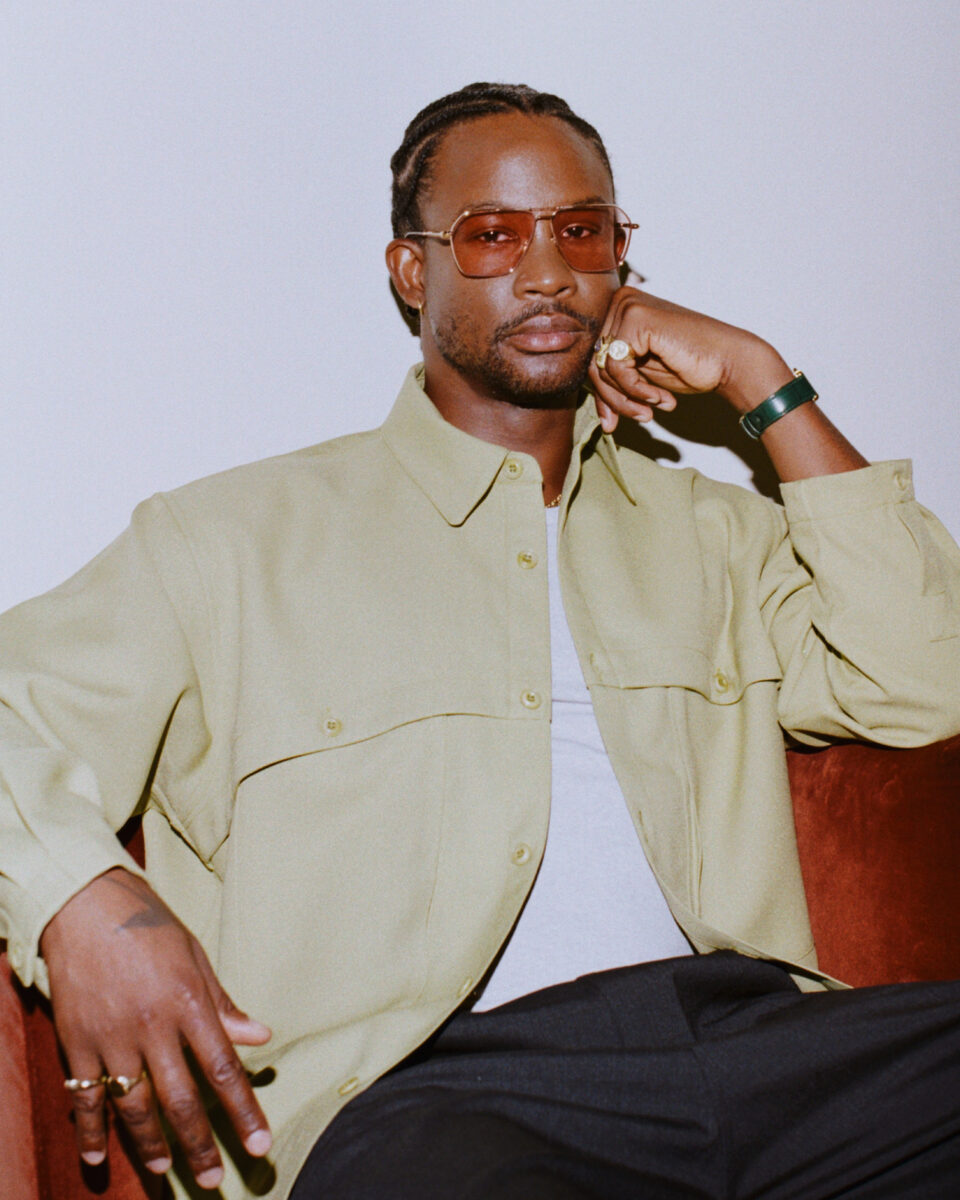
Photography by Guy Lowndes
Styling by Rudy Simba Betty
Words by Aswan Magumbe
Grooming by Bianca-Simone Scott at Forward Artists
Fashion Intern Scarlett Milroy
Videography by James Cox
Videography Assistant Andre Vasiljev
Special Thanks to The Roseate House