[analyse_image type=”featured” src=”https://ichef.bbci.co.uk/news/1024/branded_news/ca2d/live/3fffa0e0-00c9-11f1-8fbb-d70779046d18.jpg”]

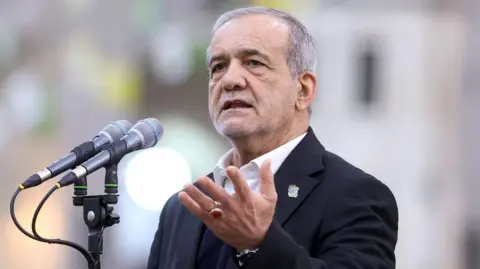 Iran’s Presidential website/WANA/Reuters
President Masoud Pezeshkian has said Iran is ready to negotiate with the US after requests from “friendly governments in the region” to respond to a proposal for talks.
In a statement on X, Pezeshkian said he had told Foreign Minister Abbas Araghchi to pursue talks “provided that a suitable environment exists – one free from threats and unreasonable expectations”.
His words come after the country’s Supreme Leader, Ayatollah Ali Khamenei, warned any attack on Iran would spark a “regional war”.
US President Donald Trump has built up forces in the region and threatened to take military action if Iran does not agree a deal on its nuclear programme and stop killing protesters.
Pezeshkian said Iran would pursue “fair and equitable negotiations” with the US, adding that they should be “conducted within the framework of our national interests”.
The talks may be held in Istanbul on Friday, with Araghchi due to meet US special envoy Steve Witkoff, according to US media reports.
The foreign ministers of Egypt, Oman, Pakistan, Qatar, Saudi Arabia and the United Arab Emirates have also been invited to participate.
Pezeshkian’s announcement came a day after Araghchi told CNN in an interview that he was “confident that we can achieve a deal” to “ensure that there is no nuclear weapons”.
Iran insists its nuclear programme is entirely peaceful and denies that it is seeking to develop nuclear weapons.
When asked about the prospect of a deal by reporters, Trump said: “If we can work something out, that would be great, and if we can’t, probably bad things would happen.”
He said a “tremendous force” was headed to Iran, including the “biggest and the best” ships.
The US military build-up in the region includes the aircraft carrier USS Abraham Lincoln, which has an air wing of around 70 aircraft, and three destroyers equipped with Tomahawk cruise missiles.
In an address on Sunday, Khamenei told Iranians: “We are not the initiators and do not want to attack any country, but the Iranian nation will strike a strong blow against anyone who attacks and harasses them.”
Last June, the US carried out air and missile strikes on three key Iranian nuclear facilities during a 12-day war between Israel and Iran.
Trump said the strikes “obliterated” Iran’s capacity to produce enriched uranium, which is used to make reactor fuel but also nuclear weapons.
The Israeli military also targeted Iran’s nuclear facilities and nuclear scientists during the war, as well as its military commanders and missile arsenal.
Iran responded to the strikes by launching hundreds of missiles and drones at Israel. It also carried out a missile attack on a major US air base in Qatar.
Last week, the US president said he had told Iran it had to do “two things” to avoid fresh US military action.
“Number one, no nuclear. And number two, stop killing protesters. They’re killing them by the thousands,” he added.
His administration is reportedly demanding that Iran end all uranium enrichment, accept limits on its ballistic missile programme, and halt support for armed groups in the region.
Iran’s supreme leader has previously refused to abandon its right to enrich uranium.
However, Reuters news agency cited an Iranian official as saying the ballistic missile programme was the biggest obstacle to a deal, and that their country was “ready to show flexibility on uranium enrichment, including handing over 400kg of highly enriched uranium, accepting zero enrichment under a consortium arrangement as a solution”.
On Tuesday, UAE presidential adviser Anwar Gargash said the Middle East had “gone through various calamitous confrontations” and did not need another one.
“I would like to see direct Iranian-American negotiations leading to understandings so that we don’t have these issues every other day,” he told the World Governments Summit in Dubai.
Qatar’s foreign ministry also said its diplomacy with Iran was “continuing very intensively” in “tandem with all our neighbours”.
Witkoff meanwhile flew to Israel on Tuesday for talks about Iran with Prime Minister Benjamin Netanyahu and the head of the Mossad spy agency, Israeli officials said.
Last month, Trump’s focus was on ending the brutal crackdown by Iranian security forces on the protests that swept across the Islamic Republic. He warned that those responsible would “pay a big price” and told protesters that “help is on its way”.
The unrest was sparked by anger over the collapse of the Iranian currency and soaring cost of living, but they quickly developed into demands for political change.
The US-based Human Rights Activists News Agency (HRANA) has said it has confirmed the killing of 6,424 protesters, 152 children, 214 people associated with the government, and 58 bystanders. It is also investigating reports of another 11,280 deaths.
Norway-based Iran Human Rights has warned that the final toll could exceed 25,000.
Iranian authorities have acknowledged that at least 3,117 people were killed, but said the majority were members of the security forces or bystanders killed by “rioters”.
Khamenei described the unrest as “sedition” orchestrated by the US and Israel.
Iranian officials told Reuters on Monday that Iran’s leadership was worried that US military action could break its grip on power by driving people back onto the streets.
Khamenei had been briefed in high-level meetings that public anger following the protests had reached a point where fear was no longer a deterrent, they said.
[analyse_source url=”https://www.bbc.com/news/articles/c4gw10mkz0yo”]