[analyse_image type=”featured” src=”https://images.euronews.com/articles/stories/09/63/70/94/1200x675_cmsv2_c0a3d57d-5f6f-58e4-ad9e-357a1eff5e6d-9637094.jpg”]

EU-Mercosur deal ‘must be applied without delay’ – Paraguay president

US navy shoot down Iranian drone in Arabian Sea

Arctic ambitions: Finland to build icebreakers for the United States

Severe floods in northern Morocco displace over 50,000 people
EU-Mercosur deal ‘must be applied without delay’ – Paraguay president
US navy shoot down Iranian drone in Arabian Sea
Arctic ambitions: Finland to build icebreakers for the United States
Severe floods in northern Morocco displace over 50,000 people
As solar and wind boom to record levels, are we ignoring the power of geothermal energy?
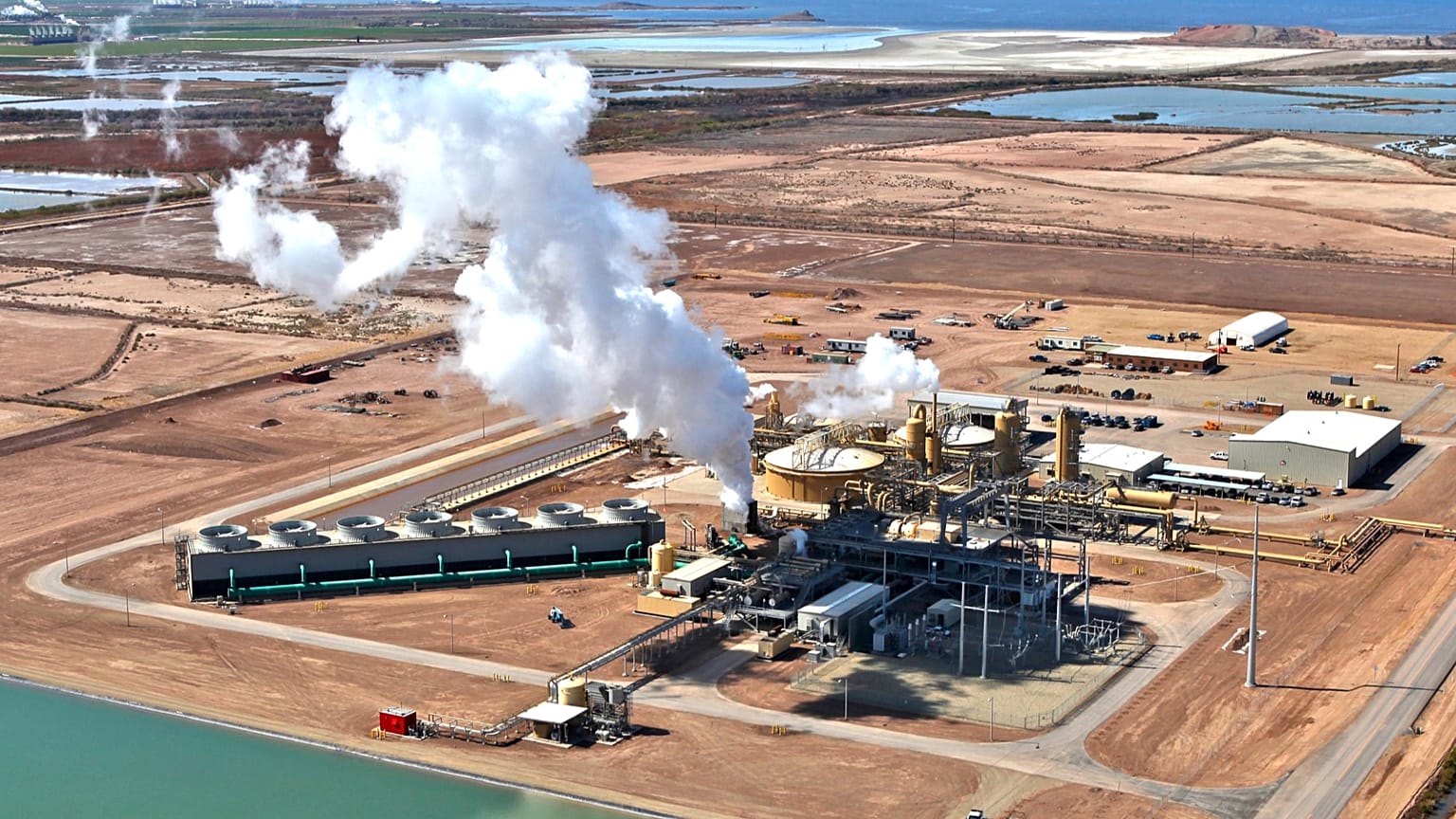
EnergySource’s First Geothermal Plant in Imperial Valley.
– Copyright Copyright Business Wire 2012.

 Facebook
 Twitter
 Flipboard
 Send
Send Reddit
 Linkedin
 Messenger
 Telegram
 VK
VK Bluesky
 Threads
 Whatsapp
Geothermal systems that harness heat from deep underground require significantly less land infrastructure than other renewable energies.
New technologies originally designed to extract oil and gas from deep underground could help “open the doors” to a fossil fuel-free future thanks to enhanced geothermal systems (EGS).
A new study from Stanford University, published in Cell Reports Sustainability, found that EGS can “significantly reduce” the amount of wind, solar, and battery infrastructure needed for a clean energy transition while keeping electricity prices competitive.
“ESG is a promising clean, renewable technology that works together with wind, solar, hydro and batteries to help power the world for all purposes,” says lead-author of the study Mark Jacobson. “[This] provides energy security while eliminating energy-related air pollution and global warming at low costs.”
How do enhanced geothermal systems work?
Unlike conventional geothermal plants that are limited to volcanic and tectonic-plate-boundary regions (such as Iceland), EGS involves drilling up to eight kilometres deep, injecting fluid into cracked rocks, then pumping the heated fluid back up to generate electricity.
Researchers compared scenarios with and without EGS and found that adding EGS to the renewable energy mix produces “substantial infrastructure savings”.
When EGS provided just 10 per cent of electricity supply, onshore wind capacity needs decreased by 15 per cent, solar capacity dropped by 12 per cent, and battery storage requirements plummeted by 28 per cent.
Total land requirements also fell from 0.57 per cent to 0.48 per cent of the countries’ combined land area. Researchers say this could be appealing for small or densely populated nations such as Taiwan and South Korea.
The study also found that clean, renewable energy dramatically reduces costs whether or not EGS is included. Both scenarios slashed annual energy costs by around 60 per cent compared with “business-as-usual fossil fuel use”.
“When health and climate costs, such as air pollution-related illnesses and sea level rise, are factored in, total social costs plummet by approximately 90 per cent,” the study says.
Because EGS provides constant electricity, experts argue it could be useful for providing electricity to off-grid data centres, which are booming in popularity across the world due to artificial intelligence (AI).
Will EGS become cheaper?
Costs have long been a barrier to the expansion of EGS, but experts predict that they could drop significantly by 2035.
Jacobson attributes this to improvements in drilling speeds, adding: “These speeds allow EGS projects to be completed quickly, unlike nuclear, which requires planting-to-operation times of 12 to 23 years worldwide.
“Also, unlike nuclear, EGS has no risk of weapons proliferation, meltdown, radioactive waste storage leaks, or underground uranium mining.”
Go to accessibility shortcuts
Read more
‘Unprecedented fleet’ of offshore wind farms to be built in North Sea
Green electricity: Which EU countries are using the most?
World breaks renewable energy record but still behind climate targets
‘Unprecedented fleet’ of offshore wind farms to be built in North Sea
Green electricity: Which EU countries are using the most?
World breaks renewable energy record but still behind climate targets
‘Staggering’ rise in coal plants in China despite clean energy gains

Scientists warn shark bites are linked to climate change. Here’s how
One of world’s largest hydropower plants faces another legal setback

Air frying fatty foods ‘better’ for air quality than alternatives

Are polar bears in Svalbard getting fatter from climate change?
Renewable materials in a changing global landscape
One of world’s largest hydropower plants faces another legal setback
Sea levels are rising – but in Greenland, the opposite is happening
Albatross puzzles scientists after flying 4,800km from its home
Finnish startup uses sand to slash industrial heat emissions by 90%
[analyse_source url=”http://www.euronews.com/green/2026/02/03/as-solar-and-wind-boom-to-record-levels-are-we-ignoring-the-power-of-geothermal-energy”]