Since my freshman year of college, I’ve used the same tiny, silver makeup mirror I picked up with my mom during a dorm-shopping trip at Bed Bath & Beyond. We bought it alongside twin XL bedsheets, bath towels, and a shower caddy that have all since landed in the dark depths of the garbage—but somehow, the mirror has survived. For all these years, it’s done its job: allowing me to see my face clearly while I pick at my skin (sorry!), pluck my eyebrows, and apply makeup. Isn’t that all a makeup mirror is for? Apparently not, according to Swan Beauty.
On January 14, the brand released a 15-inch AI-powered mirror with five technology pillars—an AI skin analyzer, a smart makeup artist, a personalized routine builder, a shoppable marketplace, and an “embedded social community”—a far cry from my now-ancient glass plucked from a now-extinct retail shelf. For the past week, I ditched my low-frills mirror and exclusively used Swan’s iteration, which comes with three lighting temperatures (warm, cool, neutral) and seven levels of brightness, and follows in the footsteps of smart mirrors like Tonal and Lululemon Studio in tech and price: It’ll cost you $795 for the aluminum hardware and an additional $10 per month to access the AI and AR tools housed within the mirror’s interface.
When a gifted sample arrived at my doorstep, I felt conflicted—I’ve been trying my best to avoid using artificial intelligence due to its reputation for encouraging mindless slop and plagiarism, perpetuating harmful biases, not to mention its extremely negative environmental impact. But no matter how much I recoil at the sight of a ChatGPT-written email, it feels like AI is quickly being integrated into everything, even beauty. Is Swan’s iteration the future of tech or just another case of beauty brand AI-washing?
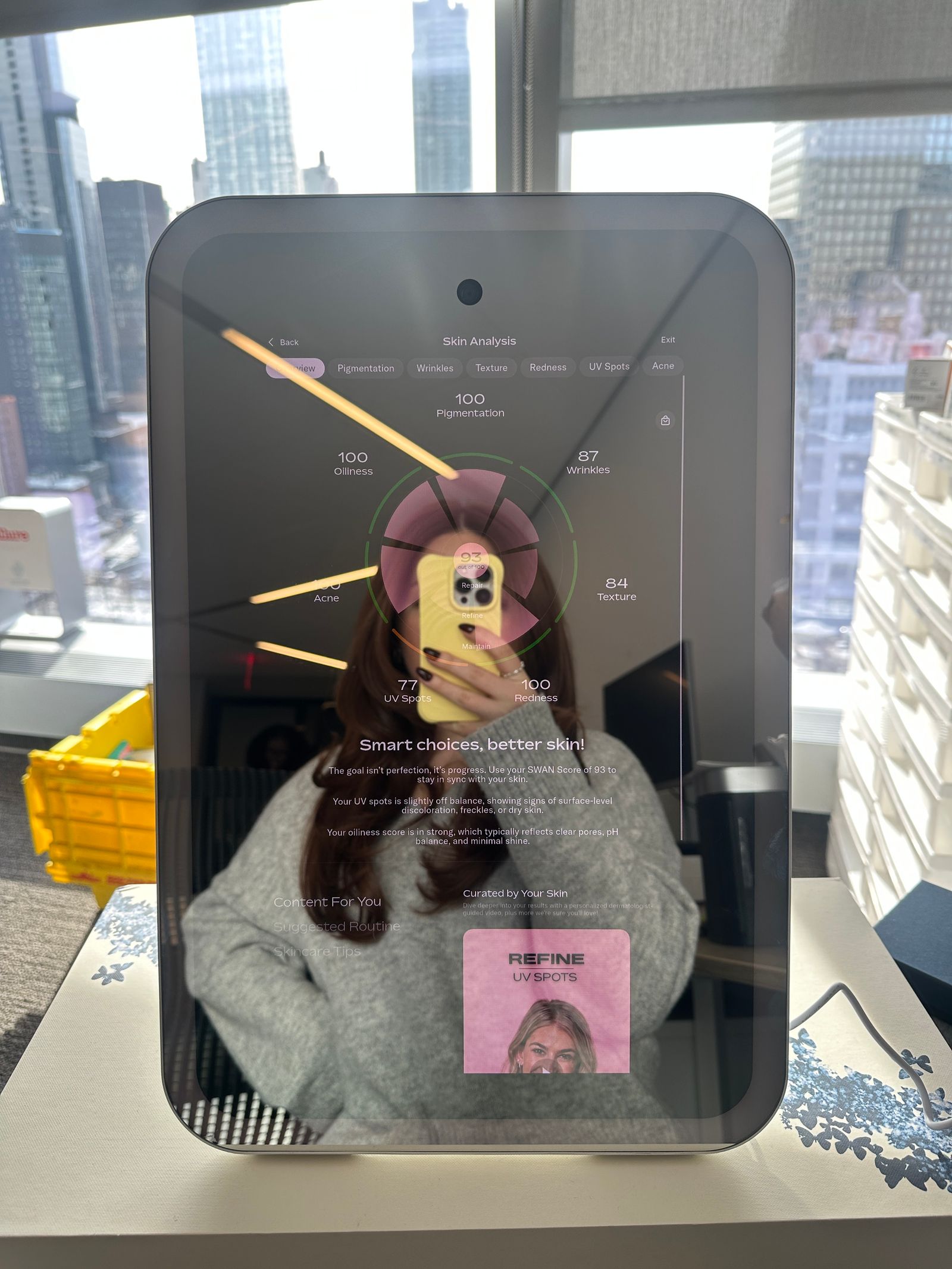
The most prominent use of AI in the Swan mirror is the feature I was, admittedly, the most excited for: the skin analyzer. After you answer six questions about different facets of your skin—including oil production, current condition, overall skin type, and your age—it takes a photo of your face and tracks seven key skin concerns: wrinkles, pigmentation, texture, oiliness, redness, acne, and UV spots. Based on those metrics, it gives your skin a “score” somewhere between 0 and 100. Personally tailored tips and product recommendations pop up on the mirror immediately after your scan. According to Colby Mitchell, the brand’s cofounder and CEO, the feature was built by dermatologists who read “thousands of faces” that they manually rated against the seven parameters “to make [Swan’s] machine as smart as it can be.”
You may be thinking, Why the hell would I need to track my skin? It’s a fair question. But tracking could actually come in handy if you’re trying to gauge the efficacy of a new product, identify specific skin triggers, or are just curious to know if it really was that third glass of wine that made your redness more pronounced.
I took two or three scans per day over the course of nine days, and my score stayed in the 87-91 range; I could work on my UV spots, apparently, and Swan recommends I use products containing niacinamide and arbutin (both known for their skin-brightening properties) to get my score up. The skin analyzer also clocked my undereye and smile lines as wrinkles, which knocked down my score despite being two things a typical human face has. Mitchell says people of all ages can benefit from using the Swan mirror, but no one is 100% free of lines, and therefore no one will have a perfect, wrinkle-free score. When asked for clarification, the Swan team said that the skin analyzer “identifies visible features like under-eye lines and smile lines because they’re a natural part of how skin evolves over time.” They added that “a 60-year-old is not evaluated against a 25-year-old, and natural aging is never framed as a failure.” And while I agree, I’m not sure the rest of the world does quite yet.
This feature was definitely interesting to use, but it didn’t feel particularly nice to have my face broken down and scored in this way, even as someone with relatively clear skin. I can see how it might prompt self-consciousness in users (including me) who may start to obsessively keep a close eye on their score. Amy Wechsler, MD, a board-certified dermatologist and psychiatrist, has similar reservations. “I’m always concerned about the way we make patients feel about themselves,” she tells Allure. “If you knock someone down, they will be vulnerable, and they will say yes to things like buying products [or] doing procedures.”
I tried changing my skin-questionnaire answers just to see what would happen, and it wound up slightly affecting my scores. Initially, I had ranked my oil production as a 62 out of 100 (indicating shiny and “unbalanced” skin), which put my average score in the mid 80s or lower 90s. When I rated my oil production as 100 (indicating “perfectly balanced” skin), my overall scores jumped to an average of 90-92. It seems as though the answers to your questions are extremely important factors in getting an accurate-ish reading, as well as having the perfect amount of even, natural light on your face (the mirror’s built-in lighting seems too bright to generate an accurate reading).
Mitchell seems to agree: “You want to be consistent with your lighting and have a clean, fresh face every day when you do it so that you’re getting consistent results,” she tells me during our meeting in New York. “The machine can only read as accurate as your photo.”
But that accuracy may also depend on skin tone. I’m a fair-skinned white woman, but Allure has previously reported that, historically, AI facial-recognition systems are especially unreliable in accurately assessing darker complexions. To combat this, Shar Pentecost, the head of product development at Swan Beauty, says the baseline for its algorithm was trained with deeper skin tones in mind. “We intentionally test and validate how the system behaves on deeper complexions and adjust how signals are interpreted when they appear differently on darker skin,” she explains, adding that Swan has “a diverse, cross-disciplinary team actively reviewing the algorithm and its outputs.” Allure was not able to specifically confirm this by the time of publication, but we’ll report back after more of our staff members have been able to test the device.
After spending far too much time staring at the texture of my face, I clicked over to the smart makeup artist, a feature that probably would’ve saved me from over-contouring in 2016. After choosing a makeup look from one of three makeup artists—Carolina Gonzalez, Allan Avendano, and Fiona Stiles—who have partnered with Swan, a dynamic overlay is adapted to your face shape to help with product application. It’s kind of like a living face chart with a built-in tutorial. Like the skin analyzer, this feature requires natural lighting and a straight-on angle to be able to read your face shape properly. At first the mirror said my face was a triangle, then an oval; then, when I moved in front of a bright window, a heart shape, which it then gave me for three scans in a row. (For what it’s worth, I’ve never been sure of my face shape, but I guess I am now.)
The makeup tutorials include written instructions and a digital face chart for each step—you can also listen to the instructions if that’s more your speed. While a majority of the included looks are a bit too full-glam for an average day (at least, for me), you can always pick and choose which steps to piece together. For example, I replaced foundation with a tinted sunscreen and nixed the eye shadow while following Stiles’s tutorial for her “Everyday Polished” look.
If I wanted to, I could record myself following the tutorial right from my screen using the mirror’s 4K camera, as well as edit and upload the footage onto Swan’s TikTok-like social feed, which is accessible from both the mirror and the app. If you’re not into strangers watching you buff bronzer onto your skin (fair!), you can save the footage or delete it—or if you’re a content creator, you can download it directly onto your phone to be posted elsewhere.
The skin analyzer and smart makeup artist are the two features you’re paying for when you opt into the mirror’s monthly subscription, along with what Mitchell calls “exclusive content” from celebrity aestheticians and makeup artists. Everything else is included. You can also download Swan’s app without ever purchasing a mirror to use its social feed and shop from its internal marketplace, powered by luxury beauty retailer Cos Bar (which was, by the way, recently acquired by Mitchell Family Office, a private investment firm owned by Mitchell’s husband).
There’s no denying that Swan’s tech is paying close attention to your clicks, saves, and interactions with the mirror, and it will in turn spew tailored product recommendations and brand advertisements that may feel more like they come from Big Brother than your best friend. During our conversation, Mitchell reiterated that Swan is not selling its users’ data and that trust is the company’s utmost priority. But still, a looming thought was cemented in the back of my mind as I spent hours gazing into the mirror: Some day, if Swan Beauty were bought by a private equity firm or experienced some kind of data breach, could my data and likeness be sold or leaked along with it?
I realize this question could be posed regarding many, many companies, and even as an AI skeptic, I have to say that the mirror isn’t giving me any hints that it’s a scary robot with a mind of its own. Mitchell says she was also hesitant about implementing AI into a product this way, but she emphasizes the amount of human labor that went and will continue to go into its development. “This device would not exist without the human touch and the expertise of the individuals we are working with. This was trained by humans. It was trained by people that are touching skin, that are working with different tones and textures,” she says. “A device can’t do that [on its own].”
When I want to return to my analog roots, Swan’s high-tech option still functions perfectly well as a regular mirror when its interactive features are turned off, and you can still use its many lighting modes to stare into your reflection—and, in my case, inspect those UV spots—the old-fashioned way.
So, do you really need to spend $795 (along with a monthly subscription fee) for a makeup mirror? For the average consumer, no—definitely not. But right now, there’s nothing quite like it on the market. If you’re a content creator, obsessive about tech or skin-care, or want to learn new, easy-to-follow makeup looks and take content as you go, then maybe these benefits justify the cost for you. I probably wouldn’t spend my own hard-earned money on the mirror if I didn’t have the chance to test it as a beauty writer, but my college makeup mirror has at last been replaced—that is, until Swan’s inevitable copycats come along.
Read more in-depth product reviews:
- The Currentbody LED Hair Growth Helmet Looks Absurd, But It’s Making a Big Difference
- Braun’s Skin iExpert Made Me a Believer in At-Home Laser Hair Removal
- Luseta Biotin & Collagen Hair Mask Nourishes Dry, Damaged Hair
Now, watch Selena Gomez’s Allure cover shoot:
Follow Allure on Instagramand TikTok, or subscribe to our newsletterto stay up to date on all things beauty.
Source URL: https://www.allure.com/story/swan-beauty-ai-mirror-review-photos